This is a special, expanded issue for the purpose of
giving an overview of the spiritual life. At times it is profitable for us
to review briefly the various elements which comprise the spiritual life. We
hope this special issue will be helpful for such an exercise, and that it
will speak to the heart as well as to the mind.
WE ARE EXPANDING OUR READERSHIP!
We are expanding our
circulation by explicitly inviting to our readership those who are not
priests, but who are interested in the spiritual life.
The Newsletter will still
be written for priests in a special way. Yet we feel much of the material
will also be of interest to those who are not priests.
To reflect the fact that
we are now expanding our readership to include all interested parties, we
think it is appropriate to offer a new act of consecration which is not
worded for priests only, but one suitable for all.
Chief Shepherd of the Flock
I am the good shepherd: the good shepherd lays
down his life for his sheep. The hired man, since he is not the shepherd and
the sheep do not belong to him, abandons the sheep as soon as he sees a wolf
coming, and runs away, and then the wolf attacks and scatters the sheep; he
runs away because he is only a hired man and has no concern for the sheep. I
am the good shepherd; I know my own and my own know me, just as the Father
knows me and I know the Father; and I lay down my life for my sheep.
(Jn 10:11-151)
The Good Shepherd gave His life so that we
may have life and have it in abundance. In this issue we offer an overview of
the life Jesus came to give. We begin by presenting a brief sketch of the
spiritual life. This will be followed by content which speaks in a more
detailed manner about the various dimensions of the spiritual life -- our life
in Christ.
A Sketch of the Spiritual Life
The Christian life is rooted in the great
event of the Incarnation. We must consequently always focus our gaze upon
Christ, realizing that the Father has spoken to us in the life, death,
resurrection, and ascension of Jesus. It only remains for us, then, to strive
to understand with greater insight the inexhaustible truth of the Word
Incarnate (Heb 1:1-2).
What was the condition of the human race at
the time of Christ’s coming? In some ways, people were much the same as we
are today. There were those just being born into this world of human drama.
There were those who, in death, were leaving it, some of whom had grasped but
little of life’s meaning. There were those who were healthy and vigorous.
There were those who were sick and lame. Some especially felt the burdens, the
grief, the suffering of the human condition. Others were ebullient and desired
all the pleasures life could provide. There was some good being accomplished.
Immorality, however, was rampant. What St. Paul tells us concerning the time
that immediately followed Christ’s existence certainly could also be applied
to the time of His entrance into the world. It is, in short, an ugly picture
that St. Paul depicts for us (Rom 1:22-32).
Into such a depraved condition Jesus
entered, with a full and generous Heart, to lead the human race from the
depths of sinfulness to the vibrant richness of a new life in Himself. Through
His enfleshment, this Christ became the focal point of all history. The
authentic hopes and dreams of the human family, now so overshadowed by the
ugliness of sin, came converging upon this Christ. He would gather them up in
Himself, give them a new luster and brilliance and dynamism, and would lead
the human family back to the Father in the Holy Spirit.
Christ was radically to release us from the
dominion of sin and elevate us to a new level of existence. This life Christ
has given us is not a type of superstructure which is erected atop human
existence. Although nature and grace are distinct, they do not lie side by
side as separate entities. Rather, grace permeates nature. The Christian is
one graced person. The Christian is one who has been raised up, caught up,
into a deeper form of life in Christ Jesus. Nothing that is authentically
human in the life of the Christian has been excluded from this new existence.
Whatever is really human in the life of the Christian is meant to be an
expression of the Christ-life. The simple but deep joys of family life, the
wonderment at nature’s beauty, the warm embrace of a mother for her child,
the agony of crucial decision making, the success or frustration that is
experienced in one’s work, the joy of being well received by others, and the
heartache of being misunderstood—all these experiences are intended to be
caught up in Christ and made more deeply human because of Him.
Jesus has come, then, not to destroy
anything that is authentically human, but to perfect it by leading it to a
graced fulfillment. The more God-like we become through Christ, the more human
we become.
We, through our incorporation into Christ
which occurs at Baptism, are meant to relive the life, death, and resurrection
of Jesus. In doing so, we are not only accomplishing our own salvation, but we
are assisting in the salvation of others also. The Incarnation continues all
the time. Christ, or course, is the one Who fundamentally continues the
Incarnation. But He enlists our help. The world no longer sees Jesus, no
longer is able to reach out and touch Him. We are the ones who now, in some
way, make Christ visible and tangible. In union with the invisible, glorified
Christ, and depending on Him as our source of life, we continue the
Incarnation in its visible and temporal dimensions. This is our great
privilege. This is our great responsibility.
The Christian is initiated into the mystery
of Christ, into his or her role in prolonging the Incarnation, through Baptism
(Rom 6:3-4).
It is not sufficient, however, that we be
incorporated into Christ through Baptism. All forms of life require
nourishment. So, too, our life in Christ must be continually nourished. How
can we continually keep in contact with Christ? There are various ways as we
live our life within the Church. We contact Christ in a most special way
through the liturgy, above all in the Eucharistic liturgy. Through our most
special and most personal meeting with Jesus in the Mass, we are more deeply
incorporated into Christ. Also, we should remember that all the sacraments
make up part of the Church’s liturgy.
The reading of Scripture provides another
special opportunity for meeting Jesus. This is true for both Old and New
Testaments. The Old Testament prefigures the New Testament and leads to it. It
is obvious, however, that we meet Christ especially in the pages of the New
Testament. How true it is to say that not to be familiar with Scripture is not
to know Jesus properly. We should resolve to read from Scripture daily.
We also meet Jesus in our interaction with
others. Everyone we meet, everyone we serve, is in the image of Jesus. We have
to take the means to grow in this awareness. If I truly believe that everyone
has been redeemed by the blood of Jesus, how should I treat everyone?
These, then, are some of the ways we keep in
contact with Jesus. Common to the various ways of meeting Jesus is a certain
degree of prayerful reflection. Our contact with Jesus in the liturgy, in
Scripture, and in our interaction with others, and so forth, will not be all
that it should be unless we are persons of prayer. The light and strength of
prayer enables us to keep in contact with Jesus as we should.
We live out our Christ-life in an atmosphere
of love. Indeed, the life Jesus has given us is centered in love. It has its
origins in the mysterious love of God (Jn 3:16).
Our new life in Jesus has arisen out of
God’s fathomless love. Christ, in His descent into human flesh, has
established a milieu of love. The life He came to give can flourish only in
the framework of love. Indeed, we can summarize the meaning of the Christian
life by stating that it is our loving response to God’s love. The pierced
Heart of Jesus, this Heart which shed its last drop of blood in the greatest
love for each one of us, is the symbol of God’s tremendous love for us.
Christ’s Heart also calls us to respond by giving ourselves in love to God
and neighbor. Yes, Jesus invites us to respond to God’s love by giving
ourselves in love to Him in an ever closer union. The more closely we are
united to Him, the greater is our capacity to love God and neighbor. The more
closely we are united with Jesus, the more closely He unites us to the Father
in the Holy Spirit, with Mary our Mother at our side.
The spiritual life, the life of holiness,
begins at Baptism. Archbishop Luis Martinez says:
"When we are born we are endowed by God
with all we need for our human life, a complete organism, and a soul with the
full range of faculties. Of course they are not all developed from birth, but
we have them then as the source of everything we are going to need in life.
And thus it is also in the spiritual order. When someone is baptized, he
receives in all its fullness that supernatural world which the Christian
carries within his soul. He receives grace, which is a participation of the
nature of God; the theological virtues, which put him in immediate contact
with the divine; the moral virtues, which serve to regulate and order all his
life; and the gifts of the Holy Spirit, the divine, mysterious receivers for
picking up the Spirit’s inspirations and movements."2
Another author states: "The Three
Divine Persons inhabit the sanctuary of our soul, taking their delight in
enriching it with supernatural gifts and in communicating to us a Godlike
life, similar to theirs, called the life of grace.
"All life, however, implies a threefold
element: a vital principle that is, so to speak, the source of life
itself; faculties which give the power to elicit vital acts; and
lastly, the acts themselves which are but its development and which minister
to its growth. In the supernatural order, God living within us produces the
same elements. He first communicates to us habitual grace (the life of
sanctifying grace) which plays the part of a vital supernatural principle. This
principle deifies, as it were, the very substance of the soul and makes it
capable, though in a remote way, of enjoying the Beatific Vision and of
performing the acts that lead to it.
"Out of this grace spring the infused
virtues and the gifts of the Holy Spirit which perfect our
faculties and endow us with the immediate power of performing Godlike,
supernatural, meritorious acts.
"In order to stir these faculties into
action, He give us actual graces which enlighten our mind, strengthen our
will, and aid us both to act supernaturally and to increase the measure of
habitual grace that has been granted to us.
"Although this life of grace is
entirely distinct from our natural life it is not merely superimposed on the
latter. It penetrates it through and through, transforms it and makes
it divine. It assimilates whatever is good in our nature, our education and
our habits. It perfects and supernaturalizes all these various elements,
directing them toward the last end, that is toward the possession of God
through the Beatific Vision and its resultant life." 3
Our being in the state of sanctifying of
grace and the special indwelling of the Persons of the Trinity within us
always exist together. We cannot have the one without the other. Our life of
grace, which is a sharing in Trinitarian life, allows us to know and love
Father, Son, and Holy Spirit in a most intimate fashion. Through grace we are
in the image of the Trinity, and we enjoy special relationships with the
Divine Persons.
Again, we listen to the words of Archbishop
Martinez as he speaks about our relationships with the Divine Persons:
"Love, we have said, is the foundation
of devotion to the Holy Spirit, as it is also the foundation of Christian
perfection. But love as a reflection of God, as His own image, is something
that encloses within its simplicity a boundless wealth and a variety of forms.
Who can fathom the depths of love?
"Human love in all its manifestations
is admirably in harmony with the love of charity; it is confident in filial
love, trusting in friendship, sweet and fruitful in the love of husband and
wife, disinterested and tender in the love of a mother. Our love of God must
include all these forms of human love; every fiber of our heart must vibrate
when the harmonious and full canticle of love bursts forth from it. But since
God is one in essence and triune in Persons, our love for Him takes on a
particular aspect accordingly as it is directed to each one of the divine
Persons.
"Our love for the Father is tender and
confident like that of children; eager to glorify Him as His only-begotten Son
taught us to do by word and example. Love for the Father is the intense desire
to have His will fulfilled on earth as it is in heaven. Our love for the Son,
who willed to become flesh for us, is characterized by the tendency to union
with Him and transformation into Him; by imitation of His example,
participation in His life, and the sharing of His sufferings and His Cross.
The Eucharist, mystery of love, of sorrow, and of union, reveals the
characteristics of this love.
"Love for the Holy Spirit also has its
special character, which we should study in order completely to understand
devotion to Him. We have explained how the Holy Spirit loves us, how He moves
us like a divine breath that draws us to the bosom of God, like a sacred fire
that transforms us into fire, like a divine artist who forms Jesus in us.
Surely, then, our love for the Holy Spirit should be marked by loving
docility, by full surrender, and by a constant fidelity that permits us to be
moved, directed, and transformed by His sanctifying action.
"Our love for the Father tends to glorify
Him; our love for the Son, to transform ourselves into Him; our love
for the Holy Spirit, to let ourselves be possessed and moved by Him."4
-
The spiritual life centers in Christ.
Here are words from the Jerusalem Catecheses: "When we were baptized
into Christ and clothed ourselves in him, we were transformed into the
likeness of the Son of God. Having destined us to be his adopted sons, God
gave us a likeness to Christ in his glory, and living as we do in
communion with Christ, God’s anointed, we ourselves are rightly called
‘the anointed ones.’ " 5
-
Msgr. Robert Guste says: "Ideal
Catholics held up to us by the Church are the saints. As you read their
lives, what do you notice? One after the other, they were men and women
who had a deep, personal relationship with Our Lord Jesus Christ. Their
hearts were on fire with love for Him..." 6
-
When we are baptized we are incorporated
into Christ’s paschal mystery of death and resurrection. St. Paul speaks
of this marvelous union with Jesus: You cannot have forgotten that all
of us, when we were baptised into Christ Jesus, were baptised into his
death. So by our baptism into his death we were buried with him, so that
as Christ was raised from the dead by the Father’s glorious power, we
too should begin living a new life. (Rm 6:3-4).
Christ has structured the Christian life
by the way He lived, died, and rose from the dead. It is obvious, then, as
Paul tells us above, that the pattern of death-resurrection must be at the
heart of the Church’s life. Individually and collectively, we continually
die with Christ so that we may continually rise with Him. Thus we pass over
in a process of ongoing religious transition to a greater participation in
Christ’s resurrection. It is true that our participation in Christ’s
resurrection will reach its completion only in eternity. Nevertheless, we
begin the life of resurrection here upon the earth, in the here and now of
human life, in the midst of joy and pain; in the experience of success and
failure, in the sweat of our brow, in the enjoyment of God’s gifts. As
Christians, we should have a sense of dynamic growth concerning our here and
now life of resurrection.
We cannot maintain the life of
resurrection or grow in it without a willingness to suffer. This does not
mean that we need to feel overwhelmed and heavily burdened in our lives. The
greater portion of suffering for most Christians seems to be an accumulation
of ordinary hardships, difficulties, and pains. At times, however, deep
suffering, even suffering of agonizing proportions, can enter into one’s
life. Whether the sufferings one encounters are of either the more ordinary
variety or the more rare and extreme type, Christians must convince
themselves that to relate properly to the cross is to grow in resurrection,
and growth in resurrection means we will also have an increased capacity to
help give resurrection to others.
- The Church invites us to share deeply in the passion of
Christ, in the cross of Christ. She does so that we might share deeply in
His life of resurrection—here and hereafter. The more we die with
Christ, the more we share in His life of resurrection—here and
hereafter. Our ultimate goal here below is not the cross, but
resurrection—the newness of life the cross leads to - here below as well
as in eternity.
We are meant to share in all of the mysteries of Christ
here below—we are meant to relive them in our own lives. And all of these
mysteries are directed to the crowning mystery of Jesus, His resurrection:
"As the Church is ever re-enacting, during all the ages, the life story
of her Divine Spouse—undergoing in the Mystical Body what He suffered in
His Natural Body, so it must be too, in some measure, for every individual
Christian that lives in real unity with Christ. It was thus that the saints
understood the life of the Divine Master. They not merely contemplated
it, they lived it. This was the source of the immense sympathy they were
capable of experiencing for Him in His different states. They felt in a
certain measure what He felt, and what is true of Our Lord’s life
considered as a whole must be true in no imperfect or limited manner of that
which was the supreme and crowning mystery in that life—namely, the
Resurrection. This must be, not merely a fact in Christian history, but a
phase of Christian experience …We do not readily perceive that, in
God’s plan, not only the Cross, but the Risen Life that followed it, is
meant to be part of our terrestrial existence. Christ did not pass from the
Cross straight to heaven. The Christian is not meant to do so either. In the
case of Jesus the Cross preceded, prepared and prefaced a risen life on
earth. In the case of the Christian the Cross is meant to play a somewhat
similar role—that is, to be the prelude to a risen life, even here below.
"The Cross cannot be completely
understood except it is viewed in the full light of the Resurrection. It is
the latter, not the former, that is the ultimate mystery for us…The Cross
is a means, not an end; it finds its explanation only in the empty tomb; it
is an entrance into life, not a mode of death. Any death that enters into
God’s plan must necessarily issue forth in life. If He lays upon us the
necessity of dying it is in order that we may live…In order that we may
live as we ought, our rebellious nature must be crucified. Crucifixion
always remains the only mode of salvation.
"God sends trials and crosses simply
to deaden in us the activity of the forces that make for the decay of the
spiritual life, in order that that spiritual life may develop and expand
unimpeded. According as the life of perverse nature ebbs away from us on our
cross united with Christ’s, the Divine Life that God has placed in all
whom He has called begins to make itself more manifest and to display
increased vigour and vitality…It is to that Resurrection, that life in
death, that God directs all the circumstances of our life—it is the object
He aims at in His dealing with us." 7
In his above words, Fr. Edward Leen,
C.S.Sp., speaks about a special episode of our participation in the
resurrection of Jesus. He speaks of our Christ-life, our life of grace, in
the highly developed state. We should all strive for this state. We must
realize, however, that all those who live in the state of grace are, in an
essential way, living the life of resurrection. They are alive in Christ
Jesus.
"I ask you to consider that our Lord
Jesus Christ is your true head and that you are a member of his body. He
belongs to you as the head belongs to the body. All that is his is yours:
breath, heart, body, soul and all his faculties. All of these you must use
as if they belonged to you, so that in serving him you may give him praise,
love and glory. You belong to him as a member belongs to the head. This is
why he earnestly desires you to serve and glorify the Father by using all
your faculties as if they were his.
"He belongs to you, but more than
that, he longs to be in you, living and ruling in you, as the head lives and
rules in the body. He desires that whatever is in him may live and rule in
you: his breath in your breath, his heart in your heart, all the faculties
of his soul in the faculties of your soul...
"You belong to the Son of God, but
more than that, you ought to be in him as the members are in the head. All
that is in you must be incorporated into him. You must receive life from him
and be ruled by him. There will be no true life for you except in him, for
he is the one source of true life. Apart from him you will find only death
and destruction. Let him be the only source of your movements, of the
actions and the strength of your life.
"Finally, you are one with Jesus as
the body is one with the head. You must, then, have one breath with him, one
soul, one life, one will, one mind, one heart. And he must be your breath,
heart, love, life, your all. These great gifts in the follower of Christ
originate from baptism. They are increased and strengthened through
confirmation and by making good use of other graces that are given by God.
Through the holy eucharist they are brought to perfection." 8
-
St. Ignatius of Antioch was deeply
consumed with love for Jesus: "At last I am well on the way to being
a disciple. May nothing, seen or unseen, fascinate me, so that I may
happily make my way to Jesus Christ! Fire, cross, struggles with wild
beasts, wrenching of bones, mangling of limbs, crunching of the whole
body, cruel tortures inflicted by the devil—let them come upon me,
provided only I make my way to Jesus Christ."9
-
Cardinal Newman tells us: "Everyone
who breathes, high and low, educated and ignorant, young and old, man and
woman, has a mission, has a work. We are not born at random... God sees
every one of us; He creates every soul, He lodges it in a body, one by
one, for a purpose. He needs, He deigns to need, every one of us."10
Because of the uniqueness of each
Christian's existence, he or she presents Christ with a unique opportunity.
Each Christian has the vocation to offer Christ his or her humanity so that
Jesus can live in that individual in a special way. This Jesus is Priest,
Prophet and King. To the extent that an individual Christian offers his or
her humanity to Jesus, that person has an unique opportunity to help to
continue the work of the redemption--an opportunity that no one else can
fulfill. Likewise, to the extent that an individual fails to offer his or
her humanity to Christ, Jesus loses the opportunity to continue His
redemptive work according to that person's uniqueness.
-
Concerning the prophetic or teaching
office of Christ, each of us has the ever-present opportunity of
witnessing to the truth of Christ by the way we live. Mother Teresa gives
a striking example of this. She says: "I received a letter from a
wealthy Brazilian man. He assured me that he had lost his faith -- not
just his faith in God but his faith in humanity as well. He was fed up
with his situation and everything around him. He only thought about
suicide.
"One day, walking on a busy street
downtown, he saw a television set in a store window. The program was about
our Home for the Dying in Calcutta, and it showed our Sisters taking care of
the sick and the dying.
"The man confessed that when he saw
that, he felt the urge to kneel and pray, after many years of not ever
kneeling or praying.
"From that day on, he recovered his
faith in God and in humanity, and he was convinced that God still loves
him."11
-
St. Paul, one who loved Jesus so deeply,
has left us these words: "But we hold this treasure in pots of
earthenware, so that the immensity of the power is God’s and not our
own. We are subjected to every kind of hardship, but never distressed; we
see no way out but we never despair; we are pursued but never cut off;
knocked down, but still have some life in us; always we carry with us in
our body the death of Jesus so that the life of Jesus, too, may be visible
in our body. Indeed, while we are still alive, we are continually being
handed over to death, for the sake of Jesus, so that the life of Jesus,
too, may be visible in our mortal flesh." (2 Cor 4:7-11).
You share my burdens,
You take them upon yourself.
You listen to me fondly when I tell you my troubles.
You never fail to lighten them.
I find You at all times and in all places.
You never leave me.
I will always find You wherever I go.
Old age or misfortune will not cause You to
abandon me.
You will never be closer to me than
When all seems to go against me.
No matter how miserable I may be,
You will never cease to be my friend.
You tolerate my faults with admirable
patience.
You are always ready to come to me, if I so desire it.
Jesus, may I die praising you!
May I die loving you!
May I die for the love of you.12
- Pope John Paul II instructs us: "The Church, as a
reconciled and reconciling community, cannot forget that at the source of
her gift and mission of reconciliation is the initiative, full of
compassionate love and mercy, of that God who is love (see 1 John 4:8) and
who out of love created human beings (see Wisdom 11:23-26; Genesis 1:27:
Psalms 8:4-8)…He created them so that they might live in friendship with
Him and in communion with one another.
"God is faithful to His eternal plan
even when man, under the impulse of the evil one (see Wisdom 2:24) and
carried away by his own pride, abuses the freedom given to him in order to
love and generously seek what is good, and (instead) refuses to obey his
Lord and Father. God is faithful even when man, instead of responding with
love to God’s love, opposes Him and treats Him like a rival, deluding
himself and relying on his own power, with the resulting break of
relationship with the One who created him. In spite of this transgression on
man’s part, God remains faithful in love.
"It is certainly true that the story
of the Garden of Eden makes us think about the tragic consequences of
rejecting the Father, which becomes evident in man’s inner disorder and in
the breakdown of harmony between man and woman, brother and brother (see
Genesis 3:12 ff; 4:1-16). Also significant is the Gospel parable of the two
brothers (the parable of the ‘prodigal son’; see Luke 15:11-32) who, in
different ways, distance themselves from their father and cause a rift
between them. Refusal of God’s fatherly love and of His loving gifts is
always at the root of humanity’s divisions.
"But we know that God…like the
father in the parable (of the prodigal son), does not close His heart to any
of His children. He waits for them, looks for them, goes to meet them at the
place where the refusal of communion imprisons them in isolation and
division. He calls them to gather about His table in the joy of the feast of
forgiveness and reconciliation.
"This initiative on God’s part is
made concrete and manifest in the redemptive act of Christ, which radiates
through the world by means of the ministry of the Church." 13
-
In the evening of that same day, the
first day of the week, the doors were closed in the room where the
disciples were, for fear of the Jews. Jesus came and stood among them. He
said to them, ‘Peace be with you,’ and, after saying this, he showed
them his hands and his side. The disciples were filled with joy at seeing
the Lord, and he said to them again, ‘Peace be with you. As the Father
sent me, so am I sending you.’ (Jn 20:19-21).
The world needs peace. Individual nations
need peace and families need peace. The Church needs peace. Each of us
individually needs peace. We must work for peace through prayer, fasting,
and other Christ-like activities.
And just what do we mean by peace? St.
Augustine says peace is the tranquility of order. God has put order into His
creation and this order must be respected and promoted if peace is to
prevail. To the extent that the human family lives according to God’s
will—lives according to the order or the plan God has established for
creation—to that extent does peace exist in the various segments of human
society. To the extent there are violations of God’s plan, of His will, to
that extent peace is absent.
If we are to be instruments of peace, we
ourselves must be at peace. Our personal peace is that tranquility of order
which results from our doing God’s will. The more we are united through
love with God in the doing of His will, the more we experience peace.
Sometimes the sense of peace we experience
is so strong that we can "feel" it pulsating throughout our being.
These are periods of what we may call the experience of extraordinary peace.
This type of peace usually is not an everyday occurrence.
Most of the time we live immersed in a
more subdued kind of peace which results from our daily attempts to do
God’s will in love. It is that peace which is a welcome and sustaining
companion as we walk the path of everyday life with its usual assortments of
joys and disappointments, successes and failures, laughter and tears.
Occasionally, very deep suffering may
enter our lives. It is during these times that we need special determination
to preserve ourselves in a basic peace of spirit despite the very
significant pain. One may wonder how a person can be at peace amidst the
experience of great suffering. St. Francis de Sales in one of his
writings—and I have not been able to locate the exact place—offers an
analogy which I think is very helpful. He asks us to picture an ocean body
of water at the time of a violent storm. The surface of the water becomes
extremely turbulent. Francis asks us, as we use our imagination, to descend
beneath the surface of the water into its depth. What do we find? The more
deeply one descends away from the turbulent surface, the calmer the water
becomes. Likewise, says the saint and doctor of the Church, should it be
with us during times of profound suffering. Although the surface of the
spirit may be very agitated, one can still maintain basic peace of spirit by
going deep down to one’s center where God is more directly experienced.
Here the person experiences a calm, a basic peace, although the suffering
remains.
If we are trying to do God’s will in
love, God intends us to be at peace. The more we conform to God’s will,
the more we are living according to the order He intends for us. In turn,
the more our lives are in harmony with the order established by God, the
more we experience peace—peace being the tranquility of order. The more we
ourselves live in this manner, the more fit instruments we become for
promoting God’s order and consequent peace throughout the various segments
of society.
-
St. Dominic was an outstanding witness
to the peace of the Lord: "Dominic possessed such great integrity and
was so strongly motivated by divine love, that without doubt he proved to
be a bearer of honor and grace. He was a man of great equanimity, except
when moved to compassion and mercy. And since a joyful heart animates the
face, he displayed the peaceful composure of a spiritual man in the
kindness he manifested outwardly and by the cheerfulness of his
countenance."14
-
Shortly before he was to die from
cancer, Joseph Cardinal Bernardin left us these inspiring words about
peace: "It is the first day of November, and fall is giving way to
winter. Soon the trees will lose the vibrant colors of their leaves and
snow will cover the ground. The earth will shut down, and people will race
to and from their destinations bundled up for warmth. Chicago winters are
harsh. It is a time of dying.
"But we know that spring will soon
come with all its new life and wonder.
"It is quite clear that I will not be
alive in the spring. But I will soon experience new life in a different
way…
"What I would like to leave behind is
a simple prayer that each of you may find what I have found—God’s
special gift to us all: the gift of peace. When we are at peace, we find the
freedom to be most fully who we are, even in the worst of times. We let go
of what is non-essential and embrace what is essential. We empty ourselves
so that God may more fully work within us. And we become instruments in the
hands of the Lord."15
"All that the beginner in prayer has
to do -- and you must not forget this, for it is very important -- is to
labor and to be resolute and prepare himself with all possible diligence to
bring his will in conformity with the will of God. As I shall say later, you
may be quite sure that this comprises the very greatest perfection which can
be attained on the spiritual road."16
Again she states: "...love consists
... in the firmness of our determination to try to please God in
everything." 17
The late Archbishop Luis M. Martinez of
Mexico strikingly speaks of the ongoing cooperation of Mary with the Holy
Spirit regarding the reproduction of Jesus within us: "Christian life is
the reproduction of Jesus in souls…
"Now, how will this mystical
reproduction be brought about in souls? In the same way in which Jesus was
brought into the world, for God gives a wonderful mark of unity to all His
works. Divine acts have a wealth of variety because they are the work of
omnipotence; nevertheless, a most perfect unity always shines forth from them
because they are the fruit of wisdom; and this divine contrast of unity and
variety stamps the works of God with sublime and unutterable beauty.
"In His miraculous birth, Jesus was the
fruit of heaven and earth…The Holy Spirit conveyed the divine fruitfulness
of the Father to Mary, and the virginal soil brought forth in an ineffable
manner our most loving Savior, the divine Seed, as the prophets called Him…
"That is the way He is reproduced in
souls. He is always the fruit of heaven and earth.
"Two artisans must concur in the work
that is at once God’s masterpiece and humanity’s supreme product: the Holy
Spirit and the most holy Virgin Mary. Two sanctifiers are necessary to souls,
the Holy Spirit and the Virgin Mary, for they are the only ones who can
reproduce Christ.
"Undoubtedly, the Holy Spirit and the
Virgin Mary sanctify us in different ways. The first is the Sanctifier by
essence; because He is God, who is infinite sanctity; because He is the
personal Love that completes, so to speak, the sanctity of God, consummating
His life and His unity, and it belongs to Him to communicate to souls the
mystery of that sanctity. The Virgin Mary, for her part, is the co-operator,
the indispensable instrument in and by God’s design. From Mary’s maternal
relation to the human body of Christ is derived her relation to His Mystical
Body which is being formed through all the centuries until the end of time,
when it will be lifted up to the heavens, beautiful, splendid, complete, and
glorious.
"These two, then, the Holy Spirit and
Mary, are the indispensable artificers of Jesus, the indispensable sanctifiers
of souls. Any saint in heaven can co-operate in the sanctification of a soul,
but his co-operation is not necessary, not profound, not constant: while the
co-operation of these two artisans of Jesus of whom we have just been speaking
is so necessary that without it souls are not sanctified (and this by the
actual design of Providence), and so intimate that it reaches to the very
depths of our soul. For the Holy Spirit pours charity into our heart, makes a
habitation of our soul, and directs our spiritual life by means of His gifts.
The Virgin Mary has the efficacious influence of Mediatrix in the most
profound and delicate operations of grace in our souls. And, finally, the
action of the Holy Spirit and the co-operation of the most holy Virgin Mary
are constant; without them, not one single character of Jesus would be traced
on our souls, no virtue grow, no gift be developed, no grace increased, no
bond of union with God be strengthened in the rich flowering of the spiritual
life.
"Such is the place that the Holy Spirit
and the Virgin Mary have in the order of sanctification. Therefore, Christian
piety should put these two artisans of Christ in their true place, making
devotion to them something necessary, profound, and constant." 18
We live out our spiritual lives within the Church. The
Church is a multi-splendored reality. Let us reflect upon some of the key
ideas connected with the Church.
-
Henri de Lubac states: "The Church
is a mysterious extension in time of the Trinity, not only preparing us
for the life of unity but bringing about even now our participation in it.
She comes from and is full of the Trinity. She is for us -- in a favourite
phrase of Bossuet -- ‘Jesus Christ … communicated’. She is ‘the
Incarnation continued.’ She is, as Dietrick Bonhoeffer used to say,
‘the presence of Christ on earth’ --- she speaks with ‘the authority
of Christ living and present in her.’… St. Paul applies to her this
same word ‘mystery’ which he had first used of Christ. She is after
all, the spouse of Christ and his body." 19
-
Fr. Bruno Forte tells us: "The
Church comes from the Trinity, reflects in itself the Trinitarian
communion—oneness in diversity—and journeys toward the Trinity, to the
final handing over of all things to Christ, so that he might hand them
over to the Father and God might be all in all. As ‘a people gathered in
the unity of the Father and of the Son and of the Holy Spirit,’ the
Church is the Church of the Father. In his universal salvific plan, God
has willed it to be a sign and instrument of the unity of people among
themselves and with him. It is the Church of the Son, who through his
incarnation and the paschal mystery has placed it in history as His Body.
It is the Church of the Spirit, who makes the Risen Christ present in
human history and enriching the people of God with charisms and
ministries, leads it toward the promised future goal." 20
-
The fact that the Church is here on
earth a reflection of the Trinitarian Community easily leads us to reflect
upon the Church as the Body of Christ, since this name given to the Church
also emphasizes the communal aspect of the Church. St. Paul tells us: For
as with the human body which is a unity although it has many parts -- all
the parts of the body, though many, still making up one single body -- so
it is with Christ. We were baptised into one body in a single Spirit, Jews
as well as Greeks, slaves as well as free men, and we were all given the
same Spirit to drink. And indeed the body consists not of one member but
of many. If the foot were to say, ‘I am not a hand and so I do not
belong to the body’, it does not belong to the body any the less for
that. Or if the ear were to say, ‘I am not an eye, and so I do not
belong to the body’, that would not stop its belonging to the body. If
the whole body were just an eye, how would there be any hearing? If the
whole body were hearing, how would there be any smelling?
Now Christ’s body is yourselves, each
of you with a part to play in the whole. And those whom God has appointed in
the Church are, first apostles, secondly prophets, thirdly teachers; after
them, miraculous powers, then gifts of healing, helpful acts, guidance,
various kinds of tongues. Are all of them apostles? Or all prophets? Or all
teachers? Or all miracle-workers? Do all have the gifts of healing? Do all
of them speak in tongues and all interpret them? (1 Cor 12:12-17; 27-30)
-
Some two thousand years ago Christ
walked the earth teaching, healing the sick, forgiving sins, extending His
mercy and kindness. By such a life which culminated in death and
resurrection, Christ redeemed the world. This objective redemption was
accomplished by Christ alone. Through it, He won for people of all time
the necessary graces for their salvation and sanctification.
However, it is necessary that such graces
be distributed to each individual as one plays out his or her part in the
drama of human existence. Such a distribution of grace is the work of
subjective redemption.
Jesus still walks the earth as the work of
redemption continues. However, He now walks the earth according to a
different type of existence. He does not walk the earth in His physical
body, but rather in His Mystical Body, the Church, the People of God.
Through the members of His Church, Christ continues to be present as He
teaches, administers the sacraments, extends His mercy -- all done through
the members of His Body, the Church. This mystical Christ, in turn, derives
all supernatural power from Christ, the Head, who reigns gloriously with the
Father and the Holy Spirit.
The Church, therefore, is the earthly
continuation of Christ’s redemptive Incarnation. This mission which the
Church has, although a great responsibility, is also a great privilege. In
proportion as each Christian offers and commits himself or herself to
Christ, the Church in her entirety more and more mirrors forth Christ to the
world. This Christ, whom the Church portrays to the world, is the Christ who
is Prophet, King and Priest.
-
We now reflect upon the Church as Spouse
of Christ. Fr. Joseph Murphy, S.J., tells us: "John Paul II always
quotes the rich doctrinal and patristic traditions of the Church which
refer to Christ as the Spouse of the Church and the Spouse of souls, given
to both in the Eucharistic mystery. For him the key to understanding the
sacramentality of marriage, not to mention the nature of humanity, is the
spousal love of Christ for the Church demonstrated in Ephesians 5. Christ
is the Head of the Church as Savior of His Body. The Church is exactly
that Body which receives from Him all that through which it becomes and is
His Body. As Head and Savior of the Church He is also Bridegroom of His
Bride…" 21
"The Church is my mother because she
brought me forth to a new life. She is my mother because her concern for me
never slackens, any more than do her efforts to deepen that life in me,
however unenthusiastic my cooperation. And though in me this life may be a
fragile and timid growth, I have seen its full flowering in others...
"Happy those who from childhood have
learnt to look on the Church as a mother! Happier still those whose
experience, in whatever walk of life, has confirmed its truth! Happy those
who one day were gripped by (and whose appreciation of it ever grew) the
astonishing newness, richness and depth of the life communicated to them by
this mother!" 22
-
Avery Dulles, S.J., the well-known
theologian who has written much about the Church, observes: "The
Church, as I have already contended, is essentially a mystery of grace, a
wonderful encounter between the divine and the human. Even in its visible
structures, the Church is not a mere organization to be judged on grounds
of efficiency, but a sacrament of God’s saving deed in Jesus Christ.
From this it follows, in my judgment, that the Church’s forms of speech
and life, and indeed its entire corporate existence, must be such as to
mediate a vital communion with Christ the Lord. The Church must be a place
of prayer and worship, praise and witness. Any institutional change in the
Church must be carefully assessed for its effect on the spiritual life of
the members. Does it intensify their faith, their hope, their charity?
Does it help them to center their lives on Christ and to ground their
existence in the God who raised him from the dead?"23
"If you live in the Church and try to
use the power of the Church to increase the life of the Church, then the
power of the Church will make you yourself whole; and in your wholeness you
will help to make your family and make your world. But you will be building
for a more than earthly beatitude because you will be building the city
which is eternal. Here you build in shadow, you build for a future which is
invisible, and so you can only build in hope. And often your plans will be
wrecked and your dreams come crashing about your ears, and you will need the
strength of the Rock which is Christ to give you patience and fortitude...
"And when death has come to you...the
Church will bless you for the life you have added to it, and there will be
men to heed you better than they did when you were here...
"But you, for your part, will be no
longer in the shadow but in the glory of the Light inaccessible; you will be
in the City that is yours because you helped to build it; you will see Him
at last as He is, and be wholly with Him; and you will have no more any
mourning or weeping or any other sorrow, for all these former things will
have been transmuted into happiness and peace, and you will walk with
Him--together with all those you have helped to bring to Him, even until the
end of the world--you will walk with Him in happiness for ever, in the cool
of the eternal evening." 24
The Church’s existence centers in her liturgy. Vatican II
says: "The liturgy is the summit toward which the activity of the Church
is directed; at the same time it is the fountain from which all her power
flows." 25 The Church’s liturgical life is centered in the
sacraments and, most especially, in the Eucharistic Sacrifice. We will briefly
consider the sacraments in general, and then more extensively develop ideas
about the Mass.
The sacraments are special encounters with
Christ. Jesus unites Himself with the sacramental sign as He offers His grace
to the recipient. In this sense, Christ and His sacraments become one; the
sacrament and its minister are merely instruments that Christ employs to give
Himself anew. The primary sacramental encounter is between Jesus and the
recipient.
Christ offers Himself through the Church and
her sacraments so that we might become ever more united to Him. This
incorporation into Christ begins at baptism, through which the Christian
becomes a member of both Christ and the Church. What is more, this
incorporation into the life of Christ means being incorporated into his
paschal mystery. Death-resurrection was the summary mystery of Christ’s
redemptive existence. Death-resurrection was the central mystery whereby
Christ gave us life, and it is the central mystery that the Christian must
relive in Christ.
Each one of the sacraments deepens our
incorporation into Jesus’ death-resurrection; each one achieves this in a
somewhat different manner according to its primary purpose; finally, and very
importantly, each of the sacraments deepens this incorporation within an
ecclesial framework. The sacraments, because they are realities of both Christ
and his Church, intensify the Christian’s relationship not only with Jesus,
but also with the members of the Church and, ultimately, with all others.
-
The death-resurrection of Jesus, which
is encountered in a special way through the sacraments, is most especially
renewed in the Eucharistic Sacrifice. Consequently, we can see the logical
connection between the sacraments and the Mass. Indeed, all of the
sacraments point to the Eucharistic Sacrifice.
-
At the Last Supper, on the night He
was betrayed, our Saviour instituted the Eucharistic Sacrifice of His Body
and Blood. He did this in order to perpetuate the sacrifice of the Cross
throughout the centuries until He should come again, and so to entrust to
His beloved spouse, the Church, a memorial of His death and resurrection:
a sacrament of love, a sign of unity, a bond of charity, a paschal banquet
in which Christ is consumed, the mind is filled with grace, and a pledge
of future glory is given to us (Vatican II, Constitution on the Sacred
Liturgy, No. 17)26
-
The Church, therefore, earnestly
desires that Christ's faithful, when present at this mystery of faith,
should not be there as strangers or silent spectators. On the contrary,
through a proper appreciation of the rites and prayers they should
participate knowingly, devoutly, and actively. They should be instructed
by God’s word and be refreshed at the table of the Lord’s body; they
should give thanks to God; by offering the Immaculate Victim, not only
through the hands of the priest, but also with him, they should learn to
offer themselves too. Through Christ the Mediator, they should be drawn
day by day into ever closer union with God and with each other, so that
finally God may be all in all. (Constitution on the Sacred Liturgy,
No. 48)27
-
Through the Eucharistic Sacrifice
Christ the Lord desired to set before us in a very special way this
remarkable union whereby we are united one with another and with our
divine Head, a union that no word of praise can ever sufficiently express.
For in this sacrifice the sacred ministers act not only as the
representative of our Saviour, but as the representative of the whole
Mystical Body and of each one of the faithful. Again, in this act of
sacrifice, the faithful of Christ, united by the common bond of devotion
and prayer, offer to the eternal Father through the hands of the priest,
whose prayer alone has made it present on the altar, the Immaculate Lamb,
the most acceptable victim of praise and propitiation for the Church’s
universal need. Moreover, just as the divine Redeemer, while dying on the
Cross, offered Himself to the eternal Father as Head of the whole human
race, so now, ‘in this clean oblation’ He not only offers Himself as
Head of the Church to His heavenly Father but in Himself His mystical
members as well. He embraces them all, yes, even the weaker and more
ailing members, with the deepest love of His Heart. (Pope Pius XII,
Mystici Corporis AAS, XXXV, 232-233)28
-
Pope John Paul II states: "This
worship, given therefore to the Trinity of the Father and of the Son and
of the Holy Spirit, above all accompanies and permeates the celebration of
the Eucharistic Liturgy. But it must fill our churches also outside the
timetable of Masses. Indeed, since the Eucharistic Mystery was instituted
out of love, and makes Christ sacramentally present, it is worthy of
thanksgiving and worship. And this worship must be prominent in all our
encounters with the Blessed Sacrament, both when we visit our churches and
when the sacred species are taken to the sick and administered to them.
"Adoration of Christ in this
sacrament of love must also find expression in various forms of
Eucharistic devotion: personal prayer before the Blessed Sacrament,
Hours of Adoration, periods of exposition—short, prolonged and annual
(Forty Hours) - Eucharistic benediction, Eucharistic processions,
Eucharistic congresses. A particular mention should be made at this point of
the Solemnity of the Body and Blood of Christ as an act of public worship
rendered to Christ present in the Eucharist, a feast instituted by my
predecessor Urban IV in memory of the institution of this great Mystery.
"All this therefore corresponds to
the general principles and particular norms already long in existence, but
newly formulated during or after the Second Vatican Council.
"…The Church and the world have a
great need of Eucharistic worship. Jesus waits for us in this sacrament of
love. Let us be generous with our time in going to meet Him in adoration and
in contemplation that is full of faith and ready to make reparation for the
great faults and crimes of the world. May our adoration never cease."29
-
The following words of Fr. M. Raymond,
O.C.S.O., emphasize the great importance regarding personal holiness and
one’s participation in the Mass: "Mass, insomuch as it is
Christ’s offering, is not only always acceptable to God, but is of
infinite value as well.
"But, inasmuch as it is your offering
and mine, and that of every other member of the Mystical Body ... we can
limit the effectiveness of God’s great Act of Love; we finite beings can
set bounds to the veritable flood of God-life made possible by the Infinite
Son of the Infinite Father." 30
Yes, the effectiveness of each Mass, which
makes the sacrifice of Calvary sacramentally present, depends in part on the
holiness of the entire Church offering it with Christ to the Father in the
Holy Spirit, including the holiness of the individual priest offering and
the holiness of his participating congregation.
Yes, the effectiveness of each Mass, which
makes the sacrifice of Calvary sacramentally present, depends in part on the
holiness of the entire Church offering it with Christ to the Father in the
Holy Spirit, including the holiness of the individual priest offering and the
holiness of his participating congregation.
-
Fr. Maurice de la Taille, S.J., formerly
professor of theology at the Pontifical Gregorian University, and a
universally recognized authority on the Mass, also points out the great
importance of personal holiness in the Church relative to the
effectiveness of the Eucharistic sacrifice: "It is, then, of the
greatest importance that there should be in the Church many holy, many
very holy persons. Devout people, men and women, who should be urged by
every means to higher sanctity, so that through them the value of our
Masses may be increased and the tireless voice of the Blood of Christ,
crying from the earth, may ring with greater clearness and insistence in
the ears of God. His Blood cries on the altars of the Church, but, since
it cries through us, it follows that the warmer the heart, the purer the
lips, the more clearly will its cry be heard at the Throne of God. Would
you wish to know why for so many years after the first Pentecost the
Gospel was so marvelously propagated, why there was so much sanctity
amongst the Christian people; why such purity in heart and mind, such
charity, the sum of all perfection? You will find the answer when you
recall that in those times the Mother of God was still on earth giving her
precious aid in all the Masses celebrated by the Church, and you will
cease to wonder that never since has there been such expansion of
Christianity, and such spiritual progress." 31
If all, then, have a responsibility to
grow in holiness in order to render the Mass more efficacious, the priest
has a special duty to do so. His goal must always be to grow in holiness --
to grow in union with Christ the Priest, this Christ Who leads us to the
Father in the Holy Spirit with Mary at our side.
-
The Sacrifice of Calvary is
sacramentally made present in the Mass. When we pray the Morning Offering
Prayer, united to the Holy Sacrifice of the Mass, we act as intercessors,
pleading to God that great graces be released all day through our
prayerful actions as we act in love according to the Father’s will.
Whether we are eating, taking care of a sick parent, enjoying time spent
with a friend, working at our job, we can help bring down great graces for
the world.
When we pray the Morning Offering Prayer
we offer our lives to the Father, through Christ, in the Holy Spirit, with
the prayerful assistance of Mary, our Mother. Let us pray together united in
our hearts in the Holy Sacrifice of the Mass. There follows a Morning
Offering Prayer.
"My dear Father, I offer You this day
all my prayers, works, joys, and sufferings in union with Jesus in the Holy
Sacrifice of the Mass, in the Holy Spirit.
"I unite with our Mother, Mary, all
the angels and saints, and all the souls in purgatory to pray to the Father
for myself, for each member of my family, for my friends, for all the people
throughout the world, for all the souls in purgatory, and for all other
intentions of the Sacred Heart.
"I love You, Jesus, and I give You my
heart. I love you, Mary, and I give you my heart. Amen."
-
Fr. Edward Leen, C.S. Sp., tells us:
"Unless we are pleasing to God we cannot be saved, we cannot realize
the purpose of our divine adoption. We cannot please God unless we
resemble Jesus Christ, and the Blessed Sacrament is instituted for the
very object of perfecting in us this likeness. Bodily food is transformed
into the flesh of him that receives it; this heavenly food, the food of
our souls, which is the Body and Blood of Jesus Christ, has the directly
opposite effect: it changes him who receives it into Itself. It must not
be forgotten that the presence in us which follows the reception of Holy
Communion is a living active presence. Our Lord is more present with us
than is a person with whom we are speaking. As He influenced whilst on
earth those who allowed themselves to fall under the charm of His
Personality, so He exercises a profound effect on the soul of the
communicant, if that soul wishes to submit to His action. We cannot be in
the society of one who is good without being incited to goodness; we
cannot be with Our Lord—and we are as close to Him as our desires
extend—without receiving the effects of His virtue and without being
stirred to become as he was, without being drawn, in a mystical sense to
become one with Him, to become ‘Christified’."32
-
From a spiritual journal: "Go to
the tabernacle. Jesus will give us our answers. He is waiting for us to
come. We must come and sit in silence and let Him work in our hearts. We
must not be filled with fear, we should be filled with hope and joy. We
must pray to the Holy Spirit to give us His wisdom to know the will of the
Father. Mary is our Mother. She will help us with all our trials and all
of our struggles. We must discipline our thoughts and go to the Heart of
Jesus. It is through the Eucharist that we will be strengthened for our
trials.
"This is how I am with Jesus. I am
empty. I want Him to make Himself known to me. I didn’t have much
theological knowledge when I started sitting in front of the tabernacle. I
was looking for love from Jesus. Nobody loved me the way my soul wanted to
be loved. I craved to be with Jesus. I wanted my heart filled. I wanted the
craving I felt inside satisfied. I thirsted for love. I sat with Him present
in the tabernacle and He filled me. He revealed Himself to me. He was the
Bridegroom of my soul and I His bride. As I became more intimately united to
Him, sitting there in silence and going to Him, I cried. I was so filled
with love. I found what I was looking for all my life. He wrote the
knowledge of Himself on my soul. He wrote this knowledge in the intimate
moments I spent with Him at Mass after Communion and before the tabernacle.
"I struggle intently to do His work,
and I am weary from running the race. I am tired, I am truly human, but the
unquenchable love I have for Him in my heart is at the core of my existence.
It is in Him I exist and in Him I love. I love Him so intently and yet I am
so unworthy of His gifts given to me. I long more for the desire to help
souls, and His desires become mine through my deep union with Him especially
after the reception of the Eucharist. On this day (Feast of the Assumption),
I felt the unquenchable purity of the Heart of Mary and the joy of dwelling
deeply in His Heart in her pure love. It was a special gift He gave to me,
to be wrapped in Mary’s Heart despite my faults. He gave Himself so
completely to me. I only long for this, knowing this presence.
-
Mother Teresa of Calcutta shares these
thoughts with us: "I make a holy hour each day in the presence of
Jesus in the Blessed Sacrament. All my sisters of the Missionaries of
Charity make a daily holy hour, as well, because we find that through our
daily holy hour our love for Jesus becomes more intimate, our love for
each other more understanding, and our love for the poor more
compassionate. Our holy hour is our daily family prayer where we get
together and pray the Rosary before the exposed Blessed Sacrament for the
first half hour, and the second half hour we pray in silence. Our
adoration has doubled our vocations. In 1963, we were making a weekly hour
together, but it was not until 1973, when we began our daily holy hour
that our community started to grow and blossom."33
-
St. Peter Julian Eymard, founder of the
Blessed Sacrament Fathers, tells us: "The Eucharist, behold the
Christian's treasure, his delight on earth. Since Jesus is in the
Eucharist for him personally, his whole life ought to be drawn to it like
a magnet to its center."34
The above thoughts on the Eucharist easily lead us to
thoughts on the priesthood:
"If the service of the Word is the
foundational element of the priestly ministry, the heart and the vital
center of it is constituted, without a doubt, in the Eucharist, which is,
above all, the real presence in time of the unique and eternal sacrifice of
Christ.
"The sacramental memorial of the
death and Resurrection of Christ, the true and efficacious representation of
the singular redemptive Sacrifice, source and apex of Christian life in the
whole of evangelization, the Eucharist is the beginning, means, and end of
the priestly ministry, since ‘all ecclesiastical ministries and works of
the apostolate are bound up with the Eucharist and are directed towards
it.’ Consecrated in order to perpetuate the Holy Sacrifice, the priest
thus manifests, in the most evident manner, his identity.
"There exists, in fact, an intimate
rapport between the centrality of the Eucharist, pastoral charity, and the
unity of life of the priest, who finds in this rapport the decisive
indications for the way to the holiness to which he has been specifically
called.
"If the priest lends to Christ, Most
Eternal High Priest, his intelligence, will, voice and hands so as to offer,
through his very ministry, the sacramental sacrifice of redemption to the
Father, he should make his own the dispositions of the Master and, like him,
live those gifts for his brothers in faith. He must therefore learn to unite
himself intimately to the offering, placing his entire life upon the altar
of sacrifice as a revealing sign of the gratuitous and anticipatory love of
God."35
-
Vatican II tells us: "Priestly
holiness itself contributes very greatly to a fruitful fulfillment of the
priestly ministry. True, the grace of God can complete the work of
salvation even through unworthy ministers. Yet ordinarily God desires to
manifest His wonders through those who have been made particularly docile
to the impulse and guidance of the Holy Spirit...
"This most holy Synod desires to
achieve its pastoral goals of renewal within the Church, of the spread of
the gospel throughout the world, and of dialogue with the modern world.
Therefore it fervently exhorts all priests to use the appropriate means
endorsed by the Church as they ever strive for that greater sanctity which
will make them increasingly useful instruments in the service of all of
God’s People." 36
What Vatican II puts before seminarians
regarding spiritual formation can also obviously be implemented by priests:
"Spiritual formation should be closely linked with doctrinal and
pastoral training. Especially with the help of the spiritual director, such
formation should help seminarians learn to live in familiar and constant
companionship with the Father, through Jesus Christ His Son, in the Holy
Spirit. By sacred ordination they will be molded in the likeness of Christ
the Priest. As friends they should be used to loyal association with Him
through a profound identification of their whole lives with His. They should
live His paschal mystery in such a way that they know how to initiate into
it the people entrusted to them. They should be taught to look for Christ in
many places: in faithful meditation on God’s word, in active communion
with the most holy mysteries of the Church, especially in the Eucharist and
the divine Office, in the bishop who sends them, and in the people to whom
they are sent, especially the poor, the young, the sick, the sinful and the
unbelieving. With the trust of a son, they should love and honor the Blessed
Virgin Mary, who was given as a mother to His disciple by Christ Jesus as He
hung dying on the cross." 37
What Vatican II puts before seminarians
regarding spiritual formation can also obviously be implemented by priests:
"Spiritual formation should be closely linked with doctrinal and pastoral
training. Especially with the help of the spiritual director, such formation
should help seminarians learn to live in familiar and constant companionship
with the Father, through Jesus Christ His Son, in the Holy Spirit. By sacred
ordination they will be molded in the likeness of Christ the Priest. As
friends they should be used to loyal association with Him through a profound
identification of their whole lives with His. They should live His paschal
mystery in such a way that they know how to initiate into it the people
entrusted to them. They should be taught to look for Christ in many places: in
faithful meditation on God’s word, in active communion with the most holy
mysteries of the Church, especially in the Eucharist and the divine Office, in
the bishop who sends them, and in the people to whom they are sent, especially
the poor, the young, the sick, the sinful and the unbelieving. With the trust
of a son, they should love and honor the Blessed Virgin Mary, who was given as
a mother to His disciple by Christ Jesus as He hung dying on the cross." 37
-
Pope John Paul II builds upon the
teaching of Vatican II: "There can be no doubt that the exercise of
the priestly ministry, especially in the celebration of the sacraments,
receives its saving effects from the action of Christ himself who becomes
present in the sacraments. But so as to emphasize the gratuitous nature of
salvation which makes a person both ‘saved’ and a ‘savior’ --
always and only in Christ -- God’s plan has ordained that the efficacy
of the exercise of the ministry is also conditioned by a greater or lesser
human receptivity and participation. In particular, the greater or lesser
degree of the holiness of the minister has a real effect on the
proclamation of the word, the celebration of the sacraments and the
leadership of the community in charity." 38
"If every Christian ought to see
himself in the Apostle John, entrusted to Mary as her son or daughter, how
much more ought priests to recognize themselves as sons of Mary, as the
subject of a ‘double’ entrustment to her. I say ‘double’ because
they are successors of John by a twofold title: as disciples and as priests.
This is beautifully drawn out by our Holy Father in his "Holy Thursday
Letter to Priests" of 1988: ‘If John at the foot of the Cross somehow
represents every man and woman for whom the motherhood of the Mother of God
is spiritually extended, how much more does this concern each of us, who are
sacramentally called to the priestly ministry of the Eucharist in the
Church!’…
"Although Jesus had already entrusted
every priest to his Mother from the height of the Cross and the Pope has
done it even hundreds of times, it is still necessary for the priest to do
so himself if he would truly experience the power and the protection of the
Mother of God in his life as her Divine Son intends it. Priests who have
done so know the difference it makes".39
-
Fr. Jean Galot, S.J. gives us these
insightful words on the priesthood: "Christ requires of the Twelve a
more complete consecration, more like his own. He calls upon them to
forsake everything to follow him and thereby associates them more closely
to his own Incarnation…
"Consecration, too, establishes a
special bond between priests and the redeeming mystery of Christ. Because
Jesus brings his own consecration to fruition through sacrifice, those on
whom he bestows his pastoral power are called upon to realize in themselves
the definition of the good shepherd who gives his life for his sheep.
Priests cannot limit their sacrificial offering to the ritual performance of
the Eucharist. They are called upon to commit themselves completely by
making that total gift of their own selves which the Eucharist implies for
their own personal lives. Their commitment to sacrifice is not just the one
required of every Christian by virtue of the universal priesthood but the
one demanded of them by a consecration that is specifically the priest’s
own.
"As to the mission of the priest, it
is entirely an expression of redemptive Incarnation in its pastoral aspect.
The Incarnation is revealed in this mission because the powers bestowed on
the priests to be exercised in the name of Christ are divine powers: the
power to hand down revealed truth authoritatively, the power to offer…
Christ’s own sacrifice in the Eucharist, the power to forgive sins and to
mediate Christ’s holiness, the power to lead the community and to promote
the development of a kingdom which is God’s own. Thus, the priest emerges
as the man of God, the man in whom God acts with a special power.
"The priestly ministry brings
redemption to fruition also because of the indissoluble bond which Christ
establishes between service and sacrifice. The Son of Man has come to serve
and to give his life as a ransom for mankind. Prolonging this service of the
Son of Man and making it available to men in every age and place means
prolonging at the same time the sacrifice that imparts freedom. All the
aspects of the priestly ministry bear the distinctive mark of sacrifice. The
priest cannot impart the truth and the life of Christ, nor live his pastoral
love, without a profound commitment to the way of the cross." 40
And here are further words of Fr. Galot:
"As a mediator, the priest is a shepherd in the name of God, or more
precisely in the name of Christ, and through Christ, in the name of the
Father. In the priest is realized the prophetic oracle of Ezechiel in which
Yahweh promises to be the Shepherd of his people. (Ezek 34).
"Some implications of this principle
must be underlined. The priest does not draw the inspiration for his
pastoral zeal from his own feelings, from his own personal resolve to create
a better world. He is shepherd on the strength of God’s pastoral intention
and represents specifically Christ the shepherd. Consequently he is called
upon to fulfill his pastoral mission not according to ideas of his own and
his own personal ambitions, but in keeping with God’s own dispensation and
the design of salvation devised by the Father and carried out by Christ.
Like Jesus himself, the priest is at the service of the Father."41
-
Pope John Paul II speaks to his brother
priests: "In a certain way prayer is the first and last condition
for conversion, spiritual progress and holiness. Perhaps in the recent
years — at least in certain quarters — there has been too much
discussion about the Priesthood, the priest’s ‘identity’, the value
of his presence in the modern world, etc., and on the other hand there has
been too little praying. There has not been enough enthusiasm for
actuating the Priesthood itself through prayer...in order to confirm the
priestly identity. It is prayer that shows the essential style of the
priest; without prayer this style becomes deformed. Prayer helps us always
to find the light that has led us since the beginning of our priestly
vocation, and which never ceases to lead us, even though it seems at times
to disappear in the darkness. Prayer enables us to be converted
continually, to remain in a state of continuous reaching out to God, which
is essential if we wish to lead others to Him. Prayer helps us to believe,
to hope and to love, even when our human weakness hinders us.
"Prayer likewise enables us
continually to rediscover the dimensions of that kingdom for whose coming we
pray every day, when we repeat the words that Christ taught us. Then we
realize what our place is in the realization of the petition: ‘Thy
kingdom come’, and we see how necessary we are in its realization."
And here are further words of John Paul II
to priests: "Dear brothers: ...you who have put your hand to the plough
and do not turn back, and perhaps even more those of you who are doubtful of
the meaning of your vocation or of the value of your service: think of the
places where people anxiously await a priest, and where for many years,
feeling the lack of such a priest, they do not cease to hope for his
presence. And sometimes it happens that they meet in an abandoned shrine,
and place on the altar a stole which they still keep, and recite all the
prayers of the Eucharistic Liturgy; and then, at the moment that corresponds
to the transubstantiation a deep silence comes down upon them, a silence
sometimes broken by a sob... so ardently do they desire to hear the words
that only the lips of a priest can efficaciously utter... So deeply do they
feel the absence of a priest among them!... Such places are not lacking in
the world. So if one of you doubts the meaning of his Priesthood, if he
thinks it is ‘socially’ fruitless or useless, reflect on this! 42
-
Here are words for the priest from Fr.
Nicholas Cachia: "This sense of the belonging of the priest to his
community is essential both for his personal life and for his pastoral
work. He is not a stranger to that community. This is particularly true of
diocesan priests. A group of diocesan priests in South Africa stated in a
document they published on the spirituality of the diocesan priest: ‘By
virtue of his diocesan vocation... the diocesan priest belongs in a
primary, immediate, and undifferentiated sense to the people of the
diocese, and to the parish to which he is sent.’
"This being with others and is
made concrete through service. Jesus presented himself as the Son of Man who
came to serve others (cf. Matt. 20,28; Mark 10,45). John presents Jesus as
laying aside his garments in order to wash the feet of his disciples, asking
them to follow his example (cf. John 13, 4-16)... As the German Bishops say
in a document on the priestly service: ‘in all these and many other New
Testament texts, there is no trace of either hierarchical triumphalism or
authoritarian arrogance. On the contrary, these texts speak of a special
mission of devoted and unity-oriented leadership, and of an assumption of
service for the Gospel’
"The note of service immediately corrects any
misunderstandings which could be connected to the authority aspect which the
priest receives over his community. We have to distinguish between authority
and power. Jesus taught with authority. But his teachings like his actions
were always aimed at the liberation of persons. The same should be true of
the Christian pastor. He receives authority with his priestly ministry, but
‘this is something very different from a license to lord it over those
under his care. Rather his authority always exists for the sake of service.
Christ has given us the example: his ultimate service was the laying down of
his life for his friends’ ."43
- Prayer is a special occasion in which we deepen our
awareness of our relationship with God. In prayer we become especially
aware of God’s loving presence and respond with our pledge of love.
Prayer deepens our desire for God and deepens our determination to carry
out His will. Prayer unites us more intimately with the Father, through
Christ, and in the Holy Spirit.
-
The best way to pray is that method
which at any particular time seems best able to put us in contact with
God. For one person this may be meditative reading— for example, a
prayerful reflection on a selected Scripture passage. As many passages may
be prayed over as seems fruitful for a particular prayer period. For
another, the best method here and now may well be a simple discussion with
God concerning the happenings of one’s life. Another person may choose
reflection on the words of a favorite prayer. Prayer over a scene of
Christ’s life is another popular method. All the above are some of the
common methods used in making meditative prayer. To have a deepened sense
of God being present to us and we to God, and to realize that this occurs
in the atmosphere of love—this is the important thing. The prayer method
we use at any particular time should best serve this purpose.
No matter what prayer method I use, my
prayers should always be Trinitarian and Christocentric. I should always
strive to realize that the Father speaks to me through Christ in the Holy
Spirit, and that I respond to the Father through and with Jesus in the Holy
Spirit.
As prayer develops, it usually becomes more
simplified. Beginners in the life of prayer often experience numerous ideas
and images regarding God and the things of God together with various acts of
the will. As prayer develops there usually occurs a simplication process
which is threefold. First, acts of the intellect become fewer, even to the
extent that one idea clearly predominates. The acts of the will also become
fewer, and that of love more and more emerges and, in summary fashion,
contains all other movements of the will. Finally, prayer’s simplication
process reaches out and touches everything in the person’s life. The
person sees life harmoniously unified in Christ, and this simplified vision
gives a sense of concentrated purpose and strength to one’s existence
which was previously not present.
Prayer and its growth process are not void of
all difficulties. The path of prayer, as with the spiritual life in general,
is not always a smooth one. Sometimes we encounter lesser sufferings along
the way; sometimes the pain is more severe. The sufferings, if properly
coped with, are meant to lead to greater union with God. It is once again a
question of living Christ’s paschal mystery of death and resurrection.
One of the common difficulties encountered
in prayer is that of coping with distractions. It is only in higher mystical
prayer, during which God takes special hold of the faculties, that
distractions are completely absent. In the more ordinary stages of prayer,
we will always have to cope with them. The challenge, then, is to strive to
bypass distractions when they do occur. Essential concentration on God and
the things of God is still possible although distractions come and go.
Dryness in prayer is another common
suffering. Often God bestows sweet consolations upon one beginning the life
of prayer in order to help the person become initiated into the rewarding
but arduous life of prayer. Often, as prayer progresses, the periods of
emotionally-felt consolation may become less frequent. A dryness of the
emotions is noticeably present. The person, grounded in the practice of
prayer, is now strong enough to continue in it even though times of
emotionally-felt consolation may be less frequent. One is learning to seek
God, rather than just God’s gifts of consolation. In seeking God, the
person will also receive consolations as God chooses to give them.
Of all the difficulties encountered during
prayer, surely the most painful is to experience God as seeming to be
distant. This is such a penetrating type of suffering because it strikes at
the very heart of prayer—the fact that prayer is a special meeting with
God in which I strive to be aware of God with heightened consciousness.
There are two basic reasons for God
seeming to be distant. God can actually be more distant because the person
is at fault. There is something of considerable significance which the
person is doing and should not be doing, or something which he or she should
be doing and is not. The solution to the difficulty is obvious. Corrective
action should be taken. If, however, upon examination the person honestly
cannot discover any such significant commission or omission, he or she can
be reasonably assured that this is a trial associated with prayer’s growth
process. Passing through this trial successfully, the person will discover
that the relative darkness has turned into a greater light, and a closer
love union with God in Christ is now experienced.
-
We should not be afraid to look at
ourselves in prayerful self-reflection. Prayerful reflection upon myself
in union with Jesus will give me a growing sense of peace and security,
resulting from an increased prayerful awareness of how much Jesus loves me
as this unique companion. If there is pain involved in prayerful
self-reflection, the pain soon fades to the background. In prayer Jesus
shows us how lovable we are. He loved us unto His brutal death. Redeemed
by the love of God, how can we be unlovable? We have been touched by
Jesus’ redemptive blood. We are thus beautiful in His sight. His love
for us continues, and the more we surrender to the boundless love of His
magnificent Heart, the more the truth, the goodness, and the beauty of our
persons shine forth.
-
Fr. John Wright, S.J., tells us:
"It is frequently said that the prayer of beginners is more active
and that as time goes on and prayer matures it becomes more passive. But
it seems to me that we must distinguish here our attitudes and awareness
from our actual activities and operations. Initially, our attitude is more
active than passive. We are more conscious of doing and acting than of
receiving. We are more aware of what we do by way of response than of what
God does in His initiative. Gradually this changes, so that we become more
and more aware of His action in us, illuminating, inspiring,
strengthening, encouraging, and so forth. This means, of course, that our
attitude becomes more passive. But our actual activity in operation
doesn’t itself become less. There is indeed a greater dependence on
God’s action, and what we do is done more freely, more simply, more
intensively and spontaneously. Our attention, then, is more upon God than
upon ourselves, but we are actually more active in the real sense. For we
see more clearly, believe more deeply, love more purely, rejoice more
unselfishly…"44
-
Thomas Merton speaks to us about the
place of love in prayer: "The instinctive characteristic of religious
meditation is that it is a search for truth which springs from love and
which seeks to pursue the truth not only by knowledge but also by love. It
is, therefore, an intellectual activity which is inseparable from an
intense consecration of spirit and application of the will. The presence
of love in our meditation intensifies our thought by giving it a deeply
affective quality. Our meditation becomes charged with a loving
appreciation of the value hidden in the supreme truth which the
intelligence is seeking. The affective drive of the will…raises the soul
above the level of speculation and makes our quest for truth a prayer full
of reverential love and adoration striving to pierce the dark cloud which
stands between us and the throne of God. We beat against this cloud with
supplication, we lament our poverty, our helplessness, we adore the mercy
of God and His supreme perfections, we dedicate ourselves entirely to this
worship."45
A great example of this is seen in the
study of the prayer life of Catherine of Sienna, saint and doctor of the
Church. Sr. Mary O’Driscolll, O.P., tells us:
"Twenty-six of Catherine of
Sienna’s prayers have been preserved for us. With one possible exception,
they are not prayers that she herself wrote or even dictated to others.
Rather, they were transcribed by her followers who were present as she
prayed aloud. All of these prayers belong to the last four years of her
life. They impress us by their simplicity, their intense concentration on
God, who is repeatedly praised and thanked, and their constant desire for
the salvation of others…
"As her prayers make evident,
Catherine of Sienna was a great intercessor. In them we find her pleading
with God persistently and urgently for mercy for all the world, the Church,
the pope, her friends and followers, all in need. It is obvious that she
does not regard intercession as merely a passing prayer to God on behalf of
one or other persons in time of crisis, but rather as an expression of her
deep, loving, permanent commitment both to God and to her neighbors. In
Catherine’s own life, the importance and intensity of her intercession
increased according as her union with God and her concern for others
increased. This observation tells us something very significant about the
prayer of intercession in the Christian life, namely, that it is not, as is
sometimes thought, a type of prayer which one passes on the way to the
heights of mystical prayer, as though intercession were for beginners and
mysticism for those who are advanced in the spiritual life, but as a type of
prayer which belongs most particularly to the life of contemplative union
with God." 46
-
Pope Paul VI on the rosary: "As a
Gospel prayer, centered in the mystery of the redemptive Incarnation, the
Rosary is therefore a prayer with a clearly Christological
orientation—the Jesus that each Hail Mary recalls is the same Jesus Whom
the succession of the mysteries proposes to us…By its nature the
recitation of the Rosary calls for a quiet rhythm and a lingering pace,
helping the individual to meditate on the mysteries of the Lord’s life
as seen through the eyes of her who was closest to the Lord. In this way
the unfathomable riches of these mysteries are unfolded."47
On May 12, 1982, Pope John Paul II made a
pilgrimage to Fatima. One of his motives for his visit was to offer thanks
for Mary’s intercession in saving his life relative to the assassination
attempt a year earlier.
Some fifteen years later in 1997, the Holy
Father gave us the following words regarding Fatima. Lynne Weil, a newspaper
reporter, gives this account: "Pope John Paul said the series of Marian
apparitions at Fatima, Portugal, rank as one of the most significant events
of this century.
"The string of apparitions that ended
80 years ago was ‘one of the greatest’ signs of the times, ‘also
because it announces in its message many of the signs that followed and it
invites (us) to follow their call’, the pope said in a letter to Bishop
Serafim de Sousa Ferreire Silva of Leiria - Fatima, Portugal. The message,
dated October 1, was released at the Vatican October 14 (1997).
"Pope John Paul said the event at
Fatima ‘helps us to see the hand of God’ even in the 20th century, with
its wars and other mass tragedies. And it showed that despite having
‘removed itself from God’, humanity was offered God’s protection, the
pontiff said.
"Pope John Paul recalled that in
Gospel accounts of Jesus’ death, he invoked clemency on his captors even
as he was being crucified and entrusted humanity to the care of his mother,
Mary.
"The pope repeated the exhortation
stemming from the Marian apparitions at Fatima that the faithful recite the
rosary every day. He asked pastors to recite the rosary, and to teach others
to recite it, daily. —CNS"
-
Growth in the Christ-life gives us an
increased awareness of our relationships with others. That is to say, the
true Christian is keenly aware that, to a great degree, God intends each
of us to press on toward maturity in the spiritual life through proper
relationships with our fellow human beings. Indeed, the Christian
imperative reminds us that we are to walk life’s path, not in isolation,
but hand in hand with our brothers and sisters of the human family.
To authentically relate to others, we must
be aware of who they really are. We must be able to penetrate beyond surface
appearances, which may or may not be appealing to us, and contact others in
their core existence. When we are truly in touch with others at the core of
their beings, we are aware of their awesome dignity. We are conscious that
these persons are created and redeemed by God in His overwhelming love for
them. Fortified with this proper awareness, we are then in a position to
relate to others as we should.
In order to be in touch with the inner
self of others, we must be aware of or in touch with our own inner or true
self. This awareness, in turn, is also an awareness that our self is in the
image of God, that we have been divinized in Christ, that we are oriented
toward love of God and neighbor. Here, then, we see the profound interaction
between the three awarenesses and loves: awareness and love of God, self and
neighbor.
As Christians, consequently, we should
have a maturing sense of how our existence is, in varied ways, profoundly
interlinked with the existence of others. This reality of union with others
is not limited to those we directly meet but includes all members of the
human family.
In rarer moments of heroic reflection, we
perhaps have dreamed of sensational ways through which we may be called to
lay down our lives for our neighbor. For most of us, however, such
opportunities will probably never occur, and this is just as well. Our
courage could well be far less in a real situation than it is in the
inflated proportions of dreamlike musings. Most people perform much better
in the less heroic atmosphere of everyday sameness. Yet each day, so
ordinarily similar to both the one which has preceded and the one which will
follow, offers constant opportunities for the laying down of one’s life
for others. If these daily opportunities are less sensational than the more
heroic occasions, they are much more numerous and therefore much more
consistently present as possibilities for serving others.
Dying daily for others means many things.
It means curbing those persistent, selfish tendencies which, if left
unchecked, gradually narrow our vision so that we hardly think of anyone but
ourselves. Dying daily for others means working at being kind and
patient—seemingly little things, but immensely important in maintaining a
spirit of harmony in the course of human affairs. Dying daily for others
means fidelity to our work, even though this fidelity must be expressed amid
temptations such as discouragement, laziness, and disinterest. Dying daily
for our neighbor means these and many other things, some of which we all
share in common, some of which are peculiar to each person’s uniqueness.
One of these common elements is this: dying for others in daily and varied
fashion is an expression of our present concern while at the same time it
increases our capacity for future love.
Jesus, of course, is our great exemplar
regarding the service of others: But Jesus called them to him and said,
‘You know that among the gentiles the rulers lord it over them, and great
men make their authority felt. Among you this is not to happen. No; anyone
who wants to become great among you must be your servant, and anyone who
wants to be first among you must be your slave, just as the Son of man came
not to be served but to serve, and to give his life as a ransom for many. (Mt
20:25-28).
God calls us to share His love for His
creation. Growth in Christ develops our awareness of this truth. The Christian
should have a deeper love for the world than the non-believer. All that is
good and true and beautiful, all that we humans reach out for in hope, all the
possibilities for our true earthly progress, all the worthwhile and
enthusiastic dreams of the human heart for a better world—yes, the Christian
should yearn more deeply for all this than the non-believer. Why? Because the
Christian knows that the world belongs to Christ. The Christian knows that the
human race’s pursuit of the true, the good, and the beautiful is ultimately
a pursuit of Christ. The Christian knows that any authentic step forward that
the human family takes marks a deepening of the Christic evolutionary process
whereby mankind and this world are more fully united to the center and the
crown of the universe—Christ Himself.
Obviously, we do not love and embrace the
world’s sinful dimension. A holy sadness should touch us when we reflect
upon the sinful depravity that defiles the world’s Christic image. We do not
refuse secular involvement, however, because of the world’s sinfulness. We
must behave in a way that is different from the way much of the world thinks
and acts, yet we must be different in a way that does not make us shirk our
responsibility towards the secular. All of us, whether we live within
monastery walls or within the explosiveness of the inner city, have this
responsibility—each in his or her own way.
Growth in the spiritual life entails an ongoing and
progressive purification. This purification enables us to grow in union with
God as it allows God to increasingly possess us through the Christ-life of
grace.
The process of purification takes many
forms. It comprises everything which cleanses us more and more of the false
self -- the self which operates outside of God’s will -- and which allows
the true self, the Christ-like self, to increasingly emerge.
One of the forms of purification is what has
traditionally been called asceticism. Asceticism is that active
self-purification aimed at helping the divine image in us to be more manifest
and operative. Asceticism helps us to become more like the persons God wants
us to be.
The Christian must experience an ongoing
conversion away from the non-authentic self to a greater Christ-likeness, to
greater development of the authentic self. Asceticism is the graced control,
the active self-purification, of one’s total being.
Christian asceticism is at the service of
freedom, of life. In aiding us to be more Christ-like, it helps us be more
alive. Far from confining our capacity to live and to enjoy life, asceticism
contributes to the ongoing process of our being persons capable of deeper
love, and, therefore, capable of greater life. One who practices a reasonable
asceticism is not one who is less interested in love and life. Such a person
is rather one who is willing to bear with the hardships involved in a
reasonable, graced control of one’s being with all its various dimensions --
intellect, will, memory, emotions, and so forth -- so that one may be more
alive, more capable of authentic love.
- Vatican II speaks to us about faith in today’s world, a
world which is to a considerable degree, characterized by unbelief:
"The remedy which must be applied to
atheism, however, is to be sought in a proper presentation of the Church’s
teaching as well as in the integral life of the Church and her members. For
it is the function of the Church, led by the Holy Spirit who renews and
purifies her ceaselessly, to make God the Father and His Incarnate Son
present and in a sense visible.
"The result is achieved chiefly by
the witness of a living and mature faith, namely, one trained to see
difficulties clearly and to master them. Very many martyrs have given
luminous witness to this faith and continue to do so. This faith needs to
prove its fruitfulness by penetrating the believer’s entire life,
including its worldly dimensions, and by activating him toward justice and
love, especially regarding the needy. What does the most to reveal God’s
presence, however, is the brotherly charity of the faithful who are united
in spirit as they work together for the faith of the gospel and who prove
themselves a sign of unity." 48
-
As the virtue of infused love
assimilates us to God’s loving activity, and this gives us a special,
God-like capacity for the exercise of love, so the infused virtue of
faith, as St. Thomas Aquinas tells us, assimilates us to the divine
knowing (cf. St. Thomas Aquinas, In Boeth de Trinitate, q. 3, a.1)
Through faith we share in God’s knowing
activity in a special way, and we are able to know God and creation in
relationship to God in a supernatural, God-like fashion.
If we are to properly progress in the
spiritual life, we must allow this vision of faith to more and more
penetrate our activities. Increasingly, we should become contemplatives in
action: we should view reality in a way that is similar to God’s view of
reality. Increasingly, everything we see should remind us of God because
everything that is really good and true and beautiful does reflect God. The
beauties of nature, for example, manifest this beauty; the raging storm at
sea reflects his power; and the goodness, the kindness, and the love that we
observe in others around us tell us that God is infinitely good and kind and
loving.
The vision of faith allows us to see the
human family and the world in a manner that differs from the nonbeliever’s
view. As contemplatives in action, we should act upon this vision. Every
man, woman, and child is marked with the blood of Christ. If Jesus loved
them so much--indeed, if he now loves them so much--can we be indifferent to
their needs, both spiritual and material? Can we be indifferent to all the
problems that burden modern men and women? If we are �Christians of
living faith, we know that we cannot be indifferent. This vision of faith
should inspire us to action according to our vocation, talents, opportunity,
time, and energy. We should be laboring to make the human family and the
world more reflective of Christ’s image.
The virtue of trust is extremely important for growth in the
spiritual life. Here are words on confidence, on trust, in God from St. Claude
La Colombière, one of the great apostles of devotion to the Heart of Christ.
"My God, I am so convinced that you
keep watch over those who hope in You, and that we can want for nothing when
we look for all from You, that I am resolved in the future to live free from
every care, and to turn all my anxieties over to You…
"Men may deprive me of possessions and
of honor, sickness may strip me of strength and the means of serving you…but
I shall never lose my hope. I shall keep it till the last moment of my life;
and at that moment all the demons in Hell shall strive to tear it from me in
vain…
"Others may look for happiness from
their wealth or their talents; others may rest on the innocence of their life,
or the severity of their penance, or the amount of their alms, or the fervor
of their prayers. As for me, Lord, all my confidence is my confidence itself.
This confidence has never deceived anyone. No one, no one has hoped in the
Lord and has been confounded.
I know, alas!, I know only too well, that I
am weak and unstable. I know what temptation can do against the strongest
virtue. I have seen the stars of heaven fall, and the pillars of the
firmament; but that cannot frighten me. So long as I continue to hope, I shall
be sheltered from all misfortune; and I am sure of hoping always, since I hope
also for this unwavering hopefulness.
"Finally, I am sure I cannot hope too
much in You, and that I cannot receive less than I hoped for from You. So I
hope that you will hold me safe on the steepest slopes, that You will sustain
me against the most furious assaults, and that You will make my weakness
triumph over my most fearful enemies. I hope that You will love me always, and
that I too shall love You without ceasing. To carry my hope once for all as
far as it can go, I hope from You to possess You, O my Creator, in time and in
eternity. Amen."49
Humility is a very important virtue given to
us for the spiritual journey.
Humility is both the realization of what we
are as creatures of God and the concrete implementation of this realization in
our Christian lives. Humility, therefore, is not an exercise in
self-depreciation; it is not telling yourself that you are no good, that you
really have nothing of any significance to contribute to the service of God.
Humility is based on truth. It is compatible with the recognition that God has
given a person certain gifts, even great gifts, of nature and grace. If we do
not recognize our God-given gifts, we do not thank God for them as we should,
nor properly develop these gifts according to His will. God wants us not only
to recognize the good that is in us, but also to realize the source of this
goodness. Although we have a responsibility to cooperate with His graces, God
is the One Who is chiefly responsible for what we are. If one person has
advanced to a level in the Christian life that is beyond the level of another,
it is ultimately because God has given that person greater graces.
If humility is based on truth and,
consequently, allows us to properly recognize our gifts, it also necessitates
that we admit to the evil within us, which is also part of the truth and must
be acted upon. Humility not only bids us to admit that there is evil in us,
but also tells us that, as creatures of God, we should conform to His will and
work against this evil side of our persons. In summary, humility allows us to
properly evaluate both the good and evil within ourselves.
Here is a quotation from St. Paul which
helps us to preserve, and grow in, humility: Who made you so important?
What have you got that was not given to you? And if it was given to you, why
are you boasting as though it were your own? (1 Cor 4:7).
And in the Letter of James we read: Humble
yourselves before the Lord and he will lift you up. (Jm 4:10)
"and that is why I am glad of
weaknesses, insults, constraints, persecutions and distress for Christ’s
sake. For it is when I am weak that I am strong. (2 Cor 12:10)
According to the wisdom of the world, it is
often thought to be a sign of weakness if one feels a sense of powerlessness
and admits the same. According to the wisdom of Christ, it is of paramount
importance that one admits weakness and powerlessness and builds upon this
realization.
If we do not admit our weakness and our
helplessness, then we are living a lie. Jesus has told us that without Him we
can do nothing. It is a sign of Christian maturity if we not only admit to our
weakness theoretically, but consistently live this realization. It is not a
question of giving in to this weakness, of capitulating to it in an evil way.
It is rather a question of realizing our helplessness and throwing ourselves
into the arms of Christ. Then we become strong with his strength; then his
grace more and more strengthens us and we actually are surprised at the depth
of our Christian existence.
At certain rather rare points along the path
of life, we become overwhelmed, for various reasons, with the burden of life.
We feel adrift upon the turbulent waters of worry and anxiety; fear gradually
strengthens its paralyzing grip. Life temporarily seems to be too much, and we
feel ourselves deluged, barely capable of coping with the harshness of the
human condition. Such episodes, painful as they are, are magnificent
opportunities for Christian growth. If we act as we should at such times --
abandon ourselves anew to Jesus -- then our Christian life takes on a new
depth and vitality; for we have become so much more closely united to Jesus
Who is our nourishment, our life, our happiness.
Of course, it is not only at times of
special trial and anxiety that, realizing our helplessness, we should turn to
Jesus. If we are spiritually sensitive, we will always be aware of our
weakness. But, very importantly, this realization of our powerlessness is not
meant in any sense to make us feel depressed or discouraged. If we build
properly upon the understanding of our weakness, we will experience deeper
peace, and love, and security -- because Jesus is very near.
I suggest that one of the most difficult
acts of self-discipline in the spiritual journey is to concentrate on the
present moment. We have a very strong tendency to often disregard the
importance of the present moment by focusing in a wrong way on the past or in
a wrong way on the future. When we give in to this tendency we suffer a
significant spiritual loss. There are proper occasions for thinking of the
past and the future. For example, we have to learn from the past and we have
to prepare for the future, but our great emphasis has to be upon the present.
There is a Latin axiom which says, age quod agis, which means: do what
you are doing, concentrate on the present. And, of course, we are familiar
with the term in the history of spirituality: the sacrament of the present
moment. Growth in self-discipline should include a greater determination to
get as much as we can out of the present moment. People with a terminal
illness have an opportunity, as they prepare for death, for increased prayer,
contrition, love of God. For those who have this opportunity of knowing with
some certainty the time of their death, I’m sure as they look back on their
lives, they are saddened by the times they did not use time and opportunities
for the service of the Lord properly, and are overjoyed at those times in
which they did use the present opportunity properly. A great means we have of
living in the present properly is a greater focus upon our Lord. For if I have
that awareness of the fact I am united with Jesus here and now, why should I
be concerned so much about the future or the past? Yes, a great help in living
in the present and deriving all the good we can from it for ourselves and
others is an ever greater focus on Jesus, because the more I focus upon Jesus
and the more I live with Him in the present moment, the more I am satisfied
with the present moment. And so let us resolve to grow in that self-discipline
which is required to really live in the present with the fullness of our being
as much as is possible, with the help of God’s grace. To do so is extremely
important for proper growth in the spiritual life.
Now is the time. Now is the time to live and
to love. Now is the time to become more united to Christ, to be more one with
Him. Now is not yesterday; now is not tomorrow; now is today, and today is a
gift from the Lord.
God gives ultimate meaning to our lives. God
reveals to us how the laughter and the tears, the work and the play, the pain
and the joy, all fit together. As we live in God, God gathers up what would
otherwise be the fragmented pieces of our lives, and arranges them into
harmonious unity. This unity emanates from our living according to God’s
plan, a plan embodying a way of existence that leads to an ever greater
experience of the true, the good, and the beautiful.
We can put obstacles in the way of God’s
transforming designs, of God’s plan for us. We can at times say
"no" to God’s initiative. We can refuse to be open to God’s
tender, loving touch. We can engage in a process of self-enclosure. We can
determine to map out our own path to supposed happiness, forgetting that plans
for happiness which exclude God are ultimately plans for experiencing
frustration and emptiness. Briefly, we can act in an obstinate fashion
regarding God’s offer of Self-communication.
At other times, it is not so much
stubbornness which leads us to say "no" to God; it is fear. We
realize that the closer we come to God, the more God will ask of us, gently
but firmly. We fear the white heat of God’s love. Such episodes along the
spiritual journey are crucial. If we keep pulling back from the intensity of
God’s love, if we keep refusing what this love wants to accomplish in us and
through us, then we will live on a rather superficial level.
We must strive to overcome whatever attitude
prevents us from increasingly giving ourselves over to God. We must realize
that progress in the spiritual life is measured by the degree to which we
abandon ourselves to God. We must realize that, if we hope to grow
spiritually, we must increasingly allow God to direct our lives.
Let us pray, then, for an increase in the spirit of
abandonment to God. As we live more according to this attitude, we will
experience in greater measure the warmth and security of God’s love, this
God Who is the ground of our being, the goal of our existence, the source of
our happiness.
-
Mother Mary Francis, P.C.C., astutely
observes: "There is an appalling dearth of thinking in our times even
in the theological domain, where the strangest conclusions are sometimes
drawn from the most tortured syllogisms. However, there is also what may
be simply and accurately described as a lack of heart. When the powers of
the mind have gone as far as they can go and concluded as much of truth as
lies within their possibilities, then those powers must give humble heed
to the heart. Is not, in fact, a humble mind one that has energetically
exhausted all its potential in order to recognize its limitations?
" ‘All that I have written seems to
me as a little straw,’ concluded St. Thomas Aquinas toward the end of his
life. His humble assessment of himself and his works was accurate. For is
not indeed everything that the mind can achieve really only ‘straw’
before the greatness of God and his incredible designs? He is a God,
however, who is glorified by our gathering all the ‘straw’ we can for
his service and the directing of our own free willed lives, while vigorously
routing a temptation toward torpor of intellect.
"Yes, a mind is for using. Its sound
conclusions call for the most serious pondering. And for the heart to claim
absolute sovereignty whether over life itself or the decisions that make for
life’s unfolding pattern is clearly an unjustified and perilous
assumption. Yet, for the mind to insist on its supreme authority in decision
making, including the decision to disregard the evidence of the heart, is a
counter insistence fraught, if not always with peril, at least with frequent
and sometimes very serious loss to the proprietors of mind and heart.
Indeed, it is the mind that delivers to the will the evidence on which the
will pronounces. Nonetheless, cerebral conclusions need enfleshing with what
only the heart can contribute: the finding of love that can never, if the
love is real and true, be at enmity with the mind but which can sometimes
unseat the mind’s best justified decisions or even topple them.." 50
-
Mother Mary Francis further writes:
"The foundress of the Poor Clare nuns, St. Clare of Assisi, was a
woman who quite noticeably and even notably used her mind. Just the fact
of her being the first woman in history herself to write a Rule of Life
for nuns indicates a mind well occupied with the proper business of a
mind. The complementary fact that she trailed beauty after her, shed
loveliness about her, took ladyhood as a continual manner of living gives
evidence that her heart was in good partnership with her mind. It was the
same with...her mentor, St. Francis of Assisi, whose great mind was
enlightened by God and used by himself to initiate a whole new way of
religious life in the Church, while his heart made of him a poet, a
singer, and sometimes a dancer, on occasion, while delivering his
sermons." 51
-
The following words are from a paper
prepared by Fr. Stephen J. Rossetti for the United States National
Conference of Catholic Bishop’s Committee on Priestly Life and Ministry.
This paper was later published in the quarterly Human Development, from
which we quote. Fr. Rossetti is president and chief executive officer of
Saint Luke Institute in Silver Spring, Maryland.
"At our Institute, we recently ran a study that found
that the average intelligence quotient of our priest patients is 122, which
is well above the societal norm of 100. This places our men in the upper 7
percent of their peers. Priests, as a group, are very bright men.
"Also in their education and training, they have
developed their intellectual skills well. Catholic priests are verbal men
who engage regularly in public speaking. They can debate ideas and abstract
concepts easily. Indeed, these qualities are important to the successful
ministry of a priest.
"Nevertheless, having a personal relationship with
Jesus also means praying from the heart, the place within which he dwells.
Yet so many of the men who wither in priesthood cannot find the ‘heart’
because they are stuck in their ‘heads’…
"Developing a personal relationship with God, or
anyone else, involves the important task of moving our prayer and dialogue
out of the head and into the heart. In this case, the term heart, used in a
metaphorical sense, does not refer only to one’s affective life; it
primarily indicates ‘the locus of vital forces in a person, to quote from
Xavier Leon-Dufour in the Dictionary of the New Testament. It is
one’s most ‘hidden place’, the place where ‘the spirit of the Son
dwells.’ 52
Gustave Thils gives a very good description of some of
the key elements of the mystical life: "It has been said, quite
accurately, that Christianity is basically mystical. As we have explained, to
live as a Christian is to participate in the very life of God and to perform
our temporal task according to the indications of His divine will. Every
Christian will understand, without difficulty, that this participation in the
divine life is, of its very nature, the mystical life in germ. What could be
more mystical than the very life of God? What other foundation for mysticism
could we desire? What other source of mysticism could we expect? And, on the
other hand, how could a Christian say that he is in the state of grace and
deny that he is on the way to the Christian mystical life? Certainly, there is
mysticism and mysticism. But the essential will always be incontestably the
participation in the life of God. Every Christian is, consequently, rich with
the very foundation of all mysticism.
"This divine foundation can be found in
a Christian who is still physically and morally a child. In this case, one
cannot yet speak of Christian mysticism. Mysticism requires, in a general way,
the realization of the ... presence of God. First of all, the mystical life
implies a certain form of consciousness: a realization of presence, an
intimate connection, a deep certitude, an interior evidence, an intuition ...
experience, which are employed with all the nuances and all the precisions
given by the spiritual authors, and the object of this consciousness: the
Transcendent Being, the Lord and Master of the supernatural order, the God Who
is love.
"This realization of ... presence
manifests itself in the ... life of faith, hope and charity. Many of the
faithful have been able to live it at certain moments of their existence, in
very brief fashion, but really; some after they have gone to Holy Communion;
others in the course of a visit to Our Lord in the Blessed Sacrament; others
on the occasion of a liturgical ceremony, an ordination, a consecration; still
others in the solitude of their home, in joy, in suffering, in mourning. If we
must avoid speaking lightly of mysticism, it is also important not to
underestimate certain minor transitory forms of true and authentic mysticism.
In order that one might be able to speak of the mystical life, it is necessary
that this realization of the presence of God become habitual. It must be
customary, easily found again, met within the course of one’s daily
existence, taken up again as soon as the mind is active, and easily enlivened
in joy, even during periods of darkness or of aridity in faith.
"In order that the Christian life reach
the mystical level, this habitual realization of the...presence of God must be
predominant ...
"The realization of the ... presence of
God, which is habitual and predominant: this is what we will henceforth call
the mystical level of the Christian life. We dare not say that many Christians
are at this point. But certain persons are at this point ..." 53
Between the occasional realization of
God’s presence and the habitual and predominant realization of His presence
there are all the stages and all the degrees.
The mystical process is one in which God
more and more takes possession of the soul. The person becomes increasingly
docile to the workings of the Holy Spirit. The predominant realization of
God’s presence leads to a deepened desire to do the Father’s will in all
things, thorough Christ, in the Holy Spirit, with the maternal assistance of
Mary.
The mystical process is very much Christ-centered. The
person becomes increasingly transformed in Christ. When the mystical
experience becomes consistent and predominant, the person can say with the
deepest meaning: I have been crucified with Christ and yet I am alive; yet
it is no longer I, but Christ living in me. The life that I am now living,
subject to the limitation of human nature, I am living in faith, faith in the
Son of God who loved me and gave himself for me. (Ga 2:19-20)
Pope John Paul II speaks to us movingly
concerning the Heart of Christ: "The Heart of the Redeemer enlivens the
whole Church and draws men who have opened their hearts ‘to the inscrutable
wealth’ of this unique Heart....
"I desire in a special way to join
spiritually with all those who inspire their human hearts from this Divine
Heart. It is a numerous family. Not a few congregations, associations and
communities live and develop in the Church, taking their vital energy in a
programmed way from the Heart of Christ. This spiritual bond always leads to a
great reawakening of apostolic zeal. Adorers of the Divine Heart become people
with sensitive consciences. And when it is given to them to have a
relationship with the Heart of our Lord and Master, the need also reawakens in
them to do reparation for the sins of the world, for the indifference of so
many hearts, for their negligence.
"How necessary these ranks of vigilant
hearts are in the Church, so that the love of the Divine Heart shall not
remain isolated and without response! In these ranks, special mention deserves
to be made of all those who offer up their sufferings as living victims in
union with the Heart of Christ pierced on the cross. Transformed in that way
by love, human suffering becomes a particular leaven of Christ’s saving work
in the Church…
"The Most Sacred Heart of Jesus reminds
us, above all, of those moments when this Heart was ‘pierced by the
lance,’ and, thereby, opened in a visible manner to man and the world. By
reciting the litany and venerating the Divine Heart in general, we learn the
mystery of the Redemption in all its divine and human profundity."
And the Pope also speaks to us about the
heart of Mary: "The Immaculate Heart of Mary was open to the word,
‘Woman, there is your son.’ It went to meet spiritually the Heart of the
Son opened by the soldier’s lance. The heart of Mary was opened by the same
love for man and for the world with which Christ loved man and the world,
offering up himself on the cross, even to that lance stroke from the soldier.
"Consecrating the world to the
Immaculate heart of Mary means approaching the same Source of Life, through
the Mother’s Intercession, that life which flowed forth from Golgatha, the
source which gushes out ceaselessly with redemption and grace. Reparation for
the sins of the world is continually being accomplished in it. It is
ceaselessly the font of new life and holiness.
"Consecrating the world to the
Immaculate Heart of the Mother means returning under the Cross of the Son.
More: it means consecration of this world to the pierced Heart of the Savior,
by bringing the world back to the very source of its Redemption. Redemption is
always greater than man’s sin and ‘the sin of the world.’ The power of
Redemption infinitely surpasses the whole range of evil in man and in the
world.
"The Heart of the Mother is aware of
it, more than anyone in the whole cosmos, visible and invisible. This is why
she calls. She does not call only to conversion; she also calls upon us to let
ourselves be helped by her, the Mother, to return to the source of the
Redemption."54
A. Boussard gives an extremely fine and
concise sketch of the theology of consecration:
"By the Incarnation, in and of itself,
the Humanity of Jesus is consecrated, so that in becoming Man, Jesus is ipso
facto constituted Savior, Prophet, King, Priest, and Victim of the One
Sacrifice that was to save the world. He is the ‘Anointed’, par
excellence, the ‘Christ’ totally belonging to God, His Humanity being that
of the Word and indwelled by the Holy Spirit. When, by a free act of His human
will, He accepts what He is, doing what He was sent to do, He can say that He
consecrates ‘Himself’. In Christ, therefore, what might be called His
‘subjective’ consecration is a perfect response to the ‘objective’
consecration produced in His Humanity through the Incarnation.
"And what Christ does brings with it a
‘consecration’ for His disciples, a very special belonging to God, since
He imparts to them His own life precisely by making them participate in His
own consecration.
"Through Baptism Christians also are
consecrated and ‘anointed’ by the power of the Spirit. They share, in
their measure, in the essential consecration of Christ, in His character of
King, Priest, and Prophet (cf. 1 Peter 2:9; 7 Peter 1:3-4; Rev. 5:9, etc.).
With Christ and through Christ, they are ‘ordered’ to the glory of God and
the salvation of the world. They do not belong to themselves. They belong to
Christ the Lord, who imparts His own life to them…
"The vocation of those who have been
baptized is to ‘live’ this consecration by a voluntary adherence—and one
that is as perfect as possible—to what it has made of them. Living as
‘children of God’, they fulfill subjectively their objective consecration;
like Jesus, they consecrate themselves. This is the deeper meaning of vows and
baptismal promises, together with the actual way of life corresponding to
them. The baptismal consecration is the fundamental one, constitutive of the
Christian. All consecrations which come after it presuppose and are rooted in
it…"55
"Jesus, You show us Your Heart as
symbol of Your life of love in all its aspects, including Your most special
love for each of us as unique individuals. Out of Your great love for us, You
died a brutal death, nailed to the wood of the cross. Out of Your great love
for us, You rose gloriously from the dead.
"From Your pierced Heart the Church
with her life-giving Sacraments was born. In the Eucharist, Crown and Center
of the Church’s life, You continue to give Yourself to us with the deepest,
most tender, most on-fire, most complete love.
"Jesus, since in Your great love You
give Yourself so completely to us, it is only fitting that we make a gift to
You in return. It is entirely fitting that we give ourselves completely to
You. Yes, we consecrate ourselves to Your most loving Heart. Each of us says
to You, O Lord, our Savior and our Friend: ‘Jesus, take me wholly, take me
completely to Your magnificent Heart. Out of love I give myself to You. Live
in and through me. In love You give Yourself completely to me. In love and in
a spirit of reparation, I want to give myself, with the help of Your grace,
entirely to You. Take me, Jesus, to an ever closer union with the Father, in
the Holy Spirit, with Mary my Mother at my side. Pierced, Glorified,
Eucharistic Heart of Jesus I place my trust in You.’ "
"Dear Blessed Virgin Mary, I consecrate myself to your
maternal and Immaculate Heart, this Heart which is symbol of your life of
love, including your most special love for me as this unique individual. You
are the Mother of my Savior. You are also my Mother. In a return of love, I
give myself entirely to your motherly love and protection. You followed Jesus
perfectly. You are His first and perfect disciple. Teach me to imitate you in
the putting on of Christ. Be my motherly intercessor so that, through your
Immaculate Heart, I may be guided to an ever closer union with the Pierced,
Glorified, Eucharistic Heart of Jesus, Chief Shepherd of the flock."
Many of the laity pray for us priests, and
consistently so. Is it not also fitting that we priests pray for all our
brothers in the priesthood, and consistently so? There follows a prayer that
can aid us in this endeavor.
"Lord Jesus, Chief Shepherd of the
Flock, we pray that in the great love and mercy of Your Sacred Heart that
You attend to all the needs of Your priest-shepherds throughout the world.
We ask that You draw back to Your Heart all those priests who have seriously
strayed from Your path, that You rekindle the desire for holiness in the
hearts of those priests who have become lukewarm, and that You continue to
give Your fervent priests the desire for the highest holiness. United with
Your Heart and Mary’s Heart, we ask that You take this petition to Your
heavenly Father in the unity of the Holy Spirit. Amen".
The above prayer is taken from the prayer
manual of Shepherds of Christ Associates, a facet of Shepherds of Christ
Ministries. The associates are members of prayer groups which meet regularly
to pray for all the needs of the entire human family, but most especially for
priests. If you would like a copy, or copies, of this prayer manual, and
further, if you would like information on how to begin a Shepherds of Christ
prayer chapter, contact us at:
Shepherds of Christ
P.O. Box 193
Morrow, Ohio 45152-0193 U.S.A.
Phone (toll free): 1-888-211-3041,
Phone: 1-513-932-4451
Fax: 1-513-932-6791
I have been reading the newsletter book Shepherds
of Christ meditatively since it came. All the articles are deep theology
and spirituality. If only priests read it properly and prayerfully, a change
towards Christ cannot but come. All my Diocesan priests got the book and are
reading it. I have sent a few copies to the seminary rector in South India
whom I know, asking him to read it and also order the newsletter. I am sure
they will profit by it.
Bishop S.A. Aruliah
Cuddapah
India
Gerard Joubert, O.P.
Houston, Texas
Compliments of the Easter Season to you!
After reading your recent newsletter Shepherds of Christ, I found it
very profitable and thought of making a request for subsequent copies as the
one I read was given to me by one of our priests.
I shall, therefore, be very thankful if
you do me the favour of sending me copies of the newsletter in the future.
May God bless your apostolate most abundantly.
In union of prayers in the Lord’s
Vineyard, I remain,
Sincerely yours in the Lord
Rev. Fr. Charles Anemelu
Berkeley Heights, New Jersey
-
Scripture quotations are taken from The
New Jerusalem Bible, Doubleday.
-
Archbishop Luis M. Martinez, The
Sanctifier, Pauline Books and Media, pp. 124-125.
-
Adolphe Janquery, S.S., The Spiritual
Life, Desclee & Co., p. 18
-
Archbishop Martinez, op. cit., pp.
67-68,
-
Jerusalem Catecheses, as in The
Liturgy of the Hours, Catholic Book Publishing Co., Vol. II, p. 608.
-
Msgr. Robert Guste, The Gift of the
Church, Queenship Publications, pp. 22-23.
-
Edward Leen, In the Likeness of
Christ, Sheed and Ward, pp. 290-300.
-
St. John Eudes, from a treatise on the
Admirable Heart of Jesus, as in The Liturgy of the Hours, Catholic
Book Publishing Co., Vol. IV, pp. 1331-32.
-
St. Ignatius of Antioch, "Ignatius
to the Romans," as in The Treasury of Catholic Wisdom,
Ignatius Press., p. 14.
-
John Henry Cardinal Newman, Discourses
Addressed to Mixed Congregations, Longmans, Green and Co., pp.
111-112.
-
Mother Teresa, In My Own Words,
Liguori Publications, p. 44.
-
St. Claude de la Columbiere, as
published by Apostleship of Prayer, Detroit Province of the Society of
Jesus.
-
Pope John Paul II, as in Celebrate
2000!, Servant Publications, pp. 140-141.
-
"From the Various Writings of the
History of the Order of Preachers," as in The Liturgy of the
Hours, Catholic Book Publishing Co., Vol lV, p. 1302.
-
Joseph Cardinal Bernardin, The Gift
of Peace, Loyola University Press, pp. 151-153.
-
St Teresa of Avila, Interior Castle,
translated by E. Allison Peers, Doubleday and Co., "Second
Mansions", p. 51.
-
Ibid., "Fourth
Mansions", p. 76.
-
Archbishop Luis M. Martinez, The
Sanctifier, op. cit. pp. 5-7.
-
Henri de Lubac, S. J., The Church:
Paradox and Mystery, translated by James R. Dunne, Alba House, p. 24.
-
Fr. Bruno Forte, He Loved Them to the
End, St. Paul Books & Media, p. 74-75.
-
The Thoughts of Pope John Paul II: A
Collection of Essays and Studies, John M. McDermott, S. J., Editor,
Editrice Pontificia Universita Gregoriana, p. 135.
-
Henri de Lubac, S.J., The Church:
Paradox and Mystery, op. cit., pp. 2-4.
-
Avery Dulles, S.J., The Resilient
Church, Doubleday & Company, p. 39.
-
Gerald Vann, O.P., The Heart of Man,
Longmans, Green and Co., pp. 151-152.
-
The Documents of Vatican II,
"Constitution on the Sacred Liturgy", America Press Edition, No.
10.
-
Ibid, No. 17
-
Ibid, No. 48.
-
Pope Pius XII, Encyclical Letter, Mystici
Corporis, AAS XXXV, pp. 232-233.
-
Letter of Pope John Paul II, The
Mystery and Worship of the Eucharist, Pauline Books and Media, No. 3
-
M. Raymond, O.C.S.O. This Is Love,
Bruce, p. 106.
-
Maurice de la Taille, S. J., The
Mystery of Faith, Book 2, "The Sacrifice of the Church",
translated by Joseph Carroll and P. J. Dalton, Sheed and Ward, p. 240.
-
Fr. Edward Leen, C.S..Sp., In the
Likeness of Christ, Sheed and Ward, pp. 250-252.
-
Mother Teresa, Rosary Meditations
from Mother Teresa, contact Missionaries of the Blessed Sacrament, PO
Box 1701, Plattsburgh, New York.
-
St. Peter Julian Eymard, Eucharistic
Handbook, Emmanuel Publications, as in Adoration, Ignatius Press,
p.97.
-
Directory on the Ministry and Life of
Priests, as in special supplement, Inside the Vatican, No. 48
-
The Documents of Vatican II,
"Decree on the Ministry and Life of Priests", America Press
Edition, No. 12.
-
The Documents of Vatican II,
"Decree on Priestly Formation", No. 8.
-
Pope John Paul II, Apostolic
Exhortation, I Will Give You Shepherds, St. Paul Books and Media,
No. 25.
-
Arthur Culkins, Soul Magazine
Jan-Feb, 1995, p. 30.
-
Jean Galot, S.J., Theology of the
Priesthood, Ignatius Press, pp. 124-125.
-
Ibid., p. 144.
-
Pope John Paul II, Holy Thursday
Letters to My Brother Priests, edited by James P. Socias, Scepter
Publications and Midwestern Theological Forum, pp. 38-40.
-
Nicholas Cachia, The Image of the
Good Shepherd As A Source for the Spirituality of the Ministereal
Priesthood, Editrice Pontificia Universita Gregoriana.
-
Fr. John Wright, S.J., A Theology of
Christian Prayer, Pueblo Pub., p. 101.
-
Thomas Merton, A Thomas Merton
Reader, Thomas P. McDonnell, editor, Doubleday, p. 325.
-
Catherine of Sienna, Selective
Writings, ed, Mary O’Driscoll, O.P., New City Press, p. 50.
-
Pope Paul VI, Devotion to the Blessed
Virgin Mary (Marialis Cultus), United States Catholic Conference, Nos.
46-47.
-
The Documents of Vatican II, op.
cit., "The Church in the Modern World", no. 21.
-
St. Claude de la Columbière, An Act
of Confidence in God, Apostleship of Prayer, Chicago Regional
Office.
-
Mother Mary Francis, P.C.C., Forth
and Abroad, Ignatius Press, pp. 121-123.
-
Ibid., pp. 120-121.
-
Fr. Stephen J. Rossetti,
"Spirituality of the Priesthood" as in Human Development,
Vol 18. No. 1, Spring, 1997, pp. 26-32.
-
Gustave Thils, Christian Holiness,
Lunnoo Publishers, pp. 556-558.
-
Pope John Paul II. Prayers and
Devotions, edited by Bishop Peter Canuis Johannes Van Lierde, Viking,
pp. 449-451.
- A. Boussard in Dictionary of Mary, Catholic Book
Publishing Co., pp. 54-55.
end of Priestly Newsletter 2000 Issue 3
 Are
your children being taught about the gift I give you in the Eucharist, Myself?
Are
your children being taught about the gift I give you in the Eucharist, Myself?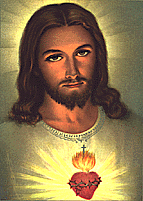


 Copyright
© 2005 Shepherds of Christ.
Copyright
© 2005 Shepherds of Christ.