The Priestly Newsletter Book II
Contents
| 1999 - Issue Five |
Shepherds of Christ Ministries
|
The pages which follow are those which made up issues 13-29 of the spirituality
newsletter for priests entitled Shepherds
of Christ. Issues 1-12 comprise volume
one, which is also available. We think it valuable that priests are able to have the newsletters
available in compact volumes.
priests are able to have the newsletters
available in compact volumes.
The purpose of this spirituality
newsletter for priests is to offer yet another aid to priests in the development
of their spiritual lives. We live in very critical times
for both the Church and the world. We priests, by our very vocation, are
in a most advantageous position to make an extremely significant contribution
to the betterment of both Church and world. And the
more we ourselves grow spiritually according
to the Gospel message, the more we are able to
help the Church and the world progress according to God’s will.
The subtitle of this book is Selected
Writings on Spirituality—for All People—as
Published in Shepherds of Christ Newsletter for Priests. Consequently,
we offer the following pages to all. Although some entries are aimed
specifically at priests, the overwhelming percentage of the material can hopefully
be used by all those interested in growth in the spiritual life.
Before readers progress to the pages of the various issues of
the newsletters, we think it valuable to
offer a brief overview of one’s spiritual journey in Christ.
An Overview of the Spiritual Life
The Christian life is rooted in the great event of the Incarnation. We must
consequently always focus our gaze upon Christ,
realizing that everything the Father wishes
to tell us has been summed up in the life, death, and resurrection of
Jesus. It only remains for us, then, to strive to understand with greater
insight the inexhaustible truth of the Word
Incarnate (Heb 1:1-2).
What was the condition of the human race at the time of
Christ’s coming? In some ways, people were
much the same as we are today. There were those just
being born into this world of human drama. There were those who, in death,
were leaving it, some of whom had grasped but little of life’s meaning.
There were those who were healthy and vigorous.
There were those who were sick and lame. Some
especially felt the burdens, the grief, the suffering of the human
condition. Others were ebullient and desired all the pleasures life could
provide. There was some good being accomplished. Immorality, however, was
rampant. What St. Paul tells us concerning the time that immediately followed
Christ’s existence certainly could also be applied to the time of His entrance
into the world. It is, in short, an ugly picture that St. Paul depicts for
us (Rom 1:22-32).
Into such a depraved condition Jesus entered, with a full and
generous Heart, to lead the human race from
the depths of sinfulness to the vibrant richness
of a new life in Himself. Through His enfleshment, this Christ
became the focal point of all history.
The authentic hopes and dreams of the human
family, now so overshadowed by the ugliness of sin, came converging upon
this Christ. He would gather them up in Himself, give them a new luster and
brilliance and dynamism, and would lead the human family back to the
Father in the Holy Spirit.
Christ was radically to release us from the dominion of sin
and elevate us to a new level of existence.
This life Christ has given us is not a type of superstructure which
is erected atop human existence. Although nature and grace are distinct, they
do not lie side by side as separate entities. Rather, grace permeates nature.
The Christian is one graced person. The Christian is one who has been raised
up, caught up, into a deeper form of life in Christ Jesus. Nothing that is
authentically human in the life of the Christian has
been excluded from this new existence.
Whatever is really human in the life of the Christian is meant to be
an expression of the Christ-life. The simple but deep joys of family life, the
wonderment at nature’s beauty, the warm embrace of
a mother for her child, the agony of crucial
decision making, the success or frustration that is experienced in
one’s work, the joy of being well received by others, and the heartache
of being misunderstood—all these experiences are
intended to be caught up in Christ and made
more deeply human because of Him.
Jesus has come, then, not to destroy anything that is
authentically human, but to perfect it by
leading it to a graced fulfillment. The more God-like we become
through Christ, the more human we become.
We, through our incorporation into Christ which occurs at
Baptism, are meant to relive the life, death,
and resurrection of Jesus. In doing so, we are not
only accomplishing our own salvation, but we are assisting in the salvation
of others also. The Incarnation continues all the
time. Christ, of course, is the one Who
fundamentally continues the Incarnation. But He enlists our help.
The world no longer sees Jesus, no longer is able to reach out and touch Him.
We are the ones who now, in some way, make Christ visible and tangible. In
union with the invisible, glorified Christ, and depending on Him as our
source of life, we continue the Incarnation in its visible and temporal dimensions.
This is our great privilege. This is our great responsibility.
The Christian is initiated into the mystery of Christ, into
his or her role in prolonging the
Incarnation, through Baptism (Rom 6:3-4).
It is not sufficient, however, that we be incorporated into
Christ through Baptism. All forms of life require nourishment. So, too,
our life in Christ must be continually nourished.
How can we continually keep in contact with Christ?
There are various ways. We contact Christ in a most special way through
the liturgy, above all in the Eucharistic liturgy. Through our most special
and most personal meeting with Jesus in the Mass, we are more deeply incorporated
into Christ. Also, we should remember that all the sacraments make
up part of the Church’s liturgy.
The reading of Scripture provides another special opportunity
for meeting Jesus. This is true for both Old
and New Testaments. The Old Testament prefigures the
New Testament and leads to it. It is obvious, however, that we meet
Christ especially in the pages of the New Testament. How true it is to say
that not to be familiar with Scripture is not to
know Jesus properly. We should resolve to
read from Scripture daily.
We also meet Jesus in our interaction with others. Everyone
we meet, everyone we serve, is in the image
of Jesus. We have to take the means to grow in
this awareness. If I truly believe that everyone has been redeemed by the
blood of Jesus, how should I treat everyone?
These, then, are some of the ways we keep in contact with
Jesus. Common to the various ways of meeting
Jesus is a certain degree of prayerful reflection. Our
contact with Jesus in the liturgy, in Scripture, and in our interaction with
others, and so forth, will not be all that it should
be unless we are persons of prayer. The light
and strength of prayer enables us to keep in contact with Jesus
as we should.
We live out our Christ-life in an atmosphere of love. Indeed,
the life Jesus has given us is centered in
love. It has its origins in the mysterious love of God (Jn
3:16).
Our new life in Jesus has arisen out of God’s fathomless
love. Christ, in His descent into human
flesh, has established a milieu of love. The life He came to give
can flourish only in the framework of love. Indeed, we can summarize the
meaning of the Christian life by stating that it is our loving response to
God’s love. The pierced Heart of Jesus, this Heart
which shed its last drop of blood in the
greatest love for each one of us, is the symbol of God’s tremendous love
for us. Christ’s Heart also calls us to respond by giving ourselves in love
to God and neighbor. Yes, Jesus invites us to respond to God’s love by giving
ourselves in love to Him in an ever closer union. The more closely we are
united to Him, the greater is our capacity to love God and neighbor. The more
closely we are united with Jesus, the more closely He unites us to the Father
in the Holy Spirit, with Mary our Mother at our side.
May the ideas contained in this brief overview of the
spiritual life be deepened and expanded
through the reading of the following pages.
Fr. Edward J. Carter, S.J.
Editor, Shepherds of Christ Newsletter
A Spirituality Newsletter for Priests
God Is Love
"I am the good shepherd: the good shepherd is one who lays down his life for his sheep. The hired man, since he is not the shepherd and the sheep do not belong to him, abandons the sheep and runs away as soon as he sees a wolf coming, and then the wolf attacks and scatters the sheep; this is because he is only a hired man and has no concern for the sheep. I am the good shepherd; I know my own and my own know me, just as the Father knows me and I know the Father; and I lay down my life for my sheep." (Jn 10:11-15
1)He hung upon a cross on a hill called Calvary. Death was near. How much Jesus had already suffered! He had been brutally scourged. Much of His sacred body was a bloody, open wound. He had been derisively crowned with thorns. In a terribly weakened condition, He carried the heavy cross to the hill of Golgotha. There He was stripped of His garments and mercilessly nailed to the cross.
Truly the Good Shepherd had laid down His life for His sheep. That magnificent Heart, overflowing with love for His Father and all of us, had beat its last.
Jesus' life was a life of love. He mightily loved His Father and all of us. The poverty, the hiddenness, the disappointments, the accomplishments, the weariness, the joy and the happiness, the pain and the agony-all that constituted the earthly life of the Incarnate Son of the Father, was experienced within the framework of love. Jesus, Who is divine and human, was the great man that He was as He walked this earth because He loved tremendously. He loved in everything He did-tenderly, manfully, with understanding and sympathy. He loved with complete devotedness and a deep concern for the individual. He loved with a passion for that which was true and beautiful and good. He loved with a complete conformity to the Father's Will. He loved always and completely. He loved with the gift of Himself, always pouring Himself out, even to the point of death. He gave Himself in love to His Father and to us until there was no more to give.This was the poignant beauty of Christ's life. He was a giant of greatness because He was one Who loved tremendously.
We can be tempted to reject this marvelous example of Christ. We can seek our greatness and fulfillment in a manner that necessarily results in disappointment. We can strive after greatness in ways that God does not intend. These wayward wanderings, however, result in a feeling of dissatisfaction and frustration. If we follow these false leads, we will eventually come to realize that they have betrayed us. Indeed, these wayward wanderings possess the potential for nothing but betrayal, because they are not rooted in Christ and His way of life-which is the way to true greatness.
We must incessantly remind ourselves of the example that Jesus has given us. We must deepen our realization that our fundamental greatness consists in what we are, and we are to the extent we love God and others. St. Paul, in his own inimitable way, tells us of this: "If I had all the eloquence of men or of angels, but speak without love, I am simply a gong booming or a cymbal clashing. If I have the gift of prophecy, understanding all the mysteries there are, and knowing everything, and if I have faith in all its fullness, to move mountains, but without love, then I am nothing at all. If I give away all that I possess, piece by piece, and if I even let them take my body to burn it, but am without love, it will do me no good whatever." (1 Cor 13: 1-3)
Our greatness, then, lies in our relating in love to both God and others-yes, even to that vast majority whom we will never see or know directly, but whom our love can nevertheless reach out and touch because of our union with Christ. With Christ, there are no space barriers, and, therefore, uniting our love to His can unite us to people the world over.
We grow as Christians through a life that is centered in love within the milieu of the human condition. This is the only framework we have for achieving our greatness, our true personhood, and, consequently, we must not shirk the human condition. Jesus did not shirk it, but rather accepted it and manifested His greatness within it, despite the pain and agony that the human condition at times heaped upon Him. It is true that Jesus rejoiced during the course of His life because of the goodness, sincerity, and response of some of those with whom He dealt. The love that Mary and Joseph showered on Jesus, for instance, gave Him great joy. During His life, however, Jesus often suffered because of the evil side of others-their pettiness, cowardice, insensitivity, selfishness, egotism. In other words, Jesus suffered at the hands of others because they were not what they should have been. However, these experiences did not thwart the greatness of Jesus. He was always what He should have been. Jesus was always the tremendous lover, and He loved even at those times when it was very painful to do so.
Our own greatness in Christ, our growth as Christians, can develop smoothly and joyfully because we, in a special way, experience the goodness and love within the hearts of others, and this makes it easy for us to love as we should. Sometimes, however, the less wholesome side of others crowds in upon us, and we find it difficult to go on loving as we should. In the same way that Christ suffered because of others, we, too, as we try to love, suffer because of others. We suffer because others do not always understand us-this can be true even of those who dearly love us. We suffer because some do not appreciate what we do for them, and sometimes what we do exacts great personal cost. We suffer because others either reject us or make us the objects of their meanness and selfishness. We suffer because there are some who ignore us. At times we suffer so much that we are tempted to withdraw from the pain of giving ourselves in love into an egotistic enclosure of self-seeking, where, we think, we will no longer suffer at the hands of others, or at least will not suffer so much. To surrender to such a temptation, however, is to forget what Christian greatness really is, namely, a life of love for God and others, a love that does not shrink from the pain that results from loving in an imperfect world, a love that is meant to become greater and more selfless regardless of the way other might treat us. Love, then, accepts both the joy and the pain of life and carries on under both conditions. Yes, we are made for love.
The first letter of John tells us: "God is love and
anyone who lives in love lives in God, and God lives in him. Love will come to
its perfection in us when we can face the day of judgment without fear; because
even in this world we have become as he is.
"In love there can be no fear, but fear is driven out by perfect love:
because to fear is to expect punishment, and anyone who is afraid is still
imperfect in love.
"We are to love, then, because he loved us first. Anyone who says, 'I love God,' and hates his brother, is a liar, since a man who does not love the brother that he can see, cannot love God, whom he has never seen.
"So this is the commandment that he has given us,
that anyone who loves God must also love his brother." (1 Jn 4:16-21)
Reflections on Love~ The more love matures, the more it concentrates on the present. Love welcomes each day with a fresh joy and a renewed gratitude to God for the opportunity to once again be and become for Him and others. Love realizes that it does not fully possess the past or the future-it can only fully grasp the present, and it loathes to waste any of the preciousness which "the now" offers.
~ Love is gentle, love is tender. Love is sensitive to the gentleness in nature. It is moved by the softness of the freshly fallen snow, the coolness of an autumn breeze tenderly stroking the brow, and the softness of the grass in May-time greenness. Much more important, love is sensitive to the need for gentleness, for tenderness, in human affairs. Consequently, love gently comforts the grief-stricken parents of a child so tragically and suddenly snatched away in death. Love gently encourages those to whom life seems hopeless. Love sensitively tends to the needs of those who are so often and so easily forgotten. Yes, the gentleness of love manifests itself in these and in many other ways, and, in so doing, imitates the gentleness, the tenderness of Jesus Himself: "Jerusalem, Jerusalem, you that kill the prophets and stone those who are sent to you! How often have I longed to gather your children, as a hen gathers her chicks under her wings, and you refused!" (Mat 23:37)
~ The fact that love is gentle does not mean that it is not strong. It is precisely this, and the blend between its tenderness and its strength constitutes one of love's most attractive traits. Love is strong in many ways. It is not discouraged by the evil in the world that threatens to thwart the accomplishments of love's goals. It realizes that the strength of goodness is mightier than the force of evil and that ultimately love wins out. Love is also strong in bearing with the temporary failures that are experienced in the pursuit of its purpose. Although love may be disappointed, it nevertheless realizes that the only failure it cannot conquer would be love's refusal-love's failure to go on loving-and true love will never quit. Love is strong in its willingness to take the necessary means to achieve its goals, even though this might entail great personal cost or cause misunderstanding, or even cause pain to those who are the recipients of this love.
~ Love is secure. A person who properly loves is in touch with one's true self and realizes that he or she is tremendously loved by God. Such a person feels secure in the exercise of love towards others. He or she feels secure enough to extend love towards others in various ways, even when little or no love is returned.
~ Closely allied to love's feeling secure is love's intuition in realizing the evils of possessiveness. Love does not try to possess the person one loves, but leaves the other free. In fact, authentic love for the other makes the other more free and helps the other to grow in all ways, including growth along the paths of real freedom. The one who loves authentically leaves the other free to grow in all sorts of ways, for example, to relate to other people and to undertake new things, activities which might well make the loved one less accessible.
~ Love is reconciliatory and integrative. Loves hates divisiveness. It knows the difference between diversity and divisiveness. It knows that healthy diversity reflects the varied richness of human existence and is something to be desired. It knows, too, that divisiveness is the sworn enemy of community. Divisiveness perniciously eats away at those bonds of love and union that are meant to unite the members of God's human family. Love, consequently, works to promote the integrative process which unites us and human events according to God's holistic plan, a plan in which the numerous and richly diversified parts become increasingly beautiful the more they contribute to the health and functioning of the whole.
~ Love is trusting. Regarding a person's relationship with God, this attitude grows in proportion to the atmosphere of love. As one grows in the realization of how much God loves him or her, and responds with a love of his or her own, trust in God matures and is a dominant facet of one's daily existence. A serenity of spirit becomes more obvious as the person grows in the awareness of both how much God cares and how supportive His loving embrace is, come what may.
This attitude of trust also characterizes one's relationships with others. One who is exercising true love is not naive or oblivious to the fact that one can be needlessly hurt by this: that one's trust can be betrayed. On the contrary, one who loves realizes that there is certainly an evil side to human nature, but, nevertheless, prefers to concentrate on the basic goodness of the human heart. This positive focus allows a person to trust that people not only will frequently act according to this goodness, but, as a matter of fact, will actually be encouraged to do so when they themselves are the recipients of a true and sincere love.
~ Love is affirming. By the very fact that one loves another, the other is encouraged to be and to become according to his or her uniqueness. Being loved enhances a person's sense of worthwhileness. A person who is loved is encouraged to develop his or her uniqueness, to feel more at home with oneself, and to accomplish further the special mission in life that only he or she can fulfill.
~ Love is patient. Love realizes that, for the most part, the growth of God's kingdom occurs at a very gradual pace. Sometimes this growth process seems exceedingly slow, and a person is tempted to wonder if the efforts of love are actually producing any effects. Patience conquers this temptation, however, and enables love's work to continue. Patience consequently helps prevent the waste of talent in the work of the kingdom. It seems that certain talented people have never realized their potential in promoting Christ's cause precisely because they were not patient enough with others and themselves. Patience is a virtue that is not much discussed, but is nevertheless extremely necessary.
~ Love is not proud, is not egotistical. Love is interested, of course, in the self and the good of the self. One who loves authentically, however, realizes that the love of one's true self is based on the awareness that one has been created and redeemed by God's love, that one has been endowed with various gifts by the Creator, and that these gifts are to be exercised in the loving service of God and others. Love, then, does not become selfishly proud in its accomplishments. Rather, love realizes that God is the ultimate source of personal accomplishments, that one can achieve only what God helps a person to accomplish. Love is very much aware of Jesus' words that without Him we can do nothing.
~ Love is both universal and specific. Love is universal in that it excludes no one. For example, love includes all members of the human family in its prayer. Love is very much aware, however, that one can say he or she loves everybody, but be sadly lacking when it comes to manifesting love in various ways according to the concrete setting of every day. True love, then, does not shy away from the painful aspects of loving specific individuals in definite, concrete circumstances. Admittedly, such a service of love can be difficult, demanding, and unattractive in certain ways. Personality flaws in others, or particular personalities that are not attractive to the one who is trying to be of help, or indifference, or even hostility on the part of those one strives to serve-these and other realities are a true test of a person's willingness to concretely implement one's avowal that one does indeed love his or her neighbor as the Lord commands, even when it is difficult to do so.
~ The Christian's fundamental relationship is his or her union with God in Christ. The more one realizes how much God loves him or her as this unique individual, and the more the person responds to this love, the greater the happiness. If this basic love relationship with God in Christ is alive and healthy, everything else in life falls into place. There may be problems, at times very severe problems. There may be great suffering. But all of this becomes bearable for the one who feels reasonably secure in God's love. A poll has been taken which finds that unhappiness is about five times greater among non-religious people than among people who would be classified as being very religious.
The saints' progress in holiness was accompanied by their conviction that God loved them mightily. We also have to allow the realization of how much God loves us to accomplish our ongoing transformation in Christ. Since it's true that God loves each of us so uniquely, so intimately, why don't we take greater effort to arrive at the existential assent to this consoling truth? By an existential assent we mean one which reaches deep down, an assent which permeates our being so thoroughly that it erases and makes repugnant the thought of compromising for a life of spiritual mediocrity. At times we foolishly shy away from God's love. We foolishly think that to give ourselves ever more to this love, to allow it to possess us more radically, will mean that our lives will be too much hemmed in, too much cut off from the pursuit of our self-designed ideas of happiness. If we succumb to such a temptation, we become similar to the prodigal son who thought happiness existed elsewhere than in his father's house. His pursuit of this false happiness ultimately ended up in his willingness to eat the food given to pigs. We ourselves are not totally blameless. To the extent we refuse to be more possessed by God's love, and choose to be directed by it, to that degree we also are willing to settle for food which is unworthy, food which can never satisfy our true cravings.
~ Love is contemplative. It realizes it must sustain and develop a contemplative awareness of reality if it is to love properly. To relate in love to reality as we should means that first we must view reality according to its true nature, that is, we must see things according to our faith vision. Jesus has left us with the proper view of God and creation. Jesus has told us how to relate to God and His creation, how to love. This faith vision must be consistently actualized through a contemplative or prayerful awareness of the people, events, and circumstances that are part of our daily lives. If we fail, for example, to see people as they really are in their core existence, namely, as created and redeemed by God's love, and instead allow ourselves to be absorbed by more superficial aspects of their persons, then we will not love them as we should.
Love seeks, therefore, a certain degree of solitude in order to nourish this contemplative attitude. A person cannot hope to exercise a contemplative awareness throughout the myriad and often complex happenings of daily existence unless there are periods of withdrawal during which one can drink more deeply of the wisdom which contemplation offers. A person must conquer the temptation that deceitfully suggests that the seeking of solitude is a selfish desire to flee the pain of human encounter. Authentic solitude is never selfish; rather, it is a renewed opportunity for refurbishing both one's contemplative vision and one's determination to love more maturely according to this perspective.
~ Love knows what love really is, and this awareness is a result of love's contemplative thrust. One of the truths that emanates from the act of contemplation is the realization of what actually constitutes true love. This is no small accomplishment, for, despite the numberless volumes that have been written about love, one can still have only a blurred idea of what it really is. Giving love is the gift of self to promote the authentic good of the other loved. Being loved is receiving the other's gift of self as a help in achieving one's real good.
The manner in which the gift of self is made is commensurate with the type of relationship. A doctor gives himself or herself to one's spouse in one way, to one's children in another, to one's patients in yet another way, and to his or her friends in a way that is still further differentiated. Whatever way the gift of self is made, however, it has the same basic goal in mind, namely, to promote the real good of the other. Love realizes that it is not always easy to discern what really promotes the true good of the other. However, despite this difficulty, love is aware of its true identity. Love, in short, knows what love really is.
~ When we experience love-hurt in abundant measure, we can be tempted to think that it may be better not to love at all. But a moment's mature reflection tells us otherwise. We are made for love. We are to love God and human persons. The only way we can grow is to love. Despite the pain, we have to love if we want to grow, if we want to be happy, if we want to be what God destines us to be. At times, and especially when the love-pain is particularly keen, we should look at the example Jesus has left us. He came upon the earth to love. He did not flinch, He did not renege. He did not quit loving when it was painful to do so-even when it became agonizingly painful to do so. This is the poignant beauty of His life.
~ "After saying this, what can we add? With God on our side who can be against us? Since God did not spare His own Son, but gave Him up to benefit us all, we may be certain, after such a gift, that He will not refuse anything He can give. Could anyone accuse those that God has chosen? When God acquits, could anyone condemn? Could Christ Jesus? No! He not only died for us-He rose from the dead, and there at God's right hand He stands and pleads for us.
"Nothing therefore can come between us and the love of Christ, even if we are troubled or worried, or being persecuted, or lacking food or clothes, or being threatened or even attacked'
"For I am certain of this: neither death nor life, no angel, no prince, nothing that exists, nothing still to come, not any power, or height or depth, nor any created thing, can ever come between us and the love of God made visible in Christ Jesus Our Lord." (Rom 8:31-39)
Thoughts About Christ
From the spiritual classic, The Imitation of Christ, we read: "Make room for Christ. When you possess Christ you are a rich man, for he is sufficient for you. He himself shall provide for you and faithfully administer all your cares. You will not have to place your hope in man. Put all your trust in God, let him be both your fear and your love. He will respond on your behalf and will do whatever is in your best interest.
"You have here no lasting city. For wherever you find yourself, you will always be a pilgrim from another city. Until you are united intimately with Christ, you will never find your true rest.
"Let your thoughts be with the Most High and direct your prayers continually to Christ. If you do not know how to contemplate the glory of heaven, take comfort in the passion of Christ, and dwell willingly in his sacred wounds. Endure with Christ, suffer for him, if you wish to reign with him.
"Once you have entered completely into the depths of Jesus, and have a taste of powerful love, then you will not care about your own convenience or inconvenience. Rather, you will rejoice all the more in insults and injuries, for the love of Jesus makes a man scorn his own needs."
2Fr. Paul de Jaeger, S.J., writes: "Why do we not once and for all spread wide the sails of the ship of our trust? Did we but do this, how utterly our lives would be changed! How this would enable us to ride before the wind, to ride fast towards the greatly desired anchorage of perfect union with Jesus! Only when she had made strong her trust did St. Teresa of the Child Jesus, trust's great Saint, set out to walk the ways of divine love. From that day on her life was changed. Is that not our need also? Would that for us too this change could be made without delay, could be made this very day! Would that, making a supreme effort to respond to the full to the infinite goodness of Jesus in the Eucharist, we could bid a final farewell to all our cowardice, to all our vain fears, to all things conducive of faulty trust'"
3Fr. Peter van Breeman, S.J., observes: "The matter of joy in the risen Lord has a great deal to do with faith, for a sad Christian is really not an authentic Christian. In this regard the words of Mother Teresa of Calcutta are impressive. She has devoted her life to the lowest form of human misery; her days are wholly taken up with the sufferings and the sorrows of the most forsaken. And, yet, her words are unqualified: 'Never let anything fill your heart with so much grief that you forget the joys of the risen Lord.' These are the words of a woman of faith'Mother Teresa can work with the poor because she has Christ's own intense joy and gladness in her heart. It is this which makes her so radiant, so appealing. For this reason people flock to her, and she is able to console them truly, not just with money or medication-she has too little of these-but above all with the true consolation that comes from faith, the faith embodied in her own life."
4
Our FatherThe Catechism states: "By calling God 'Father,' the language of faith indicates two main things: that God is the first origin of everything and transcendent authority; and that He is at the same time goodness and loving care for all His children. God's parental tenderness can also be expressed by the image of motherhood, which emphasizes God's imminence, the intimacy between Creator and creature. The language of faith thus draws on the human experience of parents, who are in a way the first representatives of God for man. But this experience also tells us that human parents are fallible and can disfigure the face of fatherhood and motherhood. We ought therefore to recall that God transcends the human distinction between the sexes. He is neither man nor woman: He is God. He also transcends human fatherhood and motherhood, although He is their origin and standard: no one is father as God is Father."
5
The Holy Spirit in Our LivesThe Catechism succinctly explains the role of the Holy Spirit in our lives: "Jesus is Christ, 'anointed,' because the Spirit is his anointing, and everything that occurs from the Incarnation on derives from this fullness. When Christ is finally glorified, He can in turn send the Spirit from his place with the Father to those who believe in him: he communicates to them his glory, that is, the Holy Spirit who glorifies him. From that time on, this joint mission will be manifested in the children adopted by the Father in the Body of his Son: the mission of the Spirit of adoption is to unite them to Christ and make them live in him."
6
Mother of Our Christ LifeRita Ring writes: "Mary is always desiring to bring forth her children to a greater Christ likeness. It is through Mary that we join in deepest intimacy with Jesus' Heart. Jesus came into this world in the womb of His Mother through the power of the Holy Spirit. It is today, in the womb of Mary, in the heart of Mary, that we are transformed through the Holy Spirit more and more to the likeness of Jesus. Let us go to the heart of our Mother and ask the Holy Spirit to increasingly sanctify us that we may go ever more deeply into the Heart of Jesus, the Heart of endless love. We do not fully comprehend the love of God. We are so limited in our vision. We do not fully know how Jesus' Heart is truly burning and on fire. Do we know what it is to feel love burning in our heart? This is what Jesus felt when He allowed Himself to suffer during His Passion and to die on the cross. His Heart was on fire."
7
Aquinas on the EucharistSt. Thomas Aquinas has left us these inspirational words on the Eucharist, the source and summit of the Christian life: "Since it was the will of God's only begotten Son that men should share in his divinity, he assumed our nature in order that by becoming man he might make men gods. Moreover, when he took our flesh he dedicated the whole of its substance to our salvation. He shed his blood for our ransom and purification, so that we might be redeemed from our wretched state of bondage and cleansed from all sin. But to ensure that the memory of so great a gift would abide with us forever, he left his body as food and his blood as drink for the faithful to consume in the form of bread and wine.
"O precious and wonderful banquet, that brings us salvation and contains all sweetness! Could anything be of more intrinsic value. Under the old law it was the flesh of calves and goats that was offered, but here Christ himself, the true God, is set before us as our food. What could be more wonderful than this? No other sacrament has greater healing power; through it sins are purged away, virtues are increased, and the soul is enriched with an abundance of every spiritual gift. It is offered in the Church for the living and the dead, so that what was instituted for the salvation of all may be for the benefit of all. Yet, in the end, no one can fully express the sweetness of this sacrament, in which the spiritual delight is tasted at its very source, and in which we renew the memory of that surpassing love for us which Christ revealed in his passion.
"It was to impress the vastness of this love more firmly upon the hearts of the faithful that our Lord instituted this sacrament at the Last Supper. As he was on the point of leaving the world to go to the Father, after celebrating the Passover with his disciples, he left it as a perpetual memorial of his passion. It was the fulfillment of ancient figures and the greatest of all miracles, while for those who were to experience the sorrow of his departure, it was destined to be a unique and abiding consolation."
8
Pope John Paul II on the PriesthoodPope John Paul II speaks on the relationship of the hierarchical priesthood and the common priesthood of the faithful: "We must consider down to the smallest detail not only the theoretical meaning but also the existential meaning of the mutual 'relation' that exists between the hierarchical priesthood and the common priesthood of the faithful. The fact that they differ not only in degree but also in essence is a fruit of a particular aspect of the richness of the very priesthood of Christ which is the one center and the one source, both of that participation which belongs to all the baptized and of that other participation which is reached through a distinct sacrament, which is precisely the sacrament of Orders. This sacrament, dear brothers, which is specific for us, which is the fruit of the special grace of vocation and the basis of our identity, by virtue of its very nature and of everything that it produces in our life and activity, serves to make the faithful aware of their common priesthood and to activate it: the sacrament reminds them that they are the People of God and enables them 'to offer spiritual sacrifices' through which Christ Himself makes us an everlasting gift to the Father. This takes place, above all, when the priest 'by the sacred power that he has'in the person of Christ (in persona Christi) effects the Eucharistic Sacrifice and offers to God in the name of all the people,' as we read in the conciliary text quoted above.
"Our sacramental priesthood, therefore, is a 'hierarchical' and at the same time 'ministerial' priesthood. It constitutes a special ministerium, that is to say, 'source,' in relation to the community of believers. It does not, however, take its origin from that community, as though it were the community that 'called' or 'delegated'. The sacramental priesthood is truly a gift for the community and comes from Christ Himself, from the fullness of His priesthood. This fullness finds its expression in the fact that Christ, while making everyone capable of offering the spiritual sacrifice, calls some and enables them to be ministers of his own sacramental Sacrifice, at the Eucharist-in the offering of which all the faithful share-in which are taken up all the spiritual sacrifices of the People of God.
"Conscious of this reality, we understand how our priesthood is 'hierarchical', that is to say, connected with the power of forming and governing the priestly people and precisely for this reason 'ministerial.' We carry out this office, through which Christ Himself unceasingly 'serves' the Father in the work of our salvation. Our whole priestly existence is and must be deeply involved with this service, if we wish to effect in an adequate way the Eucharistic Sacrifice in persona Christi.
"This priesthood calls for a particular integrity of life and service, and precisely such integrity is supremely fitting for our priestly identity. In that identity, there are expressed, at the same time, the greatness of our dignity and the 'availability' proportionate to it. It is a question of the humble readiness to accept the gifts of the Holy Spirit and to transmit to others the fruits of love and peace, to give them that certainty of faith from which derive the profound understanding of the meaning of human existence and the capacity to introduce the moral order into the life of individuals and of the human setting.
"Since the priesthood is given so that we can unceasingly serve others, after the example of Christ, the Lord, the priesthood cannot be renounced because of the difficulties that we meet and the sacrifices asked of us. Like the apostles, we have left everything to follow Christ: therefore we must persevere beside Him also through the cross."
9
Merton on PrayerThomas Merton speaks to us about the place of love in prayer: "The instinctive characteristic of religious meditation is that it is a search for truth which springs from love and which seeks to pursue the truth not only by knowledge but also by love. It is, therefore, an intellectual activity which is inseparable from an intense consecration of spirit and application of the will. The presence of love in our meditation intensifies our thought by giving it a deeply affective quality. Our meditation becomes charged with a loving appreciation of the value hidden in the supreme truth which the intelligence is seeking. The affective drive of the will'raises the soul above the level of speculation and makes our quest for truth a prayer full of reverential love and adoration striving to pierce the dark cloud which stands between us and the throne of God. We beat against this cloud with supplications, we lament our poverty, our helplessness, we adore the mercy of God and His supreme perfections, we dedicate ourselves entirely to His worship."
10
Act of ConsecrationLord Jesus, Chief Shepherd of the Flock, I consecrate my priestly life to your Heart, pierced on Calvary for love of us. From your pierced Heart the Church was born, the Church you have called me, as a priest to serve in a most special way. You reveal Your Heart as symbol of Your love in all its aspects, including Your most special love for me, whom You have chosen as Your priest-companion. Help me always to pour out my life in love of God and neighbor. Heart of Jesus, I place my trust in you!
Dear Blessed Virgin Mary, I consecrate myself to your maternal and Immaculate heart, this Heart which is symbol of your life of love. You are the Mother of my Savior and you are also my Mother. You love me with the most special love as this unique priest-son. In a return of love I give myself entirely to your motherly love and protection. You followed Jesus perfectly. You are His first and perfect disciple. Teach me to imitate you in the putting on of Christ. Be my motherly intercessor so that, through your Immaculate Heart, I may be guided to an ever closer union with the pierced Heart of Jesus, Chief Shepherd of the Flock, who leads me to the Father in the Holy Spirit.
Letters
We thank all those who have taken the time to write to us. We very much appreciate your letters. Space limitations permit us to publish only a few of these.
Dear Fr. Carter,
Deo Gratias and also to you for your Shepherds of Christ newsletter-a gem. Your articles always have solid meditation material and an inviting way of leading us priests on that path of holiness to which we are called.
May your work be graced by the Lord.Sincerely in Jesus and Mary,
Fr. Eugene Golas,
Grand Rapids, Michigan
My dear Fr. Carter:
Many thanks for the March-April issue of Shepherds of Christ. That is the first issue I ever saw or received. May the good Lord bless you. It is a wonderful newsletter. I am enclosing a small donation. May God love you.Sincerely,
Fr. Charles Jirik,
Minneapolis MN
Note: If you know of other priests who have not been receiving the Newsletter, please tell them we would be very glad to add them to our mailing list upon receiving their names and addresses.
—Editor
Dear Ed,
I recently ran across your publication. As a newly ordained priest, I found it most refreshing and affirming. Please subscribe me at the above address. We are all grateful to people like you who help people like us.Gratefully,
NOTES:
Fr. John Kennedy,
Monroe, Louisiana
end of Sept/Oct 1996
A Spirituality Newsletter for Priests
"I am the good shepherd: the good shepherd is one who lays down his life for his sheep. The hired man, since he is not the shepherd and the sheep do not belong to him, abandons the sheep and runs away as soon as he sees a wolf coming, and then the wolf attacks and scatters the sheep; this is because he is only a hired man and has no concern for the sheep. I am the good shepherd; I know my own and my own know me, just as the Father knows me and I know the Father; and I lay down my life for my sheep." (Jn 10:11-151)
A faithful shepherd takes care of his sheep in all their needs. This includes providing them with the proper food. Jesus, the perfect Shepherd, abundantly provides for the nourishment of His flock. In the Eucharist, He gives Himself in His body, blood, soul, and divinity, for our spiritual growth. He also feeds us through His word, through His teaching. The gospel of John, in Chapter 6:35-59, combines both of these ways, Christ nourishing us through His teaching and through the Eucharist. This particular section of John's gospel gives us Jesus' great discourse on the Bread of Life. The first part, verses 35-50, speaks of the teaching of Jesus as nourishment. This first part contains, therefore, the so-called sapiential theme. The second part, versus 51-59, speaks of the Eucharist as our heavenly nourishment. This part, therefore, contains the sacramental theme.
Concerning the teaching of Jesus which has been left to His Church, the Second Vatican Council states: "But in order to keep the gospel forever whole and alive within the Church, the apostles left bishops as their successors, 'handing over their own teaching role' to them. This sacred tradition, therefore, and sacred Scripture of both the Old and the New Testament are like a mirror in which the pilgrim Church on earth looks at God, from whom she has received everything, until she is brought finally to see Him as He is, face to face."2
We priests have a special privilege and responsibility to nourish ourselves with the teachings of Jesus. The more we meditate on this teaching, the more we love it, the more we ourselves live it, the more apt instruments we become in assisting the Good Shepherd in the feeding of His flock.
Reflections on the Word of God
- Getting to Know Jesus
"Philip said, 'Lord, let us see the Father and then we shall be satisfied.' 'Have I been with you all this time, Philip,' said Jesus to him, 'and you still do not know me?'"(Jn 14:8-9)
We can come to know Jesus in various ways. To hear about Jesus during the Scriptural readings of the liturgy, or to hear about him in a homily, or to experience Jesus in other ways through life within the Christian community-these are all means by which we can meet Jesus and come to know Him better.
We should also realize that prayer is a very effective and necessary means for growing in knowledge and love of Jesus. Some apparently think that, if they meet Jesus by experiencing Him in and with their neighbor in various ways, this is sufficient. We should not underestimate this communitarian manner of experiencing Jesus. It is extremely important, and we cannot do without it. But in order to know and love Jesus as we should, we also need the one-to-one situation which prayerful quiet offers. At times we need to be alone with Jesus.
We can see the necessity of this by considering how a friendship with a human person develops and grows. We can certainly grow in knowledge and live with a friend as we experience him or her in the company of others. But I think we all admit that at times we must also be alone with the other if the friendship is properly to be and to grow. I can never get to know a friend as I should merely by being with him or her in the company of other people. I also need the one-to-one experience so that I and my friend can share on a more personal and intimate basis. If this holds true for my personal relationship with a human person friend, it also holds true for my friendship with Jesus. And it is especially as I receive Jesus in the Eucharist and pray before the tabernacle at other times that the one-to-one, intimate experience of Jesus is greatly nourished. It is at such moments that Jesus offers me a supreme opportunity to grow in knowledge and love of Him-this Jesus who is God, my teacher, my friend, my Savior, who died a brutal death for love of me.
- Longing for God
"God, you are my God, I am seeking you, my soul is thirsting for you." (Ps 63:1)
God is the one who gives ultimate meaning to our lives. He reveals to us how the laughter and the tears, the work and the play, the pain and the joy, all fit together. As we live in Him, He gathers up what would otherwise be the all-too-fragmented pieces of our lives and arranges them into a harmonious unity. This unity emanates from our living according to His plan, a plan embodying a way of existence that leads us to an ever greater experience of the true, the good, and the beautiful.
As we long for God and draw nearer to Him, we may possibly experience a certain fear. We realize that the closer we come to Him, the more He will ask of us, gently but firmly. We fear the white heat of His love. Such episodes along the spiritual journey are crucial. If we keep pulling back from the intensity of His love, if we keep refusing what this love wants to accomplish in us and through us, then we live on a rather superficial level. We can still be friends with our God but we are refusing to live deeper down where the really real is more intensely experienced. We have to resist this fear which, if succumbed to, prevents us from achieving a closer union with God. God's love for us wants our happiness; God's love for us also brings about our happiness-if we are open to what He wants to do for us.
When we experience a greater yearning and thirst for God, we should, then, abandon ourselves to this desire. In doing so we will experience in greater measure the warmth and security of God's love,this God Who is the ground of our being, the goal of our existence, the source of our happiness.
- It's God's Work More Than Ours
"The word of Yahweh was addressed to me, saying,
'Before I formed you in the womb I knew you;
before you came to birth I consecrated you;
I have appointed you as prophet to the nations.'
I said, 'ah, Lord Yahweh; look, I do not know
how to speak; I am a child!'
"But Yahweh replied,
'Do not say, "I am a child."
Go now to those to whom I send you
and say whatever I command you.
Do not be afraid of them,
for I am with you to protect you-
it is Yahweh who speaks!'" (Jer 1:4-8)At certain points along the journey of life, we become rather overwhelmed with a certain kind of fear. It is a fear emanating from the realization that God is asking something very special of us. We are afraid because of the effort required, or because we feel that we have only mediocre talent for the task to which we are being summoned.
Whatever the case may be, we can all profit by reflecting on the above scripture passage dealing with God's call to Jeremiah. Jeremiah told God, in so many words, that he was not capable of the task he was being asked to accomplish. God replied, telling Jeremiah that he surely could perform the task he was being assigned-not because of what he was in himself, but because He, God, would be with Jeremiah.
To live the Christian calling in all its myriad aspects certainly demands our own effort. But this is an effort assisted mightily by God's grace. God calls, invites, inspires. We are meant to respond, to cooperate, to open ourselves to the Spirit's touch and guidance. We have a part, obviously, in accomplishing our Christian destiny. Yet God has the greater part. Whatever He asks of us, we can accomplish. Nothing, absolutely nothing, is beyond us if God calls us to it. Why, then, at times, do we tend to think and feel and act differently?
- We Are Called to Serve
"If I, then, the Lord and Master, have washed your feet, you should wash each other's feet. I have given you an example so that you may copy what I have done to you." (Jn 13:14-15)
There are two basic ways according to which we can go about the performance of work. One way focuses attention on the self; the other directs attention outward toward the God-appointed service of others.
A person who assumes the first attitude is being driven by a basic selfishness. During the years of formal education, such a person studies to acquire knowledge primarily so that his or her intellectual acquisition will later make possible various kinds of personal benefits and aggrandizements. Such a person works primarily to make money, or for the personal satisfaction involved. Such a person seeks out positions of authority, power, and status, primarily in order to be looked up to and to be ministered to.
A person who performs according to the other attitude projects a different image. If one pursues knowledge, it is not only for one's personal benefits. It is that he or she might also be variously capable of greater service to God and one's fellow human beings. When one works, it is not only for the money and personal satisfaction involved. It is that he or she might also be of service to others. If one attains positions of authority and influence, the person is motivated, not by illusions of grandeur, but rather by the desire to labor for others, to be for others, to serve others.The attitude the true Christian should assume is obvious. The true Christian may sometimes find it difficult and wearisome to live according to such an attitude. But he or she has no doubt it is the correct attitude. He or she has no doubt it is Jesus' attitude, this Jesus who girt Himself with a towel and washed and dried His disciples' feet.
- Jesus and His Church
"So I now say to you: You are Peter and on this rock I will build my church. And the gates of the underworld can never hold out against it." (Mat 16:18)
The Church is experiencing trying times. Over the ages the Church has always received various kinds of criticism from those outside her fold. Currently she is also experiencing much criticism from within. Some of this criticism is bad-negative and unrealistic. During this period of the Church's transition, a time which has seen more than its share of pain, turmoil, confusion, and anguish, the question, "why the institutional Church?" has been raised more than once. The ultimate answer, of course, is because this is the way God wants it. God has established the Church through Christ, and, as we say, that's the way it is and that's the way it's going to be.
We help one another in the Church in many different ways, in many different circumstances. We do this not sporadically, but consistently. We live the Gospel, not as isolated individuals, but as the People of God whose members are meant to be united through the closest bonds of love.
Yes, there are many good things about the Church. But there are also things which should not be. There is jealously and pettiness. Such attitudes, unbecoming people who claim to be followers of Jesus, consistently hinder the Church's work. There is also on the part of some the exercise of power politics which makes one want to cry out that this is the Christian community, not a ruthless political machine. There are also injustices perpetrated against innocent individuals, impersonalism, mediocrity. These are some of the faults existent within the Church. We should do all we can to lessen these. We should labor at diminishing these failings so that the Church's Christic image may be more apparent. Yet we also have to realize that there will always be things wrong with the Church. We are a Pilgrim Church. This means we have not yet arrived at perfection-this is the state of the heavenly Jerusalem, the Church of heaven. Here below the Church will always be marred with blemishes even as she reaches out in a spirit of ongoing conversion for a greater assimilation of the Gospel ideal.
We should, then, view the Church realistically. We should remind ourselves that it was established by God, not by any human person or persons. We should rejoice over the Church's good points, sorrow over her failings. We should contribute our share to making the Church's goodness more dynamic, more evident, more sensitive to the needs of the times, while being consumed with a holy dissatisfaction which allows us no respite concerning the evils which plague the Church, and which should not be. And, very importantly, we should mightily love the Church despite her failings. We should love the Church deeply, consistently, tenderly. The Church belongs to Jesus; it is His body. It was born from His pierced side as He hung upon the cross. The Church is Jesus' great gift to us, a gift born of the magnificent love of His Heart.
- Suffering and Happiness
"We are in difficulties on all sides, but never cornered; we see no answer to our problems, but never despair; we have been persecuted, but never deserted; knocked down, but never killed; always, wherever we may be, we carry with us in our body the death of Jesus, so that the life of Jesus, too, may always be seen in our body." (2 Cor 4:8-10)
"I want you to be happy, always happy in the Lord; I repeat, what I want is your happiness. Let your tolerance be evident to everyone: the Lord is very near. There is no need to worry; but if there is anything you need, pray for it, asking God for it with prayer and thanksgiving, and that peace of God, which is so much greater than we can understand, will guard your hearts and your thoughts, in Christ Jesus." (Phil 4:4-7)
Certain people look upon religion as a type of enslavement. Religion, claim these people, puts shackles on one's desires for full living, pleasure, and happiness.Religion, they continue, makes one fearful, forces one into a rigid pattern of do's and don'ts which restricts and even suffocates a person's thrust toward full personality development. Whatever the causes may be for arriving at this view, such an attitude grossly misrepresents the nature of true religion.
Jesus has come to make us happy, not to make us participate in a religion which destroys the joy-dimension of human life. Jesus has come to increase our capacity for true self-fulfillment, not to restrict us with a religion which, while encouraging morbid self-enclosements, destroys possibilities for healthy self-expansiveness. Jesus has come to show us the way to real pleasures, not to prevent us with a religion which looks askance at such. And the happiness and fulfillment Jesus has come to give us is meant for this life, not only for eternal life. Christianity is a religion which gives a here-and-now happiness which develops into a future and eternal happiness which satisfies our deepest desires to be fully alive.
Jesus has not promised us that the process of achieving happiness is without pain and suffering. Jesus was the happiest man who ever walked this earth. He was also the man who suffered the most. Observing the life of Jesus Himself, then, we come face to face with this undeniable Christian truth: suffering, even deep suffering, is not incompatible with deep happiness. On the contrary, whether we experience suffering or whatever, such an encounter is a means to further happiness, providing we are living in Christ Jesus.
The Christian who is not fundamentally happy presents, then, a contradiction. He or she claims to be a follower of the Jesus who has promised more abundant life and happiness. To remove the contradiction, such a Christian must look to himself or herself. Such a person does not lack a basic happiness because there is anything wanting in Jesus' message. This person lacks happiness because there is something wanting in the self. In some way or another, for some reason or another, this person has failed to assimilate properly the Gospel message. The Gospel is the good news. Jesus invites us to listen to His Gospel, to respond to it, to live it ever more fully and dynamically. Jesus tells us that, if we do, we will experience a peace and happiness beyond comprehension. We know that Jesus does not lie, that Jesus does not deceive, that Jesus does not cruelly excite the expectations of His followers and then fail to fulfill them. Again, then, if a Christian is unhappy, he or she has to look at the self and ask why. But such a person should not ask the question in isolation. It should be asked in the company of Jesus. Jesus will help the person find the answer. Jesus will help remedy the situation.
- The Love Dimension
"If I have all the eloquence of men or of angels, but speak without love, I am simply a gong booming or a cymbal clashing. If I have the gift of prophecy, understanding all the mysteries there are, and knowing everything, and if I have faith in all its fullness, to move mountains, but without love, then I am nothing at all. If I give away all that I possess, piece by piece, and if I even let them take my body to burn it, but am without love, it will do me no good whatever." (1 Cor 13:1-3)
Jesus has told us love is what it's all about. Christianity, the religion of Jesus, is a religion of love. This is what Jesus wants us to realize. This is what we must realize. We understand the work of the Incarnation when we consider it in terms of love. We ourselves live Jesus when we live the love ethic He came to preach. Love marks the beginning of a truly Christian life. Love is also its main inspiration and motivation. Love is no less its goal. To be a Christian is to be a follower of Jesus. To be a follower of Jesus is to assimilate His message of love. To be a Christian, then, is to be a lover-in imitation of Jesus Who is the tremendous lover.
Jesus shows us His Heart as symbol of His life of love, including His mighty and tender love for each of us individually. His Heart calls for our return of love. His Heart invites us to pour out our lives in love of God and neighbor.
As we do so, love expands us, makes us grow, develops our capacity to be authentically and to become authentically. Love brings to mature expression the various potentialities of Christian personhood. It makes us what Jesus wants us to be. Christian love is meant to express itself at all times in all kinds of circumstances. It is truly a virtue for all seasons. Whether it is a time to laugh or a time to cry, it is a time to love. Whether it is a time to rejoice or a time to be sorrowful, it is a time to love. Whether it is a time to experience exhilarating success or to suffer the anguish of crushing failure, it is still a time to love. Whether it is a time to work on despite boredom, monotony, and lethargy, or a time to be carried along riding the crest of enthusiasm, it is a time for love. Love's labor is never done; there is no day which is not meant to be a love-day. Love should be as constant and as certain as the never-failing cycle of night following day and and day following night.
- The Eucharist
"Then he took some bread, and when he had given thanks, broke it and gave it to them, saying, 'This is my body which will be given for you; do this as a memorial of me.' He did the same with the cup after supper, and said, 'This cup is the new covenant in my blood which will be poured out for you.'" (Lk 22:19-20)
In the Eucharist, through the humanity of Jesus, Father, Son and Holy Spirit communicate themselves to us anew. Through the intimate gift of the Eucharist, they strikingly manifest their love for us and ask for our response of love. In, with, and through Jesus we respond. Each experience of the Eucharist is meant to strengthen our love-bond with Jesus, so that we can say with increased meaning along with St. Paul, "For I am certain of this: neither death nor life, no angel, no prince, nothing that exists, nothing still to come, not any power, or height or depth, nor any created thing, can ever come between us and the love of God made visible in Christ Jesus our Lord." (Rom 8:38-39)
The Eucharist not only deepens our union with God in Christ. In receiving the Eucharist we pledge ourselves to deepen our love-union with all members of the Body which is the Church. We pledge to use those means which foster union. We determine to avoid that which causes selfish divisiveness.
The Eucharist also reminds us of our relationship with all members of the human family. Jesus died and rose for all. The Eucharistic making present of this paschal mystery nourishes our determination to assist in the work of ongoing redemption. The light we receive from the Eucharist points to what we should be doing. The strength of the Eucharist assists us to act according to the light we receive.
The Eucharist, then, possesses the rich capacity to help us maintain and develop our personal relationship with God, with members of the Church, and with all other members of the human family. And it will do just this-if we so allow it.
- To Choose Jesus
"Then Jesus said to the Twelve, 'What about you, do you want to go away too?' Simon Peter answered, 'Lord, who shall we go to? You have the message of eternal life, and we believe; we know that you are the Holy One of God.'" (Jn 6:67-69)
Even after years of close friendship with Jesus, a Christian can decide to make a radical break and go his or her way. In the mysterious depths of one's free will, a person decides, for whatever reason, no longer to walk side by side with Jesus. This Jesus, who was once such an inspiration, who so often manifested His mercy, who offered a challenging goal to achieve the true, the good, and the beautiful, who whispered His loving and tender concern-this Jesus is now rejected.
On a lesser scale, a Christian can variously reject a deep intimacy with Jesus while still fundamentally maintaining the friendship. It may be a case of superficial living in general. Jesus keeps calling to a more dynamic Christian existence, but the person keeps resisting, because he or she is fearful, or perhaps just too lazy, or whatever. Or it may be the barrier between the person and Jesus is more pin-pointed: Jesus is asking a very definite something, and He is refused. Such a Christian presents a paradox. The person knows there is no other way but Jesus, and, therefore, he or she basically commits one's life to Christ. On the other hand, the person does not commit oneself as fully as one could, and thus seems to be saying, "You are the only one, Jesus, who can lead me to real happiness here and hereafter-but I don't want to follow you too closely."
The only mature Christian attitude, we know, is to choose Jesus once and for all, and to live out the full implications of this choice. Of course, there will be failings on the part of the Christian who makes this option for Jesus. But he or she will strive to avoid developing that attitude which says, "I will go so far with you, Jesus, but no farther. I want to come close to you, Jesus, but not too close." To choose Jesus, then, and to live this choice consistently, dynamically, lovingly, and without reserve, is true Christian logic. It is to realize with Peter that Jesus is the one and the only one.
At this Christmas season, these words of Fr. Edward Leen, C.S.Sp., are particularly appropriate:
"The swaddling bands in which Mary wrapped the Infant afforded but an imperfect shelter against the chilliness of the icy draughts. There is no doubt but that the straw was rough and course in spite of all Mary's efforts to make of it a clean and smooth bed for the tender Infant limbs. The manger, to be sure, was a sorry cradle for a King, and that the august King of heaven and earth. Doubtless, it was all very comfortless, but that is only one aspect of the birth of Jesus in the stable. It was not all wretchedness and misery. In this life of the God-Man loveliness and greatness, obscurity and splendor, weakness and power ever go hand in hand, and it is the splendor and power and greatness that dominate. They are but enhanced by the dark shadows of poverty, isolation and suffering. The shadows of the life of Jesus but serve to throw the splendors into stronger relief. The stable was a wretched abode, but in it was a sanctuary as worthy of God as it is possible for a created thing to be worthy of Him. That sanctuary was Mary's soul. In it the Child-God could nestle to His Heart's content and find delight. He is God and for Him, therefore, spiritual realities are more real than material realities. In His eyes the splendors of His Mother's soul transformed the cavern into an abode of palatial splendour and beauty. The mother love of Mary wrapped the soul and heart of Jesus in a mantle of warmth that was grateful in the extreme. God had never before experienced the like from a human person. Mary lavishes tenderness mingled with adoration on the Child. She ministers to Him the warmth, the light, the comfort, denied by the cavern. Joseph's affection and adoration were a pale but still a true reflex of the love and worship of Mary. It is not easy to satisfy God. The saints, even great ones, find Him exacting in His requirements. Yet here God was satisfied. He could ask no more from the two than they had given. For they had given without niggardliness. They had given all that their hearts and souls were capable of. The hostelry in which the new-born God found shelter was not, after all, such a mean one. It was the greatest and the most beautiful that our earth has ever seen or ever will see. It was not all lowliness and sordidness that surrounded the nativity of the Saviour. Man could not take from Him His greatness, nor could the humble circumstances to which their blindness condemned Him obscure it. He was great, in spite of all that man could say or do or judge and His greatness burst in splendour through the lowly conditions of the Nativity. Trumpets proclaim the birth of princes. Never did earth re-echo to strains comparable to those that announced the birth of the Great Prince of Heaven, Mary's Son. Never was such a radiance diffused through the palaces of kings as flooded the wide spaces in the center of which was the manger. Men may not, but God always does recognize true greatness, and He sets His seal upon it."3
The recent death of Fr. Henri Nouwen, one of the most widely read of contemporary spiritual writers, offers us a special occasion to share with you the following excerpts from his voluminous writings:
- "There are two realities to which you must cling. First, God has promised that you will receive the love you have been searching for. And second, God is faithful to that promise.
"So stop wandering around. Instead, come home and trust that God will bring you what you need. Your whole life you have been running about, seeking the love you desire. Now it is time to end that search. Trust that God will give you that all-fulfilling love and will give it in a human way. Before you die, God will offer you the deepest satisfaction you can desire. Just stop running and start trusting and receiving."4- "Do not hesitate to love and to love deeply. You might be afraid of the pain that deep love can cause. When those you love deeply reject you, leave you, or die, your heart will be broken. But that should not hold you back from loving deeply. The pain that comes from deep love makes your love ever more fruitful."5
- "The first response, then, to our brokenness is to face it squarely and befriend it. This may seem quite unnatural. Our first, most spontaneous response to pain and suffering is to avoid it, to keep it at arm's length; to ignore, circumvent or deny it. Suffering-be it physical, mental or emotional-is almost always experienced as an unwelcome intrusion into our lives, something that should not be there"
"When this is, indeed, our spontaneous attitude toward our brokenness, it is no surprise that befriending it seems, at first, masochistic. Still, my own pain in life has taught me that the first step to healing is not a step away from the pain, but a step toward it. When brokenness is, in fact, just as intimate a part of our being as our chosenness and our blessedness, we have to dare to overcome our fear and become familiar with it. Yes, we have to find the courage to embrace our brokenness, to make our most feared enemy into a friend and to claim it as an intimate companion. I am convinced that healing is often so difficult because we we don't want to know the pain. Although this is true of pain, it is especially true of the pain that comes from a broken heart. The anguish and agony that result from rejection, separation, neglect, abuse and emotional manipulation serve only to paralyze us when we can't face them and keep running away from them. When we need guidance in our suffering, it is first of all a guidance that leads us closer to our pain and makes us aware that we do not have to avoid it, but can befriend it."6- "Prayer is often considered a weakness, a support system, which is used when we can no longer help ourselves. But this is only true when the God of our prayers is created in our own image and adopted to our own needs and concerns. When, however, prayer makes us reach out to God, not on our own but on his terms, then prayer pulls us away from self-preoccupation, encourages us to leave familiar ground, and challenges us to enter into a new world which cannot be contained within the narrow boundaries of our mind or heart. Prayer, therefore, is a great adventure because the God with whom we enter into a new relationship is greater than we are and defies all our calculations and predictions. The movement from illusion to prayer is hard to make since it leads us from false certainties to true uncertainties, from an easy support system to a risky surrender, and from the many 'safe' gods to the God whose love has no limits."7
- Nouwen spent a number of months in a Trappist monastery. From his diary written during those months he tells us his reason for taking time out to seclude himself within monastery walls for a time: "The more I became aware of these paradoxes, the more I started to see how much I had indeed fallen in love with my own compulsions and illusions, and how much I needed to step back, and wonder, 'Is there a quiet stream underneath the fluctuating affirmations and rejections of my little world? Is there a still point where my life is anchored and from which I can reach out with hope and courage?'"8
During his stay in the monastery, Nouwen derived this insight concerning the life of contemplation, a life all are called to share according to their state of life and particular occupation: "Contemplative life is a human response to the fundamental fact that the central things in life, although spiritually perceptible, remain invisible in large measure and can very easily be overlooked by the inattentive, busy, distracted person that each of us can so readily become. The contemplative looks, not so much around things, but through them into their center."9
- The following words of Nouwen have particular application to the priest-leader: "The world says, 'when you were young you were dependent and could not go where you wanted, but when you grow old you will be able to make your own decisions, go your own way, and control your own destiny.' But Jesus has a different vision of maturity: It is the ability and willingness to be led where you would rather not go. Immediately after Peter has been commissioned to be a leader of his sheep, Jesus confronts him with the hard truth that the servant leader is the leader who is being led to unknown, undesirable, and painful places. The way of the Christian leader is not the way of upward mobility in which our world has invested so much, but the way of downward mobility ending on the cross. This might sound morbid and masochistic, but for those who have heard the voice of the first love and said 'yes' to it, the downward-moving way of Jesus is the way to the joy and the peace of God, a joy and peace that is not of this world."10
Words From John Welch, O.Carm.
Here are some excerpts from the writings of Fr. John Welch, O. Carm., a contemporary commentator on Carmelite Spirituality:
- "John of the Cross believed that when a personality is not centered on God, but is centered on some part of God's creation, the personality is dysfunctional. When the true center emerges, false centers die, and the personality heals. From this center a person hears his or her name more clearly than ever before and other people are valued as brothers and sisters. John learned that true community is formed when each one is related not only to the others, but most especially to the Mystery at the center of all lives."11
- "Contemplation, or an openness to God's transforming love, no matter how it is approaching, is the sure attitude, the 'solution' to a life given to fragmentation and idolatry."12
- Again speaking of St. John of the Cross, Welch says: "John teaches that our human development is ultimately a process of divinization; we begin to share in God's knowing and loving. The story of our lives is told in God's Word. Fasten your eyes on this Son of God, John urges.
"Contemplation is an openness to the activity of God in our lives, however God approaches us. It is not a question of this or that lifestyle, but a sensitive listening to God's invitation from deep within our lives, no matter what the source of our human experience. Contemplation is a willing acceptance of being emptied of what is not God, and being filled with God; John wrote of it as a loving 'inflow of God.'
"In the process our humanity is transformed. We begin to live from an interior place where our prayer is God's prayer and our activity is God's activity. Such a transformal humanity sees the world clearly, possesses it in God, and works in a manner which is cooperative with God's Kingdom.
"John of the Cross tells the human story as a love story, God's love pursuing us into life, freedom, and a loving union. It is a story of graciousness at the core of life."13
Shepherds of Christ Ministries is expanding, including the increased mailing of the newsletter to priests in various parts of the world. The more we expand the circulation of the newsletter, the more it needs to be translated into other languages. We have begun a Spanish edition. We need help regarding all other languages.
We need culturally sensitive priests to review translations for theological correctness, and also to possibly help in the translations themselves. If you are able and willing to help in the ministry to priests around the world, please contact me (Edward Carter, S.J.) at the Shepherds of Christ mailing address which you will find on the back of the newsletter.
If you yourself are not able to help us, perhaps you could suggest names of others-clergy and/or laity-who could possibly be of assistance. Thank you very, very much for your prayerful consideration of this important request.
Pope John-Paul II gives us these inspiring words: "Be blessed above all things, Handmaid of the Lord, who obeyed the Divine Call in the fullest way! Be greeted, you who united yourself entirely with your Son's redemptive consecration! Mother of the Church! Enlighten the People of God on the way of faith, hope and charity! Help us to live with all the truth of the consecration of Christ for the entire human family in the contemporary world. By entrusting, O Mother, the world, all individuals and all peoples to you, we also entrust to you the very consecration of the world, putting it in your Maternal Heart.
"O, Immaculate Heart! Help us to overcome the threat of evil, which so easily takes root in the hearts of men today and, with the incommensurable effects, already weighs upon our contemporary existence and seems to close the way toward the future.
"Free us from hunger and war! From nuclear war, from incalculable self-destruction, from every kind of war, free us! From the sin against the life of man at its dawning, free us! From the hatred and debasement of the children of God, free us! From every kind of injustice, national and international, free us! From the ease treading down God's commandments, free us! From sins against the Holy Spirit, free us! Free us!
Receive, O Mother of Christ, this cry charged with the sufferings of all mankind! Charged with the suffering of entire societies. Reveal yourself once again, in the story of the world, to be merciful! May this cry halt evil! May it transform consciences!
May the light of hope, reveal itself to all in your Immaculate Heart! Amen".14
Lord Jesus, Chief Shepherd of the Flock, I consecrate my priestly life to Your Heart, pierced on Calvary for love of us. From Your pierced heart the Church was born, the Church You have called me as a priest, to serve in a most special way. You reveal Your Heart as symbol of Your love in all its aspects, including Your most special love for me, whom you have chosen as Your priest-companion. Help me always to pour out my life in love of God and neighbor. Heart of Jesus, I place my trust in You!
Dear Blessed Virgin Mary, I consecrate myself to your maternal and Immaculate Heart, this Heart which is symbol of your life of love. You are the Mother of my Savior. You are also my Mother. You love me with the most special love as this unique priest-son. In a return of love I give myself entirely to your motherly love and protection. You followed Jesus perfectly. You are His first and perfect disciple. Teach me to imitate you in the putting on of Christ. Be my motherly intercessor so that, through your Immaculate Heart, I may be guided to an ever closer union with the pierced Heart of Jesus, Chief Shepherd of the Flock, Who leads me to the Father in the Holy Spirit.
We thank all those who have taken the time to write to us. We very much appreciate your letters. Space limitations permit us to publish only a few of them:
Dear Fr. Carter,
Thanks so much for the spirituality newsletter. I'll be using the Sept.-Oct. issue for meditations for the rest of the year and beyond.I was a little down due to the fact that there are four terminal cancer patients in the parish and it is hard to cope-with them, their families, and oneself. Then your lovely newsletter came and truly lifted my spirits.
Please accept the enclosed to support your grace-filled ministry.
In Christ,
Fr. Walter E. Heinz
Pomeroy, Ohio
Dear Father,
Using your reflections is like making a retreat-great for reviewing.
God bless you,Fr. Edmund Schreiber
Franklin Park, Illinois
Dear Friend,
I want to thank you for publishing Shepherds of Christ. I really do appreciate your thoughtfulness of helping us pastors to keep our mind's focus on Jesus.Thank you,
Rev. Gerald Cernoch
Shiver, Texas
- Scriptural quotations are taken from The Jerusalem Bible, Doubleday & Co.
- The Documents of Vatican II, "Dogmatic Constitution on Divine Revelation," No. 7, American Press Edition.
- Fr. Edward Leen, C.S.Sp., In the Likeness of Christ, Sheed & Ward, pp. 45-46.
- Henri Nouwen, The Inner Voice of Love, Doubleday, p. 12.
- Ibid., p. 59.
- Henri Nouwen, Life of the Beloved, Crossroad, pp. 75-76.
- Henri Nouwen, Reaching Out, Doubleday, pp. 88-89.
- Henri Nouwen, The Genesee Diary, Doubleday, p. 14.
- Ibid., p. 361.
- Henri Nouwen, In the Name of Jesus, Crossroad, pp. 62-63.
- John Welch, O. Carm., The Carmelite Way: An Ancient Path for Today's Pilgrim, Paulist Press, p. 84.
- Ibid., p. 84.
- John Welch, O. Carm., When Gods Die, Paulist Press, p. 205.
- Pope John-Paul II, Prayers and Devotions, edited by Bishop Peter Canisuis Johannes van Lierde, O.S.A., Viking, pp. 357-358.
"Go now to those to whom I send you
and say whatever
I command you."
-Jer 1:7
end of November/December 1996
A Spirituality Newsletter for Priests
I am the good shepherd: the good shepherd is one who lays down his life for his sheep. The hired man, since he is not the shepherd and the sheep do not belong to him, abandons the sheep and runs away as soon as he sees a wolf coming, and then the wolf attacks and scatters the sheep; this is because he is only a hired man and has no concern for the sheep. I am the good shepherd; I know my own and my own know me, just as the Father knows me and I know the Father; and I lay down my life for my sheep. (Jn 10:11-151)
In laying down his life for His sheep, Jesus, the Good Shepherd, has established a new world order. Indeed, Christ is King of the universe, and all creation possesses its true meaning only in Him. St. Paul tells us:
"He is the image of the unseen God
and the first-born of all creation,
for in him were created
all things in heaven and on earth:
everything visible and everything invisible,
Thrones, Dominations, Sovereignties, Powers-
all things were created through him and for him.
Before anything was created, he existed,
and he holds all things in unity.
Now the Church is his body,
he is its head.
As he is the Beginning,
he was first to be born from the dead,
so that he should be first in every way;
because God wanted all perfection
to be found in him
and all things to be reconciled through him and for him,
everything in heaven and everything on earth,
when he made peace
by his death on the cross." (Col 1:15-20)Because the world belongs to Christ, we must love the world, the world as created and redeemed by God. We, who proclaim to be followers of Christ, must tirelessly labor so that the Christic image of the world may more and more manifest itself.
Vatican II reminds us that we have an awesome responsibility regarding the world. The Council tells us that Christ in His paschal mystery has entered into the world's history, has taken this history to Himself, and has summarized it: "For God's Word, through whom all things were made, was Himself made flesh and dwelt on the earth of men. Thus He entered the world's history as a perfect man, taking that history into Himself and summarizing it. He Himself revealed to us that 'God is love' (1 Jn 4:8)."At the same time He taught us that the new command of love is the basic law of human perfection and hence of the world's transformation.
"To those, therefore, who believe in divine love, He gives assurance that the way of love lies open to all men and that the effort to establish a universal brotherhood is not a hopeless one. He cautions them at the same time that this love is not something to be reserved for important matters, but must be pursued chiefly in the ordinary circumstances of life.
"Undergoing death itself for all of us sinners, He taught us by example that we too must shoulder that cross which the world and the flesh inflect upon those who search after peace and justice. Appointed Lord by His resurrection and given plenary power in heaven and on earth, Christ is now at work in the hearts of men through the energy of His Spirit. He arouses not only a desire for the age to come, but, by that very fact, He animates, purifies, and strengthens those noble longings by which the human family strives to make its life more human and to render the whole earth submissive to the goal.
"Now, the gifts of the Spirit are diverse. He calls some to give clear witness to the desire for a heavenly home and to keep that desire green among the human family. He summons others to dedicate themselves to the earthly service of men and to make ready the material of the celestial realm by this ministry of theirs. Yet He frees all of them so that by putting aside love of self and bringing all earthly resources into the service of human life they can devote themselves to that future when humanity itself will become an offering accepted by God.
"The Lord left behind a pledge of this hope and strength for life's journey in that sacrament of faith where natural elements refined by man are changed into His glorified Body and Blood, providing a meal of brotherly solidarity and a foretaste of the heavenly banquet."2
As we labor with Christ in helping to bring the work of creation and redemption to completion, we should not become discouraged by the fact that mankind and the temporal order seem to be less Christian than they were previously. We should not be disheartened in our efforts for Christ because of the possibility that official Christianity might become less influential in today's world.
Although we see these and other signs that seem to portend increasingly difficult times for Christianity, let us not become discouraged. We must realize that there is an external and obvious manifestation of Christianity in the world, and there is a hidden or anonymous dimension. Men and women who are not publicly professed Christians can be coming closer to Christ without actually realizing it. In fact, the entire temporal order can progress in its Christianization process in a very quiet and hidden way, so quiet and so hidden that even we Christians can hardly recognize what is actually happening.
There is only one world order, and it has been established in Christ. Every person is offered salvation, but this is Christic grace, Christic salvation. The entire temporal order comes under this Christic influence. If there is to be the authentic progress of this temporal order, it must be a progress in Christ. The Christic influence, then, reaches out and touches every human person, every authentic, human value. Regardless of how many persons realize what is happening in Christ to themselves and to the entire world order, it is definitely happening. Consequently, our Christ-oriented efforts for the human family are really effective, even though they are so hidden and mysterious at times.
We each contribute to the shaping of a better world according to a variety of circumstances. The young, for example, contribute their enthusiasm. The elderly contribute their mellowed wisdom. The conservatives contribute their concern for timeless values. The progressives contribute their penchant for change and adaptation to contemporary exigencies. Some work within the confines of a clean and quiet office. Others work amid circumstances charged with potential explosiveness. Some perform while receiving the attention of the public eye. Others perform in hidden ordinariness. Some must fight the boredom that routine work tends to generate. Others must maintain high-level awareness amid the dangers of high-risk occupations. Whatever the task and its circumstances might be, however, the imperative is the same for all of us, namely, to be where God wants us to be striving to do His will in all things out of love for God and neighbor. Only in this way can we contribute to the growth of the world order in Christ.
- A Time for Everything
"There is a season for everything, a time for every occupation under heaven." (Eccl 3:1)
Nature has its own particular cycle. There is the time of spring's greenness, a time bursting forth with new life, a new life nourished by April's rain and May's warmth. There is the time of summer's sun mixed with the gentle breeze which lies tender against the brow. There is the time of fall's briskness accompanied by the fascinating blend of October leaves in magnificent reds, yellows, and browns. There is the time of winter's cold with the pure white snow softly and gently covering all.
We, too, have our cycle, a cycle comprised of a myriad of human experiences. There is a time to laugh and a time to cry, a time to work and a time to play, a time to speak and a time to remain silent, a time to rejoice and a time to mourn. There is a time to be together and a time to be separated, a time to console and a time to be consoled, a time to help and a time to be helped, a time to enjoy the glow of success and a time to endure the pain of failure.
As we grow in the Christian life, we achieve a broadened view of human existence. We achieve a deepened realization that the Christian must increasingly mature in the capacity to cope properly with the diversified experiences of life within the human condition. We achieve a deepened realization that one aspect of our prayer-life should be a petition for the light and strength to give ourselves to the right experience, at the proper time, and in an appropriate manner. There is a time for everything.
- The Burden of Jesus Refreshes
"Come to me, all you who labor and are overburdened, and I will give you rest. Shoulder my yoke and learn from me, for I am gentle and humble in heart, and you will find rest for your souls. Yes, my yoke is easy and my burden light." (Mt 11:28-30)
Discarding the burden of Jesus can seem to be a freedom-accomplishing event. A person can think that, freed from the restrictions of the Gospel message, one now has the liberty to live a kind of human existence that yields various types of joy and happiness. Wine, women, and song, or money and positions of power, or whatever-one can pursue these unhampered once the restrictions of Jesus' way of life are done away with.
To discard the burden of Jesus may indeed lead to a certain kind of freedom. However, such a distorted kind of liberty really leads to a kind of unfreedom. The proper use of freedom leads one to a God-intended human fulfillment, to the maturation of human nature's capacity for real happiness. Contrarily, the more a person abuses one's freedom, the more one strays from the Gospel way of living, the more one becomes burdened with layers of selfishness. These layers of selfishness prevent a person from living the really real which alone can yield true happiness. The person's abuse of freedom leads to the enslavement known as selfishness. To the extent a person abuses freedom, then to that extent does one become unfree. To the extent that one throws off the burden of Jesus, to that extent does one assume the burden of one's own selfishness. This burden is not light, but heavy; this yoke is not easy, but difficult.
The burden of Jesus, on the other hand, makes us truly free. The burden of Jesus constricts our selfishness, but expands our true selves. If we give ourselves to Jesus, he cuts through the surface veneer of our un-Godlike existence, and increasingly shows us what we truly are, children of God. He reveals to us our Christic selves, persons divinized with God's grace, persons meant to achieve happiness through love of God and neighbor according to the pattern of Jesus. Walking the narrow way of Jesus, then, expands us. Surrendering our freedom to the teaching of Jesus increases our freedom; it increases our freedom to be and become what we are destined to be. This is true liberty, this is real human liberty, this is God-intended liberty. The burden of Jesus is not heavy, but light. The yoke of Jesus is not difficult, but easy. The burden of Jesus refreshes.
- Now Is the Time
"As his fellow workers, we beg you once again not to neglect the grace of God that you have received. For he says: At the favourable time, I have listened to you; on the day of salvation I came to your help. Well, now is the favourable time; this is the day of salvation." (2 Cor 6: 1-2)
We can easily develop the habit of belittling the present. Often the realization that the present alone is completely ours-not the past or the future-fails to penetrate our thinking. We can nostalgically think of the good days of times past (forgetting all too quickly that such days had their problems, frustrations, and anxieties), and unrealistically dream of an utopian future (thinking that such time will be characterized by our finally coming into our own). All the while we miss numerous opportunities to be loving, kind, generous, and patient.
Looking ahead to future times, we dream of grandiose opportunities to prove ourselves outstandingly Christian, while our neglect of present opportunities is making us terribly mediocre. Or reflecting upon the past, we squander time mourning missed opportunities, while simultaneously we waste the precious chances of the here and now.
All this is not to say that there should be no thought of the past or future. There are various ways in which reflection upon the past can be beneficial. An instance of this is allowing the remembrance of past mistakes to help prevent us from repeating the same. An appropriate look at the future is also helpful in more ways than one. If there is not sufficient consideration of the future, present planning and preparation will be incomplete. If there is no reflection upon future possibilities, present performance can be dulled because our motivation lacks the element of being buoyed by the thought of what is not yet attained, but which some day could be. Present decisions should also be influenced by a mature consideration of their future consequences. Proper reflection concerning the past and future, then, is far from being useless. As a matter of fact, such reflection is one characteristic of the mature personality. To be properly present persons, we must also be properly past and future persons.
It is correct to say, then, that we are past, present, and future. We are, however, mostly present. The past span of our lives is forever gone. And the extended future may never be, for who can promise oneself that there certainly will be another tomorrow? Today is the acceptable time. Today is the time of salvation. Today is the time when I can prayerfully meet Jesus, deepen my love for my Savior, renew my determination to belong entirely to Him. Today is the time when I have numerous opportunities to love my neighbor in quiet but meaningful ways, especially those who are poor, or lonely, or unattractive, or so forgotten. Today is the time when I can use suffering properly, rather than waste this opportunity for growth. Today is the time when I can be patient, especially with those who have a tendency to irritate me. Today is the time when I can be faithful to duty, despite the problems and anxieties which make loyal performance at least a little more difficult. Today is the time when I can rejoice in the Lord, thanking Him for His many and splendidly varied gifts-for the Eucharist, for the wonderful people in my life, for my ability to see and hear and walk, for the springtime freshness, the warm June sun, the fascinating colors of autumn leaves, and the soft whiteness of winter snow.
Now is the time. Now is the time to live and to love. Now is the time to be and to become Christian. Now is not yesterday; now is not tomorrow; now is today, and today is the day of salvation.
- A Cure for Loneliness
"I am the good shepherd: the good shepherd is one who lays down his life for his sheep....I know my own and my own know me, just as the Father knows me and I know the Father." (Jn. 10:11,14-15)
Loneliness, a trial which humans of any age have to endure, has increasingly become a problem in contemporary, industrialized society. We immediately see a paradox here: the more populated our areas become, the more loneliness seems to increase.
There are densely crowded neighborhoods and apartment buildings, crowded streets, factories, and office buildings. Surrounded by such countless numbers wherever one turns, today's urban person asks how can one feel so lonely with so many people around. It is not, however, sheer numbers of people which help to alleviate loneliness. It is rather relating to others in an authentic, meaningful way that helps soothe the pains of loneliness. And for various reasons, this proper person-relating process is rendered all the more difficult in industrialized society.
Today's person not only finds it more difficult to relate to his or her fellow human beings, He or she also experiences a greater difficulty in relating meaningfully to work. The production line method and other forms of work-impersonalism tend to put a distance between today's worker and his or her occupation, and, consequently, there more easily arises a sensation of work alienation or loneliness.
The material world surrounding us has also become an occasion for loneliness. The more we master the material world, the more estranged we seem to be regarding it. The various scientific and technological advancements which make possible our increasing mastery over the material world at the same time tend to create a certain separation between us and the physical universe. The technological know-how which acts as a kind of mediator between us and the material world simultaneously often seems to create a subtle barrier separating humans from the universe they are striving to master. We are not claiming this necessarily has to be, but merely stating what actually is occurring.
Today's Christian, as does the Christian of any age, has a radical solution to the problem of loneliness. We are not claiming that loneliness can be completely eradicated as one lives within the human condition. We are claiming, however, that the Christian has a solution which allows one to cope properly with loneliness, and thus prevent it from becoming a major and debilitating problem. The solution is Jesus Himself.
The Good Shepherd died an agonizing and brutal death for each one of us. He did so out of the greatest love for each of us. St. Gregory of Nyssa has left us these inspiring words: "Where do you pasture your sheep, O Good Shepherd, you who carry on your shoulders the whole flock? For it is but one sheep, this entire human race whom you lift onto your shoulders. Show me the place where there are green pastures, let me know restful waters, lead me out to nourishing grass and call me by name so that I can hear your voice, for I am your sheep. And through that voice calling me, give me eternal life.
"Tell me, you whom my soul loves. This is how I address you, because your true name is above all other names; it is unutterable, incomprehensible to all rational creatures. And so the name I use for you is simply the statement of my soul's love for you, and this is an apt name for making your goodness known. Very dark though I am, how could I not love you who so loved me that you laid down your life for the sheep you tend? No greater love can be conceived than this, that you should purchase my salvation at the cost of your life."3
The same magnificent Self-gift which Jesus gave forth from the cross is sacramentally made present in each Eucharistic Sacrifice. Each day Jesus comes to us in the Eucharist-body, blood, soul and divinity. He comes to us in the most complete gift of love. He longs for our return of love! Through each Eucharist He wants to nourish and further develop a deep love relationship between Himself and each of us. He has a special desire to do this regarding His priests.
We have to ask ourselves if we properly appreciate Jesus' gift of Himself which He makes to us in each Eucharist. Do we try to grow in appreciation of the fact that the Son of God, made Incarnate for love of us, comes to us in the Eucharist with the most ardent love? Do we take sufficient time to converse with Him after Communion? Are we more interested in conversing with our earthly friends than we are with this Friend Jesus? Outside of Mass, do we tend to think more about being with this or that friend than being with this Friend Jesus as He is present in the tabernacle?
Jesus is the answer to loneliness and all other problems and difficulties. We are not saying that He will completely remove them. But the more we deepen our love relationship with Him, the more He helps us to cope with loneliness or whatever. The more we surrender to his Heart, the more love, peace, joy, and security we experience, despite the suffering, and harshness of human existence.
Jesus is our Shepherd. There is nothing we shall want, nothing we really need in order to achieve our God-given destiny, as long as we are open to His guidance. Yes, there is the difficult dimension of human existence which we must all bear. Yet we only intensify for ourselves the harsher experience of life here below when we refuse in various ways to walk in the Shepherd's presence. Jesus wants to help alleviate the pains of loneliness, just as he desires to help us cope with all forms of trials and tribulations. But He will not force His love and guidance upon us. He is a Shepherd who leads only those who want to follow. If we say yes to His invitation, He will lead us ever closer to the Father, in the Holy Spirit, with Mary, our Mother, at our side.
- In his recent book, Gift and Mystery, Pope John Paul II speaks of the Eucharist and the priest: "In the Eucharist, the Son, who is of one being with the Father...offers himself in sacrifice to the Father for humanity and for all creation. In the Eucharist Christ gives back to the Father everything that has come from him. Thus there is brought about a profound mystery of justice on the part of the creature toward the Creator. Man needs to honor his Creator by offering to him, in an act of thanksgiving and praise, all that he has received. Man must never lose sight of the debt, which he alone, among all other earthly realities, is capable of acknowledging and paying back as the one creature made in God's own image and likeness. At the same time, given his creaturely limitations and sinful condition, man would be incapable of making this act of justice toward the Creator, had not Christ himself, the Son who is of one being with the Father and also true man, first given us the Eucharist.
"The priesthood, in its deepest reality, is the priesthood of Christ. It is Christ who offers himself, his Body and Blood, in sacrifice to God the Father, and by this sacrifice makes righteous in the Father's eyes all mankind and, indirectly, all creation.The priest, in his daily celebration of the Eucharist, goes to the very heart of this mystery. For this reason the celebration of the Eucharist must be the most important moment of the priest's day, the center of his life."4
- Our personal relationship with Christ is characterized by the realization of the great, personal love of His Heart for each of us and of our need to love Him in return. The chief source for growth in the personal relationship with Jesus is the Eucharist. The Catechism tells us: "The Eucharist is 'the source and summit of the Christian life.' The other sacraments, and indeed all ecclesiastical ministries and work of the apostolate, are bound up with the Eucharist and are oriented toward it. For in the blessed Eucharist is contained the whole good of the Church, namely Christ himself, Our Pasch."5
- Ignio Giordani offers us insightful thoughts concerning Catherine of Siena, saint and doctor of the Church. These thoughts center on the Eucharist: "All the strivings of theologians and diplomats and preachers and missionaries are to no avail if they do not lead to love. By loving, one gives the life of God to the loved one. As St. John of the Cross will say: 'Where you do not find love, implant love and you will find love!'
"And Christ said to Catherine: 'He who knows himself to be loved cannot do otherwise than love; in loving he will put on the spirit of Christ crucified, and in the tempestuous sea of many troubles he will find himself at peace.'"6
Elsewhere, Giordani observes: "Man is like a candle to be lighted-to be lighted in God. The combustible material is love. As the heavenly Father will say to Catherine: 'Your material is love because I have created you for love; hence without love you cannot live! Without love one must die; a lamp without oil goes out.
"'This light is lighted day by day above all at the flame of the Eucharist, sacrament of love.' 'The soul,' Jesus will say on another occasion to Catherine, 'receiving this Sacrament lives in me and I in it.'"7
- The Catechism emphasizes how all participate in the Eucharistic Sacrifice. As priests we have the privilege and the responsibility to instruct the people regarding this truth: "All gather together, Christians come together in one place for the Eucharistic assembly. At its head is Christ Himself, the principal agent of the Eucharist. He is high priest of the New Covenant; it is He Himself who presides invisibly over every Eucharistic celebration.
"It is in representing Him that the bishop or priest acting in the person of Christ the head (in persona Christi capitis) presides over the assembly, speaks after the readings, receives the offerings, and says the Eucharistic Prayer. All have their own active parts to play in the celebration, each in his own way: readers, those who bring up the offerings, those who give communion, and the whole people whose 'Amen' manifests their participation."8
- St. Peter Julian Eymard observes: "It is true also that the world does all in its power to prevent us from loving Jesus in the Most Blessed Sacrament with a real and practical love, to prevent us from visiting Him, and to cripple the effects of this love.
"The world engrosses the attention of souls; it finds and enslaves them with external occupations in order to deter them from dwelling too long on the love of Jesus.
"It even fights directly against this practical love and represents it as optional, as practicable at most only in a convent.
"And the devil wages incessant warfare on our love for Jesus in the Most Blessed Sacrament.
"He knows that Jesus is there, living and substantially present; that by Himself he is drawing souls and taking direct possession of them.
The devil tries to efface the thought of the Eucharist in us, and the good impression made by it; for in his mind, that should decide the issue of the struggle.
"And yet God is all love.
"This gentle Savior pleads with us from the Host: 'Love Me as I have loved you; abide in My love! I came to cast the fire of love on the earth, and My most ardent desire is that it should set your hearts on fire.'"9
- Rita Ring writes: "Jesus gives and gives and gives and we treat him 'nonchalantly'. He gives us love, but we must give ourselves to Him to have union with Him. He wants us to be one with Him.
"We must relish the great gifts He gives to us-the greatest gift being the gift of Himself. We should anticipate the great gift of receiving Him in the Holy Eucharist with such eagerness in our hearts.
"When we awake at night, we must think of Him and how we will receive Him the next day. We long to go to Communion to receive Him. We love Jesus in the Eucharist so much. A King comes to us. He enters our body and unites with our soul. He is the King of the kingdom of heaven-He is our Lover, He is the Almighty God, a Divine Person, and He comes to us. He wants us to come to Him with such longing. He wants us to think of Him all day. He wants us to long for Him."10
St. John Vianney and Priestly Prayer
The Curé of Ars, St. John Vianney, has some very direct words for us priests concerning prayer: "What keeps us priests back from the attainment of holiness is lack of consideration. It displeases us to withdraw our minds from outside things. We have need of intimate reflection, continuous prayer and intimate union with God."11
Much of our lives has a "hidden" dimension, just as did that of Jesus during those many years at Nazareth. Fr. Edward Leen, C.S.Sp., gives us these comforting and inspiring words concerning this aspect of our Savior's life: "It is quite true to say that it is by the cross and passion of Jesus that we are redeemed. The faith teaches that it is by the death of the Saviour on the cross that to men has been restored the dignity of the divine adoption and that from Satan has been wrested his usurped princedom of the world. But it would be a mistake to consider the passion in isolation from the rest of the life of Christ and out of all relation to it. It would give us a false view of that life were we to regard the passion as alone entering into the Divine economy of redemption and as having nothing but an accidental connection with the thirty years that preceded the public life of the Savior. That Divine life constituted a totality and an indivisible unity, each part of which has a vital and intimate union with every other part. It is through, and by means of, and in virtue of that life taken as a whole that our salvation has been achieved, and each several mystery of Our Lord's life had its part to play in the work of the redemption. Each had its redemptive effect on humanity, though all were meant to lead up to, to prepare, and to converge on the great tragedy of Good Friday. Every path in Our Lord's life led towards the hill of Calvary; Calvary in turn, projected its shadows over every mystery and simply set forth in letters of vivid flame and blood what each expressed in more sober terms. In other words, Jesus was redeeming us when He laboriously planed wood in St. Joseph's workshop as well as when He faced the awful ordeal of the passion. The hidden life played its part in the salvation of mankind no less than the public life with its denouement on Calvary. Without the passion, the hidden life would not have been accepted by God-in accordance with His eternal decree that by the death of His Son should men be redeemed. But without the hidden life redeemed mankind would not have been taught how to exercise in the ordinary circumstances of average life the virtues displayed in such an eminent degree in the passion. Men had not only to be restored to life, they had to be taught to live.
"By the death of Christ we were restored to that supernatural condition which we had forfeited by Adam's sin, but it is through the example of and by virtue of the life of Christ that we are enabled to walk worthy of our Divine vocation....Were we to dwell under the impression that access to God would be for us only through the accomplishment of works on a heroic scale, the endurance of sufferings that would bear some resemblance to those of the passion, the courage of almost all would fail. But heaven is not thrown open exclusively to men of heroic caliber. Jesus, in His goodness, has traced for us a human existence which is easy for all to imitate and at the same time one which is eminently pleasing to God. It must needs be a manner of existence pleasing to God, seeing that God made man chose it for Himself, and in all things, as He tells us, He fulfilled His Heavenly Father's pleasure."12
Pope John Paul II on the Priesthood
On the occasion of the 50th anniversary of his ordination, Pope John Paul II has these most inspiring words for all priests: "If we take a close look at what contemporary men and women expect from priests, we will see that, in the end, they have but one great expectation: they are thirsting for Christ. Everything else-their economic, social, and political needs-can be met by any number of other people. From the priest they ask for Christ! And from him they have the right to receive Christ, above all through the proclamation of the word. As the Council teaches, priests 'have as their primary duty the proclamation of the Gospel of God to all.' (Presbyterorum Ordinis, 4). But this proclamation seeks to have man encounter Jesus, especially in the mystery of the Eucharist, the living heart of the Church and of priestly life. The priest has a mysterious, awesome power over the Eucharistic Body of Christ. By reason of this power he becomes the steward of the greatest treasure of the Redemption, for he gives people the Redeemer in person. Celebrating the Eucharist is the most sublime and most sacred function of every priest. As for me, from the very first years of my priesthood, the celebration of the Eucharist has not only been my most sacred duty, but above all my soul's deepest need."13
Fr. René Laurentin, one of the world's foremost Mariologists, offers us the meaningful words concerning Mary: "She was present physically throughout the life of Christ-both by her mother's love and by her commitment to him. It was a communion of faith, of hope and of charity. Mary's presence to her son is a model for us, since, through this mother, God becomes our brother and has given her to us as mother in order to identify us with himself....We are humble children of this mother who has so profoundly adopted us in him....Mary has the mission of aiding the work of our divinization in Jesus Christ. She cooperates with him in the work of God."14
Rudolph of Saxony, whose book The Life of Jesus Christ played a key role in the conversion of St. Ignatius Loyola, gives us these inspiring words regarding the Heart of Christ: "The Heart of Christ was wounded for us with the wound of love, that through the opening of His side we may in return enter His Heart by means of love, and there be able to unite all our love with His divine love into one love, as the glowing iron is one with the fire. Therefore, for the sake of this wound which Christ received for him on the Cross, when the dart of unconquering love pierced His Heart, man should bring all his will into conformity with the will of God. But to fashion himself into conformity with Christ's sufferings, he should consider what surpassingly noble love our Lord has shown us in the opening of His side, since through it He has given us the wide open entrance into His Heart. Therefore, let man make haste to enter into the Heart of Jesus: let him gather up all his love and unite it with the divine love."15
The Holy Spirit and the Priest
The Directory on the Ministry and Life of Priests reminds us of how closely the Holy Spirit is united to priests to lead us along the path of total self-giving: 'In Priestly Ordination, the priest has received the seal of the Holy Spirit which has marked him by the sacramental character in order to always be the minister of Christ and the Church. Assured of the promise that the Consoler will abide 'with him forever' (Jn 14:16-17), the priest knows that he will never lose the presence and the effective power of the Holy Spirit in order to exercise his ministry and live with clarity his pastoral office as a total gift of self for the salvation of his own brothers."16
St. Therese on Surrender to God
The Saint of the Little Way, St. Therese of Lisieux, gives us her words on abandonment to God's will: "Neither do I any longer desire suffering or death, and still I love them both; it is love alone that attracts me, however. I desired them for a long time; I possessed suffering and believed I had touched the shores of heaven, that the little flower would be gathered in the spring time of her life. Now, abandonment alone guides me. I have no other compass! I can no longer ask for anything with fervor except the accomplishment of God's will in my soul without any creature being able to set obstacles in the way."17
The Catechism tells us: "Faith in God the Father Almighty can be put to the test by the experience of evil and suffering. God can sometimes seem to be absent and incapable of stopping evil. But in the most mysterious way God the Father has revealed his almighty power in the voluntary humiliation and Resurrection of his Son, by which he conquered evil. Christ crucified is thus 'the power of God and the wisdom of God. For the foolishness of God is wiser than men, and the weakness of God is stronger than men.' It is in Christ's Resurrection and exaltation that the Father has shown forth 'the immeasurable greatness of his power in us who believe.'"18
A. Boussard gives an extremely fine and concise sketch of the theology of consecration: "By the Incarnation, in and of itself, the Humanity of Jesus is consecrated, so that in becoming Man, Jesus is ipso facto constituted Savior. Prophet, King, Priest, and Victim of the One Sacrifice that was to save the world. He is the 'Anointed', par excellence, the 'Christ' totally belonging to God, His Humanity being that of the Word and indwelled by the Holy Spirit. When, by a free act of His human will, He accepts what He is, doing what He was sent to do, He can say that He consecrates 'Himself'. In Christ, therefore, what might be called His 'subjective' consecration is a perfect response to the 'objective' consecration produced in His Humanity through the Incarnation.
"And what Christ does brings with it a 'consecration' for His disciples, a very special belonging to God, since He imparts to them His own life precisely by making them participate in His own consecration.
"Through Baptism Christians also are consecrated and 'anointed' by the power of the Spirit. They share, in their measure, in the essential consecration of Christ, in His character of King, Priest, and Prophet (cf. 1 Pt 2:9; 2 Pt 1:3-4; Rv 5:9; etc.) With Christ and through Christ, they are 'ordered' to the glory of God and the salvation of the world. They do not belong to themselves. They belong to the Lord, who imparts His own life to them....
"The vocation of those who have been baptized is to 'live' this consecration by a voluntary adherence-and one that is as perfect as possible-to what it has made of them. Living as 'children of God', they fulfill subjectively their objective consecration; like Jesus, they consecrate themselves. This is the deeper meaning of vows and baptismal promises, together with the actual way of life corresponding to them. The baptismal consecration is the fundamental one, constitutive of the Christian. All consecrations which come after it presuppose it and are rooted in it...."19
Lord Jesus, Chief Shepherd of the Flock, I consecrate my priestly life to Your Heart, pierced on Calvary for love of us. From Your pierced heart the Church was born, the Church You have called me as a priest to serve in a most special way. You reveal Your Heart as symbol of Your love in all its aspects, including Your most special love for me, whom You have chosen as Your priest-companion. Help me always to pour out my life in life of God and neighbor. Heart of Jesus, I place my trust in You!
Dear Blessed Virgin Mary, I consecrate myself to your maternal and Immaculate Heart, this Heart which is symbol of your life of love. You are the Mother of my Savior and you are also my Mother. You love me with the most special love as this unique priest-son. In a return of love I give myself entirely to your motherly love and protection. You followed Jesus perfectly. You are His first and perfect disciple. Teach me to imitate you in the putting on of Christ Be my motherly intercessor so that, through your Immaculate Heart, I may be guided to an ever closer union with the pierced Heart of Jesus, Chief Shepherd of the Flock, who leads me to the Father in the Holy Spirit.
- Scriptural quotations are taken from The Jerusalem Bible, Doubleday & Co.
- Pastoral Constitution on the Church in the Modern World, America Press edition, Ch. 3, No. 38.
- St. Gregory of Nyssa, as in The Liturgy of the Hours, Catholic Book Publishing Co. Vol I, p. 555.
- Pope John Paul II, Gift and Mystery, Doubleday, pp. 74-75.
- The Catechism of the Catholic Church, No. 1324.
- Ignio Giordani, Catherine of Siena, Bruce Publications,p. 132.
- Ibid., pp. 121-122.
- The Catechism of the Catholic Church, No. 1348.
- St. Peter Eymard, "The Most Blessed Sacrament Is Not Loved!," as in The Treasury of Catholic Wisdom, Fr. John Hardon, S.J., ed., Ignatius Press, p. 384.
- Rita Ring, Mass Book, to be published by Shepherds of Christ Publications.
- Pope John XXIII, The Cure of Ars and the Priesthood, Encyclical Letter, Paulist Press, p. 16.
- Edward Leen, C.S.Sp., In the Likeness of Christ, Sheed & Ward, pp. 111-113.
- Pope John Paul II, op. cit., pp. 85-86.
- René Laurentin, A Year of Grace with Mary, Veritas Publications, pp. 113-114.
- Rudolph of Saxony, "The Life of Jesus Christ," as in Heart of the Redeemer, by Timothy O'Donnell, Trinity Communications, p. 101.
- "Directory on the Ministry and Life of Priests," as in special supplement, Inside the Vatican, p. 18.
- Story of a Soul, The Autobiography of St. Therese of Lisieux, ICS Publications, p. 280.
- The Catechism of the Catholic Church, No. 178.
- A. Boussard in Dictionary of Mary, Catholic Book Publishing Co., pp. 54-55.
end of January/February 1997
A Spirituality Newsletter for Priests
I am the good shepherd: the good shepherd is one who lays down his life for his sheep. The hired man, since he is not the shepherd and the sheep do not belong to him, abandons the sheep and runs away as soon as he sees a wolf coming, and then the wolf attacks and scatters the sheep; this is because he is only a hired man and has no concern for the sheep. I am the good shepherd; I know my own and my own know me, just as the Father knows me and I know the Father; and I lay down my life for my sheep. (Jn 10:11-151)
Yes, Christ, in the great love of His Heart for us, has laid down His life for us. In the giving up of His life for us He gave us new life in Him. And at the heart of our life in Him-our life of grace-is the infused virtue of love. In Jesus we have a new power to love God and others.
In the First Letter of John, we read:
"My dear people, let us love one another since love comes from God and everyone who loves is begotten by God and knows God." (1 Jn 4:7)
"Anyone who says, 'I love God,' and hates his brother, is a liar, since a man who does not love the brother that he can see cannot love God, whom he has never seen." (1 Jn 4:20)
Yes, in Christ we are called to love one another in a special way. What are some of the characteristics of our love for neighbor? There follow some reflections on our love-relationship with others.
- Our love of neighbor should exclude no one. It should embrace every single person the world over. As Christ's love for the human family is universal, so must ours be. In our universal love for others we must be willing to act to help promote their good. One way we can do this is in our prayer for their various material and spiritual needs. This constitutes no slight contribution of love, for prayer is one of the great means of channeling God's gifts to the world.
- The true Christian is imbued with consciousness of others. That is to say, the true Christian is keenly aware that, to a great degree, God intends each of us to press on toward maturity in the spiritual life through a proper relating to others. Indeed, the Christian imperative reminds us that we are to walk life's path, not in isolation, but hand in hand with our kindred human beings.
- To authentically relate with others we must be properly aware of who they really are. We must be able to penetrate beyond surface appearances, which may nor may not be appealing to us, and contact others in their core existence. When we are truly in touch with others at the core of their beings, we are simultaneously aware of their awesome dignity. We are conscious that these persons are created and redeemed by God in His love. Fortified with this proper awareness, we are thus in a position to relate to them as we should.
- In order to be in touch with the inner self of others, I must be aware of, or in touch with, my own inner or true self. This awareness, in turn, is an awareness that I too am made in the image of God, that I have been divinized in Christ and that my life has meaning in proportion to my union with Jesus. I am made for Jesus. Through and with Him, I, in love, go to the Father, in the Holy Spirit, with Mary, My Mother, at my side. Through and with Him I relate in love to all my brothers and sisters in the human family.
- The contemporary Christian has a special responsibility and privilege as a bearer of love for one's brothers and sisters. A Christian of any age certainly has a duty of love towards the human family, but our present-day world has special need of people who love their brothers and sisters, and love them deeply. The human family is faced with enormous problems, and many of these are caused because there is not enough love in the hearts of many. Not only is there not enough love, but in certain cases there is deep hatred.
We do not want to look only at the darker side of today's world. As Christians who believe that Christ has victoriously redeemed the world through His death and resurrection, we should always be aware that Christ's redemption has let loose a torrent of grace which is meant to permeate the human family more and more. The grace of Christ works to make us persons who more and more love God and others. This grace of Christ has accomplished marvels of love. The example of love for one's brothers and sisters in the human family is being multiplied countlessly each day the world over. Because good can be so hidden, and because it does not usually make headlines, we can be unaware of the vast good which does exist in many persons' hearts.
But there is a darker side. War is still with us. Great poverty, with its concomitant scourge of disease and other ills, mars much of the face of the earth. Much of this poverty is caused by the selfishness in the hearts of some, a selfishness which manifests a callous lack of love for one's neighbor. In our own United States we have enormous social challenges. We have gigantic racial problems. We have peddlers of drugs and pornographic literature who are selfishly becoming rich off the physical and moral ruin of those to whom they cater. We have an enormous deterioration of the family unit. These are examples of some of the decay which eats away at our society. As our gaze sweeps out over our own United States and the rest of the world, and we see what happens when people fail to love as they should, we have to be aware of our special responsibilities as Christians to give witness to love of neighbor.
- In dealing with others, we must strive to maintain the balance, so delicate at times, between independence from others and dependence on them. We must, on the one hand, humbly realize that in so many varied ways, we consistently depend on others.
If, however, we must, on the one hand, strive to maintain a sense of proper need for others, we must, on the other hand, couple this with a thrust toward independence. To have an attitude of healthy dependence on others is a main ingredient for Christian growth. To maintain a morbid need for others, however, is a serious obstacle in becoming the persons God destines us to be. We should never become slavishly dependent on the company of others, their love, the attention they give us, the approval they give to us, our ideas, or our work. It is, of course, always very pleasant to receive love, attention and approval. All this, however, must occur within the framework of God's will for us. We must constantly strive to lovingly do His will at all times and in all circumstances. This is the all-embracing and all-necessary imperative that permeates every facet of our being. When we live according to this imperative, we gladly and gratefully receive love, attention, and affirmation from others when it is forthcoming. We realize that to be offered this is a part of God's plan for us. If, however, such is not forthcoming at any one time, we courageously continue to live as we think God intends, aware that God in His loving faithfulness will compensate for what currently appears to be a lack of human support.
- Whether one is a married person, a single person living in the world, a religious, a priest-we all have to be aware lest we be more concerned with receiving love from our neighbor than in giving it. God wants us to receive love from others, and we need this. However, we must not allow this legitimate desire to degenerate into a morbid preoccupation whereby we always enumerate all the different ways that others should be manifesting love toward us while, at the same time, we ourselves might be guilty of neglecting numerous opportunities for loving them. If our main concern is to love others rather than to be loved by them, I think we will more often than not be surprised at the love others show us over a lifetime.
Nonetheless, even in the event we might feel slighted in this regard, our vocation as Christians is eminently clear. We ourselves must continue to love even when it is extremely difficult to do so, thus following the example of Jesus who loved even those who nailed him to the cross.
- We should strive to be evocative persons. By what we are and say and do, we should evoke, or call forth for further development, the truth, the goodness, and the beauty that is inherent in each human person. When we deal with others, we should want to aid, not hinder, them in their quest for personal growth. We are evocative persons in various ways: by offering appropriately affirming words of encouragement and commendation; by simply being kind to others; by wanting to sincerely share other's joys and sorrows; and by helping others realize that they are unique individuals with an unique mission to fulfill. These and other ways-which, again, should be infused with appropriate love-are constantly available to us. Collectively, these ways are a constant reminder to us that we can be evocative personalities not only on rather rare and so-called special occasions, but also on the special occasion of every day. For, indeed, each day is a precious gift from God.
- Communication is obviously a very important element as we deal with one another. Authentic communication requires a willingness on the part of the parties involved to appropriately share ideas, problems, ideals, joys, and sorrows. Words are obviously involved, but not all words are helpful. We must strive to discern which words are helpful and which are not-a task that is not always easy. Further, the increasing quantity of words is not always the measure of healthy communication. Sometimes the more the words are increased, the more the communication suffers. What matters most is the quality of the words that are spoken, the motivation that prompts them. Also, not all those who are involved have to speak and listen equally. If we attentively try to evaluate all the circumstances-including the different personalities involved-we will tend to contribute our appropriate share of listening and speaking. Furthermore, we must always remember that communication occurs in ways that go beyond the spoken word. Finally, we should realize that authentic communication must be rooted in the mutual respect and love that should guide our dealings with one another.
- The true Christian realizes that a special love and concern for a few should proportionately and appropriately deepen love and concern for all others. Do my special relationships with a few expand my horizons, my concerns, my love? Do they help me be more sensitive to the fact that God has created all of us brothers and sisters to one another-whether we are black, white, brown, or whatever? Or, on the other hand, do these special relationships narrow my love and attention almost exclusively to the special few involved? If the former description characterizes us, we have cause for rejoicing. If the latter, then we should be concerned and attempt to correct the situation.
Growth in the spiritual life requires that we grow in spiritual freedom. This freedom consists in striving to relate to all reality according to God's will. The following excerpt addresses itself to this important issue of spiritual freedom: "The apostles who experienced the transfiguration were obviously not expected to close their eyes to the beauty of the experience. (To do so would be to turn their backs on a wonderful gift of God; more than that, it could be an act of ingratitude.) But, on the other hand, neither were they called to set up tents there. Instead, they were expected through this experience of God to be free to carry the experience with them and go out into the unknown future, even to Jerusalem. So, other questions we are asked to grapple with by our spiritual guides are: Are we truly grateful for the people and things God has given to us to enjoy in our lives? Are we also willing to let go of them rather than to try to possess, control, or idolize them?2
The writings of St. Paul are often vividly self-revelatory. More than once the reader is allowed to see inside the person Paul. In one such passage the deep, enthusiastic love of Paul for Jesus is amply evident: "Life to me, of course, is Christ, but then death would bring me something more; but then again, if living in the body means doing work which is having good results-I do not know what I should choose. I am caught in this dilemma: I want to be gone and be with Christ, which would be very much the better, but for me to stay alive in this body is a more urgent need for your sake." (Phil: 1:21-24).
We should all be inspired by these words of Paul to stimulate our own personal enthusiasm for Jesus. After all, for us, too, to live should mean Christ. What else does the word "Christian" mean? If we reflect on the meaning of the word "Christian", we realize that it ideally means a follower of Christ, one totally committed to Christ, one for whom life has no real meaning without Jesus, one who is willing to live and die for Jesus and His cause.
Jesus calls us to share in the work of ongoing redemption. He invites, but He does not coerce. He promises us that it is an enterprise which immensely satisfies. He does not say there will be no suffering, no hardships, no weariness. He challenges us to a great work, but He does so with complete honesty - He tells us what to expect.
This Jesus who invites us is a leader who Himself has suffered greatly for His cause. There were, of course, numerous sufferings throughout His life, but His passion challenged to the utmost His capacity for pain and anguish. He had been deprived of food and sleep. He had been spat upon, made fun of, scourged, and crowned with thorns. Then there was the terrible, brutal suffering of the crucifixion itself. But, despite this great suffering brought on by the physical brutalities He endured, the greatest suffering was His immense anguish of spirit.
And what are we willing to endure for Jesus? As we labor with Him in the work of ongoing redemption, is there a limit beyond which we refuse to go in bearing suffering? Can insults separate us from the work of Christ? Can weariness? Can misunderstandings? Can the failure of others to show us love and appreciation? Can the opposition of others? We pray and hope that nothing-absolutely nothing-will ever separate us from Jesus and His cause. St. Paul offers us eloquent words in this regard: "Nothing therefore can come between us and the love of Christ, even if we are troubled or worried, or being persecuted, or lacking food or clothes, or being threatened or even attacked. As scripture promised: For your sake we are being massacred daily, and reckoned as sheep for the slaughter. These are the trials through which we triumph, by the power of him who loved us.
"For I am certain of this: neither death nor life, no angel, no prince, nothing that exists, nothing still to come, not any power, or height or depth, nor any created thing, can ever come between us and the love of God made visible in Christ Jesus our Lord." (Rm 8:35-39)
- Strength in Weakness. "So I shall be very happy to make my weakness my special boast so that the power of Christ may stay over me, and that is why I am quite content with my weaknesses, and with insults, hardships, persecutions, and the agonies I go through for Christ's sake. For it is when I am weak that I am strong." (2 Cor 12:10)
According to the wisdom of the world, it is often thought to be a sign of weakness if one feels a sense of powerlessness and admits the same. According to the wisdom of Christ, it is of paramount importance that one admits weakness and powerlessness and builds upon this realization.
If we do not admit our weakness and our helplessness, then we are living a lie. Jesus has told us that without Him we can do nothing. It is a sign of Christian maturity if we not only admit to our weakness, but consistently live this realization. It is not a question of giving in to this weakness, of capitulating to it in an evil way. It is rather a question of realizing our helplessness and throwing ourselves into the arms of Christ. Then we become strong with His strength. Then His grace more and more strengthens us and we actually are surprised at the depth of our Christian existence.
At certain rather rare points along the path of life, we feel overwhelmed, for various reasons, with the burden of life. We feel adrift upon the turbulent waters of worry and anxiety. Fear gradually strengthens its grip. Life temporarily seems to be too much, and we feel ourselves deluged, barely capable of coping with the harshness of the human condition. Such episodes, painful as they are, are magnificent opportunities for Christian growth. If we act as we should at such times, abandon ourselves anew to Jesus, then our Christian life takes on a new depth and vitality. For we have become so much more closely united to Jesus who is our nourishment, our life, our happiness.
Of course, it is not only at times of special trial that, realizing very acutely our helplessness, we should turn to Jesus. If we are spiritually sensitive, we will always be aware of our weakness. But very importantly, this realization of our powerlessness is not meant in any sense to make us feel depressed or discouraged. If we build properly upon the understanding of our weakness, we will experience deep peace, and love, and security-because Jesus is very near. And the nearer He is, the more we participate in His strength, His might.
- The Human Condition. "The Word was made flesh, he lived among us, and we saw his glory, the glory that is his as the only Son of the Father, full of grace and truth." (Jn 1:14).
Sometimes we are tempted to think that the best way to be a good Christian would be to withdraw as much as possible from earthly concerns. We think how peaceful it would be to be alone with God in our own kind of hermitage, as it were, and let the world with all its worries, anxieties, and temptations pass us by. In moments of clearer thinking, however, we realize this is a dreamy kind of thinking, unrealistic thinking, thinking which does not correspond to the plan of redemption.
Jesus, as man, redeemed us within the framework of the human condition. Jesus' human enfleshment placed Him within the world, and He accepted the full implications of His being human. He did not deny His humanity. He rather lived it to the full. He lived a full human life, not only when it was pleasant to do so. He also lived human existence perfectly when this meant being rejected, laughed at, spat upon, scourged, crowned with thorns, nailed to a cross in excruciating agony.
All His human acts helped redeem us. His preaching, His relationships with Mary and Joseph and others, His taking meals with friends, His gathering the little children in warm embrace, His healing of the sick, His thrilling to nature's beauty, the sufferings of His passion-all these human acts contributed to our redemption.
As Jesus objectively redeemed us within the framework of the human condition, so in like manner we subjectively participate in redemption. We receive the life Jesus came to give, and mature in this life, by living the human condition according to God's will. We are saved, not by fleeing the human, but by embracing it according to God's plan. Whether one is a lay person involved most intensely with the secular city, or a Trappist monk within monastery walls, that person is Christian by living the human in a graced manner, or he or she is not Christian at all.
As Jesus did before us, we also have to accept the bitter with the sweet. We cannot accept the human condition only at those times when life rewards us with intense joy and success and enthusiasm. When we experience failure or misunderstanding, when we taste the bitterness of human existence, when life seems all too much for us, at these times we also have to affirm our being human. In this way we are saved. In this way we help others be saved. In this way we follow Jesus, who always accepted His state of being human in the fullest possible manner.
Here are appropriate words for our Easter Season from St. Melito of Sardis, bishop: "There was much proclaimed by the prophets about the mystery of the Passover; that mystery is Christ, and to him be glory for ever and ever. Amen.
"For the sake of suffering humanity he came down from heaven to earth, clothed himself in that humanity in the Virgin's womb, and was born a man. Having then a body capable of suffering, he took the pain of fallen man upon himself; he triumphed over the diseases of soul and body that were its cause, and by his Spirit, which was incapable of dying, he dealt man's destroyer, death, a fatal blow.
"He was led forth like a lamb; he was slaughtered like a sheep. He ransomed us from our servitude to the world, as he had ransomed Israel from the land of Egypt; he freed us from our slavery to the devil, as he had freed Israel from the hand of Pharaoh. He sealed our souls with his own Spirit, and the members of our body with his own blood.
"He is the One who covered death with shame and cast the devil into mourning, as Moses cast Pharaoh into mourning. He is the One who smote sin and robbed iniquity of offspring, as Moses robbed the Egyptians of their offspring. He is the One who brought us out of slavery into freedom, out of darkness into light, out of death into life, out of tyranny into an eternal kingdom; who made us a new priesthood, a people chosen to be his own forever. He is the Passover that is our salvation.
"It is he who was made man of the Virgin, he who was hung on the tree; it is he who was buried in the earth, raised from the dead, and taken up to the heights of heaven. He is the mute lamb, the slain lamb, the lamb born of Mary, the fair ewe. He was seized from the flock, dragged off to be slaughtered, sacrificed in the evening, and buried at night. On the tree no bone of his was broken; in the earth his body knew no decay. He is the One who rose from the dead, and who raised man from the depths of the tomb."3
- Vatican II tells us: "At the Last Supper, on the night when He was betrayed, our Savior instituted the Eucharistic Sacrifice of His Body and Blood. He did this in order to perpetuate the sacrifice of the Cross throughout the centuries until He should come again, and so to entrust to His beloved spouse, the Church, a memorial of His death and resurrection: a sacrament of love, a sign of unity, a bond of charity, a Paschal banquet in which Christ is consumed, the mind is filled with grace, and a pledge of future glory is given to us.
"The church, therefore, earnestly desires that Christ's faithful, when present at the mystery of faith, should not be there as strangers or silent spectators. On the contrary, through a proper appreciation of the rites and prayers they should participate knowingly, devoutly, and actively. They should be instructed by God's word and be refreshed at the table of the Lord's body; they should give thanks to God; by offering the Immaculate Victim, not only through the hands of the priest, but also with him, they should learn to offer themselves too. Through Christ the Mediator, they should be drawn day by day into ever closer union with each other, so that finally God may be all in all."4- Here are thoughts from one woman's spiritual journal on the Mass:
"The priest needs to feed the people with the love of God. When people come to the Mass and the sacraments, they are spiritually fed.
"The world cries out to be fed. The Church is the body of Christ. Jesus has chosen each priest and anointed him as Christ alive in this world today. The greatest calling is to be called to be a holy priest by our Lord Himself. How dearly He loves His beloved priests and longs for their love. As He suffered so during His bitter Passion for the lack of love of some of His chosen priests betrothed to Him, He was comforted by His holy priests. Jesus truly loves His sacred priests.
"Jesus must live in the priest. The priest's every action must be one with Jesus. He is a priest forever according to the order of Melchizedek.
"When a priest is filled with the love of Jesus, He will unite more deeply with Christ in the great sacrifice being offered to the Father. In the holy sacrifice of the Mass, the faithful will see Jesus through the priest offering sacrifice to the Father. We will lift our eyes and we will feel, at this great sacrifice, the presence of God, Father, Son and Holy Spirit. We unite in offering sacrifice to the Father. We all unite as one and give ourselves in such oneness with Jesus, in such love to the Father, in the Holy Spirit. We die to all those things that are not of Him and join in this great miracle taking place. The Father looks down and He sees the sacrifice of His beautiful Son through the consecrated hands of His holy priests. Heaven unites to earth. Earth cries out in such jubilation at the great gift given from the Almighty God, and we unite as creatures giving ourselves as a sacrifice to our beloved Creator. Do we experience the presence of God as His power flows through the hands of a man, the priest who takes ordinary bread and wine and changes them into the Body and Blood of our Lord? Do we hear Jesus cry out, as He did at the last supper, with the intensity in His voice reflecting all knowledge of the upcoming events of His passion and death?
"Do we hear the priest say the words of consecration with the emotion of Jesus, about to give His life for His beloved souls? And the earth stands still. There is, at that moment, the sacrifice of Calvary sacramentally made present through the hands of the priest. Oh, that God so loved this world to give His only Son as a sacrifice and that God wants us in this deep oneness with Him. I give You myself, my beautiful God, as You so willingly gave Yourself to me on Calvary. I want to die with You.
"Love between two persons is mutual giving. It is interaction between two people. It is intimacy. It is dependent on how much we give. We receive intimacy, interaction, according to how much we put into it. God gives His all. We see Him hanging, covered with blood, crowned with thorns, hands and feet pierced. We see His precious heart, font of life and love and mercy, pierced. This is freedom. He shows us the way. We give ourselves. We sacrifice and beg to be made holy, beg to be like Him in this holy sacrifice. The most important aspect of our offering sacrifice is how we are in our heart. Are we one with Jesus, giving ourselves to our beloved Father Who is all worthy of our love? Who are we that God loves us creatures so much that He, Almighty God, becomes present, no less present than the day He walked this earth, through the hands of a man, and we take it so lightly. Think of Jesus calling out. Raise the Host high, beloved priests. This is the Son of God and you have been given the greatest honor on this earth.
"God comes to us. He gives Himself to us. Let us see ourselves as one in Him. Let us unite. Let us look at ourselves, all creatures of our beloved God, God, all Holy, all Magnificent, Almighty, all Powerful, and see what He gives us. Let us see ourselves as His creatures and Him as the Creator, and look at ourselves and see how we, and all men, are offending our precious God. As we unite, we beg, beg, with this holy sacrifice of His Son, for mercy. We watch it flow from the Father, in the Holy Spirit, through the font of grace and mercy, the pierced Heart of Jesus, through the heart of Mary, by the hands of the priest, who is one with Jesus, to us. We are so joined in such oneness with the Hearts of Jesus and Mary. We have given ourselves to Them. It is here, united to Christ in such oneness, that my sacrifice is received by the loving hands of the Father. It is in this oneness that He pours out His grace. We unite through Him, with Him, and in Him, in the unity of the Holy Spirit, and we beg for mercy as His creatures who have offended our beloved God. This is our gift to You, our beloved Father. As Vatican II says, in union with the priest, we offer the Son to the Father. We give Him the greatest thanks for this holy and living sacrifice. We unite with the whole Church. We ask to be nourished by His Body and Blood, to be filled with the Holy Spirit, and increasingly become one body in Him. We join with Mary and all the saints and constantly plead for help through this sacrifice. Through this sacrifice may we make peace with You and peace for the salvation of the whole world. We pray in love and faith for your pilgrim Church, for the Pope, our bishop and all bishops, all clergy and all people. We ask the Father to hear the prayers of His family and ask Him in mercy and love to unite all children the world over. We ask the Father to take all our brothers and sisters that have died, that were good, into heaven. And we pray that we will have the vision of Your glory, through Christ, Our Lord, and we pray through Him, with Him and in Him, in the unity of the Holy Spirit. All glory and honor is Yours, Almighty Father, forever and ever.
"We pray to the Father, with all our hearts and all our love, the 'Our Father.' We say every word. We say with such love, 'Our Father,' we pray that Thy kingdom comes on earth as it is in heaven. We want this kingdom here, we are all brothers and sisters and God is our Father and we want all men doing His will. We ask to be fed both spiritually and physically every day. We beg to be free from evil and have peace. We ask Him to keep us free from sin and anxiety and hope for His coming. We pray that the kingdom and power and the glory are God's now and forever. We give to each other peace and we beg for forgiveness and mercy. We are sinful, but we want mercy. We stand. We should shout out to the Father, "Look how sinful we are!" We beg for mercy for our sins and those of all men.
"I experience the action of the Holy Spirit in a special way from the Consecration of the Mass. It fills me with such anticipation to receive Jesus, and I want to be holy. From the Consecration, I give myself to the Father, united in the Holy Spirit, in a special way. Consecrated to the Hearts of Jesus and Mary, I experience God. I love the Mass so much. The rest of this book that follows are my experiences during Mass, after Communion, and other times. Many are experiences at Holy Cross-Immaculata Catholic Church in Cincinnati, Ohio. For four months straight I experienced special moments with my beloved Jesus there daily."5
- We should not be afraid to look at ourselves in prayerful self-reflection. Prayerful reflection upon myself in union with Jesus will give me a growing sense of peace and security, resulting from an increased prayerful awareness of how much Jesus loves me as this unique priest-companion. If there is pain involved in prayerful self-reflection, the pain soon fades to the background. In prayer Jesus shows us how lovable we are. He loved us unto His brutal death. Redeemed by the love of God, how can we be unlovable? We have been touched by Jesus' redemptive blood. We are thus beautiful in His sight. His love for us continues, and the more we surrender to the boundless love of His magnificent Heart, the more the truth, the goodness, and the beauty of our persons shine forth.
- Fr. John Wright, S.J., tells us: "It is frequently said that the prayer of beginners is more active and that as time goes on and prayer matures it becomes more passive. But it seems to me that we must distinguish here our attitudes and awareness from our actual activities and operations. Initially, our attitude is more active than passive. We are more conscious of doing and acting than of receiving. We are more aware of what we do by way of response than of what God does in His initiative. Gradually this changes, so that we become more and more aware of His action in us, illuminating, inspiring, strengthening, encouraging, and so forth. This means, of course, that our attitude becomes more passive. But our actual activity in operation doesn't itself become less. There is indeed a greater dependence on God's action, and what we do is done more freely, more simply, more intensively and spontaneously. Our attention, then, is more upon God than upon ourselves, but we are actually more active in the real sense. For we see more clearly, believe more deeply, love more purely, rejoice more unselfishly..."6
- Thomas Merton speaks to us about the place of love in prayer: "The instinctive characteristic of religious meditation is that it is a search for truth which springs from love and which seeks to pursue the truth not only by knowledge but also by love. It is, therefore, an intellectual activity which is inseparable from an intense consecration of spirit and application of the will. The presence of love in our meditation intensifies our thought by giving it a deeply affective quality. Our meditation becomes charged with a loving appreciation of the value hidden in the supreme truth which the intelligence is seeking. The affective drive of the will...raises the soul above the level of speculation and makes our quest for truth a prayer full of reverential love and adoration striving to pierce the dark cloud which stands between us and the throne of God. We beat against this cloud with supplication, we lament our poverty, our helplessness, we adore the mercy of God and His supreme perfections, we dedicate ourselves entirely to this worship."7
Lord Jesus, Chief Shepherd of the Flock, I consecrate my priestly life to Your Heart, pierced on Calvary for love of us. From Your pierced Heart the Church was born, the Church You have called me as a priest to serve in a most special way. You reveal Your Heart as symbol of Your love in all its aspects, including Your most special love for me, whom You have chosen as Your priest-companion. Help me always to pour out my life in love of God and neighbor. Heart of Jesus, I place my trust in You!
Dear Blessed Virgin Mary, I consecrate myself to your maternal and Immaculate Heart, this Heart which is symbol of your life of love. You are the Mother of my Savior and you are also my Mother. You love me with the most special love as this unique priest-son. In a return of love I give myself entirely to your motherly love and protection. You followed Jesus perfectly. You are His first and perfect disciple. Teach me to imitate you in the putting on of Christ. Be my motherly intercessor so that, through your Immaculate Heart, I may be guided to an ever closer union with the pierced Heart of Jesus, Chief Shepherd of the Flock, who leads me to the Father in the Holy Spirit.
We thank all those who have taken the time to write to us. We very much appreciate your letters. Space limitations permit us to publish only a few of them.
Dear Fr. Carter,
I want to thank you for sending me a copy of Shepherds of Christ. This Spirituality Newsletter for Priests contains very nourishing food for priests. Reading through it lifted up my "drooping spirit." May you be blessed in this ministry.
And I have a request: There are 78 Diocesan priests in the Diocese of Darjeeling, India, in the foothills of the Himalayas, working in the remote missions. A copy of Shepherds of Christ to each one of them would be very enriching. May I request you to send to me about 80 copies of Shepherds of Christ regularly so that I can send each priest in the Diocese a copy.Thanking you in advance,
Yours fraternally in the Lord,
Fr. Thomas DiSouza
Diocesan Administrator
Darjeeling, India
My dear Fr. Carter:
Just a short note and a small donation to support the wonderful work you are doing for the Lord. May He bless you and your spiritual ministry to His priests throughout the world. I read all that you have been writing with care and prayer.
In your charity, please remember me and the Church in China.Fr. Bernard Hwang
Oregon City, Oregon
- Scriptural quotations are taken from The Jerusalem Bible, Doubleday & Co.
- Robert J. Wicks and Robert M. Hanna, A Circle of Friends, Ave Maria Press, p. 97.
- St. Melito of Sardis, as found in The Liturgy of the Hours, Catholic Book Publishing Co., Vol II, pp. 458-459.
- Documents of Vatican II, Constitution on the Sacred Liturgy, Nos. 47-48, America Press edition.
- Rita Ring, The Mass: A Journey Into His Heart, to be published by Shepherds of Christ Publications.
- Fr. John Wright, S.J., A Theology of Christian Prayer, Pueblo Pub., p. 101.
- Thomas Merton, A Thomas Merton Reader, Thomas P. McDonnell, editor, Doubleday, p. 325.
end of March/April 1997
A Spirituality Newsletter for Priests
I am the good shepherd: the good shepherd is one who lays down his life for his sheep. The hired man, since he is not the shepherd and the sheep do not belong to him, abandons the sheep and runs away as soon as he sees a wolf coming, and then the wolf attacks and scatters the sheep; this is because he is only a hired man and has no concern for the sheep. I am the good shepherd; I know my own and my own know me, just as the Father knows me and I know the Father; and I lay down my life for my sheep. (Jn 10:11-151)
The Son of God be-came man for our salvation. Yes, He became incarnate. He took to Himself a real human nature. Because Jesus possessed a real human nature, He could die for us. As the Good Shepherd, He has laid down His life for us, His sheep.
There are many thoughts which come to us when we reflect upon the truth that the Son of God took to Himself a human nature and dwelt among us. Some of these are as follows:
- The Word Was Made Flesh. St. John puts it very simply in his Gospel: "The Word was made flesh, he lived among us..." (Jn 1:14). Yes, John states it so succinctly, yet these few words contain a wealth of meaning and mystery. We should expect nothing else, since this brief statement of the fourth Gospel points out the central event of all human history. These words sum up God's creative and redemptive activity. They sum up God's process of Self-communication to us. Let us briefly examine some of the implications of the Son of God becoming man.
Adequately to explain the intimacy of the way of redemption which is the Incarnation is beyond the human powers of articulation. Jesus is Emmanuel-God with us. How tremendously more approachable God is to us because we have Jesus. The more the mind dwells on the meaning of the Incarnation, the more one is stricken with wonder at this unfathomable mystery of love. And yet, for one reason or the other, we are tempted to allow the mystery of the Son becoming man to be a fact we take for granted. Our sense of appreciation becomes dulled, and our feeling of enthusiasm about Jesus becomes so tragically mediocre. If our enthusiasm concerning Jesus is less than it should be, what are the reasons? We are speaking of a deep-rooted penetrating kind of enthusiasm centered in our graced wills. Some-times this enthusiasm has deep emotional overtones. If properly controlled, this enthusiasm involving the human emotions can be a tremendous asset in one's commitment to Jesus. But we just do not have it within our power to turn the emotions on whenever we wish. The more fundamental enthusiasm for Jesus which is rooted in the human will can and should always be substantially with us.
- Realizing Jesus' Love for Us. One reason our commitment to Jesus can lose its ardor is that the realization of how much Jesus loves each of us becomes a kind of peripheral or notional assent. We intellectually assent to the fact that Jesus loves us, but at times such an assent does not have much more effect on our lives than admitting that Caesar crossed the Rubicon.
We are meant to assent with our entire being to the fact that Jesus loves each of us so uniquely, so intimately, so unreservedly. This truth of Jesus' love for us is supposed to transform our lives. It is supposed to so grip our imagination so that we can say in the spirit of St. Paul: "For I am certain of this: neither death nor life, no angel, no prince, nothing that exists, nothing still to come, not any power, or height or depth, nor any created thing, can ever come between us and the love of God made visible in Christ Jesus our Lord." (Rm 8:38-39)
Giving ourselves over to Jesus' love does not remove pain and suffering from life. But, through the prism of Jesus' love for us, suffering is seen in proper perspective. We see the pain and suffering as being able to lead to something greater, just as it did in Jesus' life. His suffering led to resurrection. We realize that if we relate to suffering properly, we become persons with a deepened capacity to love God and man - persons sharing more fully in Jesus' resurrection. With such an attitude, this pain dimension of life can at times become hardly noticeable because we are so taken up with Jesus and His cause.
- The Cause of Christ. What is this cause? Some two thousand years ago Jesus walked this earth preaching His Father's message, healing the sick, forgiving sins, extending His kindness and mercy, training the apostles. In all His varied activity, Jesus was accomplishing the redemption. Today, Jesus still walks the earth. He teaches the Father's truth. He is concerned with the sick and the ignorant. He administers the sacraments. He manifests the Father's love in many different ways. But, unlike that time of two thousand years ago, Christ Himself is not visible. He is visible only through us, His members. He extends to us the great privilege-and responsibility-of assisting Him in the continuation of His redemptive work. The total Christian community and each individual Christian are, then, certain extensions and continuations of the Incarnation. So close is this union between the Christian and Christ that St. Paul speaks very strikingly that it is more Christ than Paul who now lives: "I have been crucified with Christ, and I live now not with my own life but with the life of Christ who lives in me. The life I now live in this body I live in faith: faith in the Son of God who loved me and who sacrificed himself for my sake." (Ga 2:19-20)
Each of us has the privilege of offering Jesus his or her own unique person, one's own humanity, one's own human existence. As with St. Paul we are asked to allow Jesus to live within us. Each Christian has the opportunity to allow Jesus to live through the uniqueness which is this particular Christian. To the extent the Christian does offer himself to Jesus in this manner, to that extent Jesus has a unique opportunity of continuing His redemptive work. To the extent the Christian holds back and does not allow Jesus to live in oneself, to that degree Jesus loses this unrepeatable opportunity.
- Historical and Cultural Awareness. If we are to carry forth the salvific mission of Jesus properly, the People of God, individually and collectively, must be aware of the Incarnation's principle of historical and cultural awareness. Jesus, through His enfleshment, became situated within an historical situation. He lived at a particular stage of history, in a particular geographical locale, amid a particular kind of culture. Jesus respected this historical conditioning. Without compromising His Father's message, Jesus was aware of His historical milieu. He lived like a good Jewish man of the time. He talked in language which respected the linguistic idiom and thought patterns of the then existent Jewish culture. He accepted the Jewish people as conditioned by a certain historical and cultural milieu, and dealt with them accordingly.
The members of the Christian community must follow the example of Jesus. In living and proclaiming the Gospel message, the People of God must be aware of the particular historical and cultural milieu in which they find themselves. But, also after the example of Jesus, they must strive for this awareness without compromising the Gospel. We immediately see that the Christian community is consequently open to a double danger. On the one hand, there is the danger that the People of God will not read the signs of the times properly. On the other hand, in the effort to be aware of their historical setting there is the danger of compromising the Gospel message. But the Christian community has to face these dangers and not surrender to them.
- The Temporal Order. Another truth connected with the Incarnation - another incarnational perspective - leads us to a discussion of the Christian's responsibility toward the secular or temporal order of things. Through His enfleshment Christ has assumed, or united to Himself, not only the human race but the entire world or temporal order. The world literally belongs to Christ. The Christian's attitude toward authentic temporal values should therefore be obvious. He or she should love the world as redeemed by Jesus more than does the non-believer. The Christian should be the first to love all authentic human values. He or she should be the first to promote these values. Obviously, the real progress of these values must be according to their Christic design, however hidden this design may be at times. Very importantly, the Christian should be the first to be willing to suffer for the authentic progress of the world. And why? We reiterate-because it all belongs to Christ.
The Christian should grieve because all is not well with the temporal order. He or she should be duly disturbed that there is so much violence, murder, social injustice, lust for power, drug peddling, pursuit of hedonism, increasing Godlessness. These and other evils sadly mar the name and image of Jesus which He imprinted upon the universe through His life, death, and resurrection. The Christian should grieve because the face of Christ is thus so often covered by the sinful dust of the market place.
But the market place, the temporal order, is not all evil. Far from it. It is basically good with the creative goodness of God. It's basic goodness and beauty have been deepened by the grandeur of Jesus' redemptive effort. There is so much good in so many human hearts. This goodness manifests itself in countless ways. There are so many ways that many allow us to see their love for neighbor. There are those who selflessly give of themselves for the good of others in the field of medicine and nursing, in the political arena, in education, in science and technology, in laboring for justice for the consumer, in striving for pollution control. The list only be extended indefinitely. Some of these services of so many for the good of neighbor command national attention. Many, many more services are so hidden, hardly noticed.
Each Christian, grieving at the world's evil, but rejoicing in its goodness and potential for greater good, must be inspired to action. He or she should deeply love the world because it belongs to Christ. He or she should deeply love the people who cover the face of this world, because they too belong to Christ. His blood has touched them and redeemed them. The love of the Christian for others must be an operative, an efficacious love. It must be willing to do, to accomplish, and, in rare cases, to die. Whatever one's state of life, be it activist or cloistered contemplative, this is the privilege and the responsibility of the Christian. He or she cannot be committed to Jesus in love without concomitantly being dedicated to the human family and the temporal order. Through the Incarnation, all this is interlinked.
If the Christian is to promote the good of the temporal order, one must be free in regards to it. One must be free, even to the extent that he or she is willing to renounce certain temporal values, good in themselves, for the service of others. The one who really loves the world is the person who is willing to forego its use at times. To love the world and to love the things of the world are not always one and the same. A person can love the things of the world- selfishly - and consequently, not love the world in itself. This selfishness is an obstacle to helping the temporal order to progress as it should.
- The Human Condition. As we continue a survey of some of the truths or perspectives connected with the Incarnation, we notice that Jesus has taught us that redemption occurs within the human condition. The Father could have redeemed us in a number of ways. He chose that setting which was the Incarnation of His Son. Jesus saved us by being fully man, a man who exercised His manhood perfectly in the self-libation which was His. Although His mission led Him to give up certain human values, He saved us through real human acts. He saved us by loving Mary and Joseph, by eating with friends, by teaching, by loving the little children, by thrilling to the beauty of nature, by bearing properly insult and abuse, and, of course, by dying and rising. Summarily, Jesus saved us by living that kind of human life which was in harmony with His Father's will.
Jesus did not rebel because He found the human condition less than perfect. He had come to change things, to give a new release to the goodness of man. He was a revolutionary in the best sense. His effort was to turn things around, to reorientate the human race toward God. But Jesus was by no means always the recipient of the goodness He had come to preach. Although He taught that one should love his or her neighbor, He himself was not always loved. He suffered, and He suffered mightily, because of the mean streak, the sinful streak in others. He Who had done nothing wrong, Who had showed His love for others in so many different ways, this man was the one they beat, insulted, scourged, crowned with thorns, and nailed to the cross.
Jesus redeemed us within the human condition. We receive His redemption, and help channel it to others, within that same human condition. We are redeemed by living the authentically human in the way indicated by the Father's will. Although we are led by that will to renounce various human values at various times in various ways, we are saved by living a human existence, or we are not saved at all. We have often heard that grace does not destroy nature. But, perhaps, we do not too often penetrate the depths of this theological truth. Perhaps we do not very often have a firm realization that grace elevates nature, gives it a deepened capacity for fulfillment, and that grace needs nature. Grace must work through nature if it is to save. Consequently, we are not saved and sanctified by becoming less human. We are saved and sanctified by being very human-by allowing grace to perfect the various dimensions of our human nature. Grace inspires us to the fullest exercise of our humanity. Grace inspires to a Spirit-directed way of living, of eating and drinking, of working and playing, of enjoying sense pleasure, of experiencing joy and suffering.
Participation in the human condition, then, offers us a marvelous opportunity of developing all our human capacities in the work of ongoing redemption. Yet the human condition is not by any means a completely pleasant situation. As Jesus before us suffered because of the human condition, so also must we. The human condition can be the occasion of suffering in so many different ways. For instance, a person can suffer because others treat him or her unjustly. One can suffer also precisely because someone loves him or her and he or she loves in return. This love makes one vulnerable to pain, not because the other intends it, but merely because to love within the human condition means a certain amount of inevitable suffering. We suffer also because we are to a certain extent pilgrims in exile. We have not yet arrived at our final destiny, a destiny which will be achieved only in eternity. Because we are still on the way, we are not yet completely alive, completely fulfilled. And because all this is so, we suffer, and sometimes deeply so. But, again looking to Jesus, we must learn how to encounter suffering properly. He encountered the human condition perfectly, whether it meant great joy or deep anguish. The Spirit asks us to live by the same attitude.
- Bodily Values. Another perspective very close to the heart of the Incarnation is the concept of bodily values. The connection is obvious. The Son of God assumed a human nature with its bodily dimensions. He has given a great new dignity to the human body. Any attitude which deprecates the body is consequently totally un-Christian. There have been numerous such attitudes which have influenced Christian thought and practice, unofficially, of course. There have been Manichaeism, Gnosticism, Neo-Platonism, and Jansenism, to name some. Each of these has in one manner or other failed to see the beauty, dignity, and purpose of the human body.
The body, despite its basic goodness and grandeur, still has sinful tendencies, tendencies toward laziness, lust, unbridled pursuit of all kinds of sense pleasure. If the body is to achieve its purpose, it must obviously be properly disciplined. The one who loves his body the most is, quite obviously, not the one who gives to it all its desires. He or she is the one who takes the necessary means, however painful, to ensure that the body serves its wonderful and God-given purpose.
- Incarnationalism and Transcendence. In a quick survey of some of the important truths consequent upon the Son of God becoming man, certainly one to be mentioned is the fact that Incarnationalism leads to transcendence - to that which is invisible, to that which is above material limitation. At the offertory of the Mass, as the priest adds a drop of water to the wine to be offered, he says: "By the mystery of this water and wine may we come to share in the divinity of Christ who humbled himself to share in our humanity." The Son has come to draw us to God - to the ultimate Transcendent Reality.
Even though we would not have been given a supernatural destiny, we would have had a thrust toward the transcendent. Our graced nature has an even greater thrust toward transcendence. The ultimate Transcendent is God, and, as St. Augustine said long ago, our hearts will not rest until they rest in God.
Christ, in His human nature, points to that which is beyond His humanity and everything else created. Christ ultimately points to God alone. Through His enfleshment, the Son was marvelously immanent in this world. But this very immanence of God pointed to the otherness, the transcendence of God. Jesus taught us that there is something beyond the material, something beyond marriage, and riches, and culture, something beyond all earthly values.
Jesus told us to relate to these values in so far as they lead to God. He told us to renounce them in so far as this would be more conducive to union with God. Jesus told us something which we all have experienced - the created in itself cannot radically satisfy us. Only God can, and the created takes an ultimate meaning, and renders authentic satisfaction, only when it leads us to God. The Son became man to lead us to transcendence-indeed, to ultimate Transcendence, God Himself.
- Life and Death. "When this perishable nature has put on imperishability, and when this mortal nature has put on immortality, then the words of scripture will come true: Death is swallowed up in victory. Death, where is your victory? Death, where is your sting?" (1 Cor 15: 54-55)
Death is a certainty. It cannot be wished away. It cannot be avoided by pretending it is an event overtaking all people but oneself. It is a sign of maturity, then, that a Christian fully and meaningfully accepts the reality of his or her own death, and lives with this realization holding proper perspective in one's consciousness.
God does not intend that a morbid fear of death poison the beauty of our days. He does not intend that the thought of death diminish our enthusiasm to be and to accomplish. He does not intend that the prospect of death become an obstacle to our fulfilling our potential here below. God rather intends that we see the profound union which is meant to harmonize the reality of life with the reality of death.
If we have the proper attitude toward life, we will have the proper attitude toward death.If we live the life-event properly, we will be prepared to live the death-event properly. Death is the final event of our earthly sojourn. If we live life generously, we shall be oriented to live death generously. If we have tried lovingly to conform ourselves to God's will throughout the course of life, we will be disposed to accept His will in meeting death.
The attitudes and virtues which comprise a good Christian life are, then, the same attitudes and virtues which will assure a good Christian death. The best preparation for a successful Christian death is a successful Christian life. To live each day as it comes with a deep love of God and neighbor is simultaneously to prepare properly for the inevitable event of dying. To live each day according to God's designs is to enable one to say, "Death, where is your victory? Death, where is your sting?"
- Idols Which Should Not Be.
"When Israel was a child I loved him,
and I called my son out of Egypt.
But the more I called to them, the further they went from me;
they have offered sacrifice to the Baals
and set their offerings smoking before the idols.
I myself taught Ephraim to walk,
I took them in my arms;
yet they have not understood that I was the one looking after them.
I led them with reins of kindness,
with leading-strings of love." (Hos 11:1-4)
God loves us tenderly, mightily. He watches us grow, guiding our steps with a loving concern so deep that we can never fully fathom it. He constantly showers us with his varied gifts, all signs of His love. Reflecting upon how much God loves us and how tenderly He cares for us, we wonder how we could ever wander very far from His loving truth. But we know there are numerous idols which can usurp His place in our lives if we fail to resist their specious attractiveness.
Selfishness, greed, pride, laziness, gluttony, manipulation of others for personal gain, a hedonistic pursuit of pleasure, abuse of power and authority-these are some of the idols we can focus on rather than God Himself. It is amazing that the false glitter of such idols, which but thinly covers layers of ugliness, can tempt us to reject in varying degrees the loveliness of our God, our God who, infinite in all perfections, has consistently and overwhelmingly, and so mercifully, shown how much He loves us.
Pursuing false idols will eventually leave us feeling empty, frustrated, disgusted. How would it be otherwise? For to pursue false idols in the place of God is to expect fulfillment and happiness from that which lacks the capability to satisfy the human nature God has created. God makes us for Himself. He alone can fulfill the fundamental longing we have for complete happiness. He made our hearts to seek Him, and in Him alone do they find the love, the peace, and the security they so deeply desire.
- The Way We Talk. Jesus tells us: "Make a tree sound and its fruit will be sound; make a tree rotten and its fruit will be rotten. For the tree can be told by its fruit. Brood of vipers, how can your speech be good when you are evil? For a man's words flow out of what fills his heart. A good man draws good things from his store of goodness; a bad man draws bad things from his store of badness. So I tell you this, that for every unfounded word men utter they will answer on Judgment day, since it is by your words you will be acquitted, and by your words condemned." (Mt 12:33-37)
The above scriptural passage tells us that the faculty of speech is indeed a mighty one. It can accomplish much good. It can produce much that is evil. Consequently, to use speech in a Christlike manner is a sign that grace has taken deep hold of a person. On the other hand, a noticeably un-Christlike mode of speech is a sign that the way of Christ has not yet deeply penetrated the heart.
Our speech is laden with numerous and varied possibilities for good. There is the sympathetic word. Words which convey a sense of "I understand and I care", can be a soothing balm to the troubled heart. As insignificant as such words may seem at times to the one offering sympathy and understanding, to the recipient they can be one of the most precious gifts possible. Especially is this true at moments of deep anguish. Only one who has been spoken to with sincere sympathy at such a time can fully appreciate the healing power of the kind and understanding word.
We should also highly value our words of affirmation and encouragement. These can contribute significantly to the development of a person's potential. One person needs more affirmation and encouragement than another, but we all need some. Actually, we can be overcome with awe as we reflect on the powerful role words of affirmation can assume in helping a person to be and to to become. To help a person to be and to become what God destines him or her to be-what a privilege this is-and yet we have numerous, even daily opportunities to be such a catalyst. The right word at the proper time can help change the orientation of a person's life. On a more moderate scale, words of affirmation can be a sustaining force in a person's quest for continuing growth.
We have discussed a few ways in which our words can be a very positive force. However, the faculty of speech which can be a source of constructive good, can also be the source of destructive evil. There is the uncalled-for word which is so unkindly cutting. Always uncharitable, it is especially so when it tends to crush the already bruised reed-the heart already burdened with paralyzing sadness, or discouragement, or grief. There is also the unjust word which can so suddenly and so decisively ruin a reputation. There is the word which spreads unjust criticism concerning a person who perhaps is performing marvelously in an almost impossible situation. There can also be the word which needlessly divides people. The different forms of community we must often build rather slowly, and with much effort, pain and selflessness. Then comes the divisive word which need not be.
We can so often be tempted to look for the more grandiose opportunities to promote the cause of Christ. Such times, however, occur for most of us only at rather rare intervals. It is the more ordinary setting for accomplishing good that is usually ours. But the ordinariness of our opportunities does not detract from their inherent greatness. One of those ordinary possibilities for good, one which is constantly present, is the proper use of our God-given power of speech.
- To Pay the Price. "All the runners at the stadium are trying to win, but only one of them gets the prize. You must run in the same way, meaning to win. All the fighters at the games go into strict training; they do this just to win a wreath that will wither away, but we do it for a wreath that will never wither. That is how I run, intent on winning; that is how I fight, not beating the air. I treat my body hard and make it obey me, for, having been an announcer myself, I should not want to be disqualified." (1 Cor 9:24-27)
Long hours of practice, the physical weariness, the mental pressure of competitiveness, the at-least-occasional sting of defeat, the discipline of regular hours and diet-these are some of the factors involved in the striving for athletic success. Some never do succeed; they never make the team. Some achieve only moderate success. A few achieve top glory. However, there are always numberless individuals who keep trying. Win or lose, the price must be paid even to have the chance at victory and success.The athlete knows unequivocally that to achieve a cherished goal one must be willing to extend the necessary effort-one must be willing to pay the price.
Obviously, it is not only the athlete who must pay the price for achievement. Any worthwhile human endeavor demands effort and a type of discipline commensurate with the envisioned goal.
The medical student, for example, must endure long years of demanding and competitive study. His or her friends, engaged in less demanding academic programs, have many more leisure hours for social events and other interests. The medical student is tempted at times to wonder if the demanded price is not too great, as one watches one's peers travel considerably easier paths. The overriding desire to be a doctor, however, is etched deep within the spirit. It resides there constantly, sometimes as a quiet glow, sometimes as a burning flame, always, however, as a persistent force thrusting the young man or woman onward toward a medical career.
Our goal as followers of Jesus is to be committed Christians. If we are committed Christians, Jesus is the center of our existence. Jesus sums up all for us. In Him, and through Him, and with Him, we, as committed Christians, try to relate properly to all reality-to God, our fellow human beings, the temporal order, and all else. In order to be committed Christians, however, we have to be willing to pay the price-just as the athlete and the medical student.
Sometimes, as we so well know from our past experience, we aren't willing to pay the price. We turn a deaf ear to the voice of Jesus, which quietly but persistently calls us to higher things, to a more mature living of the Christian life. Sometimes we refuse Him because of fear, sometimes because of laziness, sometimes because we simply don't take the time to listen. There are other reasons too, but whatever the cause, we are poorer because of our refusal. In the moments of honesty we admit this to ourselves. We know that to refuse Jesus is to refuse growth. It is to refuse more vital living. It is to refuse greater happiness. It is to refuse a greater capacity to love our neighbor. It is to refuse a greater love-union with Jesus himself.
At other times, we respond to the voice of Jesus. Whatever the inconvenience involved, we are not deaf to His whisperings. Whatever the pain involved, we tell ourselves that He suffered much, much more for us. Whatever the fear involved, we are thoroughly convinced that Jesus will never fail us. We are open to the way He is leading. We pay the price-and how happy we are that we do. Jesus draws us closer to Himself. We feel more intimately the warmth and security of His loving touch. In these moments we wonder how and why we ever refuse His voice. We wonder how and why we ever refuse to pay the price.
The Priest and the Universal Church
The Directory on the Ministry and Life of Priests tells us: "The command of the Lord: go to all the nations (Mt 28:18-20) definitively expresses the place of the priest in front of the Church. Sent-missus-by the Father by means of Christ, the priest pertains 'in an immediate' way to the universal Church, which has the mission to announce the Good news unto the 'ends of the earth' (Acts 1:8).
"The spiritual gift received by priests in Ordination prepares them for a wide and universal mission of salvation. In fact, through Orders and the ministry received, all priests are associated with the Episcopal Body and, in hierarchical communion with it, according to their vocation and grace, they serve the good of the entire Church. Therefore, the membership to a particular church, through incardination, must not enclose the priest in a restricted and particularistic mentality, but rather should open him to the service of other churches, because each church is the particular realization of the only Church of Jesus Christ, such that the universal Church lives and fulfills her mission in and from the particular churches in effective communion with her. Thus, all the priests, must have a missionary heart and mind and be open to the needs of the Church and the world."2
The Directory now speaks to us concerning the priest and his relationship with the Eucharist:
"If the services of the Word is the foundational element of the priestly ministry, the heart and the vital center of it is constituted, without a doubt, in the Eucharist, which is, above all, the real presence in time of the unique and eternal sacrifice of Christ.
"The sacramental memorial of the death and Resurrection of Christ, the true and efficacious representation of the singular redemptive Sacrifice, source and apex of Christian life in the whole of evangelization, the Eucharist is the beginning, means, and end of the priestly ministry, since 'all ecclesiastical ministries and works of the apostolate are bound up with the Eucharist and are directed towards it.' Consecrated in order to perpetuate the Holy Sacrifice, the priest thus manifests, in the most evident manner, his identity.
"There exists, in fact, an intimate rapport between the centrality of the Eucharist, pastoral charity, and the unity of life of the priest, who finds in this rapport the decisive indications for the way to the holiness to which he has been specifically called.
"If the priest lends to Christ, Most Eternal High Priest, his intelligence, will, voice and hands so as to offer, through his very ministry, the sacramental sacrifice of redemption to the Father, he should make his own the dispositions of the Master and, like him, live those gifts for his brothers in faith. He must therefore learn to unite himself intimately to the offering, placing his entire life upon the altar of sacrifice as a revealing sign of the gratuitous and anticipatory love of God."3
The Heart of Christ, the Heart of Mary
Pope John Paul II speaks to us movingly concerning the Heart of Christ: "The Heart of the Redeemer enlivens the whole Church and draws men who have opened their hearts 'to the inscrutable wealth' of this unique Heart....
"I desire in a special way to join spiritually with all those who inspire their human hearts from this Divine Heart. It is a numerous family. Not a few congregations, associations and communities live and develop in the Church, taking their vital energy in a programmed way from the Heart of Christ. This spiritual bond always leads to a great reawakening of apostolic zeal. Adorers of the Divine Heart become people with sensitive consciences. And when it is given to them to have a relationship with the Heart of our Lord and Master, then need also reawakens in them to do reparation for the sins of the world, for the indifference of so many hearts, for their negligence.
"How necessary these ranks of vigilant hearts are in the Church, so that the love of the Divine Heart shall not remain isolated and without response! In these ranks, special mention deserves to be made of all those who offer up their sufferings as living victims in union with the Heart of Christ pierced on the cross. Transformed in that way by love, human suffering becomes a particular leaven of Christ's saving work in the Church...
"The Most Sacred Heart of Jesus reminds us, above all, of those moments when this Heart was 'pierced by the lance,' and, thereby, opened in a visible manner to man and the world. By reciting the litany and venerating the Divine Heart in general, we learn the mystery of the Redemption in all its divine and human profundity."
And the Pope also speaks to us about the heart of Mary: "The Immaculate Heart of Mary was open to the word, 'Woman, there is your son.' It went to meet spiritually the Heart of the Son opened by the soldier's lance. The heart of Mary was opened by the same love for man and for the world with which Christ loved man and the world, offering up himself on the cross, even to that lance stroke from the soldier.
"Consecrating the world to the Immaculate heart of Mary means approaching the same Source of Life, through the Mother's Intercession, that life which flowed forth from Golgatha, the source which gushes out ceaselessly with redemption and grace. Reparation for the sins of the world is continually being accomplished in it. It is ceaselessly the font of new life and holiness.
"Consecrating the world to the Immaculate Heart of the Mother means returning under the Cross of the Son. More: it means consecration of this world to the pierced Heart of the Savior, by bringing the world back to the very source of its Redemption. Redemption is always greater than man's sin and 'the sin of the world.' The power of Redemption infinitely surpasses the whole range of evil in man and in the world."The Heart of the Mother is aware of it, more than anyone in the whole cosmos, visible and invisible. This is why she calls. She does not call only to conversion; she also calls upon us to let ourselves be helped by her, the Mother, to return to the source of the Redemption."4
- Archbishop Joseph M. Raya of the Byzantine rite, speaks to us about prayer: "The Fathers can tell us how to fast and abstain, or how to recite and sing psalms. They can give some guidelines to the soul reaching out to touch the Lord. But they know that prayer is essentially an experience of a person-to-person relationship, a realization where mere information becomes life, where the soul reaches out to touch a deeper life. They know that it is ultimately God, and God alone, who teaches one how to pray. The cry of the apostles - 'Lord, teach us how to pray'-is not the expression of a desire for a new method. Rather, it is man's basic longing for a personal relationship and encounter with God."5
- A well-known spiritual writer of our times, Don Humbert van Zeller, reminds us that prayer is meant to unite us, not only with God, but also with each other: "Not only is there a law in our members which wars against the spirit and tempts to sin, but there is a law too which appears to be on the side of the spirit but which in fact wars against it. This is the law in us which tempts to personal autonomy. Pleading detachment from human affection and the avoidance of distraction, this spurious law is the enemy of the one thing, namely individual wholeness, which it claims to be preserving. We are whole only when we are one with everyone else. This unity of outlook has to be universal in application, because by being selective it fails in an essential quality.
"Christ died for all, and not merely for an elect percentage...
"So we must be on our guard against the temptation which disguises itself as a grace: the instinct which shrinks from closeness to our fellow human beings. Psychologists have one name for it, theologians another. By refusing to break down the barriers and by clinging to our independence, we are not only being proud and uncharitable, but are also defying the law of our nature-and a good law this time, not the kind of fallen law which tempts. Whatever the call to contemplation, it can never be the call...to contract out from mankind and live on a lonely peak.
"Somehow an exchange must be assured which means more than mutual toleration. It means welcome, consideration, the crossing over from self to another self. This is why Christianity, the law of love, alone brings completeness..."6
- A modern master of prayer, Thomas Merton, tells us: "In the 'prayer of the heart' we seek first of all the deepest ground of our identity in God. We do not reason about dogmas or faith or 'the mysteries'. We seek rather to gain a direct existential grasp, a personal experience of the deepest truths of life and faith, finding ourselves in God's truth. Inner certainty depends on purification. The dark night rectifies our deepest intentions. In the silence of this 'night of faith' we return to simplicity and sincerity of heart. We learn recollection which consists in listening for God's will, in direct and simple attention to reality. Recollection is awareness of the unconditional. Prayer then means yearning for the simple presence of God, for a personal understanding of his word, for knowledge of his will and for capacity to hear and obey him."7
There formerly was a popular song that talked about smiling on the outside, crying on the inside. The song touched upon a very real human experience. During the journey of life all of us come to turns in the road where heartache awaits us. It is impossible, given the human condition, to avoid all such turns. There are no detours available. For the most part, we have to bear the pain within the confines of our inner selves. There may be another, or a few others, who know about the pain. It can help some to talk to them about the suffering. But this by no means takes away all the pain. The greater part of the suffering remains there, lodged firmly in the center of the heart. And we wonder if it will ever leave. Obviously, we have to go on living, but the heaviness of the days caused by the heaviness of the heart, makes us feel as if we have lived, oh, such a long time, since the heartache began. We try to put up a cheerful front, and with God's help we even surprise ourselves at the degree of success we achieve with this smiling on the outside. But the few who know us well, and who may know of the pain, realize the price we are paying to appear the way we do.
During times of hidden pain, there is present a unique opportunity for spiritual growth. We have to ask Jesus to allow us to see the pain in proper perspective. We have to ask Him to help us grow through the experience-grow into persons who increasingly project Christ to the world. We have to be aware that Jesus is with us in His tender and consoling love, this love which soothes the hidden pain within, this love which allows us to be in basic peace.
St. Athanasius tells us: "Even the gifts that the Spirit dispenses to individuals are given by the Father through the Word. ...and so the graces given by the Son in the Spirit are true gifts of the Father. Similarly, when the Spirit dwells in us, the Word who bestows the Spirit is in us too, and the Father is present in the Word."8
Lord, Jesus, Chief Shepherd of the Flock, I consecrate my priestly life to Your Heart, pierced on Calvary for love of us. From Your pierced Heart the Church was born, the Church You have called me as a priest, to serve in a most special way. You reveal Your heart as symbol of Your love in all its aspects, including Your most special love for me, whom you have chosen as your priest-companion. Help me always to pour out my life in love of God and neighbor. Heart of Jesus, I place my trust in you.
Dear Blessed Virgin Mary, I consecrate myself to your maternal and Immaculate Heart, this Heart which is symbol of your life of love. You are the Mother of my Savior. You are also my Mother. You love me with a most special love as this unique priest-son. In a return of love I give myself entirely to your motherly love and protection. You followed Jesus perfectly. You are His first and perfect disciple. Teach me to imitate you in the putting on of Christ. Be my motherly intercessor so that, through your Immaculate Heart, I may be guided to an ever closer union with the pierced Heart of Jesus, Chief Shepherd of the Flock, Who leads me to the Father in the Holy Spirit.
- Scriptural quotations are taken from The Jerusalem Bible, Doubleday & Co.
- Directory on the Ministry and Life of Priests, as in special supplement, Inside the Vatican, No. 15.
- Ibid., No. 48.
- Pope John Paul II. Prayers and Devotions, edited by Bishop Peter Canuis Johannes Van Lierde, Viking, pp. 449-451.
- Archbishop John M. Raya, The Face of God: An Introduction to Eastern Spirituality, God With Us Publications, p. 199.
- Don Hubert van Zeller, More Ideas for Prayer, Templegate, pp. 119-120.
- Thomas Merton, Contemplative Prayer, Doubleday Image Book, p. 67.
- St. Athanasius, as in The Liturgy of the Hours, Catholic Book Publishing Co., Vol. III, pp. 584-585.
end of May/June 1997
A Spirituality Newsletter for Priests
"I am the good shepherd: the good shepherd is one who lays down his life for his sheep. The hired man, since he is not the shepherd and the sheep do not belong to him, abandons the sheep and runs away as soon as he sees a wolf coming, and then the wolf attacks and scatters the sheep; this is because he is only a hired man and has no concern for the sheep. I am the good shepherd; I know my own and my own know me, just as the Father knows me and I know the Father; and I lay down my life for my sheep." (Jn 10:11-151)
A faithful shepherd takes care of his sheep in all their needs. This includes providing them with the proper food. Jesus, the perfect Shepherd, abundantly provides for the nourishment of His flock. In the Eucharist He gives Himself in His body, blood, soul and divinity for our spiritual growth. He also feeds us through His word, through His teaching. The gospel of John, in Chapter 6:35-59 combines both of these ways-Christ nourishing us through His teaching and through the Eucharist. This particular section of John's gospel gives us Jesus' great discourse on the Bread of Life. The first part, verses 35-50, speaks of the teaching of Jesus as nourishment, as the bread of life. This first part contains, therefore, the so-called sapiential theme. The second part, verses 51-59, speaks of the Eucharist as our heavenly nourishment. This part, therefore, contains the sacramental theme. The Mass, of course, contains both aspects of John's Bread of Life theme. In the Mass we have the Liturgy of the Word and the Liturgy of the Eucharist-and they are profoundly connected.
Both aspects of the Bread of Life theme reveal God's tremendous love for us. The Eucharist is the sacrament of Jesus' great love for us, and His teaching is summed up in terms of love-God's overwhelming love for us and our duty to love God and neighbor. Each day we should pray for an increased realization of how much God, in Christ Jesus Our Lord, loves each of us with a most special, unique love. Growing in this awareness and living according to this awareness are keys to growth in the spiritual life. The more we are convinced of how much Jesus loves us as unique individuals, the more able are we to enter into a deep love relationship with Jesus. And, if we have the proper love relationship with Jesus, everything else falls into place. Yes, as our union with Jesus grows, He leads us, amid all the pain and all the joy, to an ever closer union with the Father in the Holy Spirit with Mary, our Mother, at our side.
- The document, Instruction on Eucharistic Worship tells us: "The mystery of the Eucharist is the true center of the sacred liturgy and indeed of the whole Christian life. Consequently the Church, guided by the Holy Spirit, continually seeks to understand and to live the Eucharist more fully."
Then, after referring to various Church documents, the Instruction continues:
"Among the doctrinal principles concerning the Eucharist formulated in these documents of the Church, the following should be noted as having a bearing upon the attitude of Christians toward this mystery, and, therefore, as falling within the scope of this instruction."
"a) The Son of God in the human nature which He united to Himself redeemed man and transformed him into a new creation by overcoming death through his own death and resurrection (cf. Gal.6:15; II Cor.5-17). For by giving His Spirit He mystically established as His body His brethren gathered from all nations. In that body the life of Christ is communicated to those who believe; for through the sacraments they are joined in a mysterious yet real way to the Christ who suffered and is glorified.
"Therefore 'Our Saviour at the Last Supper on the night when He was betrayed instituted the Eucharistic Sacrifice of His Body and Blood so that He might perpetuate the Sacrifice of the Cross throughout the centuries till His coming. He thus entrusted to the Church, His beloved Spouse, a memorial of His death and resurrection: a sacrament of love, a sign of unity, a bond of charity, a paschal meal in which Christ is eaten, the mind filled with grace, and a pledge of future glory given to us.'
"Hence the Mass, the Lord's Supper, is at the same time and inseparably:
" - A sacrifice in which the Sacrifice of the Cross is perpetuated;
" - A memorial of the death and resurrection of the Lord, who said 'do this in memory of me' (Luke 22:19);
" - A sacred banquet in which, through the communion of the Body and Blood of the Lord, the People of God share the benefits of the Paschal Sacrifice, renew the New Covenant which God has made with man once for all through the Blood of Christ, and in faith and hope foreshadow and anticipate the eschatological banquet in the kingdom of the Father, proclaiming the Lord's death 'till His coming'.
"b) In the Mass, therefore, the sacrifice and sacred meal belong to the same mystery-so much so that they are linked by the closest bond.
"For in the sacrifice of the Mass our Lord is immolated when 'he begins to be present sacramentally as the spiritual food of the faithful under the appearances of bread and wine.' It was for this purpose that Christ entrusted this sacrifice to the Church, that the faithful might share in it both spiritually, by faith and charity, and sacramentally, through the banquet of holy Communion. Participation in the Lord's Supper is always communion with Christ offering Himself for us as a sacrifice to the Father.
"c) The celebration of the Eucharist, which takes place at Mass, is the action not only of Christ, but also of the Church. For in it Christ perpetuates in an unbloody manner the sacrifice offered on the cross, offering Himself to the Father for the world's salvation through the ministry of priests. The Church, the spouse and minister of Christ, performs together with Him the role of priest and victim, offers Him to the Father and at the same time makes a total offering of herself together with Him.
"Thus the Church, especially in the great Eucharistic prayer, together with Christ, gives thanks to the Father in the Holy Spirit for all the blessings which He gives to men in creation and especially in the Paschal Mystery, and prays to Him for the coming of His kingdom.
"d) Hence no Mass, indeed no liturgical action, is a purely private action, but rather a celebration of the Church as a society composed of different orders and ministries, in which each member acts according to his own order and role.
"e) The celebration of the Eucharist in the sacrifice of the Mass is the origin and consummation of the worship shown to the Eucharist outside Mass. Not only are the sacred species which remain after Mass derived from the Mass, but they are preserved so that those of the faithful who cannot come to Mass may be united to Christ and His Sacrifice celebrated in the Mass, through sacramental Communion received with the right dispositions.
"Consequently the Eucharistic sacrifice is the source and the summit of the whole of the Church's worship and of the Christian life. The faithful participate more fully in this sacrament of thanksgiving, propitiation, petition, and praise, not only when they wholeheartedly offer the Sacred Victim, and in it themselves, to the Father with the priest, but also when they receive this same Victim sacramentally.
"f) There should be no doubt in anyone's mind 'that all the faithful ought to show to this most holy sacrament the worship which is due to the true God, as has always been the custom of the Catholic Church. Nor is it to be adored any the less because it was instituted by Christ to be eaten'. For even in the reserved sacrament He is to be adored because He is substantially present there through that conversion of bread and wine which, as the Council of Trent tells us, is most aptly named transubstantiation.
"g) The mystery of the Eucharist should therefore be considered in all its fullness, not only in the celebration of Mass, but also in devotion to the sacred species which remain after Mass and are reserved to extend the grace of the sacrifice.
"These are the principles from which practical rules are to be drawn to govern devotion due to the sacrament outside Mass and its proper relation to the right ordering of the sacrifice of the Mass according to the mind of the Second Vatican Council and the other documents of the Apostolic See on this subject."2- Father Edward Leen gives us these inspiring words on the Eucharist: "Again Our Lord raised His hands over the apostles, His lips moved in prayer, and He then said: 'Do this in commemoration of Me'; and the great mystery that He had just accomplished is perpetuated, is made possible to the end of time. The Catholic Priesthood was inaugurated. By this act Our Lord made possible for all time His stay on earth amongst men, whom He loved to such an excess. And yet He knew with His Divine foresight what that meant for Him. Though He saw that His Body and Blood would be treated with reverence by a multitude of devout souls, yet He realized full well that in many and many an instance in the course of ages He would be placing Himself at the mercy of unworthy and sinful priests who would treat Him with irreverence and sacrilege. He saw in vision all the profanations, outrages and, what was more painful still to His loving heart, the cold indifference that He was to endure from tepid and careless Christians. Nothing of that was unknown to Him, but He willed to submit Himself to all in the interests of those who were to profit by His Divine Condescension and meet His advances of love. Love, especially Divine Love, does not halt to calculate and weigh advantage and disadvantage in the balance. He risked all to serve some, whom He aimed at drawing into close intimacy with Himself.
"This love of His for us compels Him to enter into ever closer union with human souls, to be ever nearer to them than He was when He moved on earth and conversed with those about Him. During His mortal life He spoke and His words sank into His hearers' hearts and stirred them strangely. But in Holy Communion His contact with us is much more intimate and vital than it then was with those who thronged His footsteps along the Galilean highways. It is also much more active and life-giving.
"On two distinct occasions God His Father in Heaven proclaimed that the Child of Mary was His beloved Son in Whom He was well pleased. The significance of this testimony lies in this: there is no being in whom God can find His pleasure, and to whom therefore He can extend His love, unless it be Jesus Christ or one who bears a resemblance to Him. No other form of human life can please God except His, or one that takes it pattern from His' Unless we are pleasing to God we cannot be saved, we cannot realize the purpose of our divine adoption. We cannot please God unless we resemble Jesus Christ, and the Blessed Sacrament is instituted for the very object of perfecting in us this likeness. Bodily food is transformed into the flesh of him that receives it; this heavenly food, the food of our souls, which is the Body and Blood of Jesus Christ, has the directly opposite effect: it changes him who receives it into Itself. It must not be forgotten that the presence in us which follows the reception of Holy Communion is a living active presence. Our Lord is more present with us than is a person with whom we are speaking. As He influenced whilst on earth those who allowed themselves to fall under the charm of His Personality, so He exercises a profound effect on the soul of the communicant, if that soul wishes to submit to His action. We cannot be in the society of one who is good without being incited to goodness; we cannot be with Our Lord-and we are as close to Him as our desires extend-without receiving the effects of His virtue and without being stirred to become as he was, without being drawn, in a mystical sense to become one with Him, to become 'Christified'."3- Saint Thomas Aquinas tells us: "Since it was the will of God's only-begotten Son that men should share in his divinity, he assumed our nature in order that by becoming man he might make men gods. Moreover, when he took our flesh he dedicated the whole of its substance to our salvation. He offered his body to God the Father on the altar of the cross as a sacrifice for our reconciliation. He shed his blood for our ransom and purification, so that we might be redeemed from our wretched state of bondage and cleansed from all sin. But to ensure that the memory of so great a gift would abide with us forever, he left his body as food and his blood as drink for the faithful to consume in the form of bread and wine.
"O precious and wonderful banquet, that brings us salvation and contains all sweetness! Could anything be of more intrinsic value? Under the old law it was the flesh of calves and goats that was offered, but here Christ himself, the true God, is set before us as our food. What could be more wonderful than this? No other sacrament has greater healing power; through it sins are purged away, virtues are increased, and the soul is enriched with an abundance of every spiritual gift. It is offered in the Church for the living and the dead, so that what was instituted for the salvation of all may be for the benefit of all. Yet, in the end, no one can fully express the sweetness of this sacrament, in which spiritual delight is tasted at its very source, and in which we renew the memory of that surpassing love for us which Christ revealed in his passion.
"It was to impress the vastness of this love more firmly upon the hearts of the faithful that our Lord instituted this sacrament at the Last Supper. As he was on the point of leaving the world to go to the Father, after celebrating the Passover with his disciples, he left it as a perpetual memorial of his passion. It was the fulfillment of ancient figures and the greatest of all his miracles, while for those who were to experience the sorrow of his departure, it was destined to be a unique and abiding consolation."4- Here is an Eucharistic song: "Oh Burning Heart, Oh love divine, how sweet you are to me. I see the Host, I know you're here to love and care for me. I know your love a little now, so dear you are to me. Come give me life, abundant life, I thirst to be with Thee. I cannot say. There are not words to say what my heart feels. I love you so, I scarce can breathe when you come to me. I know your love a little now, so dear you are to to me. Come give me life, abundant life, I thirst to be with Thee. Your tender Heart, Oh how it beats for love of each this day. I want to give You all my love, surrender totally. I know your love a little now, so dear you are to me. Come give me life, abundant life, I thirst to be with Thee."
- Here is an Eucharistic prayer: "O Jesus I do love you so much! Help me grow in love for you. Help me to grow in the realization of the great love with which Your Heart beat for me upon Calvary, a love which is present in Your glorified Heart. Let me grasp, with deeper knowledge, that Your Heart was pierced on Calvary with a soldier's lance for love of me. Take me, Jesus, ever more closely to Your Heart. And there, let me draw forth from this burning furnace of charity. Thus, strengthened, refreshed, and encouraged, let me go forth to live the Mass all day, every day."
- Fulton Sheen gives us this dramatic account: "There was a priest who had a high office in one diocese. He was removed from office principally because of alcoholism. He went to another diocese but continued to give scandal. He happened to come into a retreat when I was talking about the holy hour, and he made the holy hour from that time on. He died in the presence of the Blessed Sacrament a month or two later. He had been battling drunkenness for years. But he overcame it in the end because of the power of the new affection. He fell in love with the Lord.
"Why do we not have zeal? Simply because we're not in love. Once we're on fire we'll do anything. When we love the Lord, we want to be with him. That is love's first effect."5- Henri Nouwen observes: "The tragedy is that much resentment is hidden within the Church. It is one of the most paralyzing aspects of the Christian community.
'Still, the Eucharist presents another option. It is the possibility to choose not resentment but gratitude. Mourning our losses is the first step away from resentment and toward gratitude. The tears of our own grief can soften our hardened hurts and open us to the possibility to say 'thanks'.
"The word 'Eucharist' means literally 'act of thanksgiving'. To celebrate the Eucharist and to live a Eucharistic life has everything to do with gratitude. Living Eucharistically is living life as a gift, a gift for which one is grateful."6- St. Peter Julian Eymard, founder of the Blessed Sacrament Fathers, tells us: "It is true also that the world does all in its power to prevent us from loving Jesus in the Most Blessed Sacrament with a real and practical love, to prevent us from visiting Him, and to cripple the effects of this love.
"The world engrosses the attention of souls; it finds and enslaves them with external occupations in order to deter them from dwelling too long on the love of Jesus.
"It even fights directly against this practical love and represents it as optional, as practicable at most only in a convent.
"And the devil wages incessant warfare on our love for Jesus in the Most Blessed Sacrament.
"He knows that Jesus is there, living and substantially present; that by Himself He is drawing souls and taking direct possession of them. The devil tries to efface the thought of the Eucharist in us, and the good impression made by it; for in his mind, that should decide the issue of the struggle.
"And yet God is all love.
"This gentle Savior pleads with us from the Host: 'Love Me as I have loved you; abide in My love! I came to cast the fire of love on the earth and My most ardent desire is that it should set your hearts on fire."7
- Why Should We Be Afraid? "Can you not buy five sparrows for two pennies? And yet not one is forgotten in God's sight. Why, every hair on your head has been counted. There is no need to be afraid: you are worth more than hundreds of sparrows". (Lk 12:6-7)
The fear of financial insecurity, the fear of not being accepted by others, the fear of professional failure, anxiety concerning whether one is capable of handling an inevitable crisis, the spectre of academic failure, the fear of being rejected in love- these are a few of the myriad worries and anxieties which can burden people along the varied path of life which now twists and turns, now stretches out straight, now descends into the valley, now ascends where the horizon can be clearly seen. To encounter circumstances during the course of life which can give rise to worry and anxiety is to be expected. To allow various fears to conquer us and rob us of basic peace of mind is to react incorrectly. To face fears and worries with Christian courage and trust, and thus fundamentally control them, is to live by the words of Jesus.
To react incorrectly to fear-causing occasions can give rise to all sorts of problems. It can obviously detract considerably from one's joy. It can stunt personality growth, lessening our attractiveness to others. It can disturb mental and physical health. It can prevent us from being proper witnesses to the fact that we are the bearers of the Good News, of the fact that Jesus' truth is meant to make us free from all sorts of enslavements, including morbid fear and worry.
Why, then, don't we decide once and for all to take Jesus at His word? He tells us not to worry. He tells us to flee from anxiety. He loves us. His Father loves us. The Holy Spirit loves us. They love us much more than we love ourselves. Their love can cut through the bonds of any fear, any worry, any anxiety. Yes, Their love can do this, if we so permit.- His Will Is Our Happiness. "Three days later, they found him in the Temple, sitting among the doctors, listening to them, and asking them questions; and all those who heard him were astounded at his intelligence and his replies. They were overcome when they saw him, and his mother said to him, 'My child, why have you done this to us? See how worried your father and I have been, looking for you.' 'Why were you looking for me?' he replied 'Did you not know that I must be busy with my Father's affairs?' But they did not understand what he meant." (Lk 2:46-50)
The above scene describes how Mary and Joseph found Jesus in the temple after having been separated from him. On the way home after the Passover celebration, they finally realized Jesus was not with them, and returned to Jerusalem to search for him. The scene has various lessons for us concerning God's will.
The scene reminds us of the guiding principle of Jesus' life-loving conformity to His heavenly Father's will. In some way Jesus knew He was supposed to remain in the temple at this particular time although Mary and Joseph were returning home. His course of action was no different in this instance than it had been in the past and would be in the future. His Father's will was made manifest and He obeyed. His Father showed the way and He followed. The Father's way was always Jesus' way, all day, every day, in all matters.
This event in Christ's life also demonstrates that conformity to God's will sometimes occasions hurt regarding loved ones. Jesus knew that His remaining behind would cause suffering for Mary and Joseph-we can well imagine their anxiety. Jesus was sorry this had to be. He certainly was not insensitive to His parents' feelings, yet He had to do what He did. There can be similar situations in our own lives. Precisely because we are striving to seek out and do God's will, we know we are causing hurt to loved ones. Yet we know there is no other course of action if we are to be open to God's designs.
The finding of the Child Jesus in the temple illustrates still a further point regarding conformity to God's will. Mary and Joseph knew that somehow it was God's will that Jesus remain in Jerusalem as they themselves headed back to Nazareth. Yet they did not comprehend why this all happened. They recognized God's will, but they did not understand it. Yet they accepted this will, along with the pain it had occasioned in their lives, and the unknowing which remained. The application of this lesson to our own Christian lives is vividly manifest. Often there occurs a happening we do not understand. We realize that somehow this is God's will, at least His permissive will, yet we do not understand why, and our unknowing is part of our pain.
It is obvious from all the above that loving conformity to God's will is the only way, although not always an easy way. Some are tempted at times to be resentful and even rebellious when confronted with the unpleasant aspects of embracing God's will. If one gives in to the temptation, such resentment and rebellion only become a dead-end street, a path leading to bitterness and unhappiness. We know this. We know that the only sure guide we have in the quest for happiness is God's will. We know, despite what our feelings may otherwise suggest, that the only way to true happiness is God's way. We know that God wants our happiness much more than we do ourselves. We know that if He permits suffering to befall us in doing His will, He likewise grants us the grace to encounter this pain properly and profitably as a step toward greater fulfillment. We know, then, deep down at the center of our existence, that God's will is our happiness.- To Be God-like. "God created man in the image of himself, in the image of God he created him, male and female he created them." (Gen 1:27)
We have a great and noble vocation. We are called to be God-like. We are called to reflect God. We are called to realize our true destiny by being aware that it is a God-like destiny.
One can betray one's destiny. A person can defile the divine image in which one has been made. A person can hideously blemish the divine likeness which is one's glory. When one lies and cheats, or commits adultery, or callously turns away from the hungry and the sick, when one hedonistically pursues pleasure, when one tortures and murders-when a person does these things, one betrays one's destiny, rejects one's great privilege and responsibility to act in a God-like fashion.
On the other hand, we can variously reflect the divine goodness. When we love, when we serve others, when we are kind and merciful, when the needs of others cry out for assistance and we respond, when we smile at a child's glee and innocence, when we continue to give although we ourselves do not receive, when we deeply sympathize with one crushed by an agonizing sorrow, when we wipe away the other's tears-when we do all these things, then we are living according to our destiny, then we are implementing our great privilege and responsibility to act in a God-like fashion.
Each day is a challenge to live in a God-like fashion. Each day is an opportunity to reject those obstacles which hinder a mirroring forth of the divine. Each day is an invitation from God to be like Him, as we pursue the true, the good, and the beautiful.
Priests' Need for Spirituality
The following words are from a paper prepared by Fr. Stephen J. Rossetti for the National Conference of Catholic Bishop's Committee on Priestly Life and Ministry. This paper was later published in the quarterly Human Development, from which we quote. Fr. Rossetti is president and chief executive officer of Saint Luke Institute in Silver Spring, Maryland. We here quote from various sections of his paper:
- "Each day I spend much time working on the psychological health of our priests. More and more, I believe that much of our current need is in the area of spirituality."
- "At our Institute, we recently ran a study that found that the average intelligence quotient of our priest patients is 122, which is well above the societal norm of 100. This places our men in the upper 7 percent of their peers. Priests, as a group, are very bright men.
"Also in their education and training, they have developed their intellectual skills well. Catholic priests are verbal men who engage regularly in public speaking. They can debate ideas and abstract concepts easily. Indeed, these qualities are important to the successful ministry of a priest.
"Nevertheless, having a personal relationship with Jesus also means praying from the heart, the place within which he dwells. Yet so many of the men who wither in priesthood cannot find the 'heart' because they are stuck in their 'heads''
"Developing a personal relationship with God, or anyone else, involves the important task of moving our prayer and dialogue out of the head and into the heart. In this case, the term heart, used in a metaphorical sense, does not refer only to one's affective life; it primarily indicates 'the locus of vital forces in a person, to quote from Xavier Leon-Dufour in the Dictionary of the New Testament. It is one's most 'hidden place', the place where 'the spirit of the Son dwells.'
"Moving out of the head and into the heart can be very difficult for a man who may have little idea how to deal with his affective side, much less the deeper dimensions of his self. In touching his inner heart, he makes himself vulnerable to God and to others. This can be a terrifying prospect.
"Yet it is so important to open ourselves to the other. We have a great desire to be known and to be loved. It is in the heart that we experience both'
"It is important to note that the Spirit helps us in our weakness. Praying from the heart means being vulnerable before God."- "In 1993 the National Federation of Priests' Councils (NFPC) surveyed 1,186 priests in the United States. Part of the survey asked about the overall satisfaction and morale of priests. The NEPC found that 91 percent of priests said they were 'utilizing their important skills and abilities in their ministry'' When asked what aspects of the priesthood they found most fulfilling, the respondents said the greatest source of satisfaction was administering the sacraments and presiding over the liturgy. The next greatest source was preaching the Word and the opportunity to work with many people and be a part of their lives'
"The NEPC survey results confirm my own impressions that priests are faithful ministers who find much satisfaction in their daily work. They sit with the dying. They visit the sick. They celebrate the sacraments. They preach the Word. In short, when 'crunch' time comes, they are there. And priests find much gratification in this work'
"Nevertheless, upon delving into the spiritual lives of our priests, we find many who are not personally thriving. To find out what is going wrong with the spirituality of these men, it might be instructive to look at the life of a priest who is doing well'
"Father Jim, a priest friend and Cathedral rector celebrated his twenty-fifth anniversary of priesthood a few months ago'
"At his anniversary liturgy, he told of a parishioner who asked him how he had remained in the priesthood for so many years and yet kept his sense of humor. First, he spoke of the love, faith, and support of his parents and family' Second, he spoke about the support of his friends, especially his priest friends' Finally, in front of the crowd gathered in the cathedral, Jim spoke about having a personal relationship with Jesus.
"We always knew Father Jim as a man of faith and dedication to the people. What we had not seen so publicly was the inner depth of this priest's spirituality. It must be this inner depth that has fueled his faith and dedication for twenty-five years.
"It has been said that priests have a difficult time speaking openly about their sexuality. This is true. But there is another subject that is almost never discussed in public and that is more intimate to a priest than his sexuality: his inner relationship with God. Each of us sitting in the Cathedral that day was struck by this man's witness to having a 'personal relationship with Jesus'."8
Augustine, one of the greatest intellects in the history of the Church, was also a man of deep feeling, of deep passion. After his conversion, his passionate nature was turned from a life of sin to a life of marvelous dedication to Christ. He is an outstanding example of how the human emotions, human feelings, are to be used in the service of God. There follow excerpts from some of Augustine's writings.
- From The Confessions, we read the moving words of Augustine: "Who am I and what kind of man am I? What evil has there not been in my deeds, or if not in my deeds, in my words, or if not in my words, then in my will? But You, Lord, are good and merciful, and your right hand had regard to the profundity of my death and drew out the abyss of corruption that was in the bottom of my heart. By Your gift I had come totally not to will what I willed but to will what you willed. But where in all that long time was my free will, and from what deep sunken hiding-place was it suddenly summoned forth in the moment in which I bowed my neck to Your easy yoke and my shoulders to your light burden, Christ Jesus, my Helper and my Redeemer? How lovely I suddenly found it to be free from the loveliness of those vanities, so that now it was a joy to renounce what I had been so afraid to lose. For You cast them out of me, O true and supreme Loveliness, You cast them out of me and took their place in me. You who are sweeter than all pleasure, yet not to flesh and blood; brighter than all light, yet deeper within than any secret; loftier than all honour, but not to those who are lofty to themselves. Now my mind was free from the cares that had gnawed it, from aspiring and getting and weltering in filth and rubbing the scab of lust. And I talked with You as friends talk, my glory and my riches and my salvation, my Lord God."9
- The sensitive heart of Augustine is again made manifest in these poetic words:
Question the beauty of the earth,
the beauty of the sea,
the beauty of the wide air around you,
the beauty of the sky;
question the order of the stars,
the sun whose brightness lights the day,
the moon whose splendor softens the gloom of night;
question the living creatures that move in the waters,
that roam upon the earth,
that fly through the air;
the spirit that lies hidden,
the matter that is manifest;
the visible things that are ruled,
the invisible that rule them;
question all these.
They will all answer you:
"Behold and see, we are beautiful."
Their beauty is their confession of God.
Who made these beautiful changing things,
if not one who is beautiful and changeth not?10- And, again, the deep emotion of Augustine speaks to us from the Confessions:
"Where did I find you, that I came to know you? You were not within my memory before I learned of you. Where, then, did I find you before I came to know you, if not within Yourself, far above me? We come to you and go from you, but no place is involved in this process. In every place, O Truth, You are present to those who seek Your help, and at one and the same time you answer all, though they seek Your counsel on different matters.
You respond clearly, but not everyone hears clearly. All ask what they wish, but do not always hear the answer they wish. Your best servant is he who is intent not so much on hearing his petition answered, as rather on willing whatever he hears from you.
Late have I loved you, O Beauty ever ancient, ever new, late have I loved you! You were within me, but I was outside, and it was there that I searched for you. In my unloveliness I plunged into the lovely things which you created. You were with me, but I was not with you. Created things kept me from you; yet if they had not been in you they would not have been at all. You called, you shouted, and you broke through my deafness. You flashed, you shone, and you dispelled my blindness. I drew in breath and now I pant for you. I have tasted you; now I hunger and thirst for more. You touched me, and I burned for your peace".11
Here are words from St. Claude de la Columbiere, one of the great apostles of devotion to the Heart of Christ. Speaking to Jesus, Claude says:
You share my burdens,
You take them upon yourself.
You listen to me fondly when I tell you my troubles.
You never fail to lighten them.
I find You at all times and in all places.
You never leave me.
I will always find You wherever I go.
Old age or misfortune will not cause You to abandon me.
You will never be closer to me than
When all seems to go against me.
No matter how miserable I may be,
You will never cease to be my friend.
You tolerate my faults with admirable patience.
You are always ready to come to me, if I so desire it.
Jesus, may I die praising you!
May I die loving you!
May I die for the love of you.12
Bernard, saint and doctor of the Church, and one greatly devoted to Mary, offers us these inspiring words:
"If you will not be submerged by tempests, do not turn away your eyes from the splendor of this star. If the storms of temptation arise, if you crash against the rocks of tribulation, look to the star, call upon Mary. If you are tossed about on the waves of pride, of ambition, of slander, of hostility, look to the star, call upon Mary. If wrath or avarice or the enticements of the flesh upset the boat of your mind, look to Mary. If you are disturbed by the immensity of your crimes, if you begin to be swallowed up by the abyss of depression and despair, think of Mary! In danger, in anxieties, in doubt, think of Mary, call upon Mary. Let her name not leave your lips, nor your heart, and that you may receive the help of her prayer, do not cease to follow the example of her conduct. If she holds you, you will not fall, if she protects you, you need not fear."13
Our growth according to Jesus' pattern of death-resurrection is impossible without a life of prayer. Growth in prayer not only increases our love of God, but also enhances our loving concern for others.
A great example of this is seen in the study of the prayer life of Catherine of Sienna, saint and doctor of the Church. Sr. Mary O'Driscolll, O.P., tells us:
"Twenty-six of Catherine of Sienna's prayers have been preserved for us. With one possible exception, they are not prayers that she herself wrote or even dictated to others. Rather, they were transcribed by her followers who were present as she prayed aloud. All of these prayers belong to the last four years of her life. They impress us by their simplicity, their intense concentration on God, who is repeatedly praised and thanked, and their constant desire for the salvation of others'
"As her prayers make evident, Catherine of Sienna was a great intercessor. In them we find her pleading with God persistently and urgently for mercy for all the world, the Church, the pope, her friends and followers, all in need. It is obvious that she doe not regard intercession as merely a passing prayer to God on behalf of one or other persons in time of crisis, but rather as an expression of her deep, loving, permanent commitment both to God and to her neighbors. In Catherine's own life, the importance and intensity of her intercession increased according as her union with God and her concern for others increased. This observation tells us something very significant about the prayer of intercession in the Christian life, namely, that it is not, as is sometimes thought, a type of prayer which one passes on the way to the heights of mystical prayer, as though intercession were for beginners and mysticism for those who are advanced in the spiritual life, but as a type of prayer which belongs most particularly to the life of contemplative union with God." 14
Lord Jesus, Chief Shepherd of the Flock, I consecrate my priestly life to Your Heart, pierced on Calvary for love of us. From Your pierced Heart the Church was born, the Church You have called me, as a priest to serve in a most special way. You reveal Your Heart as symbol of Your love in all its aspects, including Your most special love for me, whom You have chosen as Your priest-companion. Help me always to pour out my life in love of God and neighbor. Heart of Jesus, I place my trust in You!
Dear Blessed Virgin Mary, I consecrate myself to your maternal and Immaculate heart, this Heart which is symbol of your life of love. You are the Mother of my Savior and you are also my Mother. You love me with the most special love as this unique priest-son. In a return of love I give myself entirely to your motherly love and protection. You followed Jesus perfectly. You are His first and perfect disciple. Teach me to imitate you in the putting on of Christ. Be my motherly intercessor so that, through your Immaculate Heart, I may be guided to an ever closer union with the pierced Heart of Jesus, Chief Shepherd of the Flock, who leads me to the Father in the Holy Spirit.
We thank all those who have taken the time to write to us. We very much appreciate your letters. Space limitations permit us to publish only a few of these.
Dear Rev. Fr. Ed Carter, S.J.,
Thank you very much for providing us with rich spiritual literature.
The Shepherds of Christ Newsletter has been very useful to us and I have received positive response from a good number of priests. Thank you for the good work and we shall be happy if you continue sending them to us.Fr. John Bazimenyera, St. Augustine's Institute, Kampala, Uganda.
Dear Fr. Carter,
It took me such a long time to answer your letter of over a month ago. I am sorry for this delay. I have just received your issue of SHEPHERDS OF CHRIST for March/April 1997 for which I heartily thank you. I have already distributed quite a lot to our Gozitan priests, and they want to thank you as they find your newsletter very enriching spiritually. I am sending some copies to the Seminarians in Malta and to other priests there.
By the way, I have some good news for you, I think. A little over a month ago His Lordship, the bishop of Baton Rouge was our guest at Manresa Retreat House. He came over to visit the families of three Gozitan priests who work in his diocese. I have introduced the SHEPHERDS OF CHRIST newsletter to him, which he appreciated greatly. I also passed over some copies to the Spiritual Father of the American College in Rome who was accompanying His Lordship.God bless you with His love and peace. Rev. Joseph M. Galdes, S.J., Gozo, Malta.
- Scriptural quotations are taken from The Jerusalem Bible, Doubleday & Co.
- The Liturgy Documents, "The 1967 Instruction on Eucharistic Worship", Liturgy Training Program, Archdiocese of Chicago, pp 37-41.
- Fr. Edward Leen, C.S..Sp., In the Likeness of Christ, Sheed and Ward, pp. 250-252..
- St. Thomas Aquinas, as in The Liturgy of the Hours, Catholic Book Publishing Co., Vol III, pp. 610-611.
- Through the Year with Fulton Sheen, compiled by Henry Dietrich, Servant Books, p. 15.
- Henri Nouwen, With Burning Hearts, Orbis, p. 30..
- St. Peter Julian Eymard, The Real Presence: Eucharistic Meditations, published by Eymard League, as in The Treasury of Catholic Wisdom, Fr. John Hardin, S.J. ed., Ignatius Press, p. 584.
- Fr. Stephen J. Rossetti, "Spirituality of the Priesthood" as in Human Development, Vol 18. No. 1, Spring, 1997, pp. 26-32.
- Confessions of St. Augustine, translated by John K. Ryan, Doubleday & Co., as found in The Treasury of Catholic Wisdom, op. cit., p. 128
- St. Augustine, as in the Liturgy of the Hours, op. cit., Vol III, p. 1967.
- Ibid., p. 273.
- St. Claude de la Columbiere, as published by Apostleship of Prayer, Detroit Province of the Society of Jesus.
- St. Bernard, as in Hilda Graef, Mary: A History of Doctrine and Devotion, Christian Classics, Vol I., p. 237.
- Catherine of Sienna, Selective Writings, ed, Mary O'Driscoll, O.P., New City Press, p. 50..
end of July/August 1997
A Spirituality Newsletter for Priests
I am the good shepherd: the good shepherd is one who lays down his life for his sheep. The hired man, since he is not the shepherd and the sheep do not belong to him, abandons the sheep and runs away as soon as he sees a wolf coming, and then the wolf attacks and scatters the sheep; this is because he is only a hired man and has no concern for the sheep. I am the good shepherd; I know my own and my own know me, just as the Father knows me and I know the Father; and I lay down my life for my sheep. (Jn 10:11-151)
Yes, the Good Shepherd has laid down His life for us. Through His life, His brutal and agonizing suffering and death on the cross, and His glorious resurrection, He has achieved new life for us. We truly live a new life in Jesus: "You have been taught that when we were baptized in Christ Jesus we were baptized in His death; in other words, when we were baptized we went into the tomb with Him and joined Him in death, so that as Christ was raised from the dead by the Father's glory, we too might live a new life." (Rom 6:3-4).
And again Paul speaks to us: "...wherever we may be, we carry with us in our body the death of Jesus, so that the life of Jesus, too, may always be seen in our body." (2 Cor 4:10).
Christ has come to give us a share in Trinitarian life. In Baptism the Persons of the Trinity have given Themselves to us in an extraordinary fashion. The intimacy of this Trinitarian communication imprints upon us the image of the Trinity. Because Christ as man mediates this Trinitarian gift, this image also possesses a Christ-like dimension. This Christ-like, Trinitarian image within us is our life of sanctifying grace. This life of grace, this Christ-life, allows us to communicate with Father, Son and Holy Spirit, the divine Persons who dwell within us. This Christ-life allows us to pour ourselves out in love of God and neighbor.
The life that Christ has given us is not a type of superstructure which is erected atop our human nature. Although nature and grace are distinct, they are not side by side as separate entities. Rather, grace permeates nature. The Christian is one graced person. He or she has been raised up into a deeper form of life in Christ Jesus. Nothing that is authentically human has been excluded from this new existence. Whatever is really human in the life of the Christian is meant to be an expression of the Christ-life. The simple but deep joys of family life, the joy of being accepted by another in deep friendship, the wonderment at nature's beauty, the agony of crucial decision-making, the success or frustration that is experienced in one's work, the joy of being well received by others and the heartache of being misunderstood-all these human experiences are intended to be caught up in Christ and made more deeply human because of Him.
Christ, has come, then, not to destroy anything which is authentically human, but to perfect it by leading it to a graced fulfillment.
There follows various ideas concerning our life in Our Savior, our life in Christ Jesus Our Lord.
- A well known spiritual writer of our day, Fr. William Johnston, S.J. observes: "Friendship with Jesus has played a central part in the lives of thousands of Christian mystics who have experienced Jesus walking beside them as he walked beside the disciples going to Emmaus, or who have experienced him living in them as he lived in Paul... They have spoken to the Lord about their hopes and fears, about their plans and projects, about their successes and failures, about their joys and sorrows. They have realized that he is the friend of friends, the faithful one who will not let them down. They have realized that this is the friendship in which all other friendships are rooted.
"Intimacy with Jesus has also been central to the lives of thousands, even millions, of simple Christians who have knelt before him asking for daily bread and for help in their difficulties.
"But now I hear you again. You ask about racial problems and nuclear war. You complain that this Jesus-and-I spirituality is is a cop-out, a flight from the urgent problems of our explosive world.
"Well, it could be a cop-out...But properly understood this prayer has a profoundly social dimension-we know that Jesus is concerned with the poor, the sick, the oppressed, the downtrodden, the underprivileged, the despised. Not only is he concerned with them; he identifies with them. If we want to be his friend, we must also be their friend. If we want to be his friend we must open our hearts to be his friend, his presence in the vast world of suffering and oppression. Friendship with Jesus is friendship with the world."2
- Building upon Johnston's thought, we should always remind ourselves that our ministry towards others-whether it be as a social activist or as a scholar in the world of academe-is effective in direct proportion to our relationship, our union, with Jesus. If our relationship with Jesus is a mediocre one, then the fruits of our ministry are relatively mediocre. If our union with Jesus is deep and vital, then our ministry bears much fruit. Indeed, our service to others is meaningful and effective proportionate to our love-relationship with Jesus. Let us not foolishly try to tell ourselves otherwise. Let us not think that the real success in our ministry is necessarily in proportion to the amount of praise, acceptance, and acclamation we receive. Let us not think that our ministry is necessarily lacking when we receive little or no thanks for our service to others, when they ridicule us, when we are misunderstood by those for whom we are taking special efforts to serve in the Lord. Rather, in all cases the true measure of the success of our ministry depends upon our love-union with Jesus. In the Gospel of John we read:
"I am the true vine,
and my Father is the vinedresser.
Every branch in me that bears no fruit
he cuts away,
and every branch that does bear fruit he prunes
to make it bear even more.
You are pruned already,
by means of the word that I have spoken to you.
Make your home in me, as I make mine in you.
As a branch cannot bear fruit all by itself,
but must remain part of the vine,
neither can you unless you remain in me.
I am the vine,
you are the branches.
Whoever remains in me, with me in him,
bears fruit in plenty;
for cut off from me you can do nothing. (Jn 15:1-5).
- Father Edward Leen, C.S. Sp., gives us these inspiring words: "The...knowledge we have acquired of the Heart of Jesus stimulates us to penetrate further into its depths, and is accompanied by the ardent desire to eliminate the unlikeness that exists between the movement of His Heart and those of our own. The study of Him excites in us the desire to become like Him as man. And then when our life and acts bear a resemblance to those of Jesus, God comes and pours His Divinity into our souls in abundance, lavishes on them the gifts of His grace, and gradually breaking down the barriers that exist between creature and Creator, initiates souls into the happiness that accompanies union with the Divinity. Great happiness results from this union, even in the imperfect mode of it that belongs to the condition of our state of exile on earth. This is the whole theory of sanctity. The initiative in the giving of grace comes from God. He gives to all who do not present an obstacle to His giving. ...Accordingly, as Our Heavenly Father sees the souls of His adopted children assuming the features of the soul of His Only-Begotton Son, He dispenses His treasures more freely. He gives in proportion to the degree of resemblance what He discerns us to bear to Jesus in the conduct of our life. This is the meaning of those mysterious words that were heard from Heaven on the occasion of the Transfiguration, 'This is my beloved Son, in Whom I am well pleased, hear ye Him' (Mt.17:5). It is also the explanation of St. Paul's teaching, the whole burden of which was that the Christian should learn of Christ."3
- And, elsewhere, Fr. Leen educates us as to what it means to live in Christ Jesus: "To believe in Jesus Christ is not the same thing as believing Him. Belief in Him is something more than accepting His statements as true, on His word; it is even more than yielding assent to certain mysterious propositions relative to His origin, His life, and His dual nature. Belief in a person is not equivalent to believing a person or believing things about that person. It means a complete going over, and a whole-hearted surrender of ourselves, to the man in whom we place our belief. It is to substitute His principles and views for our own. Hence, to believe in Jesus Christ is to subscribe to His entire theory of life and to accept it as our own. It means to make His values ours. Life for such a believer has that inner meaning, that significance, that purpose which it has for the divine Master. If He, with His insight into things, declares that the ideal human life is such and such, His true followers most warmly embrace that ideal, as being the only one. In a word, to believe in Jesus Christ, is to accept His guiding principles of life, to renounce all theories of the 'good life' that are in opposition to His and to submit not only our whole conduct but our judgments as well, to His ruling. It is to make His mind ours in those matters that pertain to the working out of our life on earth. 'For let this mind be in you, which was also in Christ Jesus,' writes the Apostle in his letter to the Phillipeans (Phil 2:5). It is to be noted that we do not rise to this transforming belief by merely holding that the Savior's theory of life is, indeed, praiseworthy, admirable, sublime and incomparable if, at the same time, we regard it as one that admits of more humble alternatives. We do not 'Believe in the Saviour wholly, unless we have the practical conviction that His theory of life and life's conduct is the only one admissible."4
- Pope John Paul II, in his encyclical, On Human Work, observes: "The Christian finds in human work a small part of the cross of redemption in which Christ accepted his cross for us. In work, thanks to the light that penetrates us from the resurrection of Christ, we always find a glimmer of new life, of the new good, as if it were an announcement of 'the new heavens and the new earth' (cf 2 Pt 3:13; Rev 21:1) in which man and the world participate precisely through the toil that goes with work. Through toil-and never without it.
"On the one hand, this confirms the indispensability of the cross in the spirituality of human work; on the other hand, the cross which this toil constitutes reveals a new good springing from work itself, from work understood in depth and in all its aspects and never apart from work."5
- Again, Pope John Paul II speaks to us concerning our sharing the cross and resurrection of Jesus: "Those who share in Christ's sufferings have before their eyes the paschal mystery of the cross and resurrection in which Christ descends, in a first phase, to the ultimate limits of human weakness and impotence: Indeed, he dies nailed to the cross. But if at the same time in this weakness there is accomplished his lifting up, confirmed by the power of the resurrection, then this means that the weaknesses of all human sufferings are capable of being infused with the same power of God manifested in Christ's cross. In such a concept, to suffer means to become particularly susceptible, particularly open, to the working of the salvific powers of God offered to humanity in Christ. In him God has confirmed his desire to act especially through suffering, which is man's weakness and emptying of self, and he wishes to make his power known precisely in this weakness and emptying of self."6
- A leading representative of the French School of Spirituality, St. John Eudes, speaks to us concerning our union with Jesus." "I ask you to consider that our Lord Jesus Christ is your true head and that you are a member of His body.
"He belongs to you as the head belongs to the body. All that is His is yours: breath, heart, body, soul and all His faculties. All these you must use as if they belonged to you, so that in serving Him you may give Him praise, love and glory. You belong to Him as a member belongs to the Head. This is why He earnestly desires you to serve and glorify the Father by using all your faculties as if they were His."7
- St. Peter Canisuis, doctor of the Church, was gifted with a special mystical experience as he received the apostolic blessing prior to his departure for Germany. He has rightly become known as the second apostle of that country. Here is his description of part of that mystical experience. His words bring out his deep love for, and union with, his beloved Saviour, Our Lord Jesus Christ: "Finally, my Savior, I seemed to be gazing at the Heart of your Sacred Body with my own eyes. It was as if you opened to me and told me to drink from it as from a spring, inviting me to draw the waters of salvation from these springs of yours. I was filled with longing that the waters of faith, hope and charity should flow from your Heart into me. I thirsted for poverty, chastity and obedience; I begged you to wash me all over and dress me in fine clothing. Then I dared to touch your beloved heart and bury my thirst in it; and you promised me a role woven in three parts to cover my naked soul and help me greatly in my undertaking. Those three parts were peace, love and perseverance. Secure in the protection of this garment, I was confident that I would lack nothing, and everything would turn out for your glory."8
- Openness to God. "In the sixth month the angel Gabriel was sent by God to a town in Galilee called Nazareth, to a virgin betrothed to a man named Joseph, of the House of David; and the virgin's name was Mary. He went in and said to her, 'Rejoice, so highly favored! The Lord is with you.' She was deeply disturbed by these words and asked herself what this greeting could mean, but the angel said to her, 'Mary, do not be afraid; you have won God's favor. Listen! You are to conceive and bear a son, and you must name him Jesus. He will be great and will be called Son of the Most High. The Lord God will give him the throne of his ancestor David; he will rule over the house of Jacob forever and his reign will have no end.' Mary said to the angel, 'But how can this come about, since I am a virgin?' 'The Holy spirit will come upon you' the angel answered 'and the power of the Most High will cover you with its shadow. And so the child will be holy and will be called Son of God. Know this too: your kinswoman Elizabeth has, in her old age, herself conceived a son, and she whom people called barren is now in her sixth month, for nothing is impossible to God.' I am the handmaid of the Lord, said Mary 'let what you have said be done to me'. And the angel left her." (Lk 1:26-38).
God wants the best for us. His love is eager-eager to draw us ever closer to Himself. His love for us is a transforming love. As we surrender to it more and more, this love accomplishes our ongoing conversion. It thrusts us forward to become more deeply Christian. God's love for us contains the absolute capacity to make us happy, to make us fulfilled persons, to make us what in the depths of our beings we really know we should be and want to be.
We can put obstacles in the way of God's transforming designs. We can say no to this love. We can refuse to be open to God's tender, loving touch. We can engage in a process of self-enclosedness. We can determine to map out our own path to happiness, forgetting that plans for happiness which exclude God are ultimately plans for experiencing frustration and emptiness.
At other times it is not so much selfishness which leads us to say no to God, it is rather fear. We hear God's voice calling us higher. We hear His voice asking something which seems very difficult. We hear His voice asking something we had not at all expected. Yes, we hear all this-and we draw back. We draw back because we are afraid. We refuse God because our fear focuses our attention on what we are rather than on what God is. We look too much at our own weakness, rather than at God's power which can transform our inadequacy into a mighty strength.
In all this Mary offers an example. Selfishness was totally foreign to her. She did not belong to herself. She belonged to God. She was not closed in upon herself. She was completely open to God. When God spoke, she listened. When God pointed the way, she followed. She realized that life is not a process a person masters by carefully mapping out one's own self-conceived plans of conquest, but a mystery to be gradually experienced by being open to God's personal and loving guidance.
Selfishness, then, did not close Mary off from God's call. Neither did fear. God asked her to assume a tremendous responsibility. He asked her to be the Mother of Jesus. Mary did not engage in a process of false humility and say that such a great role was above her. She did not say that she did not have the proper qualifications for this awesome mission. Briefly, she did not waste time looking at herself, making pleas that she was not worthy, telling the angel he had better go look for someone else. No, Mary did not look at herself. Her gaze was absorbed in God. She fully realized that whatever God asked of her, His grace would accomplish. She fully realized that although she herself had to cooperate, this work was much more God's than hers.
Mary's words, then, truly sum up what is the authentic Christian response at any point of life, in any kind of situation: "I am the handmaid of the Lord," said Mary, "let what you have said be done to me".
- People are Looking at Us. "You are the light of the world. A city built on a hill-top cannot be hidden. No one lights a lamp to put it under a tub; they put it on the lamp-stand where it shines for everyone in the house. In the same way your light must shine in the sight of men, so that, seeing your good works, they may give the praise to your Father in heaven" (Mt 5:14-16).
Jesus taught by word and action. He talked to huge crowds, to small groups, to various individuals. He talked about love and friendship, about joy and suffering, about life and death. He had a message to spread, His Father's message, and He did not miss His opportunities. It was not enough for Him merely to talk about His Father's message. He was also constantly teaching by the total event of His life, death and resurrection. Not only His words, but also His actions spoke out loud and clear. He not only talked about the love we should have for one another. He incarnated this teaching in the laying down of His own life for the salvation of all. His words spoke eloquently of brotherly love. So also did His bloody and bruised body nailed to a cross. His words sounded so convincing. The way He went about living could also pierce the hardest heart.
Jesus invites us to assist Him in the continuation of His teaching mission. The method of procedure remains the same; we, too, like Jesus before us, are to teach by both word and action. The opportunities for teaching by word are more numerous than we might expect. For it is not only bishops and priests and teachers of religious studies who teach by word. Parents, as they rear their children, have numerous opportunities to teach Jesus' message. Friends talk about all sorts of things. If one is sincerely Christian, his or her friend will eventually know.
The opportunities to teach about Jesus by the way we act are even more numerous than are the occasions for variously speaking about the message of Jesus. People are looking at us. We cannot long hide the life-vision which thrusts us forward, which motivates so much of what we do. If we live according to the pleasure principle, this becomes evident. If we live according to the money principle, this also becomes manifest. If we are close followers and friends of Jesus, this too becomes clear to people. They will know by the way we work and play, by our attitude towards life and death, by our refusing to become bitter despite even great suffering, by the way we treat others, especially those who are poor, or ridiculed, or discriminated against, or passed over as unimportant and of little worth. If we are deeply Christian, Christ's way of thinking and doing will necessarily affect our own way of thinking and doing. We are called to project Jesus and His message through our own humanities. Either we do, or we don't. Either we seize the numerous and daily opportunities for helping to preach Jesus by the way we live, or we do not. Either we respond to Jesus' invitation to be a light for the world, or we do not. This invitation goes out to all, but to priests in a special way. Jesus, through Holy Orders, has given Himself to the priest in a most special way. If the priest, realizing Jesus' precious love for him as this unique priest-companion, surrenders to Christ, this gives Him special joy. For the priest, because of his special union with Jesus, can be a light to the world in a most extraordinary way.
- The Directory on the Ministry and Life of Priests tells us: "It is necessary to recall the irreplaceable value that the daily celebration of the Holy Mass has for the priest...He must live it as the central moment of his day and of his daily ministry, fruit of a sincere desire and an occasion for a deep and effective encounter with Christ, and he must take the greatest care to celebrate it with intimate participation of the mind and heart.
"In a society ever more sensitive to communication through signs and images, the priest must pay adequate attention to all that which can enhance the decorum and sacredness of the Eucharistic celebration. It is important that, in such ceremonies, proper attention is given to the appropriateness and cleanliness of the place, the structure of the altar and tabernacle, the dignity of the sacred vessels, the vestments, the hymns, the music, the necessary silence, etc. These are all elements which can better contribute to a better participation in the Eucharistic Sacrifice. In fact, a lack of attention to the symbolic aspects of the liturgy and, even more, carelessness and coldness, superficiality and disorder...weaken the process of strengthening the faith. Those who improperly celebrate the Mass reveal a weakness in their faith and fail to educate the others in the faith. Celebrating the Eucharist well, however, constitutes a highly important catechesis on the Sacrifice...
"The centrality of the Eucharist should be apparent not only in the worthy celebration of the Sacrifice, but also in the proper adoration of the Sacrament so that the priest might be the model for the faithful also in devote attention and diligent meditation...whenever possible done in the presence of our Lord in the tabernacle. It is hoped that the priests entrusted with the guidance of communities dedicate long periods of time for communal adoration and reserve the greatest attention and honour for the Most Blessed Sacrament of the altar, also outside of the Holy Mass, over any other rite or gesture. 'Faith and love for the Eucharist will not allow Christ to remain alone in his presence in the tabernacle.9'"
- From a person's spiritual journal we read: "When a priest is filled with the love of Jesus, he will unite more deeply with Christ in the great sacrifice being offered to the Father. In the holy sacrifice of the Mass, the faithful will see Jesus through the priest offering sacrifice to the Father. We will lift our eyes and we will feel, at this great sacrifice, the presence of God, Father, Son and Holy Spirit. We unite in offering sacrifice to the Father. We all unite as one and give ourselves in such oneness with Jesus, in such love to the Father, in the Holy Spirit. We die to all those things that are not of Him and join in this great miracle taking place. The Father looks down and He sees the sacrifice of His beautiful Son through the consecrated hands of His holy priests. Heaven unites to earth. Earth cries out in such jubilation at the great gift given from the Almighty God and we unite as creatures giving ourselves as a sacrifice to our beloved Creator. Do we experience the presence of God as His power flows through the hands of a man, the priest who takes ordinary bread and wine and changes them into the Body and Blood of Our Lord? Do we hear Jesus cry out, as He did at the last supper, with the intensity in His voice reflecting all knowledge of the upcoming events of His passion and death?"10
- Father Edward Farrell tells us: "It is necessary each day to spend time alone with the Lord if one desires to know him more intimately. The rhythm of our prayer is given to us by the Gospel itself. Ultimately, the reason why a Christian prays is because Christ commands it. He commands it with his life; and if we are Disciples of Jesus, then we must pray as he did."11
- No realistic person expects to avoid a considerable share of distress during the course of human events. Times of distress are obviously an inevitable aspect of life within the human condition. They are as certain as the summer's sun, the winter's snow, or the spring rain. The question, then, is not whether a human life will encounter distress. The question is rather how often, to what degree, what form will the distress assume, and what will be the person's reaction.
We all consistently experience the lesser distresses of everydayness. The varied array of petty annoyances, the agonizingly slow pace at which our efforts to accomplish good must often proceed, being misunderstood, being passed by unnoticed, bearing with boredom, experiencing the times of ordinary depression, bearing with the common variety of physical aches and illnesses-these are some of the more consistent and ordinary distresses afflicting everyone without exception.
At rarer moments in the course of life, distress can assume much greater proportion. We feel overwhelmed, crushed, perhaps tempted to despair. So great is our distress that each moment seems like an hour, each hour like a day, each day like an eternity. Whatever the varied cause of deep distress, they commonly produce the feeling that, although the trouble has made but recent entry into one's existence, it seems as if the distress has already been so long-lived.
Whether our distress is moderate or severe, God invites us to pray-not only then, but certainly then. Our prayer can be varied. We can pray for patience to bear with the more moderate trouble of every day. We can pray for much needed courage to bear with the kind of agonizing suffering which can make one weep. We can pray for light to remind us of the purpose of suffering, and strength to live accordingly. We can pray to ask for God's removal of the suffering if such is His good pleasure, and for loving conformity to His will in the matter if He permits the distress to perdure. Prayer, then, is a varied remedy for times of distress. The power of distress variously to affect us is great. But the power of prayer, which variously allows us to cope properly with distress, is even greater.
- Our prayer is mediated by Christ-this is simply an application of the fundamental truth that Jesus is the mediator between the Father and us in all things. Our prayer, then should be rooted in Christ. It is important to realize that, varied as the manner of our prayer may be, we always approach the Father through and with Jesus, in the Holy Spirit.
"We can implement the Christo-centrism of prayer by prayerfully considering the mysteries or events of Christ's life, allowing their consideration to penetrate us, allowing these events to shape our lives more according to Christ's image. Also, our Christ-consciousness during a period of prayer may take the form of allowing a particular teaching of Jesus to take deeper hold of us. While obviously not comprising an exhaustive list, these are a few examples of how our prayer can be Christo-centric. Yes, in prayer the Father wishes to speak to us through His Incarnate Son. Under the Spirit's guidance we open ourselves to the Father's Christ-centered, love-centered message, and respond with a love of our own: "At various times in the past and in various different ways, God spoke to our ancestors through the prophets; but in our own time, the last days, he has spoken to us through his Son, the Son that he has appointed to inherit everything and through whom he made everything there is." (Heb 1:1-2)
- A well-known spiritual writer of our times, Don Hubert van Zeller tells us: "The question arises as to how the simple prayer of faith relates to attendance at Mass. Does not the mind, when following the movement of the Mass, have to let go of the simplicity and take up a more diversified prayer? Admittedly the mind ranges over a number of subjects presented to it by what is going on at the altar, but its focus is still on God alone. The thought of God, and union with him, holds the essential part of the soul while attention is given by the interior and exterior senses to the action of sacrifice.
"In praying with Christ at the Mass we are not complicating our prayer but in fact simplifying it. If Christ's prayer is unified, and if we share that prayer, our prayer too is unified. His is direct, immediate, simple, as offers himself to the Father in sacrifice. So can ours be. The senses perceive in diversity, but the soul receives and responds in unity.
"This is not an academic but practical matter. In the history of Catholic spirituality the idea has been put forward that interior prayer is something so still and secret as to be incompatible with the act of assisting at Mass. The Mass would disturb the soul's tranquility. The Mass is one kind of prayer (so the argument runs) and the silent search after God in the heart is another. The implication is that the soul has to come down from the mountain to witness the sacrifice in the plain. Since the sacrifice is Christ's, and since but for Christ's sacrifice we Christians could not pray at all, such a theory is surely inadmissible."12
Although death has recently taken him from us in one way, Henri Nouwen will always remain with us through his written words. There follow a few excerpts from these writings.
- "I vividly remember how I had, at one time, become totally dependent on the affection and friendship of one person. This dependency threw me into a pit of great anguish and brought me to the verge of a very self-destructive depression. But from the moment I was helped to experience my interpersonal addiction as an expression of a need for total surrender to a living God who would fulfill the deepest desires of my heart, I started to live my dependency in a radically new way. Instead of living it in shame and embarrassment, I was able to live it as an urgent invitation to claim God's unconditional love for myself, a love I can depend on without any fear."13
- "The joy that Jesus offers his disciples is his own joy, which flows from his intimate communion with the One who sent him. It is a joy that does not separate happy days from sad days, successful moments from moments of failure, experiences of honor from experiences of dishonor, passion from resurrection. This joy is a divine gift that does not leave us during times of illness, poverty, oppression, or persecution. It is present even when the world laughs or tortures, robs or maims, fights or kills. It is truly ecstatic, always moving us away from the house of fear into the house of love, and always proclaiming that death no longer has the final say, though its noise remains loud and its devastation visible."14
- "But it is exactly in this willingness to know the other fully that we can really reach out to him or her and become healers. Therefore, healing means, first of all, the creation of an empty but friendly space where those who suffer can tell their story to someone who can listen with real attention. It is sad that often this listening is interpreted as technique. We say, 'Give him a chance to talk it out. It will do him good.' And we speak about the 'cathartic' effect of listening, suggesting that 'getting it out of your system', or 'getting it out in the open' will in itself have a purging effect. But listening is an act that must be developed, not a technique that can be applied as a monkey wrench to nut and bolts. It needs the full and real presence to each other. It is indeed one of the highest forms of hospitality."15
- "Who thinks that he is immortal?-Every time we search anxiously for another human being who can break the chains of our loneliness, and every time we build new defenses to protect our life as an inalienable property, we find ourselves caught in that tenacious illusion of immortality. Although we keep telling each other and ourselves that we will not live forever and that we are going to die soon, our daily actions, thoughts and concerns keep revealing to us how hard it is to fully accept the reality of our own statements.
"Small, seemingly innocent events keep telling us how easily we externalize ourselves and our world. It takes only a hostile word to make us feel sad and lonely. It takes only a rejecting gesture to plunge us into self-complaint. It takes only a substantial failure in our work to lead us into a self-destructive depression. Although we have learned from parents, teachers, friends and many books, sacred as well as profane, that we are worth more than what the world makes us, we keep giving an eternal value to the things we own, the people we know, the plans we have, and the successes we 'collect'. Indeed, it takes only a small disruption to lay our illusion of immortality bare and to reveal how much we have become victimized by our surrounding world suggesting we are 'in control'. Aren't the many feelings of sadness, heaviness of heart and even dark despair, often intimately connected with the exaggerated seriousness with which we have clothed the people we know, the ideas to which we are exposed and the events we are part of? The lack of distance, which ex-cludes the humor in life, can create a suffocating depression which prevents us from lifting our heads above the horizon of our own limited existence."16
Life, in its basic orientation and purpose, is really quite simple. However, this fundamental simplicity of life is expressed in a multiplicity of ways. There are, as a consequence, many pieces which compose the varied and complete picture of human existence. It is not always easy to keep each piece in its proper place. To try to keep all aspects of life in balance requires consistent effort. To maintain a proper sense of perspective offers a challenge which makes persistent demands upon our powers of Christian maturity.
All sorts of human experiences, some pleasant, some exciting, some painful, can make inroads on our sense of perspective. These experiences, if not correctly handled, can detract from a balanced vision of life. What are some of these experiences?
Episodes of failure have a peculiar power to distort our sense of perspective. The failure, especially if it is of more extreme proportions, seems to spread its cloak over our entire consciousness, trying to make us forget those many times we have experienced success. Failure can be a source of growth. But not automatically. It takes a rather painful effort to make the experience of failure a positive factor in our quest for Christian maturity.
At the other end of the spectrum we find states of happiness and success. These, for different reasons, can also make us lose a sense of proportion if they are not properly assimilated. During times of success and happiness, particularly at moments of ecstatic happiness, we have to hold our hearts with a gentle but firm grasp lest they lead us down undesirable paths. Happiness can be an impetus and inspiration for noble and successful living. But if not properly controlled, moments of success and happiness can be a heady wine. In our desire to continue to bask in the glow of happiness, we can block out other aspects of our lives-the call of duty or whatever-which rightfully demand their proper share of time and attention.
Experiencing failure-which we mentioned above-is one kind of suffering. But there are other kinds also. As we look at suffering with a faith-vision, we see that it is meant to be expansive. It is intended, through its process of purification, to deepen our capacity for real living. If properly assimilated, suffering has a special capacity to make us capable of deeper love toward God and neighbor. If, however, we try to immaturely flee the suffering, if we rebel under its purifying thrusts, then suffering has an opposite effect. It tends to make us bitter.
Rather than expanding us, it narrows us. It turns us selfishly in on ourselves. It makes us engage in a process of continual self-pity. It narrows our vision, making us morbidly gaze at our pain in a way which distorts the experience of suffering. We fail to see the place of suffering in the broader scheme of things. We fail to see that suffering is an inevitable dimension of life. Because we have lost perspective, we fail to see that unless one is willing to accept suffering properly, he or she is really refusing to continue in the quest for maturity. To refuse suffering is to refuse personal growth.
Anxiety concerning a particular task or goal to be achieved is another kind of experience which can narrow the broad vision which is our balanced view of life. Because of the importance the matter has for us, we begin to think as if the very success or failure of life itself depends on whether or not we properly perform the task or achieve the goal in question. We tend to lose perspective. We tend to narrow down our gaze almost exclusively to this one matter at hand, forgetting that, while it is important, it still makes up but one point in the long journey which is the totality of our human existence.
The above examples chosen from the many possibilities of life's experiences, are sufficient to make us realize that to maintain a consistent and dynamic sense of perspective is no easy task. Yet the pursuit of such a balanced view of life is well worth the effort. People who maintain a proper perspective of life manifest a certain calm. They can experience failure, success, suffering, joy, happiness, and apprehension. But their experience of all this is channeled through the prism which is a balanced view of life. As a result they seem to be basically at peace with themselves, and consistently so. They are persons who drink deeply of the peace of Christ, this Christ who always maintained that perfect perspective of human existence.
St. Augustine has these words for pastors: "Certainly, if there are good sheep there are also good shepherds; good sheep give rise to good shepherds. But all good shepherds are one in the one good shepherd; they form a unity. If only they feed the sheep, Christ is feeding the sheep. The friends of the bridegroom do not speak with their own voice, but they take great joy in listening to the bridegroom's voice. Christ himself is the shepherd when they act as shepherds. 'I feed them', he says, because his voice is in their voice, his love in their love...
"All shepherds should therefore be one in the one good shepherd. All should speak with the one voice of the one shepherd, so that the sheep may hear and follow their shepherd; not this or that shepherd, but one shepherd. All should speak with one voice in Christ, not with different voices...The sheep should hear the voice, a voice purified from all schism, freed from all heresy..."17
These words of Augustine emphasize the profound union which exists between Christ and His shepherds. Building upon Augustine's thought we should always strive to grow in the conviction that the closer the shepherd is united with his Savior and Master, the more fruitful is his ministry. Vatican II tells us: "Priestly holiness itself contributes very greatly to a fruitful fulfillment of the priestly ministry. True, the grace of God can complete the work of salvation even through unworthy ministers. Yet ordinarily God desires to manifest His works through those who have been made particularly docile to the impulse and guidance of the Holy Spirit. Because of their intimate union with Christ and their holiness of life, these men can say with the apostle: "It is now no longer I that live, but Christ lives in me.'" (Gal 2:20)18
Father Arthur Culkins, a contemporary Marian scholar, offers us these words on Mary and the priest:
"If every Christian ought to see himself in the Apostle John, entrusted to Mary as her son or daughter, how much more ought priests to recognize themselves as sons of Mary, as the subject of a 'double' entrustment to her. I say 'double' because they are successors of John by a twofold title: as disciples and as priests. This is beautifully drawn out by our Holy Father in his "Holy Thursday Letter to Priests" of 1988: 'If John at the foot of the Cross somehow represents every man and woman for whom the motherhood of the Mother of God is spiritually extended, how much more does this concern each of us, who are sacramentally called to the priestly ministry of the Eucharist in the Church!'...
"Although Jesus had already entrusted every priest to his Mother from the height of the Cross and the Pope has done it even hundreds of times, it is still necessary for the priest to do so himself if he would truly experience the power and the protection of the Mother of God in his life as her Divine Son intends it. Priests who have done so know the difference it makes".19
Pope John-Paul II speaks to us concerning the action of Father, Son, and Holy Spirit towards us: "The truth, revealed in Christ, about the 'Father of mercies,' enables us to 'see' him as particularly close to man, especially when man is suffering, when he is under threat at the very heart of his existence and dignity. And this is why, in the situation of the Church and the world today, many individuals and groups guided by a lively sense of faith are turning, I would say almost spontaneously, to the mercy of God. They are certainly being moved to do this by Christ himself, who through his Spirit works within human hearts. For the mystery of God the 'Father of mercies' revealed by Christ becomes, in the context of today's threats to man, as it were, a unique appeal addressed to the church."20
Lord, Jesus, Chief Shepherd of the Flock, I consecrate my priestly life to Your Heart, pierced on Calvary for love of us. From Your pierced Heart the Church was born, the Church You have called me as a priest, to serve in a most special way. You reveal Your heart as symbol of Your love in all its aspects, including Your most special love for me, whom you have chosen as your priest-companion. Help me always to pour out my life in love of God and neighbor. Heart of Jesus, I place my trust in you.
Dear Blessed Virgin Mary, I consecrate myself to your maternal and Immaculate Heart, this Heart which is symbol of your life of love. You are the Mother of my Savior. You are also my Mother. You love me with a most special love as this unique priest-son. In a return of love I give myself entirely to your motherly love and protection. You followed Jesus perfectly. You are His first and perfect disciple. Teach me to imitate you in the putting on of Christ. Be my motherly intercessor so that, through your Immaculate Heart, I may be guided to an ever closer union with the pierced Heart of Jesus, Chief Shepherd of the Flock, Who leads me to the Father in the Holy Spirit.
- Scriptural quotations are taken from The Jerusalem Bible, Doubleday & Co.
- William Johnston, Christian Mysticism Today, Doubleday Harper and Row, p. 88.
- Edward Leen, C.S. Sp., In The Likeness of Christ, Sheed & Ward, pp. 198-199.
- Edward Leen, C.S. Sp., Why the Cross? Sheed & Ward, pp. 46-47.
- Pope John-Paul II, On Human Work (Laborem Exercens), United States Catholic Conference, No. 27.
- Pope John-Paul II, On the Christian Meaning of Suffering (Salvific Doloris), United States Conference, No. 23.
- St. John Eudes, Lib. 1,5: opera omnia 6, 107. 113-115 as in The Liturgy of the Hours, Catholic Book Publishing Co., Vol. IV, p. 1331.
- Supplement to the Divine Office for the Society of Jesus, published by the English Province of the Society of Jesus, pp. 21-22.
- Directory on the Ministry and Life of Priests as in Inside the Vatican, November 1994, Special Supplement. For quotation within the excerpt, see C.I.C. can. 929; Missale Romanum, Institutio generalis, nn. 81; 298; S. Congregation for the Divine Cult, Instruction Liturgicae instaurationes (5 September 1970, 8c; AAS 62 (1970), 701.)
- Rita Ring, Mass Book, Shepherds of Christ Publications, p. 103.
- Edward Farrell, The Father is Very Fond of Me, Dimension Books, p 96.
- Dom Hubert van Zeller, More Ideas for Prayer, Templegate, pp. 35-36.
- Henri Nouwen, Life of the Beloved, Crossroads, pp. 80-81.
- Henri Nouwen, Lifesigns, Doubleday, pp. 98-99.
- Henri Nouwen, Reaching Out, Doubleday, p. 67.
- Ibid, p. 82.
- St. Augustine, Sermon 46, 29-30: CCL 41, 555-557 as in The Liturgy of the Hours, Catholic Book Publishing Co., pp. 305-306.
- The Documents of Vatican II. "Decree on the Ministry and Life of Priests", America Press, Ch 3, No. 12.
- Arthur Culkins, Soul Magazine Jan-Feb, 1995, p. 30.
- Pope John Paul II, Rich in Mercy (Dives in Misericordia), United States Catholic Conference, No. 2.
end of September/October 1997
A Spirituality Newsletter for Priests
I am the good shepherd: the good shepherd is one who lays down his life for his sheep. The hired man, since he is not the shepherd and the sheep do not belong to him, abandons the sheep and runs away as soon as he sees a wolf coming, and then the wolf attacks and scatters the sheep; this is because he is only a hired man and has no concern for the sheep. I am the good shepherd; I know my own and my own know me, just as the Father knows me and I know the Father; and I lay down my life for my sheep. (Jn 10:11-151)
Yes, the Good Shepherd has laid down His life for us. Through His life, his brutal and agonizing suffering and death on the cross, and His glorious resurrection, He has achieved new life for us.
As we well know, this life begins at Baptism. God intends that this life develop in the fullest possible manner. The saints are the ones who have admirably responded to God’s call to develop this Christ-life in full measure. We are indeed truly wise, then, if we learn from the wisdom of the saints. Their teaching and example, rooted in the Gospel, are guides for us in developing the life Jesus came to give us.
There follow either excerpts from some of the saints’ writings or commentaries of others:
~ St. Therese of Lisieux, doctor of the Church: It is entirely fitting that our first entry contains remarks concerning St. Therese of Lisieux, whom Pope John Paul II has recently proclaimed to be a doctor of the Church. Within his remarks, the Pope tells us why we should listen to the wisdom of the saints: God Himself speaks to us through them.
Here are excerpts from the Pope’s homily: "Therese Martin, a discalced Carmelite of Lisieux, ardently desired to be a missionary. She was one, to the point that she could be proclaimed patroness of the missions. Jesus himself showed her how she could live this vocation: By fully practicing the commandment of love, she would be immersed in the very heart of the church’s mission, supporting those who proclaim the Gospel with the mysterious power of prayer and communion. Thus she achieved what Vatican Council II emphasized in teaching that the Church is missionary by nature (cf. ad Gentes, No. 2). Not only those who choose the missionary life, but all the baptized are in some way sent ad gentes…
"This is why I chose this missionary Sunday to proclaim St. Therese of the Child Jesus and the Holy Face a doctor of the universal church: a woman, a young person, a contemplative.
"Everyone thus realizes that today something surprising is happening. St. Therese of Lisieux was unable to attend a university or engage in systematic study. She died young. Nevertheless, from this day forward she will be honored as a doctor of the Church, an outstanding recognition which raises her in the esteem of the entire Christian community far beyond any academic title.
"Indeed, when the magisterium proclaims someone a doctor of the Church, it intends to point out to all the faithful, particularly to those who perform in the Church the fundamental service of preaching or who undertake the delicate task of theological teaching and research, that the doctrine professed and proclaimed by a certain person can be a reference point, not only because it conforms to revealed truth but also because it sheds new light on the mysteries of the faith, a deeper understanding of Christ’s mystery. The council reminded us that, with the help of the Holy Spirit, understanding of the depositum fidei continually grows in the Church, and not only does the richly contemplative study to which theologians are called, not only does the magisterium of pastors, endowed with the ‘sure charism of truth’, contribute to this growth process, but also that ‘profound understanding of spiritual things’ which is given through experience, with a wealth and diversity of gifts, to all those who let themselves be docilely led by God’s Spirit (cf. Dei Verbum No. 8). Lumen Gentium, for its part, teaches that God himself ‘speaks to us’ (No. 50) in his saints. It is for this reason that the spiritual experience of the saints has a special value for deepening our knowledge of the divine mysteries, which remain ever greater than our thoughts, and not by chance does the Church choose only saints to be distinguished with the title of ‘doctor’.
"Therese of the Child Jesus and the Holy Face is the youngest of all the doctors of the Church, but her ardent spiritual journey shows such maturity, and the insights of faith expressed in her writings are so vast and profound that they deserve a place among the great spiritual masters.
"In the apostolic letter I wrote for this occasion, I stressed several salient aspects of her doctrine. But how can we fail to recall here what can be considered its high point, starting with the account of the moving discovery of her special vocation in the Church? ‘Charity’, she wrote, ‘gave me the key to my vocation. I understood that if the Church had a body composed of different members, the most necessary and most noble of all could not be lacking to it, and so I understood that the Church had a heart and that this heart was burning with love. I understood that it was love alone that made the Church’s members act, that if love were ever extinguished, apostles would not proclaim the Gospel and martyrs would refuse to shed their blood. I understood that love includes all vocations…Then in the excess of my delirious joy, I cried out: ‘O Jesus, my love…at last I have found my vocation, my vocation is love!’ (Ms. B, 3 v)…
"…Therese had one ideal, as she herself says: ‘What we ask of him is to work for his glory, to love him and to make him loved’ (Letter 220).
"The way she took to reach this ideal of life is not that of the great undertakings reserved for the few, but on the contrary, a way within everyone’s reach, the ‘little way’, a path of trust and total self-abandonment to the Lord’s grace. It is not a prosaic way, as if it were less demanding. It is in fact a demanding reality, as the Gospel always is. But it is a way in which one is imbued with a sense of trusting abandonment to divine mercy, which makes even the most rigorous spiritual commitment light.
"Because of this way in which she receives everything as ‘grace’, because she put her relationship with Christ and her choice of love at the center of everything, because of the place she gives to the ardent impulses of the heart on her spiritual journey, Therese of Lisieux is a saint who remains young despite the passing years, and she is held up as an eminent model and guide on the path of Christians as we approach the third millennium."2
~ Bishop Patrick V. Ahern, Auxiliary Bishop of New York, gives us these thoughts concerning St. Therese: "Therese dreamed of the day when everyone in the world might be holy, so that God might have from every human heart the love for which He longs.
"Therese took God’s call to holiness seriously and knew it was for everyone, for ordinary people like us whom she called ‘the army of little souls.’ Holiness of life and ardent love for God is not for the elite but for the rank and file. She is the democrat of mysticism. Every one of us is called by God to His intimate friendship, to receive the love He pours out upon us in a torrent, and to give back to Him the love for which He begs…We need to hear the Church’s universal call to holiness…from a person, from one who lived God’s love to a degree unheard of in our modern world, from a saint, who is universally attractive, even charming, from a popular saint with a joyous smile and a ready wit who loved to amuse people, who had the most radiant blue eyes—her cousin Marie Guerin used to tease her when they were young about her beautiful eyes to make her blush—from a saint who is so easy to love and who, with all that, is still in dead earnest about the mission God gave her to lead the army of little souls."3
~ St. John of the Cross: "What does it profit you to give God one thing if He wishes for another? Consider what it is God wants and then do it."4
~ St. Teresa of Avila: In the following words from her classic work, The Interior Castle, Teresa is speaking of those who seek to bypass the humanity of Jesus in their prayer: "How much more is it necessary not to withdraw through one’s own efforts from all our good and help which is the most sacred humanity of our Lord Jesus Christ. I cannot believe that these souls do so, but they just don’t understand; and they will do harm to themselves and others…"5
~ St. Peter Julian Eymard: "Our Lord Jesus Christ is our inheritance. He wants to give Himself to everybody, but not everybody wants Him. There are some who want Him, but they will not submit to the condition of good and pure living which He has laid down; and their malice has the power to render God’s bequest null and void."6
~ The Uncertain Path. Yahweh said to Abram, "Leave your country, your family and your father’s house, for the land I will show you. I will make you a great nation; I will bless you and make your name so famous that it will be used as a blessing." (Gn. 12:1-2).
God spoke to Abraham. He told him to leave his homeland, as He called him from the security emanating from the known to a type of insecurity rooted in the unknown. Abraham had known a particular type of existence and this carried with it a specific type of security. Now God was asking him to relinquish this security or certainty and to launch out into the relatively unknown with its attendant insecurity. Abraham responded to the word of God and departed his homeland. He accepted the forthcoming uncertainty, confident that the certainty of God’s love for him would allow him to cope properly with the uncertainty of his exodus.
Abraham is an example for all of us, since we all obviously must confront numerous and diversified uncertainties along the path of life.
For example, uncertainty confronts us when there seems to be various manifestations of God’s will, but we are not yet certain which option He intends for us. There are signs indicating He wants us to make this particular choice, but there are other signs which point in a different direction. We must bear with the pain of the uncertainty until the issue becomes reasonably clarified.
There are other occasions when God indicates He wishes a person to depart in certain respects from the patterned way he or she had been doing things. It is not that the person’s way was wrong, but rather that God now has certain new designs for the individual. The person is somewhat apprehensive concerning the newly-charted path God seems to be unfolding before him or her. There thus enters into one’s life an uncertainty born of the realization that to some extent one must leave go of the previous ways together with the certainty and security these ways provided.
When God permits uncertainty to enter our lives, He is presenting us with an occasion for growth. If we confront uncertainty properly, we become more mature Christians. We grow in the realization of the need for trust. We comprehend that our uncertainty is an opportunity to come closer to our loving God. The state of uncertainty, then, paradoxically leads to a greater certainty—to a deepened realization, a deepened certitude, that God loves us and cares for us.
~ A Sense of Community. If our life in Christ means anything to you, if love can persuade at all, or the Spirit that we have in common, or any tenderness and sympathy, then be united in your convictions and united in your love, with a common purpose and a common mind. That is the one thing which would make me completely happy. There must be no competition among you, no conceit; but everybody is to be self-effacing. Always consider the other person to be better than yourself, so that nobody thinks of his own interests first but everybody thinks of other people’s interests instead. (Phil 2:1-4)
A selfless person is a beautiful person. A person who is consistently thinking of others reinforces one’s belief in the inherent goodness of human nature. The Christian community needs this kind of person. He or she is a community-forming person. Such a person looks to the building up of the entire body. Such a person looks for ways to promote union and avoid divisiveness.
A community-forming person is one who rejoices in the gifts and accomplishments of others. He or she does not jealously brood over these successes, but thanks God, happy that the Church has been so blessed. One’s joy is thus being constantly multiplied, for the person easily and sincerely shares in the success of others. One’s own joy, consequently, is not enslaved to what happens only to oneself, but rather is a joy linked to the growth, interests, and accomplishment of community.
A community-forming person is also one who responsibly uses his or her talents and opportunities for the good of all. The person realizes that one’s own Christian growth contributes to the Church’s progress, while one’s mediocrity or regression is a burden to all. The person realizes that the exercise of one’s God-given capabilities is beneficial to the community as well as oneself, while abuse or neglect of talents likewise affects not only oneself, but others also.
We can, then, consider a community-forming person from many different perspectives. We see that such a person has a rich and diversified capacity to promote the Christian Community’s ongoing conversion, growth, and sense of solidarity. But from whatever perspective we consider the community-forming person, we always observe a person who is thinking and acting as guided by a sense of "we", not just "I".
~ The Good Life. I have come so that they may have life and have it to the full. (Jn 10:10).
We often hear the phrase, "the good life". As used within the context of contemporary American culture—and perhaps other cultures too—the phrase means being able to afford such things as a very nice home in the suburbs, a very expensive car, a jet flight to Paris, expensive ski-vacations, and the finest scotch whiskey. "The good life", then, means being able to enjoy the more expensive comforts of an affluent society…
The good life for the committed Christian has to mean something else. The good life means living according to the teaching and example of Jesus. The good life means exercising this way of life not only when it is extremely pleasant to do so. It also means living the life of Christian love when sorrow, suffering, and anxiety are with us in plentiful measure.
Jesus does not use glamorous advertising techniques as do those who variously try to persuade us to join the ranks of those who are living this world’s "good life". He does not demonstrate His way by telling us that happiness can easily be bought or had. He promises us happiness and fulfillment—the true good life—but He very candidly tells us that there is hardship involved.
Enjoying the material pleasures and comforts of life can certainly be compatible with the life Jesus came to give us. But these must be used according to God’s will. They are means and not ends in themselves. How evident this is, yet how often we can be tempted to think otherwise, even though we be committed Christians. A considerable portion of the human race has always operated according to the principle that wealth and the things money can buy are really the key to human happiness. Jesus has emphatically told us that this is a false philosophy.
We can at times be dull of mind and dull of heart, so slow to understand what Jesus came to teach and to give. By the way Jesus spoke and lived we know for certain in which direction true happiness—the true good life—actually lies. His way is the way to true peace, to true happiness, to the true fulfillment of life which the human heart so much desires.
Everyday and Its Possibilities
We grow in Christian holiness within the framework of everyday life. This is such an obvious statement. It is one of those self-evident truths, a truth which no logical person would begin to challenge. Isn’t it strange, then, that we can rather often seem to think that our real opportunity for growth in Christian holiness somehow is not the opportunity which is everyday, but that opportunity which is in a kind of no man’s land, an ethereal kind of opportunity removed from the ordinary pains and struggles and joys of everyday living, a nebulous opportunity which our hazy thinking really cannot pinpoint when we reflect upon the matter. When we tend to think our opportunity for really being and becoming Christian has not yet really arrived, then we are guilty, whether we like to admit it or not, of such unrealistic thinking.
Our problem, then, is not that there is lacking ample opportunity for being and becoming Christian. Our problem rather is that we have a tendency to want different opportunities than everydayness presents. We know, for instance, that a Christian should be kind and considerate but we tend to sit back and play a waiting game, as if the proper opportunities for being considerate and kind have not yet really arrived.
Our task is to allow faith, hope and love to be more vital, more operative, day by day, everyday. The more mature our Christian faith, hope and love become, the more we will look upon each day as a renewed opportunity for allowing Jesus to live in and through us. We will increasingly come to see with a clearer vision that the possibilities and opportunities for Christian holiness are inserted deeply and firmly within the framework of everydayness. Yes, that’s where they exist, and in bountiful measure.
Life can be hard. Sometimes the harshness of life seems all too much for us. We would like to withdraw from the mainstream of the human condition, and hide, curled up, in a far away corner of human existence where this harshness of life cannot touch us. There, we think, we can feel so peaceful, and warm, and secure. But we know this is unrealistic thinking. We know such thoughts, pleasant as they may seem at times, are, in reality, flights of fantasy.
And yet we do need alleviation from the harshness of life. We need means whereby its blows are softened, or compensated for. One of these means is to allow the tenderness of life to exercise its proper role. God intends this. He has planted the touch of tenderness in the work of His creation. We see many examples of this in the animal kingdom. A mother dog, for instance, playfully and tenderly paws her little pups.
God has also made the human heart for tenderness. The human heart of Jesus is the perfect example of this. More than once Jesus displayed a sense of manly tenderness. We can picture Jesus saying: Jerusalem, Jerusalem, you that kill the prophets and stone those who are sent to you! How often have I longed to gather your children, as a hen gathers her chicks under her wings, and you refused! (Mt. 23:37)
God has made us, then, to experience touches of tenderness. We need to open ourselves to this tenderness of life. If we do not, can we long endure the painful and brutal dimension of life? If there were not touches of tenderness, who could properly endure the death of loved ones, or sickness, or emotional distress, or loneliness?
The tenderness of life assumes many diverse forms. There is the tenderness which unites man and wife—the touch and the look and the kiss of tenderness. There is the maternal touch of tenderness—and because of it the baby feels secure, wanted, loved. There is the warm, receptive smile of a friend. The gentle, encouraging word is also a form of tenderness. Husky athletes visiting a hospital for crippled children offer a touching scene also. Perhaps clumsily, yet very sincerely and tenderly, these hulking men stroke a young brow or caress the blond hair of a little disabled child. Food baskets delivered to the poor at Christmas are other reminders to us that the tender, loving concern of the human heart, in some degree at least, still looks out for the world’s disinherited. A mother, tearfully and joyfully embracing her son returned from war’s battlefields, offers a classic scene ranking high on the list of manifestations of life’s tenderness. Two little boys, one black and one white, hugging one another in their gleeful playfulness—a tender scene like this can do much to diminish the harsh blemish of prejudice.
Nature also offers us signs of tenderness. There is the delicate touch of snowflakes against the cheek, or the gentle fall of a steady rain. Rolling meadows offer their soft bed of greenness for springtime picnics. And the soft breeze lies tender against the brow made warm by the summer’s sun.
We can act falsely grown-up, and tell ourselves we don’t need the tenderness of life, saying that to be very much concerned with it is a sign of childishness or weakness. We can say all this—but that will not change the fact that God has delicately woven the touch of tenderness into the tapestry of human life. To be open properly to the tenderness of life is simply to recognize one of the dimensions of our humanity. It is to be more human and happier than we would otherwise be
In these our times there have been few people who have touched millions of hearts the world over as much as has Mother Teresa. Truly, she has left us a lasting legacy teaching us how love of God and neighbor must always be present together. Here are excerpts from the homily given by Cardinal Angelo Sodano, Vatican Secretary of State, at Mother Teresa’s funeral Mass: "Our brothers and sisters in the Lord, distinguished authorities from India and from around the world, bereaved Missionaries of Charity: The hour has arrived for us to say a final farewell to the late Mother Teresa…
"At the close of a century which has known terrible extremes of darkness, the light of conscience has not been altogether extinguished. Holiness, goodness, kindness, love are still recognized when they appear on history’s stage. The Holy Father, Pope John Paul II, has given voice to what so many people of every condition have seen in the woman of unshakeable faith: her extraordinary spiritual vision, her attentive and self-sacrificing love of God in each person she met, her absolute respect for the value of every human life and her courage in facing so many challenges. His Holiness, who knew Mother Teresa so well, wishes this funeral ceremony to be a great prayer of gratitude to God for having given her to the Church and to the world…
"It has been said that Mother Teresa might have done more to fight the causes of poverty in the world. Mother Teresa was aware of this criticism. She would shrug as if saying: ‘While you go on discussing causes and explanations I will kneel beside the poorest of the poor and attend to their needs.’ The beggar, the leper, the victim of Aids do not need discussions and theories; they need love. The hungry cannot wait for the rest of the world to come up with the perfect answer; they need effective solidarity. The dying, the handicapped and the defenseless unborn, who are without a constituency in the Utopian ideologies which, especially in the last 200 years, have been trying to model the perfect world, need a living human presence and a caring hand…
"In silence and contemplation, in prayerful adoration before the tabernacle, she learned to see the true face of God in every suffering human being. In prayer she discovered the essential truth which underlies the Church’s social teaching and her religious and humanitarian work in every age and in every part of the world: Jesus Christ, the eternal Word made flesh, the redeemer of mankind, has wished to identify himself with every person—especially the poor, the sick and the needy…
"Speaking at the Angelus prayer on Sunday last, the Holy Father recalled these other words of Mother Teresa: ‘The fruit of prayer is faith, the fruit of faith is love, the fruit of love is service and the fruit of service is peace.’ Let us begin to change the world for the better by turning in humble prayer to God, the creator of all that exists. Let us be renewed in faith. Let our hearts be filled with genuine love. Let each person do something useful and demanding for those in need. Only when we learn to see others, no matter how different and removed from us, as our beloved brothers and sisters will humanity learn the ways of peace…
"Dear Mother Teresa, the consoling dogma of the communion of saints allows us to feel close to you. The entire Church thanks you for your luminous example and promises to make it our heritage.
"Today on behalf of Pope John Paul II, who sent me here, I offer you a final earthly farewell, and in his name I thank you for all that you have done for the poor of the world. They are favorites of Jesus. They are also favorites of our Holy Father, his vicar on earth. It is in his name that I place on your coffin the flower of our deepest gratitude.
"Dear Mother Teresa, rest in peace."7
~ Fr. Robert Schwartz, a theologian and a past president of the National Organization for Continuing Education of Roman Catholic clergy, reminds us that the priest must always strive for awareness of the proper relationship between time and eternity: "As teachers, priests are to articulate the relationship between the temporal and the eschatological, presenting them as modes of existence which must be embraced simultaneously by Christians, inasmuch as the earthly mediates the heavenly and in turn the future exerts its power within the temporal sphere. The tendency of some to choose an overly transcendent and disembodied spirituality, and the preference of others for an extremely utilitarian and materialistic approach, must be balanced by the incarnational vision which lies at the heart of an appropriate priestly spirituality. Because the temporal and the eschatological are intimately linked in the vision of Vatican II, the heavenly kingdom is not an excuse for abandoning the world, but an invitation to a paschal journey which leads through earthly life to the perfect realization of humanity in the reign of God which lies beyond it."8
~ The theologian, Jean Galot, S.J., has some insightful thoughts on the priest as shepherd: "As a mediator, the priest is a shepherd in the name of God, or more precisely in the name of Christ, and through Christ, in the name of the Father. In the priest is realized the prophetic oracle of Ezechiel in which Yahweh promises to be the Shepherd of his people. (Ezek 34).
"Some implications of this principle must be underlined. The priest does not draw the inspiration for his pastoral zeal from his own feelings, from his own personal resolve to create a better world. He is shepherd on the strength of God’s pastoral intention and represents specifically Christ the shepherd. Consequently he is called upon to fulfill his pastoral mission not according to ideas of his own and his own personal ambitions, but in keeping with God’s own dispensation and the design of salvation devised by the Father and carried out by Christ. Like Jesus himself, the priest is at the service of the Father."9
Here are words of Fr. Angelo Amato, S.D.B., professor of theology at the Salesian Pontifical University in Rome: "The maternal presence of Mary in our life is not a Catholic invention or an exaggeration of the popular piety, but a biblical reality found in the heart of the Trinitarian mystery of salvation…Mary is the creature chosen by God to become the Mother of His beloved Son. The presence of Mary in the mystery of Christ and of the Church is not therefore optional or cosmetic, but theological and soteriological…
"For this reason among Protestants, too, there exist today representative figures who are trying to recover the biblical figure of Mary, as well as the ecclesial tradition condensed, for example, in the four Marian dogmas. We mention, among others, authors like Henry Chavannes, John Macquarry with his recent book, ‘Mary for all Christians’, Ulrich Wickert…
"And today, more than ever, is valid the affirmation made by John H. Newman (1801-1890) in 1865: ‘Exactly those nations and lands that got rid of the devotion to the Mother of God, have lost faith in Christ’s divinity; while those lands which were faithful to Mary, have conserved Orthodoxy’."10
~ In his homily at the World Youth Day Mass in Paris, Pope John Paul II put forth these words on the Eucharist: "‘Rabbi, where are you staying?’ Each day the Church responds: Christ is present in the eucharist, in the sacrament of his death and resurrection. In and through the eucharist you acknowledge the dwelling place of the living God in human history. For the eucharist is the sacrament of the love which conquers death. It is the sacrament of the covenant, pure gift of love for the reconciliation of all humanity. It is the gift of the real presence of Jesus the redeemer…Thanks to the eucharist, constantly renewed among all the peoples of the world, Christ continues to build his church: He brings us together in praise and thanksgiving for salvation, in the communion which only infinite love can forge. Our worldwide gathering now takes on its fullest meaning, through the celebration of the Mass. For Christ is now answering your own question and the questions of all those who seek the living God. He answers by offering an invitation: This is my body, take it and eat. To the Father he entrusts his supreme desire: that all those whom he loves may be one in the same communion."11
~ The Holy Father offers us further words on the Eucharist. Speaking of Mary, he tells us: "Her motherhood is particularly noted and experienced by the Christian people at the Sacred Banquet—the liturgical celebration of the mystery of the Redemption—at which Christ, his true body born of the Virgin Mary, becomes present.
"The piety of the Christian people has always rightly sensed a profound link between devotion to the Blessed Virgin and worship of the Eucharist: this is the fact that can be seen in the liturgy of both the West and the East, in the traditions of the Religious Families, in the modern movements of spirituality, including those for youth, and in the pastoral practice of the Marian Shrines. Mary guides the faithful to the Eucharist."12
To follow Jesus entails a willingness to suffer for Him and His cause. The furthering of any worthwhile cause demands a spirit of sacrifice, a willingness to endure a variety of hardships and difficulties. We cannot expect it to be otherwise regarding the cause of Christ. To help further the process of ongoing redemption demands a price.
There is an almost endless variety of pains, sufferings, and difficulties which can arise in following Jesus and promoting His cause. At times seeing few, if any, visible results of our labors, feeling unappreciated, experiencing opposition, sometimes comprehending that we are being hated precisely by some of those whom we are striving to help, at times being laughed at and ridiculed—these are some of the ways we experience the sufferings of an apostle.
The suffering involved in contributing to the process of ongoing redemption is not, however, the complete picture. The happiness resulting from commitment to Christ and His mission far outweighs the hardships. To be aware that one is so intimately loved by Jesus, to experience the satisfaction that one is contributing to a cause that cannot fail, to play a role in helping to bring to others the love and peace of Jesus—all of this makes for a life that has no equal. The committed follower of Christ, experiencing what it means to be closely associated with Jesus, realizes why St. Peter said, Lord,…it is wonderful for us to be here. (Mt. 17:4).
A Priest Needs More Than Theology
Fr. William Barry, S.J. observes: "For too long divinity schools, seminaries, and formation programs seemed to operate on the assumption that sound theology was all that a minister needed. Again, just as I do not wish to disparage sound psychology, so too, I am not disparaging sound theology. After all, this book is based on the premise that a sound theology is helpful for ministry. Reading a good book about marriage may help a couple, but it does not spare them the pains and joys of actually relating. Likewise, a sound course on God…helps a minister, but it cannot take the place of engaging God in relationship. Thus, if I am to help others with their relationship with God, I must have developed my own relationship. Else I will deserve the epithet, "Hypocrite!’…"13
Thoughts from a Spiritual Journal
Here are certain reflections from a spiritual journal. Notice how Father, Son, Holy Spirit, and Mary enter into the person’s experience:
"Well, the night was black, as black as black could be and the cold pierced my bones. I felt its chill go through my entire body and I wanted to scream and it happened—He gave me an outpouring of His life in my soul and my darkness was truly turned to light, another light, not the light of the eyes, a light of knowing God, the joy of beholding His heavenly embrace, the great illumination of another mystery. Oh such sweet gifts He gives when, in an instant, I pray my rosary and the Holy Spirit fills my heart with lights and the mystery lights up and I know, I just know, and I experience a great insight into God.
"This is the reason for this letter, for I laid on my bed and I wanted to cry and I was deeply afraid for the demons pressed in as rocks poking at me and hurting my precious skin. I laid in bed and I went into the womb of my Mother Mary and I asked for the Holy Spirit to flood me with His light and it came: death-resurrection, darkness-light, sorrow-joy, suffering and pain, but oh, the joy of His light, the joy of His glory. It is in the death there is the resurrection.
"So, I walk the road to Calvary. I mount the cross and I die. I offer sacrifice and in the morning when the night is done I see the glory of the resurrection. I experience His joy in my heart.
"So I went to bed and went into the womb of my Mother Mary and the Holy Spirit flooded me with light and I united deeply to my precious Jesus on the cross. I know Him and His love. I reminisced on all the places of deepest intimacy I had shared with Him and my heart burned. I wanted Him to be so close to me, and I loved Him so much. I cried out, ‘I love you, I love you, I love you.’ In that moment I knew Him. He had removed my bonds and set me free. I then knew Jesus as never before.
"I felt my great love for God the Father. I have been experiencing my littleness as a child and knowing my Father, seeing myself very little and knowing my Father and wanting as a little child to please Him. Then tonight I realized more His Fatherly love. I saw myself depending on Him, needing Him, crying to Him, loving Him and then I realized His might and love coming to me.
"So I knew in an instant. He gives you a light and you know. I experienced the Trinity. My heart was consumed. I was engulfed in the love of Father, Son and Holy Spirit. I stopped to be in the embrace, wanting it to never end, for in this embrace I felt peace, a peace I had not felt before, so different from the days that had proceeded this moment, the days of suffering and trial.
"I mounted the cross. I felt the nails press deeply into my hands and feet. I felt the crown of thorns on my head. I said to Him, "Oh, why, my God, if you love me, do you make it so hard?
"And then I pictured Jesus on the cross. I saw His mouth with blood running from the corner of it. I saw the body of one close to death. I saw His wounds, blistery and red, pouring out His precious blood. I saw the hollowness of His cheeks and the exhaustion of one ready to expire in death. I saw the anguishing Lord Who came to show us His way. His way is death and resurrection. His way is pain and glory. His way is the way to eternal life!"
Lord, Jesus, Chief Shepherd of the Flock, I consecrate my priestly life to Your Heart, pierced on Calvary for love of us. From Your pierced Heart the Church was born, the Church You have called me as a priest, to serve in a most special way. You reveal Your Heart as symbol of Your love in all its aspects, including Your most special love for me, whom you have chosen as your priest-companion. Help me always to pour out my life in love of God and neighbor. Heart of Jesus, I place my trust in you.
Dear Blessed Virgin Mary, I consecrate myself to your maternal and Immaculate Heart, this Heart which is symbol of your life of love. You are the Mother of my Savior. You are also my Mother. You love me with a most special love as this unique priest-son. In a return of love I give myself entirely to your motherly love and protection. You followed Jesus perfectly. You are His first and perfect disciple. Teach me to imitate you in the putting on of Christ. Be my motherly intercessor so that, through your Immaculate Heart, I may be guided to an ever closer union with the pierced Heart of Jesus, Chief Shepherd of the Flock, Who leads me to the Father in the Holy Spirit.
Dear Fr. Ed Carter,
Thank you very much for your kind letter and for the enclosures. Congratulations for the wonderful work that is being done to animate the Shepherds. I believe such material is very essential these days to nourish and strengthen the Ministers of the Word and the Sacraments.
I would like to give a copy each to every Priest working in the diocese and to the seminarians in their final stages of formation. I will be happy to receive 100 copies of Shepherds of Christ for that purpose.Yours in Christ Jesus,
Robert Kerkerketla, SDB DD
Bishop of Tezpur, India
Dear Fr. Ed Carter,
Peace be with you!
My name is Joseph Grima and I am a seminarian studying theology at the Sacred Heart Seminary in Victoria, Gozo-Malta. I was handed a copy of your Newsletter not long ago and was very impressed with the spiritual information you provide for priests.
I would like to ask you, if it is not too much trouble, if you could send some copies for us here at the seminary. At the moment we are 15. Also, in that issue there was a note for those interested in obtaining the first 12 issues in book form. I am very interested in your spirituality and would like very much to have it.
Continue the good work. The modern world is in much need of spiritually prepared priests.
God Bless and may the New Year be for you a year full of joy, blessings and service in the Lord.Yours in Christ,
Sem. Joseph Grima
Dear Fr. Ed Carter,
Thank you very much for your kind letter. Sorry for the long delay in answering. I was always on the move.
I found the Newsletter very much spiritually enriching. Congratulations for this very meaningful apostolate. I have some 80 priests and 60 Major Seminarians. I would like to give to all, so kindly send 150 copies.
Once again I congratulate you for this noble effort and the trouble you take for the Church.Yours in Our Lord,
Bishop Gregory Karotemprel, CMI
Gujarat, India
- Scriptural quotations are taken from The Jerusalem Bible, Doubleday & Co.
- Pope John Paul II, "Homily", L’Osservatore Romano, as in Origins, CNS Documentary Service, Nov. 6, 1997, Vol 27, No. 21. , Washington, D.C.
- Bishop Patrick V. Alern, as in The Catholic Faith, Vol. 3, No. 6.
- St. John of the Cross, "Sayings of Light and Love,". No. 70, as in The Collected Works of Saint John of the Cross, tr. by Kieran Kavanaugh, O.C.D., and Otilio Rodriguez, O.C.D., ICS Publications.
- St. Teresa of Avila, The Interior Castle, Bk. VI, Ch. 7, as in The Collected Works of St. Teresa, tr. by Kieran Kavanaugh, O.C.D., and Otilio Rodriguez, O.C.D., ICS Publications, Vol II, p. 399.
- St. Peter Julian Eymard, The Real Presence: Eucharistic Mediations and Holy Communion, published by Eymard League, as in The Treasury of Catholic Wisdom, ed., by John Hardon, S.J., Ignatius Press, p. 573.
- Cardinal Angelo Sodano, "Homily" as in Origins, CNS Documentary Service, Sept. 25, 1997, Vol 27, No. 15.
- Fr. Robert M. Schwartz, Servant Teachers of the People of God, Paulist Press, p. 106.
- Fr. Jean Galot, S.J. Theology of the Priesthood, Ignatius Press, p. 144.
- Fr. Angelo Amato, SDB, as in Alliance of the Two Hearts, Two Hearts Media Organization, pp. 141-142.
- Pope John Paul II, "Homily", as in Origins, CNS Documentary Service, Sep. 4, 1997, Vol 27, No. 12, p. 190.
- Pope John Paul II, The Mother of the Redeemer, United States Catholic Conference, No. 44.
- Fr. William Barry, S.J. Spiritual Direction and the Encounter with God, Paulist Press, p. 96.
end of 1998 - Issue One
A Spirituality Newsletter for Priests
I am the good shepherd: the good shepherd is one who lays down his life for his sheep. The hired man, since he is not the shepherd and the sheep do not belong to him, abandons the sheep and runs away as soon as he sees a wolf coming, and then the wolf attacks and scatters the sheep; this is because he is only a hired man and has no concern for the sheep. I am the good shepherd; I know my own and my own know me, just as the Father knows me and I know the Father; and I lay down my life for my sheep. (Jn 10:11-151)
Yes, the Good Shepherd has laid down His life for us. He has laid down His life for us so that we may have life, and have it more abundantly. The life which Jesus gives us, the life of grace, to a very great extent depends on the life of prayer for its sustenance and growth. There follow several prayers and various thoughts on prayer.
~ Here is a prayer for union with Jesus. "Come to me, Lord, and possess my soul. Come into my heart and permeate my soul. Help me to sit in silence with You and let You work in my heart.
"I am Yours to possess. I am Yours to use. I want to be selfless and only exist in You. Help me to die to myself and live only for You. Use me as You will. Let me never draw my attention back to myself. I only want to operate as You do, dwelling within me.
"I am Yours, Lord. I want to have my life in You. I want to do the will of the Father. Give me the strength to let You operate my very being. Help me to act as You desire. Strengthen me against the distractions of the devil to take me from your work.
"When I worry, I have taken my focus off of You and placed it on myself. Help me not to give in to the promptings of others to change what in my heart You are making very clear to me. I worship You, I adore You and I love You. Come and dwell in me now."
~ Pope John Paul II tells us that our present age has a special need for prayer. "Our difficult age has a special need of prayer. In the course of history…many men and women have borne witness to the importance of prayer by consecrating themselves to the praise of God and to the life of prayer, especially in monasteries and convents. So, too, recent years have been seeing a growth in the number of people who, in ever more widespread movements and groups, are giving first place to prayer and seeking in prayer a renewal of their spiritual life. This is a significant and comforting sign, for from the experience there is coming a real contribution to the renewal of prayer among the faithful, who have been helped to gain a clearer idea of the Holy Spirit as he who inspires in hearts a profound yearning for holiness.
"In many individuals and many communities, there is a growing awareness that, even with all the rapid progress of technological and scientific civilization, and despite the real conquests and goals attained, man is threatened, humanity is threatened. In the face of this danger, and indeed already experiencing the frightful reality of man’s spiritual decadence, individuals and whole communities, guided as it were by an inner sense of faith, are seeking the strength to raise man up again, to save him from himself, from his own errors and mistakes that often make harmful his very conquests. And thus they are discovering prayer, in which the ‘Spirit who helps us in our weakness’ manifests himself. In this way the times in which we are living are bringing the Holy Spirit closer to the many who are returning to prayer. And I trust that all will find in the teaching of this Encyclical nourishment for their interior life, and that they will succeed in strengthening, under the action of the Spirit, their commitment to prayer in harmony with the Church and her Magisterium." 2
~ The life of prayer requires an attitude of listening. Brother David Steindl-Rast, O.S.B.speaks to us about the role of listening in the spiritual life: "The key word of the spiritual discipline I follow is ‘listening’. This means a special kind of listening, a listening with one’s heart. To listen in that way is central to the monastic tradition in which I stand. The very first word of the Rule of St. Benedict is ‘listen!’—‘Ausculta!’—and all the rest of Benedictine discipline grows out of this one initial gesture of wholehearted listening, as a sunflower grows from its seed.
"Benedictine spirituality in turn is rooted in the broader and more ancient tradition of the Bible. But here, too, the concept of listening is central. In the biblical vision all things are brought into existence by God’s creative Word; all of history is a dialogue with God, who speaks to the human heart. The Bible has been admired for proclaiming with great clarity that God is One and Transcendent. Yet, the still more admirable insight of the religious genius reflected in biblical literature is the insight that God speaks. The transcendent God communicates Self through nature and through history. The human heart is called to listen and to respond.
"Responsive listening is the form the Bible gives to our basic religious quest as human beings. This is the quest for a full human life, for happiness. It is the quest for meaning, for our happiness hinges not on good luck; it hinges on peace of heart. Even in the midst of what we call bad luck, in the midst of pain and suffering, we can find peace of heart, if we find meaning in it all. Biblical tradition points the way by proclaiming that God speaks to us in and through even the most troublesome predicaments. By listening deeply to the message of any given moment I shall be able to tap the very Source of Meaning and to realize the unfolding meaning of my life.
"To listen in this way means to listen with one’s heart, with one’s whole being. The heart stands for that center of our being at which we are truly ‘together’. Together with ourselves, not split up into intellect, will, emotions, into mind and body. Together with all other creatures, for the heart is that realm where I am intimately united with all. Together with God, the source of life, the life of my life, welling up in the heart. In order to listen with my heart, I must return again and again to my heart through a process of centering, through taking things to heart. Listening with my heart, I will find meaning." 3
~ Here is a prayer of St. Ignatius Loyola:
Soul of Christ, sanctify me
Body of Christ, save me
Blood of Christ, inebriate me
Water from the side of Christ wash me
Passion of Christ, strengthen me
O good Jesus, hear me
Within Thy wounds hide me
Permit me not to be separated from Thee
From the wicked foe defend me
at the hour of my death call me
and bid me come to Thee
That with Thy saints I may praise Thee
For ever and ever. Amen. 4~ The Curé of Ars, St. John Vianney, has some direct words for us priests concerning prayer: "What keeps us priests back from the attainment of holiness is lack of consideration. It displeases us to withdraw our minds from outside things. We have need of intimate reflection, continuous prayer and intimate union with God."5
~ Closely connected with the words of St. John Vianney is the story related by Fr. Henri Nouwen, one of the best-known spiritual writers of our times: "Not long ago I met a parish priest. After describing his hectic schedule—religious services, classroom teaching, luncheon and dinner engagements, and organizational meetings—he said apologetically, ‘yes, but there are so many problems.’ When I asked, ‘whose problems?’, he was silent for a few minutes and then more or less reluctantly said, ‘I guess my own.’ Indeed, his incredible activities seemed in large part motivated by fear of what he would discover when he came to a standstill. He actually said, ‘I guess I am busy in order to avoid a painful self-concentration.’ " 6
~ The rosary has traditionally been a popular and powerful form of prayer. Pope Paul VI tells us: "As a Gospel prayer, centered in the mystery of the redemptive Incarnation, the Rosary is therefore a prayer with a clearly Christological orientation—the Jesus that each Hail Mary recalls is the same Jesus Whom the succession of the mysteries proposes to us… By its nature the recitation of the Rosary calls for a quiet rhythm and a lingering pace, helping the individual to meditate on the mysteries of the Lord’s life as seen through the eyes of her who was closest to the Lord. In this way the unfathomable riches of these mysteries are unfolded." 7
~ One of the most eminent theologians of our times, Hans Urs Von Balthasar, says: "Those who consider Christian contemplation outdated and turn to the values of the world to give them fresh force are victims of an illusion. Only ‘in Christ’ do things attain their ultimate meaning and end…" 8
~ Thomas Merton reminds us that love must be at the very heart of our prayer: "The instinctive characteristic of religious meditation is that it is a search for truth which springs from love and which seeks to pursue the truth not only by knowledge but also by love. It is, therefore, an intellectual activity which is inseparable from an intense consecration of spirit and application of the will. The presence of love in our meditation intensifies our thought by giving it a deeply affective quality. Our meditation becomes charged with a loving appreciation of the value hidden in the supreme truth which the intelligence is seeking. The affective drive of the will…raises the souls above the level of speculation and makes our quest for truth a prayer full of reverential love and adoration striving to pierce the dark cloud which stands between us and the throne of God. We beat against this cloud with supplications, we lament our poverty, our helplessness, we adore the mercy of God and His supreme perfections, we dedicate ourselves entirely to His worship." 9
~ The best way to pray is that method which at any particular time seems best able to put us in contact with God. For one person this may be meditative reading— for example, a prayerful reflection on a selected Scripture passage. As many passages may be prayed over as seems fruitful for a particular prayer period. For another, the best method here and now may well be a simple discussion with God concerning the happenings of one’s life. Another person may choose reflection on the words of a favorite prayer. Prayer over a scene of Christ’s life is another popular method. All the above are some of the common methods used in making meditative prayer. To have a deepened sense of God being present to us and we to God, and to realize that this occurs in the atmosphere of love—this is the important thing. The prayer method we use at any particular time should best serve this purpose.
No matter what prayer method I use, my prayers should always be Trinitarian and Christocentric. I should always strive to realize that the Father speaks to me through Christ in the Holy Spirit, and that I respond to the Father through and with Jesus in the Holy Spirit.
As prayer develops, it usually becomes more simplified. Beginners in the life of prayer often experience numerous ideas and images regarding God and the things of God together with various acts of the will. As prayer develops there usually occurs a simplication process which is threefold. First, acts of the intellect become fewer, even to the extent that one idea clearly predominates. The acts of the will also become fewer, and that of love more and more emerges and, in summary fashion, contains all other movements of the will. Finally, prayer’s simplication process reaches out and touches everything in the person’s life. The person sees life harmoniously unified in Christ, and this simplified vision gives a sense of concentrated purpose and strength to one’s existence which was previously not present.
Prayer and its growth process are not void of all difficulties. The path of prayer, as with the spiritual life in general, is not always a smooth one. Sometimes we encounter lesser sufferings along the way; sometimes the pain is more severe. The sufferings, if properly coped with, are meant to lead to greater union with God. It is once again a question of living Christ’s paschal mystery of death and resurrection.
One of the common difficulties encountered in prayer is that of coping with distractions. It is only in higher mystical prayer, during which God takes special hold of the faculties, that distractions are completely absent. In the more ordinary stages of prayer, we will always have to cope with them. The challenge, then, is to strive to bypass distractions when they do occur. Essential concentration on God and the things of God is still possible although distractions come and go.
Dryness in prayer is another common suffering. Often God bestows sweet consolations upon one beginning the life of prayer in order to help the person become initiated into the rewarding but arduous life of prayer. Often, as prayer progresses, the periods of emotionally-felt consolation may become less frequent. A dryness of the emotions is noticeably present. The person, grounded in the practice of prayer, is now strong enough to continue in it even though times of emotionally-felt consolation may be less frequent. One is learning to seek God, rather than just God’s gifts of consolation. In seeking God, the person will also receive consolations as God chooses to give them.
Of all the difficulties encountered during prayer, surely the most painful is to experience God as seeming to be distant. This is such a penetrating type of suffering because it strikes at the very heart of prayer—the fact that prayer is a special meeting with God in which I strive to be aware of God with heightened consciousness.
There are two basic reasons for God seeming to be distant. God can actually be more distant because the person is at fault. There is something of considerable significance which the person is doing and should not be doing, or something which he or she should be doing and is not. The solution to the difficulty is obvious. Corrective action should be taken. If, however, upon examination the person honestly cannot discover any such significant commission or omission, he or she can be reasonably assured that this is a trial associated with prayer’s growth process. Passing through this trial successfully, the person will discover that the relative darkness has turned into a greater light, and a closer love union with God in Christ is now experienced.
~ The Eucharist is our greatest prayer. Let us pray for the grace to offer the Holy Sacrifice deeply united to the Eucharistic Heart of Jesus, this Jesus with Whom and through Whom we make adoration, thanksgiving, petition, and satisfaction to the Father in the Holy Spirit.
Growth in the life of prayer not only deepens our relationship with God in Christ, it also deepens our relationship with all members of the human family. Prayer deepens our determination to do our part in helping to make the world a more fit dwelling place for ourselves and all our brothers and sisters.
God calls us to share His love for His creation. Growth in Christ develops our awareness of this truth. The Christian should have a deeper love for the world than the non-believer. All that is good and true and beautiful, all the good we humans reach out for in hope, all the possibilities for our true earthly progress, all the worthwhile and enthusiastic dreams of the human heart for a better world—yes, the Christian should yearn more deeply for all this than does the non-believer. Why? Because the Christian knows the world belongs to Christ. The Christian knows that the human family’s pursuit of the true, the good, and the beautiful is really a pursuit of Christ. The Christian knows that any authentic step forward that the human family takes marks a deepening of the Christic evolutionary process whereby the human family and the world are more fully united to the center and the crown of the universe—Christ Himself.
Obviously, we do not love and embrace the world’s sinful dimension. A holy sadness should touch us when we reflect upon the sinful depravity that defiles the world’s Christic image. We do not refuse secular involvement, however, because of the world’s sinfulness. We must behave in a way that is different from the way much of the world thinks and acts, yet we must be different in a way that does not make us shirk our responsibility toward the secular. All of us, whether we live within monastery walls or within the explosiveness of the inner city, have this responsibility—each in his or her own way.
~ Fr. David Turaldo has left us these words on the Eucharist:
"In his self-giving, the Lord Jesus consumed the form of his historical and earthly presence. Then he placed himself under the form of bread and wine, so that everyone might eat and drink of him and live.
"Having drawn all things to himself in his experience of death, he has become the source of a creation whose goodness and beauty are based on a harmonious balance stemming from the reconciliation by him and accomplished in him.
"The person who nourishes himself on the life-giving and substantial food that is the body and blood of Christ, acquires a consciousness of being rooted in Christ Jesus. The consciousness becomes the life-giving center of all one’s human resources—which, clothed with new light, constitute the identity of the person ‘conformed to the image of the Son’.
"The person becomes a radiant power in the cosmos of that life-giving substance progressively taking up its dwelling in him.
"Humbly giving his energies to this Eucharistic presence, he collaborates with God’s great and marvelous work for the unity of all." 10
~ Pope John Paul II reminds us that the Eucharist builds the Church: "It is an essential truth, not only of doctrine but also of life, that the Eucharist builds the Church, building it as the authentic community of the People of God, as the assembly of the faithful, bearing the same mark of unity that was shared by the Apostles and the first disciples of the Lord. The Eucharist builds ever anew this community and unity, ever building and regenerating it on the basis of the Sacrifice of Christ since it commemorates his death on the Cross, the price by which he redeemed us. Accordingly, in the Eucharist we touch in a way the very mystery of the Body and Blood of the Lord, as is attested by the very words used at its institution, the words with which those called to this ministry in the Church unceasingly celebrate the Eucharist." 11
~ Whether he is the head of a parish or whatever, the priest must have as his only desire to love God with his whole being and to love his neighbor as himself. It is not power or recognition that the priest seeks, but rather to be one with Christ and to act in His name. As Christ acted before him, the priest must act for the love and glory of the Father, not for power, money, recognition, a title. The priest acts in the name of Jesus. As did Jesus before him, the priest must concentrate on serving, not on being served. As did Jesus before him, the priest must act always in love.
~ Fr. Robert Schwartz observes: "Because the Eucharist is the foundation, dynamic force and goal of priestly ministry, priests both are nourished there on the servant Christ and offer this same sustenance to others as their greatest service to them. Moreover, inasmuch as all ecclesial service involves participating in the life and mission of Jesus himself, the servant-leadership which is most characteristic of presbyteral ministry is Eucharistic both in origin and in expression. The response of the assembly to the priests’ Eucharistic ministry can be a profound invitation to union with Christ, as the people evoke and affirm the priestly identity of their ministers." 12
~ Fr. Jean Galot, S.J. gives us these insightful words on the priesthood: "Christ requires of the Twelve a more complete consecration, more like his own. He calls upon them to forsake everything to follow him and thereby associates them more closely to his own Incarnation…
"Consecration, too, establishes a special bond between priests and the redeeming mystery of Christ. Because Jesus brings his own consecration to fruition through sacrifice, those on whom he bestows his pastoral power are called upon to realize in themselves the definition of the good shepherd who gives his life for his sheep. Priests cannot limit their sacrificial offering to the ritual performance of the Eucharist. They are called upon to commit themselves completely by making that total gift of their own selves which the Eucharist implies for their own personal lives. Their commitment to sacrifice is not just the one required of every Christian by virtue of the universal priesthood but the one demanded of them by a consecration that is specifically the priest’s own.
"As to the mission of the priest, it is entirely an expression of redemptive Incarnation in its pastoral aspect. The Incarnation is revealed in this mission because the powers bestowed on the priests to be exercised in the name of Christ are divine powers: the power to hand down revealed truth authoritatively, the power to offer… Christ’s own sacrifice in the Eucharist, the power to forgive sins and to mediate Christ’s holiness, the power to lead the community and to promote the development of a kingdom which is God’s own. Thus, the priest emerges as the man of God, the man in whom God acts with a special power.
"The priestly ministry brings redemption to fruition also because of the indissoluble bond which Christ establishes between service and sacrifice. The Son of Man has come to serve and to give his life as a ransom for mankind. Prolonging this service of the Son of Man and making it available to men in every age and place means prolonging at the same time the sacrifice that imparts freedom. All the aspects of the priestly ministry bear the distinctive mark of sacrifice. The priest cannot impart the truth and the life of Christ, nor live his pastoral love, without a profound commitment to the way of the cross." 13
Happiness Now. "I want you to be happy, always happy in the Lord; I repeat, what I want is your happiness. Let your tolerance be evident to everyone: the Lord is very near. There is no need to worry; but if there is anything you need, pray for it, asking God for it with prayer and thanksgiving, and that peace of God, which is so much greater than we can understand, will guard your hearts and your thoughts, in Christ Jesus." (Phil 4:4-7).
Certain people look upon religion as a type of enslavement. Religion, claim these people, puts shackles on one’s desire for full living, pleasure, and happiness. Religion, they continue, makes one fearful, forces one into a rigid pattern of do’s and don’ts which restricts and evens suffocates a person’s thrust toward full personality development. Whatever the causes may be for arriving at this view, such an attitude grossly misrepresents the nature of true religion.
Jesus has come to make us happy, not to make us participate in a religion which destroys the joy-dimension of human life. Jesus has come to increase our capacity for true self-fulfillment, not to restrict us with a religion which, while encouraging morbid self-enclosement, destroys possibilities for healthy self-expansiveness. Jesus has come to show us the way to real pleasure, not to present us with a religion which looks askance at such. And the happiness and fulfillment Jesus has come to give us are meant for this life, not only for eternal life. Christianity is a religion which gives a here-and-now happiness which develops into a future and eternal happiness which satisfies our deepest desires to be fully alive.
Jesus has not told us that the process of achieving happiness is without pain and suffering. Jesus was the happiest man Who ever walked the earth. He was also one who suffered greatly. Observing the life of Jesus Himself, then, we come face to face with this undeniable Christian truth: suffering, even deep suffering, is not incompatible with deep happiness. On the contrary, whether we experience suffering or whatever, such an encounter is a means to further happiness provided we are living in Christ Jesus.
The Christian who is not fundamentally happy presents, then, a contradiction. He or she claims to be a follower of the Jesus Who has promised more abundant life and happiness. To remove the contradiction, such a Christian must look to himself or herself. He or she does not lack a basic happiness because there is something wanting in Jesus’ message. The person lacks happiness because there is something wanting in the self. In some way or another, for some reason or another, the person has failed to assimilate properly the Gospel message. The Gospel is the good news. Jesus invites us to listen to this Gospel, to respond to it, to live it ever more fully and dynamically. Jesus tells us that if we do, we will experience a peace and happiness beyond comprehension. We know that Jesus does not lie, that Jesus does not deceive, that Jesus does not cruelly excite the expectations of His followers and then fail to fulfill them. Again, then, if a Christian is unhappy he or she has to look at the self and ask why. The person should not ask this question in isolation, but rather in the company of Jesus. Jesus will help the person find the answer. Jesus will help remedy the situation.
~ God’s Tender Concern. In Isaiah we read:
Does a woman forget her baby at the breast,
or fail to cherish the son of her womb?
Yet even if these forget,
I will never forget you. (Is 49:15)One of the greatest and most rewarding of human experiences is to feel loved and wanted by another. Partners in marriage, parents and children, friend and friend—all these experience the tenderness of personal concern, a loving concern which penetrates deep down and makes the loved one feel warmly alive. The one who is loved thus feels a sense of elation that his or her uniqueness is indeed attractive to another. The person feels inspired to develop this uniqueness, to be and to become according to God’s marvelous design.
God’s love for each of us obviously far surpasses any human person’s capacity to show us concern. The love of all mothers for their children, the love shown each other by husbands and wives the world over, friendship’s love which has united persons of all ages and all cultures down through the ages—all this vast and accumulated beauty and dynamism of human love does not equal God’s love for each of us.
Since this is true, why don’t we feel more fully alive, more in awe at life’s beauty, more eager to fulfill the various possibilities God offers us to be and to become more thoroughly Christian? If God loves us so deeply and so tenderly, why should we worry or be anxious? If God loves us so much, why do we allow sadness to ruin our days? If the all-powerful God loves us so intimately, what trial, or temptation, or difficulty is too great to overcome? If God’s wonderful love urges us on to further growth, why do we at times respond so feebly? In brief, why do we sometimes variously close in on ourselves and fail to open ourselves to the warm, sensitive, tender and concerned touch of God’s love?
The late Archbishop Luis M. Martinez of Mexico strikingly speaks of the ongoing cooperation of Mary with the Holy Spirit regarding the reproduction of Jesus within us: "Christian life is the reproduction of Jesus in souls…
"Now, how will this mystical reproduction be brought about in souls? In the same way in which Jesus was brought into the world, for God gives a wonderful mark of unity to all His works. Divine acts have a wealth of variety because they are the work of omnipotence; nevertheless, a most perfect unity always shines forth from them because they are the fruit of wisdom; and this divine contrast of unity and variety stamps the works of God with sublime and unutterable beauty.
"In His miraculous birth, Jesus was the fruit of heaven and earth…The Holy Spirit conveyed the divine fruitfulness of the Father to Mary, and the virginal soil brought forth in an ineffable manner our most loving Savior, the divine Seed, as the prophets called Him…
"That is the way He is reproduced in souls. He is always the fruit of heaven and earth.
"Two artisans must concur in the work that is at once God’s masterpiece and humanity’s supreme product: the Holy Spirit and the most holy Virgin Mary. Two sanctifiers are necessary to souls, the Holy Spirit and the Virgin Mary, for they are the only ones who can reproduce Christ.
"Undoubtedly, the Holy Spirit and the Virgin Mary sanctify us in different ways. The first is the Sanctifier by essence; because He is God, who is infinite sanctity; because He is the personal Love that completes, so to speak, the sanctity of God, consummating His life and His unity, and it belongs to Him to communicate to souls the mystery of that sanctity. The Virgin Mary, for her part, is the co-operator, the indispensable instrument in and by God’s design. From Mary’s maternal relation to the human body of Christ is derived her relation to His Mystical Body which is being formed through all the centuries until the end of time, when it will be lifted up to the heavens, beautiful, splendid, complete, and glorious.
"These two, then, the Holy Spirit and Mary, are the indispensable artificers of Jesus, the indispensable sanctifiers of souls. Any saint in heaven can co-operate in the sanctification of a soul, but his co-operation is not necessary, not profound, not constant: while the co-operation of these two artisans of Jesus of whom we have just been speaking is so necessary that without it souls are not sanctified (and this by the actual design of Providence), and so intimate that it reaches to the very depths of our soul. For the Holy Spirit pours charity into our heart, makes a habitation of our soul, and directs our spiritual life by means of His gifts. The Virgin Mary has the efficacious influence of Mediatrix in the most profound and delicate operations of grace in our souls. And, finally, the action of the Holy Spirit and the co-operation of the most holy Virgin Mary are constant; without them, not one single character of Jesus would be traced on our souls, no virtue grow, no gift be developed, no grace increased, no bond of union with God be strengthened in the rich flowering of the spiritual life.
"Such is the place that the Holy Spirit and the Virgin Mary have in the order of sanctification. Therefore, Christian piety should put these two artisans of Christ in their true place, making devotion to them something necessary, profound, and constant." 14
If we are to follow the lead of the Holy Spirit as we should, we must possess a distinct spiritual freedom. By this we mean that we must be free enough relative to persons, places, occupations—to everything—so that we might hear the voice of the Spirit and respond as we should. To put it another way, we must always be striving to relate to all things according to God’s will. To do so is already to follow the Spirit’s lead; to do so is also to make ourselves more free, more sensitive to the Spirit’s guidance.
Some possess enough of this freedom (with its proportionate sensitivity) to hear what the Spirit is saying; but here and now they are not free enough to do what the Holy Spirit is asking. It may be a question of ridding oneself of a particular practice, or of initiating a certain course of action. The person, however, is not free enough to respond to the Spirit’s lead.
In the way we are using the phrase "spiritual freedom," we do not mean to imply the person is not responsible when this freedom is not operative. We simply mean that because of inordinate attachments, the person does not use free will properly regarding the Holy Spirit’s requests.
Sometimes the shackles of our non-freedom possess such strength that it is only with extraordinary effort that we break loose from them. Once free, we are overwhelmed with a new sense of spiritual vitality. We resolve to preserve our new-found freedom at all costs.
Those who have been deprived of political or other types of freedom cherish these freedoms once gained or regained. The freedom of which we are speaking, the freedom to do whatever God may ask, is one which calls for the deepest rejoicing. For in possessing this freedom, we are fulfilling the purpose of our existence. Is this not reason to rejoice from the depths of our being?
We are finite creatures. By this very fact we have limitations of various sorts. We must, however, distinguish between false limitations—those which need not be—and those which legitimately emanate from our finitude.
False limitations are those which, for various reasons, we wrongfully inflict upon ourselves. Let us consider some of these.
There is that limitation with which we are burdened when we waste time comparing ourselves with others. We say that if we possessed the talents of this or that person, well certainly then we could achieve great things. All the while, we partially waste the gifts we do possess. We miss numerous opportunities for serving God and others because we foolishly squander time and attention bemoaning the fact that we lack this or that talent.
We also needlessly limit our possibilities for achievement when we fail to generate the proper motivation which would allow for the reasonable development and implementation of our gifts. Properly motivating ourselves is something we must consistently strive for. The kind of motivation that thrusts us forward at one stage of our lives and in one set of circumstances may well not be the particular motivating factor we need at other points of life’s journey.
There are numerous limitations which need not be. There are also limitations which are inevitable. There are, for instance, situations which limit the use of the talents we actually do possess, and there is little or nothing we can do to change the circumstances. At other times when we do have the opportunity to exercise our talents we realize, sometimes with painful awareness, that there is only so much time and energy. We realize we must leave much undone precisely because of such restraints. There are also those situations in which, despite our own good will, we are limited in what we can accomplish because of the disinterest and even hostility of those we are trying to serve.
Let us pray for the gift to be able to distinguish between those limitations which need not exist and those which are inevitable. Let us pray for the strength to eliminate those limitations which need not be. Finally, let us ask for the courage to endure patiently those restrictions which are beyond our power to remove.
Sister Mary Rose McGeady, president of Covenant House, tells us: "If you were to sit quietly in the back of our chapel at Covenant House you might notice a couple of things.
"First you’d notice that our chapel is one of the few peaceful places at Covenant House. As the largest crisis shelter for homeless kids on the continent, Covenant House is a pretty crazy place. We serve l,200 children a night—kids from all walks of life and from every part of the country. On most nights there is noise, lots of noise that comes from lots of pain, lots of joy, lots of despair and lots of hope.
"But if you were to sit in the chapel, you'd escape most of that.
"What you would see, however, is a kid every once in a while, who would enter respectfully, walk to the front of the chapel and drop a slip of paper in a special box—our prayer box.
"On these scraps of paper, my kids scribble their notes to God…
"This morning when I reached into the box, the first scrap of paper I touched held this heart-wrenching plea: "Please Help Me, God!
"I felt glued to the floor… As president of Covenant House, I have met thousands of homeless kids. Somehow, everything I believe about these kids, everything I have come to love and respect about them was summed up in that four-word plea:
"Please Help Me, God".
"Every day I meet hundreds of kids who’ve endured every imaginable horror (and some you can’t even imagine) in their homes and on the streets. Their lives are one story after another of abuse, degradation and abandonment.
"And so, after all that, they wonder if anyone really knows they are hurting, or cares.
"Please Help Me, God".
"They come to us exhausted, hungry, cold, desperate—without any of the basics of life every child has a right to expect. It’s not hard to understand why they would cry out this plea…
"Please Help Me, God".
"And so, they reach out as best they can. Some of the most moving experiences of my life have been listening to these special pleas, as part of our prayer circles. Unless you have been there yourself, it’s almost impossible to comprehend how moving those moments are, to hear kids read the scripture and pray from their hearts to the God who remains their friend when they have been able to rely on few others. In these moments, which I will always treasure, I can almost hear their broken hearts being repaired and soothed as they pray:
"Please Help Me, God". 15
It is not only the destitute children who come to Covenant House who have broken hearts. We all possess wounded hearts to one degree or another. Let us not deny this. Let us not deny our need to be healed by the divine physician, Jesus, Our Lord and Savior. And so, each day as we come to prayer, let us go to the Heart of Jesus. Resting there, and feeling loved and secure, let us ask Our Lord to heal us more and more so that we may go forth each day more able to accomplish the great mission He has given to each of us.
Please help us, Lord Jesus.
Fr. Wilfred McGreal, O. Carm., gives us this thought concerning the teaching of St. John of the Cross:
"John did not ask that those he was guiding should turn their back on life. What he was saying was that God is everything: nature and people in themselves, are as nothing. The way to come to love people and value our planet is to see them as God sees them in a loving, sustaining gaze. John does not want people to lose their identity, because after all it is the unique person that God loves and is calling into the relationship. What John is against is putting anything before God. He wants everyone to be free so that they can soar on eagles’ wings, as even a silken thread can hold an eagle down. Nada is the true freedom that is meant to take us away from all that is negative in our lives and, above all, free us from alienation." 16
Lord, Jesus, Chief Shepherd of the Flock, I consecrate my priestly life to Your Heart, pierced on Calvary for love of us. From Your pierced Heart the Church was born, the Church You have called me as a priest, to serve in a most special way. You reveal Your Heart as symbol of Your love in all its aspects, including Your most special love for me, whom you have chosen as your priest-companion. Help me always to pour out my life in love of God and neighbor. Heart of Jesus, I place my trust in you.
Dear Blessed Virgin Mary, I consecrate myself to your maternal and Immaculate Heart, this Heart which is symbol of your life of love. You are the Mother of my Savior. You are also my Mother. You love me with a most special love as this unique priest-son. In a return of love I give myself entirely to your motherly love and protection. You followed Jesus perfectly. You are His first and perfect disciple. Teach me to imitate you in the putting on of Christ. Be my motherly intercessor so that, through your Immaculate Heart, I may be guided to an ever closer union with the pierced Heart of Jesus, Chief Shepherd of the Flock, Who leads me to the Father in the Holy Spirit.
Dear Fr. Carter,
I would like to thank you for the first issue of l998 of Shepherds of Christ which you have sent me.
I have found your newsletter thought-provoking and spiritually enriching. I have handed four of the five copies you sent me to the two Rectors of our Minor and Philosophy seminaries, to the priest in contact with our young priests and with vocations, and to our cloister at Carmel. I am sure that they will appreciate it as much as I do.
I shall be grateful if you could send me 75 copies. You can be sure they will be read avidly and greatly appreciated. Also, I shall be extremely grateful if you send me 3 copies of the first l2 letters that have appeared in book form.
Congratulations on this excellent apostolate. Keep up the good work you are doing. May Mary, our blessed Mother, bless this spiritual apostolate of yours. I have appreciated very much the quotations you put from Fr. Angelo Amato, S.D.B. and from Cardinal Newman regarding our blessed Mother.Thanking you once again,
In caritate Christi
Armando Trinidad
Archbishop of Lahore, Pakistan
Dear Father,
I have been asked by His Excellency Bishop Frances Gerard Brooks, D.D., to thank you for your recent letter.
At a recent diocesan conference our bishop informed the priests of the diocese of your recent letter and provided for their perusal the samples of your newsletter. The response was very positive, with many priests indicating a desire to receive your newsletter on a regular basis.
His Excellency has asked me to confirm with you the possibility of ordering 60 copies of your newsletter. This will allow for a copy to be given to every priest, deacon and seminarian of the diocese. It will also facilitate "sample" copies to be distributed further afield.Rev. Niall Sheehan
Cathedral Presbytery
Newry, Northern Ireland
- Scriptural quotations are taken from The Jerusalem Bible, Doubleday & Co.
- Pope John Paul II, Dominum et Vivificantem. Encyclical Letter, as in The Encyclicals of John Paul II, J. Michael Miller, C.S.B., editor, Our Sunday Visitor Publishing Division, No. 65.
- David Steindl-Rast, O.S.B., A Listening Heart, Crossroad, pp. 9-10.
- The Spiritual Exercises of St. Ignatius, Loyola University Press, p. xvii.
- Pope John XXIII, The Curé of Ars and the Priesthood, Encyclical Letter, Paulist Press, p. 16.
- Henri Nouwen, The Wounded Healer, Doubleday, p. 90.
- Pope Paul VI, Devotion to the Blessed Virgin Mary, Encyclical Letter, United States Catholic Conference, Nos. 46-47.
- Hans Urs Von Balthasar, Prayer, Sheed and Ward, p. 53.
- Thomas Merton, A Thomas Merton Reader, Thomas P. McDonnell, editor, Doubleday, p. 325.
- David Turaldo, Revelation of Love, Pauline Books and Media, p. 133.
- Pope John Paul II, Daily Meditations, Editions Paulines, p. 198.
- Robert M. Schwartz, Servant Teachers of the People of God, Paulist Press, p. 145.
- Jean Galot, S.J., Theology of the Priesthood, Ignatius Press, pp. 124-125.
- Archbishop Luis M. Martinez, The Sanctifier, translated by Sr. M. Aquinas, O.S.U., Pauline Books and Media, pp. 5-7.
- Sr. Mary Rose McGeady, Please Help Me, God, Covenant House, pp. 5-7.
- Wilfred McGreal, O. Carm., John of the Cross, Triumph, p. 59.
end of 1998 - Issue 2
A Spirituality Newsletter for Priests
1)I am the good shepherd: the good shepherd is one who lays down his life for his sheep. The hired man, since he is not the shepherd and the sheep do not belong to him, abandons the sheep and runs away as soon as he sees a wolf coming, and then the wolf attacks and scatters the sheep; this is because he is only a hired man and has no concern for the sheep. I am the good shepherd; I know my own and my own know me, just as the Father knows me and I know the Father; and I lay down my life for my sheep. (Jn 10:11-151)
Yes, the Good Shepherd has laid down His life for us. Through His brutal death on the cross and His glorious resurrection, Jesus has given us a new life. Indeed, He has established a new world order. He has drawn all things to Himself. St. Paul speaks eloquently concerning this in his Letter to the Colossians:
He is the image of the unseen
God
and the first-born of all creation,
for in him were created
all things in heaven and on earth:
everything visible and everything invisible,
Thrones, Dominations, Sovereignties, Powers—
all things were created through him and for him.
Before anything was created, he existed,
and he holds all things in unity.
Now the Church is his body,
he is its head.
As he is the Beginning,
he was first to be born from the dead,
so that he should be first in every way;
because God wanted all perfection
to be found in him,
and all things to be reconciled through him and for him,
everything in heaven and everything on earth,
when he made peace
by his death on the cross. (Col. 1:15-20).
Pope John Paul II also reminds us of the cosmic dimension of Christ’s redemptive Incarnation: "The Incarnation of God the Son signifies the taking up into unity with God not only of human nature, but in this human nature, in a sense, of everything that is ‘flesh’: the whole of humanity, the entire visible and material world. The Incarnation, then, also has a cosmic significance, a cosmic dimension. The 'first born of all creation’ becoming incarnate in the individual humanity of Christ, unites himself in some way with the entire reality of man, which is also ‘flesh’—and in this reality with all ‘flesh’, with the whole of creation."2
Yes, through His enfleshment Christ has assumed, or united to Himself, not only the human family, but the entire world order. The Christian’s attitude toward authentic human values should therefore be obvious. He or she should love the world as redeemed by Jesus more than does the non-believer. The Christian should be the first to love all authentic human values. The Christian should be the first to promote these values. Obviously, the real progress of these values can only be according to their Christic design, however hidden this design may be at times.
Yes, the Christian should be the first to be willing to suffer for the authentic progress of the human race and the entire world order. And why? We reiterate—because it all belongs to Christ.
The Christian should grieve because all is not well with the temporal order. He or she should be duly disturbed that there is so much violence, murder, social injustice, lust for power, drug peddling, pursuit of hedonism, increased alienation from God. These and other evils sadly mar the name and image of Jesus which He imprinted upon the world through His life, death, and resurrection. The Christian should grieve because the cosmic face of Christ is thus so often covered by the sinful dust of the market place.
However, the market place, the temporal order, is not all evil. Far from it, it is basically good with the creative goodness of God. It’s basic goodness and beauty have been deepened by the grandeur of Jesus’ redemptive effort. There is so much good in so many human hearts, and this goodness manifests itself in so many ways.
Each Christian, grieving at the world’s evil, but rejoicing in its goodness and potential for greater good, must be inspired to action. He or she should deeply love the world because it belongs to Christ. He or she should deeply love the people who cover the face of this world, because they have been redeemed by the sacred Blood of Jesus, and are precious to our Savior to a degree we can never fully comprehend.
The love of the Christian for the human family and the world which encompasses this family must be an operative, an efficacious love. Permeated with this love, a person must be willing to do, to accomplish, and, in rare cases, to die for the cause of Christ. Whatever one’s state of life—whether one is a social activist or a cloistered contemplative—this is the privilege and the responsibility of the Christian. The Christian cannot be committed to Jesus in love without concomitantly being dedicated in love to one’s neighbors and the entire God-given world order.
If the Christian is to promote the good of the world order, one must be free regarding it. The more one possesses this freedom, the more one helps promote the Christic progress of the world. We must be free so that we use the things of this world, or not use them, depending upon what God’s will directs us to. Indeed, the one involved in the affairs of the world according to God’s will is the one who helps promote the world’s true progress.
There follow various thoughts concerning Christ, the Christian, and the world.
~ The face stares out at us from the
magazine page. It is the face of a little child, a war orphan. Hunger,
loneliness, fear, physical pain—all this is revealed in the tiny  features.
The child has not placed these afflictions upon herself. No, forces over which she has no control have put these severe sufferings upon such little shoulders.
As we look at the picture, what is our reaction? Do we quickly turn to another page to find more pleasant material? Do we remain basically unmoved by what we see? Do we say others are to blame, and therefore, we have no responsibility toward such children? Or are we seriously moved? Do we tell ourselves we all have a responsibility to do something so that the number of these ravaged children will decrease rather than increase?
The picture of the child is there for all of us to see. What picture of ourselves emerges from our particular kind of reaction?
~ Pope John Paul II makes this observation concerning today’s world: "The development of technology and the development of contemporary civilization, which is marked by the ascendency of technology, demand a proportionate development of morals and ethics. For the present, this last development seems unfortunately to be always left behind. Accordingly, in spite of the marvel of this progress, in which it is difficult not to see also authentic signs of man’s greatness, signs that in their creative seeds are revealed to us in the pages of the book of Genesis, as early as where it describes man’s creation, this progress cannot fail to give rise to disquiet on many counts. The first reason for disquiet concerns the essential and fundamental question: Does this progress, which has man for its author and promoter, make human life on earth ‘more human’ in every aspect of that life? Does it make it more ‘worthy of man’? There can be no doubt that in various aspects it does. But the question keeps coming back with regard to what is more essential: whether in the context of this progress man, as man, is becoming truly better, that is to say more mature spiritually, more aware of the dignity of his humanity, more responsible, more open to others, especially the neediest and the weakest, and readier to give and to aid all."3
~ Here is another observation of Pope John Paul II concerning our present-day world: "A disconcerting conclusion about the most recent period should serve to enlighten us: side by side with the miseries of under development, themselves unacceptable, we find ourselves up against a form of superdevelopment, equally inadmissible, because like the former it is contrary to what is good and to true happiness. This superdevelopment, which consists in an excessive availability of every kind of material goods for the benefit of certain social groups, easily makes people slaves of ‘possession’ and of immediate gratification, with no other horizon than the multiplication or continual replacement of the things already owned with others still better. This is the so-called civilization of ‘consumption’ or ‘consumerism’, which involves so much ‘throwing-away’ and ‘waste’. An object already owned but now superseded by something better is discarded, with no thought of its possible lasting value in itself, nor of some other human being who is poorer.
"All of us experience firsthand the sad effects of this blind submission to pure consumerism: in the first place a crass materialism, and at the same time a radical dissatisfaction, because one quickly learns—unless one is shielded from the flood of publicity and the ceaseless and tempting offers of products—that the more one possesses the more one wants, while deeper aspirations remain unsatisfied and perhaps even stifled."4
~ Vatican II reminds us that Christ in His paschal mystery has entered into the world’s history, has taken this history to Himself, and has summarized it:
"For God’s Word, through whom all things were made, was Himself made flesh and dwelt on the earth of men. Thus He entered the world’s history as a perfect man, taking that history up into Himself and summarizing it. He Himself revealed to us that ‘God is love’ (l Jn 4:8). At the same time He taught us that the new command of love was the basic law of human perfection and hence of the world’s transformation.
"To those, therefore, who believe in divine love, He gives assurance that the way of divine love lies open to all men and that the effort to establish a universal brotherhood is not a hopeless one. He cautions them at the same time that this love is not something to be reserved for important matters, but must be pursued chiefly in the ordinary circumstances of life.
"Undergoing death itself for all of us sinners, He taught us by example that we too must shoulder that cross which the world and the flesh inflict upon those who search after peace and justice. Appointed Lord by His resurrection and given plenary power in heaven and on earth, Christ is now at work in the hearts of men through the energy of His Spirit. He arouses not only a desire for the age to come, but, by that very fact, He animates, purifies, and strengthens those noble longings too by which the human family strives to make its life more human and to render the whole earth submissive to this goal.
"Now, the gifts of the Spirit are diverse. He calls some to give clear witness to the desire for a heavenly home and to keep that desire green among the human family. He summons others to dedicate themselves to the earthly service of men and to make ready the material of the celestial realm by this ministry of theirs. Yet He frees all of them so that by putting aside love of self and bringing all earthly resources into the service of human life they can devote themselves to that future when humanity itself will become an offering accepted by God.
"The Lord left behind a pledge of
this hope and strength for life’s journey in that sacrament of faith where
natural elements refined by man are changed into His glorified Body and Blood,
providing a meal of brotherly solidarity and a foretaste of the heavenly
banquet."5
~ Pope Paul VI speaks to us about our life in Christ: "One could well meditate the ‘distinctive mark’ imprinted on the Christian; it is a seal superimposed on the divine image already naturally outlined in the soul of rational man, giving him with ever-increasing clearness the face of Christ, which the face of the Christian becomes when stamped with this mystic impression.
"This is a stupendous anthropology, often too little realized in the conception of man become Christian. Indeed, today the tendency to secularization, or to neglect of religious values and duties, leads to disregard of the Christian physiognomy molded by the sacramental character, so that it often becomes masked (for it cannot be erased) by a profane appearance.
This very nearly results in a return to a purely natural or even pagan aspect, the fact being forgotten that the term ‘Christian’ is not simply nominal, but real, involving entrance into the life of Christ, a decisive act for whoever follows Him, committing him utterly—if he does not want to betray the honour of his title—to fidelity, danger, and testimony (Acts 11,26; l Pet 4, 16).6
~ Here are certain stanzas from one of the poems of St. Therese of Lisieux, who has recently been declared to be a doctor of the Church by Pope John Paul II:
It’s to you alone Jesus, that
I’m attached.
It’s into your arms that I run and hide.
I want to love you like a little child.
I want to fight like a brave warrior.
Like a child full of little attentions,
Lord, I want to overwhelm you with caresses,
And in the field of my apostolate,
Like a warrior I throw myself into the fight!…
Your heart that preserves and
restores innocence
Won’t betray my trust!
In you, Lord, rests my hope.
After this exile, I’ll go to see you in Heaven…
When in my heart the storm arises,
To you, Jesus, I lift up my head.
In your merciful look,
I read: "Child, for you I made the Heavens".
I know well, my sighs and tears
are before you, all radiant with charms,
The seraphim in Heaven form your court,
And yet you beg for my love!…
You want my heart, Jesus, I give
it to you.
I surrender all my desires to you,
And those whom I love, O my Spouse, my King,
From now on I only want to love them for you.7
~ Here is an excerpt from a spiritual journal: "And I opened my heart, but I waited and felt suspended in mid-air for my whole desire was to embrace Him and it felt as if He did not come. I suffered and suffered and wanted only to experience Him with this outpouring of His grace. Then His grace overtook my weary soul and He dwelt in me in this heightened form. The Bridegroom made Himself known to me and then it felt as if this intensity had left, but the lingering memory of this moment when He intimately united Himself to me was implanted forever on my weary soul, as I sit and wait for that day when I will experience the fulfillment of myself existing only in Him. I long to have oneness in the Divine Master, the Bridegroom of my soul. I love you Jesus, come to me, that I may know you most intimately. Embrace my soul and fill me with your gifts. I desire to experience the deepest union with you, my Bridegroom, Jesus Christ, Savior of the world, Lamb of God. Through my union with you, My Jesus, I desire to experience the deepest union with the Father in the Holy Spirit."
And, "I rested my head on the pierced chest of my Savior. I felt His presence and put my head on His pierced wound. I see His side and I experience the wound within my own heart. His Heart was wounded by our sins, and I rest upon this wound.
"Open up the wound and go into His burning Heart. See the wound opening and enter into the great, red abyss of His fiery love. It is in the wound that I enter.
"His glorified body has this wound. It is from His pierced Heart that our life flows.
"The glorified wounds of Christ are my delight. He carried the cross. He bore the pain. He was pierced that we could live in Him!"
~ Fr. Edward Leen, C.S. Sp., reminds us:
"It is only if we take up our crosses daily, that is, face each task that
each day brings with courage, intent only on doing it rightly and well,
striving to succeed, but not making success the condition of our efforts,
doing it because it is God’s bidding, and not because it holds out a
prospect of ministering to our egoism—it is only on this condition that our
life will produce its transforming effect on us, and make us like to Jesus
Christ…"8
God’s Will as Strength of Our Wills
St. Catherine of Siena, doctor of the Church, gives us these inspiring words on the human will:
I acknowledge, eternal God;
I acknowledge, eternal God, high eternal Trinity,
that you see me and know me.
I have seen this in your light…
I see too
that you saw that perverse law in us
that is always ready to rebel against your will,
and you saw
that we would often follow that law (cf. Rom 7:22-23).
Truly I see
that you saw the weakness of this human nature of ours,
how weak and frail and poor it is.
This is why,
supreme provider
who have provided for your creature in everything,
and best of helpers
who have given us help for every need—
this is why you gave us
the strong citadel of our will
as a partner for this weakness of our flesh.
For our will is so strong
that neither the devil nor any other creature
can conquer it
unless we so choose—
unless free choice,
in whose hand this strength has been put,
consents to it.
O infinite goodness!
Where is the source of such strength
in your creature’s will?
In you,
supreme and eternal strength!
So I see
that our will shares in the strength of yours,
for out of your will
you gave us ours.9
Archbishop Luis M. Martinez tells us: The true Director of souls, the intimate Master, the soul of the spiritual life, is the Holy Spirit. Without Him, as we have already said, there is no sanctity. The perfection of a soul is measured by its docility to the movement of the Spirit, by the promptitude and fidelity with which its strings produce the divine notes of the song of love. A soul is perfectly holy when the Spirit of love has taken full possession of it, when the divine Artist finds no resistance or dissonance in the strings of that living lyre, but only celestial strains coming forth from it, limpid, ardent, and delightfully harmonized."10
Fr. Arthur Culkins, a contemporary Marian scholar, offers us these words on Mary and the priest: "If every Christian ought to see himself in the Apostle John, entrusted to Mary as her son or daughter, how much more ought priests to recognize themselves as sons of Mary, as the subject of a ‘double’ entrustment because they are successors of John by a twofold title: as disciples and as priests. This is beautifully drawn out by our Holy Father in his ‘Holy Thursday Letter to Priests’ of 1988: ‘If John at the foot of the cross somehow represents every man and woman for whom the motherhood of the Mother of God is spiritually extended, how much more does this concern each of us, who are sacramentally called to the priestly ministry of the Eucharist in the Church!’…
"Although Jesus had already entrusted every priest to his Mother from the height of the cross and the Pope has done it even hundreds of times, it is still necessary for the priest to do so himself if he would truly experience the power and the protection of the Mother of God in his life as her Divine Son intends it. Priests who have done so know the difference it makes."11
~ Fr. David Turoldo observes: "Bread is the image of gratuitous giving. Its fragrant presence in our homes recalls the desire for a unity, the savor of tenderness, the life we would like to experience daily. The breaking of bread reveals the joy of sharing and an inner certitude that impels us to overcome difficult interior and exterior relationships. To be able to break bread every day is to hope to exist not by means of an ephemeral substance, but by means of the true substance that renders our experience of life internally free and externally faithful. To introduce into our life the spirit of the Eucharist that has been celebrated, means to place at the center of our being the mystery the Eucharist contains, as energy generating an authentic response in our way of life. ‘Eucharist’ means ‘thanksgiving.’ Our daily pilgrimage assumes, therefore, a continuity of praise, celebrated in everything that we are, make and experience, even in sufferings and contradictions."12
~ The Directory on the Ministry and Life of Priests tells us: "It is necessary to recall the irreplaceable value that the daily celebration of the Holy Mass has for the priest… He must live it as the central moment of his day and of his daily ministry, fruit of a sincere desire and an occasion for a deep and effective encounter with Christ, and he must take the greatest care to celebrate it with intimate participation of the mind and heart."13
The Need for Humility.
Humble yourselves before the Lord and he will lift you up. (Jas. 4:l0).
Humility is the realization that I am a creature of God, and the living out of this truth in daily existence.
Humility is not a process of self-depreciation. It is not telling myself that I am of little worth and have little to contribute. Humility prompts me to look at my good points and my bad points. Humility also prompts me to respond with appropriate attitudes and actions.
Since humility is based on truth, it never demands that I deny my particular gifts. If I do not properly recognize these, I will not thank God properly, nor will I be in the most advantageous position for the proper use and development of my talents. I should, then, recognize the good in myself, while at the same time realizing the ultimate source of all good, God Himself.
If I am humble, I will also look at my evil side. I will admit to un-Christian attitudes and actions. Very importantly, I will also take the necessary measures to improve the situation.
Humility will also enable me to look realistically upon life in the human condition. Being humble—realizing my creaturehood—means I realize that precisely because I am human, I will experience pain. Precisely because I am exposed to the human condition not only in its pleasant aspects, but also in its dimensions of sin, suffering, and anguish, I will suffer, and sometimes because of the evil of others. Humility allows me to accept this without bitterness. Humility allows me to react properly.
Humility also assists me in realizing and implementing the fact that I am a social creature—one intended by God to help others and, in turn, one intended to be helped myself. If I am proud, I tend to go my own way. I tend to be closed in on my own selfish concerns, not attentive to the needs of my brothers and sisters in the human family. I tend to be closed in, shut off from the concern and assistance others could offer, thinking that I am strong enough, and certainly capable enough, to care for myself.
Humility also assists me to accept my fundamental self. God has created me with certain talents, with a certain fundamental temperament. Humility bids me to accept this God-intended self, while, of course, always striving to develop, improve, and mature.
Humility likewise assists me in accepting my present life-situation in so far as I can determine this is God’s here-and-now design. If I am not properly humble, I can quietly and subtly rebel regarding the present. Unsatisfied with my present situation, I fail to respond properly, neglecting present opportunities, while restlessly complaining that the present situation is not challenging enough, that it is failing to actuate a potential being wasted away on the performance of such prosaic tasks.
I do not think we easily and consistently consider humility and its various applications. This fact, however, does not lessen its necessity. It simply implies that we have to strive to become more aware of humility’s role in Christian living. Otherwise, we will never become sufficiently mature and strong Christians, Christians strong with God’s strength precisely because we are humble. In our pursuit of growth in humility, let us focus our gaze upon Jesus: "Shoulder my yoke and learn from me, for I am gentle and humble in heart…" (Mt 11:29).
Fr. John Wright, S.J., tells us: "It is frequently said that the prayer of beginners is more active and that as time goes on and prayer matures it becomes more passive. But it seems to me that we must distinguish here our attitudes and awareness from our actual activities and operations. Initially, our attitude is more active than passive. We are more conscious of doing and acting than receiving. We are more aware of what we do by way of response than of what God does in His initiative. Gradually this changes, so that we become more and more aware of His action in us, illuminating, inspiring, strengthening, encouraging, and so forth. This means, of course, that our attitude becomes more passive. But our actual activity in operation doesn’t itself become less. There is indeed a greater dependence on God’s action, and what we do is done more freely, more simply, more intensively and spontaneously. Our attention, then, is more upon God than upon ourselves, but we are actually more active in the real sense. For we see more clearly, believe more deeply, love more purely, rejoice more unselfishly…"14
Psychotherapy and God’s Compassionate Love
Patrick J. McDonald, M.S.W, a psychotherapist, tells us how he has discovered the therapeutic value of God’s compassionate love: "I have been associated with the mental health profession for thirty years. My current efforts to heal have evolved into honest and straightforward encounters with people, and that keeps my work as refreshing and challenging as when I first began.
"In my early days, I spent a great deal of time studying the masters in the field in an effort to absorb their almost magical healing techniques. They seemed to possess a special quality that fostered dramatic results where a less experienced person would accomplish nothing. Because of their personal charm, their explanations of what took place in therapeutic encounter were convincing. It was easy to identify with their power, presence and effectiveness.
"After spending years exploring the rich variety of techniques in the ever-expanding field of psychotherapy, I began to realize that the masters made their technique work primarily because they believe in their efficacy. Their technique reflected their persons, values, biases, and blind spots as well as their charisma. The structure, theoretical basis, and conceptual framework of their techniques became convincing ways to explain what took shape in their work with clients. Even then, some explanations remained at the level of pure mythology.
"Romance with techniques began to evaporate quickly as I went through several life transitions of my own. Midlife brought me to a more honest place with myself. The death of both of my parents engendered an honest compassion for the losses of others. A deepening spirituality in the face of loss brought me face-to-face with the compassionate God. Each of these difficult matters brought me back to the hard work of facing myself, an inherently less desirable task than absorbing someone else’s techniques.
"Now I keep techniques somewhere in the background, where they belong. They have their value, of course, but only as part of a disciplined effort to put the client in touch with the same compassionate love of God that touches me. At best, my person becomes a concrete sign of the reality of God’s love for those who are ready to explore it.
"A firm belief that God is the healer in all circumstances has invited me to enter into a reservoir of energy that reflects the power of divine healing. Healing has evolved into an almost effortless labor of love. Consequently, my practice of psychotherapy is now more enjoyable than when I first began the serious study of human development."15
Jean Vanier, founder of L’Arche communities, tells us: "For twenty-five years now I have had the privilege of living with men and women with disabilities. I have discovered that even though a person may have serious brain damage, that is not the source of his or her greatest pain. The greatest pain is rejection, the feeling that nobody really wants you ‘like that’. The feeling that you are seen as ugly, dirty, a burden, of no value. That is the pain I have discovered in the hearts of our people…
"My experience has shown that when we welcome people from this world of anguish, brokenness and depression, and when they gradually discover that they are wanted and loved as they are and that they have a place, then we witness a real transformation—I would even say ‘resurrection’. Their tense, angry, fearful, depressed body gradually becomes relaxed, peaceful and trusting. This shows through the expression on the face and through all their flesh. As they discover a sense of belonging, that they are part of a ‘family’, then the will to live begins to emerge."16
One of the most painful sufferings we experience within the human condition is failure. The suffering is often exacerbated because we over-identify with the situation. We have linked too much of our being with the task or whatever else has prompted the failure. We tend to think, for example, that because we have failed in a particular work, we have failed as human beings. However, as much as we may have involved ourselves in the work, we are not the work itself. This is not to say that we are always blameless. We may be considerably at fault regarding the failure. On the other hand, we may be basically without culpability. Whichever the case, we must strive not to over-identify with the situation. This only increases the pain, and needlessly so.
Even though we escape the needless pain of over-identifying with the failure, there are other sufferings involved. There is very obviously the pain of the failure itself. There is also the pain of regrouping, of starting over, of getting on with the rest of life. This is not easy. But the pain involved is less than that which results from remaining mired in failure, allowing it to rob us of some of the joy which is meant to be ours. There have been, are, and will be failures of various kinds and degrees in our lives. In union with our friend, Jesus, the great consoler, let us accept the pain involved, learn from it, and continue the spiritual journey as wiser human beings.
Lord, Jesus, Chief Shepherd of the Flock, I consecrate my priestly life to Your Heart, pierced on Calvary for love of us. From Your pierced Heart the Church was born, the Church You have called me as a priest, to serve in a most special way. You reveal Your Heart as symbol of Your love in all its aspects, including Your most special love for me, whom you have chosen as your priest-companion. Help me always to pour out my life in love of God and neighbor. Heart of Jesus, I place my trust in you.
Dear Blessed Virgin Mary, I consecrate myself to your maternal and Immaculate Heart, this Heart which is symbol of your life of love. You are the Mother of my Savior. You are also my Mother. You love me with a most special love as this unique priest-son. In a return of love I give myself entirely to your motherly love and protection. You followed Jesus perfectly. You are His first and perfect disciple. Teach me to imitate you in the putting on of Christ. Be my motherly intercessor so that, through your Immaculate Heart, I may be guided to an ever closer union with the pierced Heart of Jesus, Chief Shepherd of the Flock, Who leads me to the Father in the Holy Spirit.
Many of the laity pray for us priests, and consistently so. Is it not also fitting that we priests pray for all our brothers in the priesthood, and consistently so? There follows a prayer that can aid us in this endeavor.
"Lord Jesus, Chief Shepherd of the Flock, we pray that in the great love and mercy of Your Heart that You attend to all the needs of your priest-shepherds throughout the world. We ask that you draw back to your Heart all those priests who have seriously strayed from your path, that you rekindle the desire for holiness in the hearts of those priests who have become lukewarm, and that you continue to give your fervent priests the desire for the highest holiness. United with Your Heart and Mary’s Heart, we ask that you take this petition to your heavenly Father in the unity of the Holy Spirit. Amen".
The above prayer is taken from the prayer manual of Shepherds of Christ Associates, a facet of Shepherds of Christ Ministries. The associates are members of prayer groups which meet regularly to pray for all the needs of the entire human family, but most especially for priests. If you would like a copy, or copies, of this prayer manual, and, further, if you would like information on how to begin a Shepherds of Christ prayer chapter, contact us at:
Shepherds of Christ, P.O. Box 193, Morrow, Ohio 45152-0193
Phone (toll free): 1-800-211-3041
Fax: 1-513-932-6791
Dear Fr. Carter,
A priest friend of mine has introduced me to your excellent publication, Shepherds of Christ.
I would be pleased if you could include me in your mailing list.
With every blessing on your special work,Yours Sincerely,
Rev. Daniel Barr
Lifford, Ireland
Dear Fr. Carter,
I got your newsletter, Shepherds of Christ from a Jesuit friend in Kampala. It has been a service of inspiration, not only to me, but also to those with whom I shared it. I would appreciate it if you could avail me of some of the issues.God Bless,
Yours,
Fr. Michael Canuroma Opoki
Awasa, Ethiopia
Dear Fr. Carter,
God Bless you for your kindness in sending me the 1998, Issue Two, of your Newsletter.
How I love to receive those copies. The priests to whom I distribute them want to thank you too as they find in your newsletter a useful spiritual guide. Even the Seminarians are appreciating your kindness. We have all to thank you prayerfully, especially at mass.
Please thank also your Shepherds of Christ Associates for their prayers and good work. I am offering a Mass for all your intentions. God bless you all.Sincerely in Christ,
Rev. Joseph, M. Galdes, S.J.
Victoria, Gozo-Malta
- Scriptural quotations are taken from The Jerusalem Bible, Doubleday & Co.
- Pope John Paul II, Encyclical Dominum et Vivificantem, as in The Encyclicals of John Paul II, edited with introductions by J. Michael Miller, C.S.B., Our Sunday Visitor Publishing Division, No. 50. 3.
- Pope John Paul II, (Encyclical) Redemptor Hominis, as in The Encyclicals of John Paul II, (see above note), No. 15. 4.
- Pope John Paul II, Encyclical Sollicitudo Rei Socialis, as in The Encyclicals of John Paul II, (see note 2 above), No. 28. 2&3.
- The Documents of Vatican II, "Pastoral Constitution on the Church in the Modern World", America Press Edition, No. 38.
- The Teachings of Pope Paul VI, Libreria Editrice Vaticana, p. 125.
- St. Thèrèse of Lisieux, Poem 36, as in Spiritual Life, Spring 1998.
- Edward Leen, C.S.Sp., In the Likeness of Christ, Sheed and Ward, p. 240.
- From The Prayers of Catherine of Siena, Suzanne Noffke, translator, Paulist Press, as found in Catherine of Siena, Mary O’ Driscoll, O.P., editor, New City Press, Prayer 14, pp. 74-76.
- Archbishop Lius M. Martinez, The Sanctifier, Pauline Books and media, p. 18.
- Arthur Culkins, Soul Magazine, Jan. - Feb., 1995, p. 30.
- David Turaldo, Revelation of Love, Pauline Books and Media, p.109.
- Directory on the Ministry and Life of Priests, as in Inside the Vatican, Nov., 1994, Special Supplement, No. 49.
- John Wright, S.J., A Theology of Christian Prayer, Pueblo Pub., p. 101.
- Patrick J. Mc Donald, M.S.W., "The Power of Compassionate Love", Human Development, Vol. 19, Number One, 1998, pp. 23-24.
- Jean Vanier, From Brokenness to Community, Paulist Press, pp. 13 & 15.
end of 1998 - Issue Three
A Spirituality Newsletter for Priests
I am the good shepherd: the good shepherd is one who lays down his life for his sheep. The hired man, since he is not the shepherd and the sheep do not belong to him, abandons the sheep and runs away as soon as he sees a wolf coming, and then the wolf attacks and scatters the sheep; this is because he is only a hired man and has no concern for the sheep. I am the good shepherd; I know my own and my own know me, just as the Father knows me and I know the Father; and I lay down my life for my sheep. (Jn 10:11-151)
Yes, the Good Shepherd laid down His life for us in His brutal and agonizing death on the cross and rose gloriously from the dead so that we might have abundant life in Him.
One of the most important aspects of the life Jesus came to give us is peace. We have the following account of Jesus' appearance to the disciples after His resurrection:
"In the evening of that same day, the first day of the week, the doors were closed in the room where the disciples were, for fear of the Jews. Jesus came and stood among them. He said to them, 'Peace be with you,' and showed them his hands and his side. The disciples were filled with joy when they saw the Lord, and he said to them again, 'Peace be with you'" (Jn 20:19-21).
~ The world needs peace. Individual nations need peace and families need peace. The Church needs peace. Each of us individually needs peace. We must work for peace through prayer, fasting, and other Christ-like activities.
And just what do we mean by peace? St. Augustine says peace is the tranquility of order. God has put order into His creation and this order must be respected and promoted if peace is to prevail. To the extent that the human family lives according to God's will--lives according to the order or the plan God has established for creation--to that extent does peace exist in the various segments of human society. To the extent there are violations of God's plan, of His will, to that extent peace is absent.
If we are to be instruments of peace, we ourselves must be at peace. Our personal peace is that tranquility of order which results from our doing God's will. The more we are united through love with God in the doing of His will, the more we experience peace.
Sometimes the sense of peace we experience is so strong that we can "feel" it pulsating throughout our being. These are periods of what we may call the experience of extraordinary peace. This type of peace usually is not an everyday occurrence.
Most of the time we live immersed in a more subdued kind of peace which results from our daily attempts to do God's will in love. It is that peace which is a welcome and sustaining companion as we walk the path of everyday life with its usual assortments of joys and disappointments, successes and failures, laughter and tears.
Occasionally, very deep suffering may enter our lives. It is during these times that we need special determination to preserve ourselves in a basic peace of spirit despite the very significant pain. One may wonder how a person can be at peace amidst the experience of great suffering. St. Francis de Sales in one of his writings--and I have not been able to locate the exact place--offers an analogy which I think is very helpful. He asks us to picture an ocean body of water at the time of a violent storm. The surface of the water becomes extremely turbulent. Francis asks us, as we use our imagination , to descend beneath the surface of the water into its depth. What do we find? The more deeply one descends away from the turbulent surface, the calmer the water becomes. Likewise, says the saint and doctor of the Church, should it be with us during times of profound suffering. Although the surface of the spirit may be very agitated, one can still maintain basic peace of spirit by going deep down to one's center where God is more directly experienced. Here the person experiences a calm, a basic peace, although the suffering remains.
If we are trying to do God's will in love, God intends us to be at peace. The more we conform to God's will, the more we are living according to the order He intends for us. In turn, the more our lives are in harmony with the order established by God, the more we experience peace--peace being the tranquility of order. The more we ourselves live in this manner, the more fit instruments we become for promoting God's order and consequent peace throughout the various segments of society.~ St. Dominic was an outstanding witness to the peace of the Lord: "Dominic possessed such great integrity and was so strongly motivated by divine love, that without doubt he proved to be a bearer of honor and grace. He was a man of great equanimity, except when moved to compassion and mercy. And since a joyful heart animates the face, he displayed the peaceful composure of a spiritual man in the kindness he manifested outwardly and by the cheerfulness of his countenance."2
~ Shortly before he was to die from cancer, Joseph Cardinal Bernardin left us these inspiring words about peace: "It is the first day of November, and fall is giving way to winter. Soon the trees will lose the vibrant colors of their leaves and snow will cover the ground. The earth will shut down, and people will race to and from their destinations bundled up for warmth. Chicago winters are harsh. It is a time of dying.
"But we know that spring will soon come with all its new life and wonder.
"It is quite clear that I will not be alive in the spring. But I will soon experience new life in a different way...
"What I would like to leave behind is a simple prayer that each of you may find what I have found--God's special gift to us all: the gift of peace. When we are at peace, we find the freedom to be most fully who we are, even in the worst of times. We let go of what is non-essential and embrace what is essential. We empty ourselves so that God may more fully work within us. And we become instruments in the hands of the Lord."3~ Here is the beautiful prayer of St. Francis of Assisi:
Lord, make me an instrument of your peace.
Where there is hatred, let me sow love.
Where there is injury, pardon.
Where there is doubt, faith.
Where there is despair, life.
Where there is darkness, light.
Where there is sadness, joy.
O Divine Master, grant that I may not so much seek
to be consoled, as to console;
to be understood, as to understand;
to be loved, as to love;
for it is in giving that we receive,
it is in pardoning that we are pardoned.
It is in dying that we are born to eternal life.~ St. Paul speaks to us about the peace of the Lord: "I want you to be happy, always happy in the Lord; I repeat, what I want is your happiness. Let your tolerance be evident to everyone: the Lord is very near. There is no need to worry; but if there is anything you need, pray for it, asking God for it with prayer and thanksgiving, and that peace of God, which is so much greater than we can understand, will guard your hearts and your thoughts, in Christ Jesus." (Phil 4:4-7)
~ Speaking of Eucharistic participation, Vatican II tells us: "The Church, therefore, earnestly desires that Christ's faithful, when present at this mystery of faith, should not be there as strangers or silent spectators. On the contrary, through a proper appreciation of the rites and prayers they should participate knowingly, devoutly, and actively. They should be instructed by God's word and be refreshed at the table of the Lord's body; they should give thanks to God; by offering the Immaculate Victim, not only through the hands of the priest, but also with him, they should learn to offer themselves too. Through Christ the Mediator, they should be drawn day by day into ever closer union with God and with each other, so that finally God may be all in all."4
The above words remind us that the universal priesthood gives the faithful a real priestly power of offering the Eucharistic sacrifice. This capacity of offering, of course, differs from that power of offering which the priest receives through ordination. Nevertheless, all of us do participate in the priesthood and victimhood of Jesus, who is chief priest and victim in the Mass.~ Pope John-Paul II, in one of his writings prior to his becoming Pope, points out that the truth of our sharing in the priesthood of Christ is central to the entire teaching of Vatican II: "...the attitude which derives from sharing in the priesthood of Christ is seen as one which contains in a special way all the richness of faith, both as regards content and as regards subjective commitment. The Conciliary teaching, which lays so much emphasis on this attitude, also shows us its proper place in the inner life of every Christian and the life of every Christian community, in which all the wealth of faith must be sought and developed. It can in a sense be said that the doctrine concerning Christ's priesthood and man's share in it is at the very centre of the teaching of Vatican II and contains in a certain manner all that the Council wished to say about the Church, mankind and the world.
"Only against the background of the truth concerning Christ's priesthood, in which all the People of God share, does the Council delineate the mutual 'subordination' between the priesthood of all the faithful and the hierarchical priesthood."5~ The following words of Fr. M. Raymond, O.C.S.O., are closely connected with the above. His words emphasize the great importance regarding personal holiness and one's participation in the Mass. "Mass, insomuch as it is Christ's offering, is not only always acceptable to God, but is of infinite value as well. But, inasmuch as it is your offering and mine, and that of every other member of the Mystical Body...we can limit the effectiveness of God's great Act of Love; we finite beings can set bounds to the veritable flood of God-life made possible by the Infinite Son of the Infinite Father."6
~ Yes, the effectiveness of each Mass, which makes the sacrifice of Calvary sacramentally present, depends in part on the holiness of the entire Church offering it with Christ to the Father in the Holy Spirit, including the holiness of the individual priest offering the Mass and the holiness of his participating congregation.
Fr. Maurice de la Taille, S.J., formerly professor of Theology at the Pontifical Gregorian University, and a universally recognized authority on the Mass, points out the great importance of personal holiness in the Church relative to the effectiveness of the Eucharistic sacrifice: "It is, then, of greatest importance that there should be in the Church many holy, many very holy persons. Devout people, men and woman, who should be urged by every means to higher sanctity, so that through them the value of our Masses may be increased and the tireless voice of the Blood of Christ, crying from the earth, may ring with greater clearness and insistence in the ears of God. His Blood cries on the altars of the Church, but, since it cries through us, it follows that the warmer the heart, the purer the lips, the more clearly will its cry be heard at the Throne of God. Would you wish to know why for so many years after the first Pentecost the Gospel was so marvelously propagated; why there was so much sanctity amongst the Christian people; why such purity in heart and mind, such charity, the sum of all perfections? You will find the answer when you recall that in those times the Mother of God was still on earth giving her precious aid in all the Masses celebrated by the Church, and you will cease to wonder that never since has there been such expansion of Christianity, and such spiritual progress."7
If all, then, have a responsibility to grow in holiness in order to render the Mass more efficacious, the priest has a special duty to do so. His goal must always be to grow in holiness--to grow in union with Christ the priest, this Christ Who leads us to the Father in the Holy Spirit with Mary at our side.~ Let us continue to build upon the thought of Fr. de la Taille. He states that the Masses which took place while Our Blessed Mother was still upon earth were extraordinarily effective because of her great holiness.
~ Not all agree with everything Joseph Cardinal Bernardin said and did during his tenure as head of the Chicago archdiocese. I think all, though, will agree that he gave an outstanding witness concerning how a Christian should face and accept death. During his final months as a cancer patient, he gave inspiration to millions. There is another aspect of the Cardinal's life that I also think all would voice agreement on--that the Cardinal, as Archbishop of one of the Church's largest archdioceses, was an extremely busy man. Yet, he tells us, in one of his final comments to us before his death, that he gave one hour each day to prayer, and that he treasured this early morning time with the Lord. "I learned many years ago that the only way I could give quality time to prayer was by getting up early in the morning (I must add parenthetically that I didn't have a great desire to get up so early--I usually tried to stay in bed as late as I could.) The early hours of the morning, before the phones and doorbells started to ring, before the mail arrived, seemed to me to be the best for spending quality time with the Lord. So I promised God and myself that I would give the first hour of each day to prayer. Though not knowing then whether I would keep the promise, I'm happy to say that I have kept it for nearly twenty years. This doesn't mean that I've learned how to pray perfectly. It doesn't mean that I have not experienced the struggles that other people have faced. Quite the contrary. But early on, I made another decision. I said, 'Lord, I know that I spend a certain amount of that morning hour of prayer day dreaming, problem-solving, and I'm not sure that I can cut that out. I'll try, but the important thing is, I'm not going to give that time to anybody else. So even though it may not unite me as much with you as it should, nobody else is going to get that time'.
We can, therefore, make our own participation in the Eucharistic Sacrifice much more effective by striving to develop within us those dispositions of Mary which she brought to her own participation in the Eucharist sacrifice while she was upon earth.
Let us ask Mary to help us participate in the Eucharistic sacrifice as perfectly as possible. She is the perfect model for us in the putting on of Christ crucified and Christ glorified. Mary has been given great insight into how one is to participate more and more in Christ's paschal mystery of death and resurrection, this paschal mystery which becomes sacramentally present upon our altars at the Eucharistic sacrifice.
Mary is the Sorrowful Mother who has cried. She is also the one who is totally wrapped in victory as she stands above the altar of sacrifice. Mary is the Lady of Victory, the Lady of Peace and Joy, the Lady Clothed with the Sun. Through her Immaculate Heart she brings the crying children of Eve into greater light so that grace will flow in great torrents from the altars of sacrifice.
Let us pray that we ourselves will contribute more and more in helping the waters of salvation flow more copiously from our altars to the thirsty earth.
As we have indicated, the fruitfulness of each Mass depends greatly on the holiness of the priest offering the Eucharistic sacrifice. An aspect of the priest's holiness is his coming to the altar with that presence of being which allows him to have the greatest appreciation of the awesome event which is to take place. The priest attains the proper presence at the Mass proportionate to his oneness with Christ. In turn, his oneness with Jesus is in proportion to his union with Mary. For it is Mary's God-given role to cooperate with the Holy Spirit in producing the deepening of the image of Jesus within us. Consequently, the more one is united to Mary, the more the Holy Spirit, Whose spouse Mary is, forms us in Christ.
Besides having a duty to grow in appreciation of the greatness of the Mass himself, the priest has a great privilege and responsibility to teach the faithful how to participate more fruitfully in the Mass. Many seem to come to the Mass knowing little regarding the greatness of the event about to occur. Many seem to come to the altar lacking in that proper knowledge and proper overall disposition which would allow for a proper participation in the Eucharistic sacrifice.
In childlike trust, let us ask the Father to grant us through Christ and in the Holy Spirit with the assistance of Mary our Mother, ever greater knowledge and love of the Eucharist: "At that time Jesus exclaimed, 'I bless you, Father, Lord of heaven and earth, for hiding these things from the learned and the clever and revealing them to mere children. Yes, Father, for that is what it pleased you to do. Everything has been entrusted to me by my Father; and no one knows the Son except the Father, just as no one knows the Father except the Son and those to whom the Son chooses to reveal him." (Mt 11:25-27)
"What I have found as time has gone on is that the effect of that first hour doesn't end when the hour is up. That hour certainly unites me with the Lord in the early part of the day, but it keeps me connected to him throughout the rest of the day as well. Frequently, as I face issues, whether positive or negative, I think of my relationship to the Lord and ask for his help. So these are two important points, at least for me. Namely, even if it's not used right, you shouldn't give that time to somebody else; you should just keep plugging away. And secondly, if you do give the time, little by little you become united with the Lord throughout your life, which is very important.
"What do I do during my morning prayer? I pray some of the Liturgy of the Hours. For me, that's a very important prayer. It's a prayer of the Church, and I feel connected with all the people, especially clerics and religious, who are reciting or praying the Liturgy of the Hours throughout the world. And so it gives me not only the feeling but also the conviction that I'm part of something that is much greater. And, secondly, a major portion of the prayers of the various hours are from the Psalms. I have found the Psalms to be very special because they relate in a very direct way, human way, the joys and sorrows of life, the virtues, the sins. They convey the message that good ultimately wins out. And as you see the people who are mentioned in the Psalms struggling to be united with the Lord, it gives you a certain amount of encouragement knowing that even thousands of years ago this same thing was happening.
"I also pray the Rosary because it brings into vivid images some of the high points in the Lord's life and ministry as well as that of his Blessed Mother. It's a real help. Some people think it may be repetitious, and in a sense it is. But it keeps you focused on the mysteries of the Lord, Joyful Mysteries, Sorrowful Mysteries, Glorious Mysteries.
"And then I spend part of my time in mental prayer, reflection. I try to enrich that as much as I can prayerfully reflecting on the Scriptures and other good spiritual books...Without prayer, you cannot be connected or you cannot remain united with the Lord. It's absolutely essential."8~ Thomas Merton has left us these words concerning prayer and self-knowledge:"The sincerity of all prayer, whether liturgical or private, depends on the fundamental acknowledgment of our actual spiritual state. We have to have some realization of what we are supposed to be, of what we are not, and of what we are. The first step towards a liberty that is a free gift of God's grace, is the free acknowledgment of our own need for His grace. Or, in other words, if our liberty aspires to a union with the supreme freedom of the Spirit Who is Liberty itself, it must begin by freely accepting the truth about ourselves. For without truth we cannot see to make choices, and if freedom cannot see to choose, it is not fully free. We must see and accept the mystery of God's love in our own apparently inconsequential lives."9
~ Vatican II tells us: "Priestly holiness itself contributes very greatly to a fruitful fulfillment of the priestly ministry. True, the grace of God can complete the work of salvation even through unworthy ministries. Yet ordinarily God desires to manifest His wonders through those who have been made particularly docile to the impulse and guidance of the Holy Spirit."10
~ The priest can obviously appropriately apply to himself what Vatican II says concerning the spiritual formation of seminarians: "Spiritual formation should be closely linked with doctrinal and pastoral training. Especially with the help of the spiritual director, such formation should help seminarians learn to live in familiar and constant companionship with the Father, through Jesus Christ His Son, in the Holy Spirit. By sacred ordination they will be molded in the likeness of Christ the Priest. As friends they should be used to loyal association with Him through a profound identification of their whole lives with His. They should live His paschal mystery in such a way that they know how to initiate into it the people entrusted to them.
"They should be taught to look for Christ in many places: in faithful meditation on God's word, in active communion with the most holy mysteries of the Church, especially in the Eucharist and the divine Office, in the bishop who sends them, and in the people to whom they are sent, especially the poor, the young, the sick, the sinful, and the unbelieving. With the trust of a son, they should love and honor the most Blessed Virgin Mary, who was given as a mother to His disciple by Christ Jesus as He hung dying on the cross."11~ The Directory on the Ministry and the Life of Priests tells us: "The priests, as collaborators of the Episcopal Order, form with their Bishop a sole presbyterate and participate, in a subordinate degree, in the only priesthood of Christ. Similar to the Bishop, they participate in that espousal dimension in relation to the Church which is well expressed in the Rite of the episcopal ordination when the ring is entrusted to them...
"By this communion with Christ the Spouse, the ministerial priesthood is also founded--as Christ, with Christ, and in Christ--in that mystery of transcendent supernatural love of which the marriage among Christians is an image and a participation.
"Called to the act of supernatural love, absolutely gratuitous, the priest should love the Church as Christ has loved her, consecrating to her all his energies and giving himself with pastoral charity in a continous act of generosity."12
Friendship is a process of self-liberation. As I give myself to another in friendship, I am aided in the process of escape from my false self. I am aided in the process of growing in true self-identity. The facade which the false self has erected around the authentic self gradually dissolves through the dynamics of true friendship. Why is this? When another receives me in friendship, that other receives me as I am. The friend loves me in my good points, loves me despite my bad points. In the warmth of this receptive love, I am encouraged to be and to become my authentic self. I do not have to project a false self in the hopes that such an image might be more acceptable to the other. I am encouraged to take the risk of being my true self, since I know the other will not reject me. As a matter of fact, my true self is more attractive to the friend and to others precisely because it is my authentic self--the self God destines me to be. Friendship, then, increases my freedom--the freedom to be my real self. The deeper the friendship, the more I am encouraged by the other's love to be and to become, to exercise my talents and to bring them to ever greater maturation for love of God and neighbor.
If my possibilities of growing according to my authentic self are enhanced as I give myself to a human-person friend, much more are the possibilities enhanced as I give myself to Jesus in friendship. The more I am aware of Jesus' tremendous and personal love for me, the more secure I feel in developing my real self. Being accepted by Jesus as an intimate friend should really change my life--as it changed the life of St. Paul and many others. As Jesus has given himself entirely to me, so I should give myself entirely to Him. This deep and intense friendship accomplishes my ongoing transformation, my ongoing conversion. This friend Jesus, through the strength and the tenderness of his love, gradually draws me out of my selfish self, gradually makes me freer to really be, gradually allows my Christic, divinized self to emerge more and more in expressions of love of God and neighbor.
Sharing the pleasant experiences of life with this friend Jesus enhances their joy. Being loved and accepted by others, enjoying the challenge and success of work, experiencing simple joys as well as moments of overwhelming happiness, drinking in the breathless beauties of nature, these and all other such experiences take on deeper meaning to the extent I share them with Jesus. His presence, far from lessening our joy, increases it, and makes us want to thank God all the more for the beauty, the awesomeness, the grandeur, and the tenderness of life.
Sharing with Jesus the difficult aspects of life within the human condition lessens their burden. If Jesus is my friend, should a sense of failure ever snuff out my determination to struggle on? If Jesus is my friend, should fear ever paralyze me? If Jesus is my friend, is there any cross which I can claim is too heavy? If Jesus is my friend, can I ever allow suffering to make me bitter?
This friend Jesus always wants to be so near. He is strong, tender, understanding, gentle, loving. He sympathizes, encourages, challenges, inspires. He leads, but does not force. He admonishes us when we are wrong, but He does not reject us. He is overjoyed at a good deed, and gently but firmly reminds us that there is more to do and to accomplish. This friend Jesus is the perfect friend. He is your friend, and my friend.
Pope John-Paul II tells us: "The more the Church's mission is centered upon man--the more it is, so to speak, anthropocentric--the more it must be confirmed and actualized theocentrically, that is to say, be directed in Jesus Christ to the Father...Today I wish to say that openness to Christ, who as the Redeemer of the world fully 'reveals man to himself', can only be achieved through an ever more mature reference to the Father and his love...Making the Father present as love and mercy is, in Christ's own consciousness, the fundamental touchstone of his mission as the Messiah..."13
Archbishop Luis M. Martinez instructs us: "Consecration to the Holy Spirit must be total: nothing must draw us away from His loving possession. Undoubtedly vacillations and deficiencies are part of our imperfection, but even so, our love must not be extinguished. Rather, it must lift its divine flame toward infinite love in the midst of all human vicissitudes.
True devotion to the Holy spirit, therefore, is not something superficial and intermittent, but something profound and constant, like Christian life itself; it is the love of the soul that corresponds to the love of God, the gift of the creature who tries to be grateful for the divine Gift, the human cooperation that receives the loving and efficacious action of God. As divine love is eternal, its gift without repentance and its action constant, it is our part to have our heart always open to love, ready to receive the unspeakable gift, and to keep all our powers docile to the divine movement."14
St. Paul tells us: "Life to me, of course, is Christ, but then death would bring me something more; but then again, if living in this body means doing work which is having good results--I do not know what I should choose. I am caught in the dilemma: I want to be gone and be with Christ, which would be very much the better, but for me to stay alive in this body is a more urgent need for your sake." (Phil l:21-24)
We should all be inspired by these words of Paul to stimulate our own personal love and enthusiasm for Jesus. After all, for us, to live should mean Christ. What else does the word Christian mean? If we reflect on the meaning of the word Christian, we realize that it ideally means a follower of Christ, one totally committed to Christ, one for whom life has no real meaning without Jesus, one who is willing to live and to die for Jesus and His cause. Why is it at times that we do not allow Jesus to influence our lives as He should? Why at times do we tend to relegate Him to the back of our consciousness and go off in various self-centered directions? Why, apparently, do so many Christians become enthusiastic about all kinds of projects, and yet have such faint enthusiasm for that all-important project which is the work of Jesus? As committed Christians, we should take the appropriate means which will prevent us from succumbing to such an attitude.
We have the privilege and the responsibility of allowing Jesus to live through us. Jesus wants to live in us. He wants us to help Him continue His redemptive mission in and through us. Some two thousand years ago Jesus walked the earth teaching, healing the sick, forgiving sins, extending His love and mercy, choosing His apostles, forming His Church. In all this He was achieving what theologians call the objective redemption. We had no part in this. However, we now live in the stage of subjective redemption--the application of the fruits of Jesus' objective redemption to individual subjects or persons. In this phase of redemption, Jesus asks our help. He asks us to lend Him our hands, our speech, our minds, our wills, our hearts.
In this work of ongoing redemption, each of us has a special mission, a special role to fulfill. No one can fulfill another's mission. Each of us, being a unique person, has a unique mission to carry out. John Cardinal Newman reminds us: "...everyone who breathes, high and low, educated and ignorant, young and old, man and woman, has a mission, has a work. We are not sent into this world for nothing; we are not born at random...God sees everyone of us; He creates every soul, He lodges it in the body, one by one, for a purpose. He needs, He deigns to need, every one of us. He has an end for each of us; we are all equal in His sight, and we are placed in our different ranks and stations, not to get what we can out of them for ourselves, but to labor in them for Him. As Christ has His work, we too have ours; as He rejoiced to do His work, we must rejoice in ours also."15
We accomplish our mission in, with, through, and for Jesus. He is with us showing the way, gently teaching us how to live according to the pattern of His own life. He encourages us when the days become bleak. He constantly reminds us of His tender and concerned love for each of us. He inspires us to greater things. He tells us that He wants us, that He needs us, that He thinks so much of us, that He values so highly what each of us has to contribute. This is the Jesus we follow. To live is Christ.
The Christian and the Social Order
Vatican II states: "Coming down to practical and particularly urgent consequences, this Council lays stress on reverence for man; everyone must consider his every neighbor without exception as another self, taking into account first of all his life and the means necessary to living it with dignity, so as not to imitate the rich man who had no concern for the poor man Lazarus.
"In our times a special obligation binds us to make ourselves the neighbor of absolutely every person...whether he be an old man abandoned by all, a foreign laborer unjustly looked down upon, a refugee, a child born of an unlawful union and wrongfully suffering for a sin he did not commit, or a hungry person...
"Furthermore, whatever is opposed to life itself, such as any type of murder, genocide, abortion, euthanasia, or willful self-destruction; whatever violates the integrity of the human person, such as mutilation, torments inflicted on body or mind, attempts to coerce the will itself; whatever insults human dignity, such as subhuman living conditions...as well as disgraceful working conditions, where men are treated as mere tools for profit, rather than as free and responsible persons; all these things and others of their like are infamies indeed. They poison human society, but they do more harm to those who practice them than those who suffer from the injury. Moreover, they are a supreme dishonor to the Creator."16
Many of the laity pray for us priests, and consistently so. Is it not also fitting that we priests pray for all our brothers in the priesthood, and consistently so? There follows a prayer that can aid us in this endeavor.
"Lord Jesus, Chief Shepherd of the Flock, we pray that in the great love and mercy of Your Heart that You attend to all the needs of your priest-shepherds throughout the world. We ask that you draw back to your Heart all those priests who have seriously strayed from your path, that you rekindle the desire for holiness in the hearts of those priests who have become lukewarm, and that you continue to give your fervent priests the desire for the highest holiness. United with Your Heart and Mary's Heart, we ask that you take this petition to your heavenly Father in the unity of the Holy Spirit. Amen".
The above prayer is taken from the prayer manual of Shepherds of Christ Associates, a facet of Shepherds of Christ Ministries. The associates are members of prayer groups which meet regularly to pray for all the needs of the entire human family, but most especially for priests. If you would like a copy, or copies, of this prayer manual, and, further, if you would like information on how to begin a Shepherds of Christ prayer chapter, contact us at:
Shepherds of Christ, P.O. Box 193, Morrow, Ohio 45152-0193, U.S.A.
Phone (toll free): 1-800-211-3041
Phone 1-513-932-4451
Fax: 1-513-932-6791
St.
Louis de Montfort and
Consecration to Jesus and Mary
J. Patrick Gaffney, S.M.M., writes of St. Louis de Montfort: "Montfort's intense devotion to Mary is clearly Christocentric. So strongly does the saint insist upon the point that he forcefully teaches that if devotion to Mary alienated us from Jesus it would have to be rejected as a diabolical temptation...With Mary we enter into a more intense and more immediate union with the Incarnate Wisdom. To wrench Mary from salvation history and therefore from Christian life is, for Montfort, to reject the plan of salvation as decreed by the Father.
"The total, lived-out acceptance of the reality of our faith is what Montfort calls 'Consecration to the Eternal and Incarnate Wisdom.' This loving, free surrender to God's plan renews us in the Spirit so that we may 'carry out great things for God and for the salvation of souls' (cf. The True Devotion, 214)...and all must be done in the 'milieu' of Mary's maternal influence so that we may, like her, be temples of the Holy Spirit and thereby renew the face of the earth."17
And here are words from St. Louis himself: "The more one is consecrated to Mary, the more one is consecrated to Jesus."18
Lord, Jesus, Chief Shepherd of the Flock, I consecrate my priestly life to Your Heart, pierced on Calvary for love of us. From Your pierced Heart the Church was born, the Church You have called me as a priest, to serve in a most special way. You reveal Your Heart as symbol of Your love in all its aspects, including Your most special love for me, whom you have chosen as your priest-companion. Help me always to pour out my life in love of God and neighbor. Heart of Jesus, I place my trust in you.
Dear Blessed Virgin Mary, I consecrate myself to your maternal and Immaculate Heart, this Heart which is symbol of your life of love. You are the Mother of my Savior. You are also my Mother. You love me with a most special love as this unique priest-son. In a return of love I give myself entirely to your motherly love and protection. You followed Jesus perfectly. You are His first and perfect disciple. Teach me to imitate you in the putting on of Christ. Be my motherly intercessor so that, through your Immaculate Heart, I may be guided to an ever closer union with the pierced Heart of Jesus, Chief Shepherd of the Flock, Who leads me to the Father in the Holy Spirit.
Here are a few of the many letters we have been receiving, a number of which are increasingly coming from countries outside the U.S.A. This is indicative of the expanding international circulation of the Newsletter.
Dear Father,
This date two copies of your Catholic newsletter reached my desk. I put other mail aside and read your publication.
It sold itself. Therefore I would ask for 60 copies that can be spread among our priests, brothers, sisters, deacons and catechists.
I am sure they will appreciate what you send.
Blessings and best wishes.
Your servant in Christ,
Cardinal Pio Taofinu'u
Archbishop of Samoa-Apia
Dear Fr. Edward:
Thank you for the Shepherds of Christ Newsletter. You are putting in the hands of our priests timely materials for spiritual reading and for allocutions and homilies. I myself will find this helpful for my apostolate of giving recollections and retreats to seminarians and priests.
I will be glad to have 60 copies of each issue of the Newsletter starting with the forthcoming newsletter.
Permit me to extend to you and your companions in the apostolate my appreciation and gratitude for extending your help to your fellow priests in the ministry.
God bless you.
Sincerely yours,
Angel N. Lagdameo
Bishop of Dumaguete, Philippines
Dear Fr. Carter,
I have just finished reading issue Two, 1998 of Shepherds of Christ.
I really enjoyed it. It had real spiritual depth. I especially enjoyed the piece on Spiritual Freedom and John of the Cross. Really all the pieces were worthwhile. I liked the mix of traditional pieces (the two consecration prayers and Anima Christi) and your quoting of contemporary writers like Henri Nouwen and Robert Schwartz.
It was an act of the Holy Spirit--divine intervention--that I even read the newsletter. Like all priests, I receive so much unsolicited mail that I automatically toss out a lot of it without looking at it. Somehow, I looked at your newsletter on May 21, my birthday. Your newsletter was my best birthday gift. Keep up the good work.
In Christ,
Fr. Eamon Tobin, Cocoa Beach, Florida
Dear Fr. Carter,
Thank you for your newsletter of priestly spirituality, "Shepherds of Christ". It is both informative and inspirational.
In the peace of Christ,
Fr. Austin Green, O.P. University of Dallas
- Scriptural quotations are taken from The Jerusalem Bible, Doubleday & Co.
- "From the Various Writings of the History of the Order of Preachers," as in The Liturgy of the Hours, Catholic Book Publishing Co., Vol lV, p. 1302.
- Joseph Cardinal Bernardin, The Gift of Peace, Loyola University Press, pp. 151-153.
- The Documents of Vatican II, "Constitution on the Sacred Liturgy", American Press Edition, No. 48.
- John Paul II, Sources of Renewal: The Implementation of Vatican II, translated by P.S. Falla, Harper & Row, p. 225.
- M. Raymond, O.C.S.O., This Is Love, Bruce, p. 106.
- Maurice de la Taille, S.J., The Mystery of Faith: Book 2, "The Sacrifice of the Church", translated by Joseph Carroll and P.J. Dalton, Sheed & Ward, p. 240.
- Joseph Cardinal Bernardin, The Gift of Peace, Loyola Press, University Press, pp. 96-100.
- Thomas Merton, The New Man, Farrar, Straus and Cudaby, p. 231.
- The Documents of Vatican II, op. cit., "Decree on the Ministry and Life of Priests", No. 12.
- Ibid, "The Decree on Priestly Formation," No. 8.
- Directory on the Ministry and the Life of Priests as in Inside the Vatican, Special Supplement, Nov., 1994, No. 13.
- Pope John Paul II, Dives in Misericordia as in The Encyclicals of John Paul II, edited with introductions by J. Michael Miller, C.S.R., Our Sunday Visitor Publishing Division, Nos 1.4 and 3.4.
- Archbishop Luis M. Martinez, The Sanctifier, Pauline Books and Media, p. 48.
- John Cardinal Newman, Discourses Addressed to Mixed Congregations, Longmans, Green, and Co., p. 111-112.
- The Documents of Vatican II, op. cit., "The Church in the Modern World", No. 27.
- God Alone, The Collected Works of St. Luis de Montfort, p. xv.
- St. Luis de Montfort, True Devotion as in God Alone, op. cit., p. 327.Scriptural quotations are taken from The Jerusalem Bible, Doubleday & Co.
end of 1998 - Issue Three
A Spirituality Newsletter for Priests
I am the good shepherd: the good shepherd is one who lays down his life for his sheep. The hired man, since he is not the shepherd and the sheep do not belong to him, abandons the sheep and runs away as soon as he sees a wolf coming, and then the wolf attacks and scatters the sheep; this is because he is only a hired man and has no concern for the sheep. I am the good shepherd; I know my own and my own know me, just as the Father knows me and I know the Father; and I lay down my life for my sheep. (Jn 10:11-151)1)
Yes, the Good Shepherd has laid down His life for us. As He was near death, an awesome episode in the work of redemption took place: Near the cross of Jesus stood his mother and his mother's sister, Mary the wife of Clopas, and Mary of Magdala. Seeing his mother and the disciple he loved standing near her, Jesus said to his mother, "Woman, this is your son". Then to the disciple he said, "This is your mother." And from that moment the disciple made a place for her in his home." (Jn 19:25-27).
Speaking of Mary, Vatican II tells us: "In an utterly singular way she cooperated by her obedience, faith, hope and burning charity in the Savior's work of restoring supernatural life to souls. For this reason she is a mother to us in the order of grace." 2
Mary is the Mother of Jesus. She is also our Mother. The above words of Scripture and of the Second Vatican Council attest to this.
Yes, Jesus has given us Mary as our spiritual Mother. As He hung on the cross, Jesus told John to look upon Mary as his Mother, this John who represented all of us. In His moment of deepest anguish and suffering, Jesus was thinking of us. As the undescribable physical pain racked His body from head to toe, as the unfathomable spiritual anguish penetrated to the depths of His magnificent Heart, Jesus was thinking of us. If we allow this scene to penetrate into our hearts, if we take the time to contemplate the depth of Jesus' and Mary's love for us as their Hearts were pierced with grief, we are truly overwhelmed with the magnificent greatness, sorrow, and tenderness of the scene.
The fact that Mary is our Mother, the fact that she has such a powerful role to play in our salvation in no way detracts from the mediatorship of Christ. Vatican II states: "The maternal duty of Mary toward men in no way obscures or diminishes this unique mediation of Christ, but rather shows its power. For all the saving influences of the Blessed Virgin on men originate, not from some inner necessity, but from the divine pleasure. They flow forth from the superabundance of the merits of Christ, rest on His mediation, depend entirely on it, and draw all their power from it. In no way do they impede the immediate union of the faithful with Christ. Rather, they foster this union." 3
In her loving, maternal role, Mary cooperates with the Holy Spirit in forming Christ in us. Pope John Paul II tells us: "The Church knows that 'all the saving influences of the Blessed Virgin on mankind originate... from the divine pleasure...' This saving influence is sustained by the Holy Spirit, Who, just as He overshadowed the Virgin Mary when he began in her the divine motherhood, in a similar way constantly sustains her solicitude for the brothers and sisters of her Son." 4
Mary, our Mother is ever with us, guiding us, teaching us, caring for us, protecting us, loving us. With her maternal assistance we go to the Father through and with Christ in the Holy Spirit.
Mary nourishes our growth in Christ with a very tender and specialized love for each of us. She regards each of us as a precious, unique individual. John Paul II again speaks to us: "Of the essence of motherhood is the fact that it concerns the person. Motherhood always establishes a unique and unrepeatable relationship between two people: between mother and child and between child and mother. Even when the same woman is the mother of many children, her personal relationship with each one of them is of the very essence of motherhood. For each child is generated in a unique and unrepeatable way, and this is true both for the mother and for the child." 5
The Holy Father then applies these ideas to Mary and us: "It can be said that motherhood 'in the order of grace' preserves the analogy with what 'in the order of nature' characterizes the union between mother and child. In the light of this fact it becomes easier to understand why in Christ's testament on Golgotha His Mother's new motherhood is expressed in the singular, in reference to one man." 6
This is the awesome and consoling truth-you and I are very precious to Mary. She shows us her Heart as a symbol of her life of love, including her most special, unique love for each of us individually. Yes, she loves each of us much more than we can ever fathom. It is our great privilege and responsibility to love her in return. She asks for this love, she asks for our trust, she asks us to come to her maternal and Immaculate Heart, so that she can lead us ever closer to the Heart of her Son, Jesus.
Are we sorrowful, anxious, troubled? Let us go to Mary our Mother and ask her to console us. Let us ask her for the grace to handle our sorrow, our anxieties, our troubles properly-according to God's will. In this way our suffering will bring us closer to Christ as it simultaneously allows us to contribute to the ongoing Christianization of the world.
Are we especially joyful, happy, basking in the glow of a goal successfully accomplished? Let us go to Mary and ask her to help us handle our joy, our happiness, our success as God intends. Let us petition her not to allow our joy to make us forgetful of God, our God Who is the source of all true joy, success and happiness.
Yes, Mary invites us to come to her in all circumstances-whether it be in joy or sorrow, success or failure, laughter or tears. Mary wants us to share in her maternal wisdom so that we may understand how to use our various experiences to come closer to God in Christ. Sharing our lives with Mary in this fashion, and on a consistent basis, requires that we love her, that we trust her, that we surrender ourselves to her maternal love.
Help us, Mother Mary, to probe ever more deeply into the depths of your love for us. Help us to realize more and more that to be loved by you is to experience a sweetness, a warmth, a tenderness, a serenity, a security, which makes us cry out, "O Mother, how good and loving you are!"
~ Pope John Paul II reminds us: "The Eucharist is above all else a sacrifice. It is the sacrifice of the Redemption and also the sacrifice of the New Covenant...
"It is therefore very opportune and necessary to continue to actuate a new and intense education, in order to discover all the richness contained in the new liturgy. Indeed, the liturgical renewal that has taken place since the Second Vatican Council has given, so to speak, greater visibility to the Eucharistic Sacrifice. One factor contributing to this is that the words of the Eucharistic Prayer are said aloud by the celebrant, particularly the words of consecration, with the acclamation by the assembly immediately after the elevation.
"All this should fill us with joy, but we should also remember that these changes demand new spiritual awareness and maturity, both on the part of the celebrant-especially now that he celebrates 'facing the people'-and by the faithful. Eucharistic worship matures and grows when the words of the Eucharistic Prayer, especially the words of consecration, are spoken with great humility and simplicity, in a worthy and fitting way, which is understandable and in keeping with their holiness; when this essential act of the Eucharistic Liturgy is performed unhurriedly; and when it brings about in us such recollection and devotion that the participants become aware of the greatness of the mystery being accomplished and show it by their attitude." 7~ He gave His last breath! He gave the last beat of His Heart for love of each one of us! How can we refuse Jesus who spread His arms on the cross and gave His life for you and for me? How can we not trust Him when He loved us so much that He allowed them to tear His flesh, to crown Him with piercing thorns, and, lastly, to hang Him on a cross? He endured all this for love of each of us, and that same love has prompted Him to still be with us in His Eucharistic presence-in the Mass and in the tabernacle. And we can at times take His Eucharistic presence so lightly!
Death has no power over our Savior. Locked in the tomb, He rose triumphant on the third day as He had foretold. He has come to give us life. He gives us the sacrament of Baptism that initiates us into His life. This life He gives us is centered in love-love of God and neighbor. He came to show us the way and His way is love. He died for love of us and He rose for love of us! Each day He calls out to each of us to be His close companions, to march on a world that has to a large degree forgotten God, that has forgotten how to love. It is a struggle to live in the world, but the battle is won with hearts that are filled with His love, hearts that are empowered by the grace that He pours out in the Eucharist. He calls out for us to come to the Eucharistic Sacrifice and be fed with His very flesh and blood! He invites us to converse with Him as we pray before the tabernacle. The Eucharist is our greatest source of spiritual nourishment. It is Jesus' great gift to us-the gift of Himself. This is the love He gives. This is the love He asks us to share.
Yes, the Eucharistic Christ calls out ever so gently in His tender voice and with His burning Heart. He calls out to us and says, Come to me, all you who labor and are over burdened, and I will give you rest. (Mt 11:28). But in our blindness we can turn away, forgetting to realize the true treasure in our midst. Jesus remains with us this day in the Eucharist, really present, body and blood, soul and divinity, as really present as He was when He walked this earth. And He calls out in a gentle voice, with a burning Heart, "My beloved friends, I long for your love. Open up your hearts to Me. I am the Son of God! I have all the power! You cannot do anything without Me!"~ Fr. Robert M. Schwartz, theologian and former president of the United States National Organization for Continuing Education of Roman Catholic Clergy, tells us: "The eucharist is the privileged moment in which the eschatological Christ quickens and guides the pilgrim journey of the church. This celebration nourishes transcendent values, deepens insight into the present identity of the community, and draws attention to its future goal; therefore, it is truly the source of conversion to the life of the kingdom, changing the lives and desires of those who participate in it. There, Jesus himself is offered to the community gathered in worship as a foretaste of the goal of ecclesial existence: perfect communion of life and love in Christ. This dynamic presence of Jesus embodies the grace of his life, death and resurrection, giving power and efficacy to ministry. Since the eucharist renders Jesus present both as crucified servant and as eschatological Lord, it is the source of pastoral charity and the pattern of ministerial spirituality. Because service is the sign of the kingdom and the way which leads to its consummation, the Eucharistic Christ unites the present and the future in himself by nourishing the community with his self-giving love as messianic priest." 8
Our Union with the Resurrected Christ
The Church invites us to share deeply in the passion of Christ, in the cross of Christ. She does so that we might share deeply in His life of resurrection-here and hereafter. The more we die with Christ, the more we share in His life of resurrection-here and hereafter. Our ultimate goal here below is not the cross, but resurrection-the newness of life the cross leads to - here below as well as in eternity.
We are meant to share in all the mysteries of Christ here below-we are meant to relive them in our own lives. And all of these mysteries are directed to the crowning mystery of Jesus, His resurrection: "As the Church is ever re-enacting, during all the ages, the life story of her Divine Spouse-undergoing in the Mystical Body what He suffered in His Natural Body, so it must be too, in some measure, for every individual Christian that lives in real unity with Christ. It was thus that the saints understood the life of the Divine Master. They not merely contemplated it, they lived it. This was the source of the immense sympathy they were capable of experiencing for Him in His different states. They felt in a certain measure what He felt, and what is true of Our Lord's life considered as a whole must be true in no imperfect or limited manner of that which was the supreme and crowing mystery in that life-namely, the Resurrection. This must be, not merely a fact in Christian history, but a phase of Christian experience "...We do not readily perceive that, in God's plan, not only the Cross, but the Risen Life that followed it, is meant to be part of our terrestrial existence. Christ did not pass from the Cross straight to heaven. The Christian is not meant to do so either. In the case of Jesus the Cross preceded, prepared and prefaced a risen life on earth. In the case of the Christian the Cross is meant to play a somewhat similar role-that is, to be the prelude to a risen life, even here below.
The Cross cannot be completely understood except it is viewed in the full light of the Resurrection. It is the latter, not the former, that is the ultimate mystery for us...The Cross is a means, not an end; it finds its explanation only in the empty tomb; it is an entrance into life, not a mode of death. Any death that enters into God's plan must necessarily issue forth in life. If He lays upon us the necessity of dying it is in order that we may live...In order that we may live as we ought, our rebellious nature must be crucified. Crucifixion always remains the only mode of salvation.
"God sends trials and crosses simply to deaden in us the activity of the forces that make for the decay of the spiritual life, in order that that spiritual life may develop and expand unimpeded. According as the life of perverse nature ebbs away from us on our cross united with Christ's, the Divine Life that God has placed in all whom He has called begins to make itself more manifest and to display increased vigour and vitality...It is to that Resurrection, that life in death, that God directs all the circumstances of our life-it is the object He aims at in His dealing with us." 9
In his above words, Fr. Edward Leen, C.S.Sp., speaks about a special episode of our participation in the resurrection of Jesus. He speaks of our Christ-life, our life of grace, in the highly developed state. We should all strive for this state. We must realize, however, that all those who live in the state of grace are, in an essential way, living the life of resurrection. They are alive in Christ Jesus. St. Paul tells us: "You have been taught that when we were baptized in Christ Jesus we were baptized in His death; in other words, when we were baptized we went into the tomb with Him and joined Him in death, so that as Christ was raised from the dead by the Father's glory, we too might have a new life." (Rom 6:3-4).
Pope John Paul II instructs us: "The Church, as a reconciled and reconciling community, cannot forget that at the source of her gift and mission of reconciliation is the initiative, full of compassionate love and mercy, of that God who is love (see 1 John 4:8) and who out of love created human beings (see Wisdom 11:23-26; Genesis 1:27: Psalms 8:4-8)...He created them so that they might live in friendship with Him and in communion with one another.
"God is faithful to His eternal plan even when man, under the impulse of the evil one (see Wisdom 2:24) and carried away by his own pride, abuses the freedom given to him in order to love and generously seek what is good, and (instead) refuses to obey his Lord and Father. God is faithful even when man, instead of responding with love to God's love, opposes Him and treats Him like a rival, deluding himself and relying on his own power, with the resulting break of relationship with the One who created him. In spite of this transgression on man's part, God remains faithful in love.
"It is certainly true that the story of the Garden of Eden makes us think about the tragic consequences of rejecting the Father, which becomes evident in man's inner disorder and in the breakdown of harmony between man and woman, brother and brother (see Genesis 3:12 ff; 4:1-16). Also significant is the Gospel parable of the two brothers (the parable of the 'prodigal son'; see Luke 15:11-32) who, in different ways, distance themselves from their father and cause a rift between them. Refusal of God's fatherly love and of His loving gifts is always at the root of humanity's divisions.
"But we know that God...like the father in the parable (of the prodigal son), does not close His heart to any of His children. He waits for them, looks for them, goes to meet them at the place where the refusal of communion imprisons them in isolation and division. He calls them to gather about His table in the joy of the feast of forgiveness and reconciliation.
"This initiative on God's part is made concrete and manifest in the redemptive act of Christ, which radiates through the world by means of the ministry of the Church." 10
Archbishop Luis Martinez speaks to us of the action of the Holy Spirit upon us: "Love for the Holy Spirit also has its special character, which we should study in order completely to understand devotion to Him. We have explained how the Holy Spirit loves us, how He moves us like a divine breath that draws us to the bosom of God, like a sacred fire that transforms us into fire, like a divine artist who forms Jesus in us. Surely, then, our love for the Holy Spirit should be marked by loving docility, by full surrender, and by a constant fidelity that permits us to be moved, directed, and transformed by His sanctifying action.
"Our love for the Father tends to glorify Him; our love for the Son, to transform ourselves into Him, our love for the Holy Spirit, to let ourselves be possessed and moved by Him." 11
~ The following words are from a paper prepared by Fr.Stephen J. Rossetti for the United States National Conference of Catholic Bishop's Committee on Priestly Life and Ministry. The paper was later published in the quarterly Human Development, from which we quote. Fr. Rossetti is president and chief executive officer of Saint Luke Institute in Silver, Maryland. In the following words he talks about a key factor regarding the priest's personal relationship with Jesus:
"Catholic priests are verbal men who engage regularly in public speaking. They can debate ideas and abstract concepts easily. Indeed, these qualities are important to the successful ministry of a priest.
"Nevertheless, having a personal relationship with Jesus also means praying from the heart, the place within which he dwells. Yet so many of the men who whither in priesthood cannot find the 'heart' because they are stuck in their 'heads'...
"Developing a personal relationship with God, or anyone else, involves the important task of moving our prayer and dialogue out of the head and into the heart. In this case, the term heart, used in a metaphorical sense, does not refer only to one's affective life; it primarily indicates 'the locus of vital forces' in a person, to quote from Xavier Jean-Dufour in the Dictionary of the New Testament. It is one's most 'hidden place', the place where 'the spirit of the Son dwells'.
"Moving out of the head and into the heart can be very difficult for a man who may have little idea how to deal with his affective side, much less the deeper dimensions of his self. In touching his inner heart, he makes himself vulnerable to God and to others. This can be a terrifying prospect.
"Yet it is so important to open ourselves to the other. We have a great desire to be known and to be loved. It is in the heart that we experience both...
It is important to note that the Spirit helps us in our weakness. Praying from the heart means being vulnerable before God. It means praying from our brokenness. This is difficult. It is hard enough for us to accept that we are broken, much less to learn to pray out of our brokenness... To have a truly personal relationship with God, we must learn to accept our own failings and to pray from the heart." 12~ The theologian, Jean Galot, S.J., tells us that it is the shepherd's quality that best epitomizes the priestly functions.: "By tracing our steps back to the origin of the priestly ministry, we can find in the very words of Christ a principle of unity by reference to which all the priestly functions can be grasped as a unity. This is the quality of the shepherd. Jesus defines himself as a shepherd, thus suggesting what constitutes the ministry of his own priesthood. Since his priesthood is a new and original creation, and loftier than the Jewish priesthood, it is the shepherd's quality that best epitomizes the priestly functions.
"Christ the shepherd leads the flock by the word he speaks and guarantees the truth of his teaching by the supreme testimony which is the gift of his own self. He offers himself in sacrifice in order to impart to his sheep a bountiful life, especially through the Eucharist. The three functions-preaching, worship, and leadership-become the expression of the shepherd's love, and from that love they draw their inspiration." 13
The Christian and the Social Order
Bishop John Kinney of St. Cloud, Minnesota, U.S.A., issued a pastoral letter on social justice on August 20, 1998. Here are excerpts from the letter: "Every human being is created by God, redeemed by Jesus Christ and called to communion with God. For this reason every person has a sacred dignity... Each of us is so loved by God that the only possible response we can offer is to love God in return and to love and respect all that God has created.
"In this sacred dignity all humans are equal...The dignity of the human person means that all life is sacred. Christians respect the lives of all humans and extend this respect to all of creation. Life is a loving gift of the Creator. Our response- always and everywhere-must be to show loving respect for such a gift. The dignity of the human person is the foundation of the Church's teaching about people and about how we organize our society.
"Today we hear a great deal about individual rights. Many of us are quick to claim personal rights against the claims of others, sometimes against the good of the community. Catholic social teaching offers a balanced view of individual rights. Human rights flow from our God-given dignity. They belong to us precisely as humans, and they belong to all people...They are part of what it means to be a human person. Human rights surround and protect the dignity of each person.
"The most fundamental human right we can name is the right to life. From conception to natural death, people have the right to live their lives as fully as they can. Catholic teaching condemns abortion, euthanasia and assisted suicide as grave sins against the Creator of all life. The Church is becoming increasingly clear on its condemnation of the evil of capital punishment. Another fundamental human right is having the means necessary to live our lives in dignity. The right to life means that each and every person on this planet has the right to a share of earthly goods sufficient for oneself and one's family. Every person has the right to adequate food, clothing, housing, health care, education, employment and a safe environment. It is not enough to speak of the right to life without acknowledging the right to live that life in the dignity reflective of creatures made in the image of God." 14
Here are some inspiring and insightful words of Thomas Merton on the need for prayerful silence in our lives:
"Silence does not exist in our lives merely for its own sake. It is ordered to something else. Silence is the mother of speech. A lifetime of silence is ordered to an ultimate declaration, which can be put into words, a declaration of all we have lived for.
"Life and death, words and silence, are given us because of Christ...In Him we die to illusion and live to truth. We speak to confess Him, and we are silent in order to meditate on Him and enter deeper into His silence, which is at once the silence of death and of eternal life-the silence of Good Friday and the peace of Easter morning.
"We receive Christ's silence into our hearts when first we speak from our heart the word of faith. We work out our salvation in silence and in hope. Silence is the strength of our interior life. Silence enters into the very core of our moral being, so that if we have no silence we have no morality. Silence enters mysteriously into the composition of all the virtues, and silence preserves them from corruption.
"If we fill our lives with silence, then we live in hope, and Christ lives in us and gives our virtues much substance. Then, when the time comes, we confess Him openly...and our confession has much meaning because it is rooted in deep silence. It awakens the silence of Christ in the hearts of those who hear us, so that they themselves fall silent and begin to wonder and to listen. For they have begun to discover their true selves." 15
Mother Mary Francis, P.C.C., a Poor Clare nun, offers these insightful reflections: "The love of the religious woman for her crucified Christ has to be the center, the root, the meaning of her life. If it is not so, what reason would there be for not terminating one role of service in favor of something more personally inviting, more 'modern', more novel, more self-pandering? And in the hours of that deep travail of the spirit, of the heart, that must come to all and from which women consecrated in religious life are assuredlly not excluded or excused, what will keep the religious faithful in her consecration except a profound and tender love for a Divine Bridegroom. Hers.
Religous life must be a life of service, true enough. Service to mankind, service to the Church, service to one's own community. But that is its expression, not its core. Its inmost core is spousal love for Christ. Not to hold Christ as the Bridegroom of the soul, and yes, of the heart, will inevitably leave a religious sooner or later with nothing but doing that tries to supply for the want of being and always tragically fails...
"Women, long or presently downtrodden, crying out for respect and recognition, are already in that very action power figures in the most profound sense. Power is to be acknowledged not only in vindication of rights and assumption of certain primacies, desirable and praiseworthy as such may be, but also and more radically in each new expression of the triumph of love and suffering over wrong and even evil. The all powerful God was all-triumphant on the cross. One needs to search out the meaning of things.
"Who are the great power figures in the Passion of Christ? The period of Jesus' earthly life was hardly one offering historical verification of woman leading nations or holding high offices in government. Yet then, as now, or in that later century when a young peasant girl was to lead all the French forces to victory and make possible the crowning of the Dauphin at Rheims, or again when a young Sienese woman was to prevail upon the Pope to betake himself back to his proper home and throne in Rome when no male forces had been able either to persuade or to force him in that direction, women have been power figures.
Indeed, woman must exercise her powers, but she needs to know what they are. She has the right and the duty of her womanhood to discover and point out beauty, to confess the tuth about herself, first to herself and then to all, to persevere in goodness under whatever travail... And there is her fashioning by God himself for suffering. Tears are her best battle cry. Nor is that a play on words.
"We see the love-companies of woman following after Jesus. We find them fearlessly stepping out of the shouting and menacing crowd to make their way through the bands of soldiers and gather around a pain-staggering Jesus. No one, it appears, dared to halt them. Or, evidently, even thought of it. And to do what? Shout out protest? Shriek for justice? No, just to weep for the One they loved. They risked their lives and the lives of the infants on their arms just to make clear to Jesus that they loved him more than their lives. There was Veronica, who...fearlessly manifested a love-power so great that she could simply part the soldiers and ruffians surrounding Jesus on his Way of the Cross and make her way through to offer solace to him whom she loved more deeply than life itself. Again-to do what? Utter an impassioned and wholly deserved condemnation of his murderers? No, just to wipe the sweat and the blood from his face. Under the Cross, man was outnumbered by woman. Two feminine power figures stood there with strength of love so great that no soldier dared drag or even wave them away. Two women. The Immaculate Mother of God and a converted woman of the streets." 16
~ Here are words from a spiritual journal: "For there is but one thing I seek-it is the desire of my soul to live in truth. As I live in Him, His truth lives in me, and I act in His truth. There is but one truth and it is His truth. He is the Way, the Truth, and the Life. He is alive in us and we live in His truth.
"I see the martyrs, those that were wlling to give their lives for Him, for this truth. Many went to a brutal death in total isolation, wanting only their God. Within the soul is this intense craving for God that cannot be satisfied by any earthly person, place, or thing. Within the soul is this driving thirst for this intense union with God. It is a driving force that leads a soul, such as a martyr, to choose Him rather than one's own life on earth. It may not be that God will call us to martyrdom, but living in today's world which is permeated to such a great degree with secularism, we have many occasions each day to suffer little martyrdoms as we strive always to live in His truth. These little encounters with death, as I will call them, bring us closer to Him Who is the Truth. For every time we choose to die to that part of the world which is untruth and live for Him, we experience a new sharing in His resurrection.
"So many today think that suffering is something to steer clear of. True, we may take those means of alleviating suffering which are according to God's will. But in this life, suffering is inevitable. A study of the life of our Savior shows us this. In His truth He teaches us that suffering encountered according to the Father's will truly leads to greater life.
"I must speak further of the truth, for it is that I wish to address. There is but one truth, it is found in Jesus. That center of truth is found within all of us. But this place is affected by our surroundings and the information we allow ourselves to take in. In the purity of our reading material, in the proper screening of all we watch and things we engage in, we can keep this center of truth most optimally connected to Him Who is the absolute Truth.
"The truth is found in living in God's will. At every moment the Father wishes us to live according to His plan with Christ, in the Holy Spirit, aided by the maternal intercession of Mary. Living in this way, we help to bring about the reign of Jesus' Heart and the triumph of Mary's Heart."~ St. John of the Cross, Doctor of the Church, instructs us: "Strive to preserve your heart in peace and let no event of this world disturb you. Reflect that all must come to an end." 17
~ St. Theresa of Lisieux, recently made doctor of the Church by Pope John Paul II, has left us these inspiritng words: "Neither do I desire any longer suffering or death, and still I love them both; it is love alone that attracts me, however. I desired them for a long time; I possesed suffering and believed I had touched the shores of heaven, that the little flower would be gathered in the spring time of her life. Now, abandonment alone guides me. I have no other compass! I can no longer ask for anything with fervor except the accomplishment of God's will in my soul without any creature being able to set obstacles in the way." 18
~ Fr. Avery Dulles, S.J., says, "The Church is...a sign. It must signify in a historically tangible form the redeeming grace of Christ as relevantly given to...every age, race, kind, and condition. Hence the Church must incarnate itself in every human culture." 19
Three days later, they found him in the Temple, sitting among the doctors, listening to them, and asking them questions; and all those who heard him were astounded at his intelligence and his replies. They were overcome when they saw him, and his mother said to him, "My child, why have you done this to us? See how worried your father and I have been, looking for you." "Why were you looking for me?" he replied "Did you not know that I must be busy with my Father's affairs?" But they did not understand what he meant. (Lk 2:46-50).
The above scene describes how Mary and Joseph found Jesus in the temple after having been separated from him. Returning home after the Passover celebration, they finally realized Jesus was not with them, and returned to Jerusalem to search for him. The scene has various lessons for us concerning God's will.
The scene reminds us of the guiding principle of Jesus' life-loving conformity to His heavenly Father's will. In some way Jesus knew He was supposed to remain in the temple at this particular time although Mary and Joseph were returning home. His course of action ws no different in this instance than it had been in the past and would be in the future. His Father's will was made manifest and he obeyed. His Father showed the way and he followed. The Father's way was always Jesus' way, all day, everyday, in all matters. As followers of Jesus, his guiding principle has to be ours also.
This event in Christ's life also demonstrates that conformity to God's will sometimes occasions hurt regarding loved ones. Jesus knew that his remaining behind would cause suffering for Mary and Joseph-we can well magine their anxiety. Jesus was sorry this had to be. He certainly was not insensitive to the feelings of Mary and Joseph, yet he had to let it all happen. There can be similar situations in our own lives. Precisely because we are striving to seek out and do God's will, we know we are causing hurt to loved ones. Yet we know there is no other course of action, if we are to be open to God's designs and true to ourselves.
The finding of the child Jesus in the temple illustrates still a further point regarding conformity to God's will. Mary and Joseph knew that somehow it was God's will that Jesus remain in Jerusalem as they themselves headed back to Nazareth. Yet they did not comprehend why all this happened. They recognized God's will, but they did not understand it. Yet they accepted His will along with the pain it had occasioned in their lives. The application of this lesson to our own Christian lives is vividly manifest. Often there occurs a happening we do not understand. We realize that somehow this is God's will, at least His permissive will. Yet we do not understand, and our lack of comprehension is part of our pain.
It is obvious from all the above that conformity to God's will in love is the only way, although not always an easy way. At times one can be tempted to be resentful and even rebellious when confronted with the aspects of embracing God's will. Such resentment and rebellion, if consented to, becomes only a dead-end street, a path leading to bitterness and unhappiness. We know this. We know that the only sure guide we have in the quest for happiness is God's will. We know, despite what our feelings may tempt us to do, that the only way to true happiness is God's way. We know that God wants our happiness much more than we do ourselves. We know that if He permits suffering to cross our paths in doing His will, He likewise grants us the grace to encounter this pain properly and profitably as a step toward greater Christian holiness. We know, then, deep down at the center of our existance, that God's will is our happiness.
Many of the laity pray for us priests, and consistently so. Is it not also fitting that we priests pray for all our brothers in the priesthood, and consistently so? There follows a prayer that can aid us in this endeavor.
"Lord Jesus, Chief Shepherd of the Flock, we pray that in the great love and mercy of Your Heart that You attend to all the needs of your priest-shepherds throughout the world. We ask that you draw back to your Heart all those priests who have seriously strayed from your path, that you rekindle the desire for holiness in the hearts of those priests who have become lukewarm, and that you continue to give your fervent priests the desire for the highest holiness. United with Your Heart and Mary's Heart, we ask that you take this petition to your heavenly Father in the unity of the Holy Spirit. Amen".
The above prayer is taken from the prayer manual of Shepherds of Christ Associates, a facet of Shepherds of Christ Ministries. The associates are members of prayer groups which meet regularly to pray for all the needs of the entire human family, but most especially for priests. If you would like a copy, or copies, of this prayer manual, and, further, if you would like information on how to begin a Shepherds of Christ prayer chapter, contact us at:
Shepherds of Christ, P.O. Box 193, Morrow, Ohio 45152-0193, U.S.A.
Phone (toll free): 1-800-211-3041
Phone 1-513-932-4451
Fax: 1-513-932-6791
Lord, Jesus, Chief Shepherd of the Flock, I consecrate my priestly life to your Heart, pierced on Calvary for love of us. From your pierced Heart the Church was born, the Church you have called me, as a priest, to serve in a most special way. You reveal Your Heart as a symbol of Your love in all its aspects, including Your most special love for me, whom you have chosen as Your priest-companion. Help me always to pour out my life in love of God and neighbor. Heart of Jesus, I place my trust in You!
Dear Blessed Virgin Mary, I consecrate myself to your maternal and Immaculate Heart, this Heart which is symbol of your life of love. You are the Mother of my Savior. You are also My Mother. You love me with a most special love as this unique priest-son. In a return of love I give myself entirely to your motherly love and protection. You followed Jesus perfectly. You are His first and perfect disciple. Teach me to imitate you in the putting on of Christ. Be my motherly intercessor so that, through your Immaculate Heart, I may be guided to an ever closer union with the pierced Heart of Jesus, Chief Shepherd of the Flock, Who leads me to the Father in the Holy Spirit.
Dear Father,
Yesterday I received your letters and the book, Spirituality Newsletters.
I am delighted because there is so much material coming on to my desk it is well-nigh impossible to read much of it. However, your gift looks to me as if it will fill a great need for us here. We simply do not have the time to read a great deal and have often thought it would be a great thing if one of us could digest a great deal of the writings we receive, summarize them and send them to the rest of us. However, that too is quite impractical we find. And I rather think that what you have sent is the very thing we need, and because it is on spirituality it will be the greatest help and inspiration. I have to tell you that all the priests here are great workers, and all of them work long hours manually in travel by boat, in caring for light plants, boat engines, buildings, etc., just to support their stations, (most on pretty lonely islands) so that they have little money to buy good books, and little time to read them if they get them. What you have sent seems to really fill a bill for us. It seems at first sight to be the essence of the great need we have, for the development of the priest himself in spirituality.
Thank you very much indeed. I am really grateful.
Yours very sincerly and fraternally in Our Lord
Bishop D.C. Morre
Diocese of Alotau
Papua new Guinea
Dear Fr. Carter,
I look forward to receiving my Shepheds of Christ newsletter. Each issue is truly an uplifting experience.
Would it be possible to take articles from the newsletter for publication in my parish bulletin? I would like to share such inspiring information with my parishioners.
Sincerely in Christ,
Rev. W. Paysse
Slidell, Louisiana
- Scriptural quotations are taken from The Jerusalem Bible, Doubleday & Co.
- The Documents of Vatican II, "Dogmatic Constitution on the Church", America Press edition, no. 61
- Ibid., No. 45.
- Pope John Paul II, Encyclical Letter, The Mother of the Redeemer, United States Catholic Conference, No. 38.
- Ibid., No. 45.
- Ibid., No. 45.
- Pope John Paul II, Letter, The Mystery and Worship of the Eucharist, Pauline Books and Media, No. 9.
- Robert M. Schwartz, Servant Leaders of the People of God, Paulist, p. 154.
- Edward Leen, In the Likeness of Christ, Sheep and Word, pp. 290-300.
- Pope John Paul II, as in Celebrate 2000!, Servant Publications, pp. 140-141.
- Archbishop Luis Martinez, The Sanctifier, Pauline Books and Media, p. 68.
- Stephen J. Rossetti, "Spirituality of the Priesthood", as in Human Development, Vol 18, No. 1, Spring, 1997, pp. 26-32.
- Jean Galot, S.J. Theology of the Priesthood, Ignatius Press, p. 137
- Bishop John Kinney, as in Origins, CNS Documentary Service, Sept. 10, 1998, Vol. 28, No. 13
- A Thomas Merton Reader, Thomas Mr Donnell, editor, Doubleday, p. 459.
- Mother Mary Frances, P.C.C. Forth and Abroad, Ignatius Press pp. 180-184.
- The Collected Works of St. John of the Cross, O.C.D., and Otilio Rodriguez, O.C.D., "Maxims and Counsels", Double day and Co., No. 75. p. 679
- Story of a Soul, The Autobiography of St. Therese of Lisieux, ICS Publications, p.280.
- Avery Dulles, Models of the Church, Doubleday, p. 63.
end of 1998 - Issue Five
A Spirituality Newsletter for Priests
I am the good shepherd: the good shepherd is one who lays down his life for his sheep. The hired man, since he is not the shepherd and the sheep do not belong to him, abandons the sheep and runs away as soon as he sees a wolf coming, and then the wolf attacks and scatters the sheep; this is because he is only a hired man and has no concern for the sheep. I am the good shepherd; I know my own and my own know me, just as the Father knows me and I know the Father; and I lay down my life for my sheep. (Jn 10:11-151)1)
Yes, the Good Shepherd has given His all for us. Through His life, His brutal and agonizing suffering and death on the cross, and His glorious resurrection, He has achieved new life for us. Through the sacrament of Holy Orders, Jesus has provided His Church with priests who play a major role in the dispensing of this life which Jesus has come to give and to give most abundantly. There follow various thoughts on the priesthood.~ Pope John Paul II states: "It is within the Church's mystery, as a mystery of Trinitarian communion in missionary tension, that every Christian identity is revealed, and likewise the specific identity of the priest and his ministry. Indeed, the priest, by virtue of the consecration which he receives in the sacrament of orders, is sent forth by the Father through the mediatorship of Jesus Christ, to whom he is configured in a special way as head and shepherd of his people, in order to live and work by the power of the Holy Spirit in service of the Church and for the salvation of the world."2
~ The Holy Father further states: "The priest finds the full truth of his identity in being a derivation, a specific participation in and continuation of Christ himself, the one high priest of the new and eternal covenant. The priest is a living and transparent image of Christ the priest. "3
~ Fr. Richard Nahman, O.S.A., tells about the priest's relationship with Christ.
"All too often Christ is one known about-maybe better known about than Napoleon, Alexander the Great, John F. Kennedy-but still only known about and not known. Much can be said, much can be appreciated and a great deal of dedication can spring from knowledge about someone. But a personal relationship cannot be built on mere knowledge about another. Knowledge about an individual and knowing anyone differs not in the order of knowledge but in the order of experience. One may have studied every conceivable expression of the reality 'friendship', and may know as much as there is to know about friendship, but if he has never had a friend, then he does not know friendship.
"It might be profitable here to ask the question: Does priestly formation today emphasize, if not in theory at least in practice, knowledge about Christ or knowledge of Christ?
"A priest is a man to whom Christ offers himself as the other in response to Whom he will find his own identity. A priest is called to come to know Christ, him crucified. And this knowledge leads to love, and this love to union and this union to identity...
"The crisis of identity within the priest fraternity can only be met by establishing the ground of the individual's identity really with full intellectual conviction, in that of Christ. This is the Christian paradox-losing oneself to find oneself-to which the priest gives witness, not by what he does, but by what he is. It is the abandon in faith. But all too frequently one's reaction is one of a drowning man, clinging desperately to the neck of his would-be-saver. The more tenaciously he hangs on to what is immediately at hand, the more certainly he is bringing his own destruction.
For the priest, the dynamics of being himself, achieving and coming to realize his own identity, lies totally in the depth and intensity of his personal relationship with Christ as a person whose dynamic, vital and real presence is 'experienced' and 'realized' in his daily life." 4~ The priest can obviously apply to himself in an appropriate way what Vatican II says concerning the spiritual formation of seminarians: "Spiritual formation should be closely linked with doctrinal and pastoral training. Especially with the help of the spiritual director, such formation should help seminarians learn to live in familiar and constant companionship with the Father, through Jesus Christ His Son, in the Holy Spirit. By sacred ordination they will be molded in the likeness of Christ the Priest. As friends they should be used to loyal association with Him through a profound identification of their whole lives with His. They should live His paschal mystery in such a way that they know how to initiate into it the people entrusted to them.
"They should be taught to look for Christ in many places: in faithful meditation on God's word, in active communion with the most holy mysteries of the Church, especially in the Eucharist and the divine Office, in the bishop who sends them, and in the people to whom they are sent, especially the poor, the young, the sick, the sinful, and the unbelieving. With the trust of a son, they should love and honor the most Blessed Virgin Mary, who was given as a mother to His disciple by Christ Jesus as He hung dying on the cross." 5~ The theologian, Jean Galot, S.J., has some insightful thoughts on the priest as shepherd: "As a mediator, the priest is a shepherd in the name of God, or more precisely in the name of Christ, and through Christ, in the name of the Father. In the priest is realized the prophetic role of Ezekiel in which Yahweh promises to be the Shepherd of his people (Ezek 34).
"Some implications of this principle must be underlined. The priest does not draw the inspiration for his pastoral zeal from his own feelings, from his own personal resolve to create a better world. He is shepherd on the strength of God's pastoral intention and represents specifically Christ the shepherd. Consequently he is called upon to fulfill his pastoral mission not according to ideas of his own and his own personal ambitions, but in keeping with God's own dispensation and the design of salvation devised by the Father and carried out by Christ. Like Jesus himself, the priest is at the service of the Father." 6~ The Directory on the Ministry and Life of Priests reminds priests that the Eucharist must be at the center of their lives: "It is necessary to recall the irreplaceable value that the daily celebration of the Holy Mass has for the priest...He must live it as the central moment of his day and of his daily ministry, fruit of a sincere desire and an occasion for a deep and effective encounter with Christ, and he must take the greatest care to celebrate it with intimate participation of the mind and heart.
"In a society ever more sensitive to communication through signs and images, the priest must pay adequate attention to all that which can enhance the decorum and sacredness of the Eucharistic celebration. It is important that, in such ceremonies, proper attention is given to the appropriateness and cleanliness of the place, the structure of the altar and tabernacle, the dignity of the sacred vessels, the vestments, the hymns, the music, the necessary silence, etc. These are all elements which can better contribute to a better participation in the Eucharistic Sacrifice. In fact, a lack of attention to the symbolic aspects of the liturgy and, even more, carelessness and coldness, superficiality and disorder... weaken the process of strengthening the faith. Those who improperly celebrate the Mass reveal a weakness in their faith and fail to educate the others in the faith. Celebrating the Eucharist well, however, constitutes a highly important catechesis on the Sacrifice...
"The centrality of the Eucharist should be apparent not only in the worthy celebration of the Sacrifice, but also in the proper adoration of the Sacrament, so that the priest might be the model for the faithful also in devout attention and diligent meditation...whenever possible done in the presence of our Lord in the tabernacle. It is hoped that priests entrusted with the guidance of communities dedicate long periods of time for communal adoration and reserve the greatest attention and honour for the Most Blessed Sacrament of the altar, also outside of the Holy Mass, over any other rite or gesture. 'Faith and love for the Eucharist will not allow Christ to remain alone in his presence in the tabernacle.' " 7~ The same Directory emphasizes the great love priests should have for the Church: "The priests, as collaborators of the Episcopal Order, form with their Bishop a sole presbyterate and participate, in a subordinate degree, in the only priesthood of Christ. Similar to the Bishop, they participate in that espousal dimension in relation to the Church which is well expressed in the Rite of the episcopal ordination when the ring is entrusted to them...
"By this communion with Christ the Spouse, the ministerial priesthood is also founded-as Christ, with Christ, and in Christ-in that mystery of transcendent love of which the marriage among Christians is an image and a participation.
"Called to the act of supernatural love, absolutely gratuitous, the priest should love the Church as Christ has loved her, consecrating to her all his energies and giving himself with pastoral charity in a continuous act of generosity."8~ From Fr. Benedict Groeschel's book, A Priest Forever, here are the inspiring words of Fr. Eugene Hamilton, who was ordained a priest very shortly before he died of cancer. The following words were written as he was beginning to write his book, Servant, Victim, Brother, Listener, Friend:
Here is one author's reflections on Jesus' friendship with St. John. It offers us an occasion to reflect upon our own friendship with Jesus. Fr. Jean Galot, S.J. says of Jesus and John:
"These reflections will form the basis for the rest of my outlook toward the disease, life, death, the priesthood, and others. One could say they are the lens through which I look at cancer and the overall experience.
"My hope is that all those affected by this disease-the patients, families, friends, and those who care for them, will come to a certain amount of peace in their own particular situation. I have found such peace in the Will of the Father. That is where the seminarian and future priest will himself find peace as well. Cardinal Cooke realized this and chose Fiat Voluntas Tua ("Thy Will Be Done") as his episcopal motto. For those left behind for a while, my prayer is for your own peace as well." 9
"Christ's friendship assumes different forms. His love for Peter and John appear to have been outstanding in the case of his disciples, but he loved them in different ways. His love for John is more tender, and John will be known 'as the disciple whom Jesus loved.' All the disciples were, of course, disciples whom Jesus loved, but the words indicate that he had a particularly tender love for John, a love corresponding to John's sensitive nature. John is attracted by Christ from the first moment he meets him. Until then, apparently, he had been a follower of John the Baptist in his search for an ideal way of life and a spiritual master. It is not difficult to understand that the gentle ways of Jesus must have made an immediate impression on him, compared with the harsh asceticism of the Baptist. He therefore abandons the company of the austere prophet who threatens the people with divine wrath to follow the 'lamb of God,' who has come to take away the sins of the world. He feels a special need for affection himself and is drawn to a Master whose preaching is so obviously inspired by his pity for the crowds and whose miraculous cures show that he is constantly moved by goodness. Hence he is the disciple who becomes the closest follower of Jesus, in the sense that he is the nearest to him and most sensitive to all the manifestations of his friendship. Along with Peter and James he witnesses the Transfiguration on Tabor and the agony in the garden at Gethsemane. But above all he has the good fortune to lie on Christ's breast at the Last Supper. The physical heart of Jesus has a particular meaning for him, and he abandons himself to it, so to speak. This action marks the climax of his friendship and expresses the full measure of his love; it is also destined to remain the permanent symbol of his love, for John will be called 'the disciple who leaned upon the breast of the Lord.' At Calvary John takes his place at the foot of the cross along with the woman, and Christ confides to him the one he holds dearest in this world, his own mother. He gives the most loving of his disciples his most tender gift. The friendship John has formed with the Son was destined to be continued with his mother in the same atmosphere of gentle affection. At Calvary John also witnesses something destined to make a profound impression upon him, the piercing of the side of Jesus by the spear of the soldier. The spear of course only pierces a dead body, but it reaches the human heart on which the beloved apostle has been leaning less than twenty-four hours before in a transport of love. In the same way that the gift of his heart on the previous evening had been a symbol of his great friendship for him, so the piercing of his side now appears to John as a symbol of a love which has suffered to the bitter end. This spectacle serves to bind him to Christ more than ever and puts the seal, as it were, on their friendship.
John is the first of the apostles to arrive at the empty tomb on the morning of Easter. He is also the first one to recognize the Lord on the shore of the sea of Tiberias, because his love is more tender and therefore more perceptive. Finally, Christ promises John that his death shall be a prolongation of their friendship. The chief of the apostles is destined to undergo martyrdom, but John will only have to remain here until the Lord comes. His death will recall their intimacy at the Supper; Christ will simply come and allow the apostle's head to rest on his breast. The beautiful expression often used to describe a Christian death, 'going to sleep in the Lord', is especially applicable in the case of John, because he learned so well to know the meaning of that rest." 10
Pope John Paul II tells us: "The Church professes the mercy of God, the Church lives by it in her wide experience of faith and also in her teaching, constantly contemplating Christ, concentrating on him, on his life and on his Gospel, on his cross and resurrection, on his whole mystery. Everything that forms the 'vision' of Christ in the Church's living faith and teaching brings us nearer to the 'vision of the Father' in the holiness of his mercy. The Church seems in a particular way to profess the mercy of God and to venerate it when she directs herself to the heart of Christ. In fact, it is precisely this drawing close to Christ in the mystery of his heart which enables us to dwell on this point-a point in a sense central and also most accessible on the human level-of the revelation of the merciful love of the Father, a revelation which constituted the central content of the messianic mission of the Son of Man." 11
The Resurrected Christ has sent the
Holy Spirit to sanctify the world:
Still, I am telling you the truth:
it is for your own good that I am going,
because unless I go,
the Paraclete will not come to you;
but if I go,
I will send him to you (Jn 16:7)The task of the Holy Spirit is to imprint the mystery of Christ ever more deeply upon the whole of creation. The Spirit is gradually leading us to full communion with the Father through Christ.
As this process evolves, the Holy Spirit concentrates His action upon the Church.
The Church progressively evolves by assimilating more perfectly the mystery of Christ. The Holy Spirit guides this process. He is the soul of the Church. He constantly labors to unite the diversified elements of the Church so that she is constantly being formed more and more according to the image of Christ.
The Holy Spirit as Sanctifier not only guides the entire Church, but He also guides each member of the Church. He strives to deepen the image of Christ which has been indelibly imprinted upon the Christian through Baptism and Confirmation. He labors to guide the Christian so that his or her activity becomes increasingly Christ-like. In this regard we notice the biblical distinction between living according to the Spirit rather than according to the flesh. To live according to the flesh does not refer only to sins against chastity. It refers to anything in one's life which is not according to the Spirit. Therefore, capitulating to intellectual pride, something "spiritual," would be living according to the flesh.
On the other hand, to live according to the Spirit can include the most intense involvement with material creation. This is Christ-like activity as long as one is following the lead of the Holy Spirit.
In summary, the Holy Spirit promotes the process of our growing as sons and daughters of the Father in Christ: "All who are guided by the Spirit of God are sons of God; for what you received was not the spirit of slavery to bring you back into fear; you received the Spirit of adoption, enabling us to cry out, 'Abba, Father!' The Spirit himself joins with our spirit to bear witness that we are children of God. And if we are children, then we are heirs, heirs of God and joint heirs with Christ, provided that we share his suffering, so as to share his glory." (Rom 8:14-17).
Fr. René Laurentin, one of the world's foremost Mariologists, speaks to us concerning Mary's presence to Christ: "Mary is present throughout the life of Christ...She introduced him into the human family, unfolded his humanity, accompanied him throughout his hidden life until he reached the age of thirty. She became involved in his ministry by suggesting to him the sign of Cana (John 2:1-22). During the three years of separation, her spiritual communion deepened further. She was one with him physically and morally during his suffering and death on Calvary, through compassion with his passion. She prepared for and accompanied, through her prayer, the birth of the Church (Acts 1:14). Finally, she rejoined her son in the glory of the Assumption."
Laurentin also speaks about the presence of Mary in the life of the Church: "Mary's discreet and universal presence continues throughout the life of the Church: visible and invisible, in history, its churches, its religious art. The call for her intercession appears throughout the dogmatic history of the Councils and the various complex struggles within the Church which, during the Carolingian era, inspired the famous anthiphon: 'You have conquered all heresies throughout the world.'
"She was also the inspiration for the initiatives and victories of the Church. Many feasts were instituted in order to commemorate her efficacious assistance. From the earliest centuries, the most ancient churches were dedicated to her since she was the first temple of God and remains the model of all others. Mary, model of the Church, is also the model of the churches where the eucharistic presence of the Lord is renewed and where prayer takes place continuously."
Present to the universal Church, Mary is also present to the individual Christian. Laurentin quotes from the writings of numerous holy men and women who give witness concerning this personal presence of Mary. There follow some of Laurentin's quotations regarding this testimony.
He refers to St. Anthony of Padua: "And St. Anthony of Padua, Doctor of the Church, whose canonization broke all records, taking place less than two years after his death, concluded one of his principal homilies with this prayer: 'We beseech you, Our Lady, our hope, tossed about as we are by the storm. You, Star of the Sea, bright ray, direct us towards safe harbour, assist our arrival by the protection of your presence. (Sermon 3 in Praise of the Virgin, op. 1, p 163.)"
Laurentin also refers to Jean Jacques Olier, founder of the Sulpicians, and one of the most prominent figures of the French School of Spirituality. He quotes Olier: "One Saturday Mary became interiorly present to my soul...She recalled to me that her dear son had told me that he would only live in me through her...as if she were a sacrament by which he wished to communicate his life to me. (Brettonvillers, L'esprit de Monsieur Olier, t. 1, 1, 9 pp. 396-397)."
And it is not surprising that Laurentin, in his discussion of Mary's presence to us, refers to St. Louis de Montfort, one of the greatest apostles of devotion to Mary. Laurentin says: "Let us not pick any further from the petals of the dossier (Laurentin refers to the list of citations he has made concerning Mary's presence to us) which stretches over the centuries and which seems to justify de Montfort's prediction in his Treatise on True Devotion (no 46): 'At the end of the world, the greatest saints will be those who are most devoted to praying to the most Holy Virgin, and who have had her always present... in order... to have her as their powerful helper in their time of need '' " 12
Let us remind ourselves, regarding St. Louis de Montfort, that his Marian devotion is deeply Christocentric. J. Patrick Gaffney, S. S. M., tells us: "Montfort's intense devotion to Mary is clearly Christocentric. So strongly does the saint insist upon the point that he forcefully teaches that if devotion to Mary alienated us from Jesus it would have to be rejected as a diabolical temptation...with Mary we enter into a more intense and more immediate union with the Incarnate Wisdom. To wrench Mary from salvation history and therefore from Christian life is, for Montfort, to reject the plan of salvation as decreed by the Father." 13
~ "At the Last Supper, on the night He was betrayed, our Savior instituted the Eucharistic Sacrifice of His Body and Blood. He did this in order to perpetuate the sacrifice of the Cross throughout the centuries until He should come again, and so to entrust to His beloved spouse, the Church, a memorial of His death and resurrection: a sacrament of love, a sign of unity, a bond of charity, a paschal banquet in which Christ is consumed, the mind is filled with grace, and a pledge of future glory is given to us (Vatican II, Constitution on the Sacred Liturgy, No. 47) 14
~ The Church, therefore, earnestly desires that Christ's faithful, when present at this mystery of faith, should not be there as strangers or silent spectators. On the contrary, through a proper appreciation of the rites and prayers they should participate knowingly, devoutly, and actively. They should be instructed by God's word and be refreshed at the table of the Lord's body; they should give thanks to God; by offering the Immaculate Victim, not only through the hands of the priest, but also with him, they should learn to offer themselves too. Through Christ the Mediator, they should be drawn day by day into ever closer union with God and with each other, so that finally God may be all in all." (Constitution on the Sacred Liturgy, No. 48) 15
~ "Through the Eucharistic Sacrifice Christ the Lord desired to set before us in a very special way this remarkable union whereby we are united one with another and with our divine Head, a union that no word of praise can ever sufficiently express. For in this sacrifice the sacred ministers act not only as the representative of our Saviour, but as the representative of the whole Mystical Body and of each one of the faithful. Again, in this act of sacrifice, the faithful of Christ, united by the common bond of devotion and prayer, offer to the eternal Father through the hands of the priest, whose prayer alone has made it present on the altar, the Immaculate Lamb, the most acceptable victim of praise and propitiation for the Church's universal need. Moreover, just as the divine Redeemer, while dying on the Cross, offered Himself to the eternal Father as Head of the whole human race, so now, 'in this clean oblation' He not only offers Himself as Head of the Church to His heavenly Father but in Himself His mystical members as well. He embraces them all, yes, even the weaker and more ailing members, with the deepest love of His Heart. (Pope Pius XII, Mystici Corporis AAS, XXXV, 232-233) 16
~ Fr. Bruno Forte tells us: "If the Eucharist forms the Church, it is also true that the Church makes the Eucharist. The Word is not proclaimed if there is no one to announce it; the memorial is not celebrated if there is no one to do it in obedience to the Lord's mandate. Word and Sacrament, therefore, require the ministry of the Church, the service of proclamation, of the celebration of the sacrifice, and of the regathering of the human family into the unity of the holy people of God. The eucharistic Church is totally ministerial: totally committed to this threefold role: prophetic, priestly and royal. Every baptized person is formed by the Spirit into the likeness of Christ, Priest, Prophet, and King, and consequently, in communion with all the others, committed to proclaiming the Word of God with his or her life, to celebrating the Easter memorial in order to bring about in history the justice of the...Kingdom of God." 17
~ From a spiritual journal we are given these words concerning the Mass: "I love you, Jesus, I love you. I love you, in the deepest love that I experience in uniting in the Sacrifice of the Mass. Let our hearts sing with the love of God as we are transformed more and more into the creatures that are more like the Father intends us to be. In this great mystery of God's burning love for His creatures, we unite with our beloved Savior in deepest union. In the Holy Eucharist, He gives Himself to us, and we become one with the Father through Jesus, in the Holy Spirit. Jesus gives us a share in His life and He nourishes this life with His own Body and Blood. We become one in Him, and we are united more deeply to each other. We are one body in Him."
~ Fr. Bruno Forte, a professor of Theology on the Pontifical Theological Faculty of Italy, tells us: "The Church comes from the Trinity, reflects in itself the Trinitarian communion-oneness in diversity-and journeys toward the Trinity, to the final handing over of all things to Christ, so that he might hand them over to the Father and God might be all in all. As 'a people gathered in the unity of the Father and of the Son and of the Holy Spirit,' the Church is the Church of the Father. In his universal salvific plan, God has willed it to be a sign and instrument of the unity of people among themselves and with him. It is the Church of the Son, who through his incarnation and the paschal mystery has placed it in history as His Body. It is the Church of the Spirit, who makes the Risen Christ present in human history and enriching the people of God with charisms and ministries, leads it toward the promised future goal." 18
Three Great Teachers of Prayer
St. John of the Cross, St. Teresa of Avila, and St. Ignatius of Loyola have all spoken with great spiritual insight on prayer. Fr. Thomas McKenna, C.M., offers some astute observations concerning their spiritual doctrine: "Confessing that the approach to God happens only in God's terms, Teresa nonetheless painted the way there in warm and welcoming colors. Her chronicle of the journey through a series of successively enclosed chambers (mansions) is classic among the descriptions of the mystical path. Sparkling as it does with images of emerging butterflies and bubbling artesian wells, it depicts her move from active to passive contemplation. Hardly a passive personality, Teresa initiated a prodigious reform within the Carmelites and this also testified to the synergy between genuine interior life and effective apostolic action."
"If Teresa sketched resting points along the spiritual ascent, her prodigy, John of the Cross, fixed his gaze on the summit. Compactly in his poetry but also in interpretive prose, John detailed the melting-down and recasting of human desire as it draws near the Divine. His is a shadowy passage through a twilight of the senses and spirit, an intensely dark nocturne, and out into a dawn streaked with the divine light. Over the course of that night, the darkness that blinded the traveler is revealed as the radiance of God, which at the earlier stage could not be recognized for the light it was...
"Ignatius of Loyola took a different tact as he found intimacy with God in the press of active service. As he interacted with his times and circumstances, he discovered certain patterns of divine guidance embedded within his experience and subsequently constructed an imaginatively rich method to help others appropriate theirs. Basic to his logic was a conviction that the Spirit of Jesus is 'afoot in the universe,' particularly within each individual, and that therefore the Spirit-filled person is able to know by both interior and exterior signs which activities are the genuine works of Christ. Such a mystical perception of the world ties the closest of bonds between prayer and ministry, providing the apostle to view all activities in their relation to their divine ground, and conversely to find that source in all things." 19
There are certain days which make us especially glad to be alive. Sometimes,-but not always-the weather is consonant with our inner feelings. If it happens to be fall (I speak as a resident of the mid-west in the U.S.A.), the air is crisp, quickened with October freshness. The leaves spellbind us with their rich and varied colors-their golds, and reds, and browns. The sky is autumn blue, clear blue, crowned with a golden sun. Or, if it happens to be spring, a deep and fresh greenness seems to cover everything, breathing forth new signs of hope for the world. A gentle breeze mixed with the sun's warmth in a perfect mixture makes us eagerly seek the out-of-doors.
Regardless of what the weather may be, special days, in the ultimate meaning of our present use of the word special, awaken us in an unique way regarding the beauty of life. We feel an inner glow. Life has a mysterious freshness on these days, making us especially aware of its grandeur, its tenderness, its expansiveness, its capacity to call us forth to greatness. On such days the splendid drama of life deeply attracts us, takes hold of us in those inner depths where we are most alive, where we are most ourselves.
We need these days on which we feel deeply alive. If such days do not periodically refresh us with their pleasant arrival, then boredom and the monotonous aspect of daily living, the drudgery of life, would be too much for us. As the little child needs to be especially refreshed on occasion by a surprise gift of candy or a toy, so all of us need periodic excursions into the realm of these special kind of days. They, too, are often pleasant surprises, for usually we cannot forecast their advent with any degree of precision.
We should make the most of these special days. They are precious gifts which God lovingly offers us. Through them God enlivens the awareness of our lives, and gives us the desire to refurbish what may have become a rather lethargic type of existence. We can fall into a rut of wasting many of the opportunities which each day presents. Our lethargic condition can cause us to squander much of life's precious moments. We must allow the beauty of the special kind of day we have been describing to once again enliven our appreciation of the value of life. We must determine not to squander existence, but to drink in its preciousness from the depths of our being in Christ Jesus Our Lord, Who leads us to the Father, in the Holy Spirit,with Mary our Mother at our side.
St. Therese of Lisieux, recently declared to be a doctor of the Church, was given special insight by God into spiritual matters. Here are some excerpts from her writings:
~ "This year, June 9, the feast of the Holy Trinity, I received the grace to understand more than ever how much Jesus desires to be loved". 20
~ "I understand so well that it is only love which makes us acceptable to God, that this love is the only goal I ambition. Jesus deigned to show me the road that leads to the Divine Furnace, and the road is the surrender of the little child who sleeps without fear in its Father's arms." 21
~ "Oh, if all weak and imperfect souls felt what the least of souls feels, that is, the soul of your little Therese, not one of you would despair of reaching the summit of love. Jesus does not demand great actions from us but simple surrender and gratitude." 22
~ "...He (Jesus) finds few hearts who surrender to Him without reservations, who understand the real tenderness of His infinite Love." 23
~ Here is an excerpt from a spiritual journal: "I envision the sorrowful face of my beautiful Mother. I can see the face, so sorrowful-words cannot express the sorrow. This is the face Jesus saw on the way to Calvary. How could anyone describe the face Christ saw as Mary walked the nightmare path!
"I feel I am suffering, and I want relief. Behold the face of Mary on the way to Calvary. Behold the face of Christ as Mary looked at Him. Endurance! His face was covered with blood and wounds. This was the face of Mary, this was the face of Jesus. His way is the way of the cross-and the cross leads to resurrection. In all the sufferings, Jesus and May were comforted as they peered into each other's eyes. Let us be wrapped in the love of these two Hearts. Pure love unites with pure love and we are caught in the embrace. This love is found in dwelling in the Hearts of Jesus and Mary. We are comforted by their love, even in suffering, even in great suffering."~ Here is an excerpt regarding Edith Stein, recently canonized by Pope John Paul II. The description refers to her life in the Carmelite Convent: "Edith did find some difficulty in adapting to community life. Her ineptitude at manual labor was a unique cross. She told Frau Conrad-Martius how difficult it was to get used to 'all the little details of the religious life'. But even these difficulties became part of her joy; they were like the 'small change' of the immense treasure that she offers the Lord and that he redeemed in joy. What counted was the essence of this life that she had so long desired, hoped for and awaited-the total oblation of herself to him whom she loved, a lasting presence with him, total absorption in him and therefore, always greater nearness to him. How could Edith help but be joyful? And when news came from the outside, how could she not but offer these heartaches as a pledge of her love for her Lover?." 24
The Christian and the Social Order
Pope John Paul II instructs us: "In order to overcome today's widespread individualistic mentality, what is required is a concrete commitment to solidarity and charity, beginning in the family with the mutual support of husband and wife and the care which the different generations give to one another. In this sense the family too can be called a community of work and solidarity. It can happen, however, that when a family does decide to live up fully to its vocation, it finds itself without the necessary support from the State and without sufficient resources. It is urgent therefore to promote not only family policies, but also those social policies which have the family as their principal object, policies which assist the family by providing adequate resources and efficient means of support, both for bringing up children and for looking after the elderly, so as to avoid distancing the latter from the family unit and in order to strengthen relations between generations.
"Apart from the family, other intermediate communities exercise primary functions and give life to specific networks of solidarity. These develop as real communities of persons and strengthen the social fabric, preventing society from becoming an anonymous and impersonal mass, as unfortunately often happens today. It is in inter-relationships on many levels that a person lives, and that society becomes more 'personalized.' The individual today is often suffocated between two poles represented by the State and the marketplace. At times it seems as though he exists only as a producer and consumer of goods, or as an object of state administration. People lose sight of the fact that life in society has neither the market nor the State as its final purpose, since life itself has a unique value which the State and the market must serve. Man remains above all a being who seeks the truth and strives to live in that truth, deepening his understanding of it through a dialogue which involves past and future generations." 25
Many of the laity pray for us priests, and consistently so. Is it not also fitting that we priests pray for all our brothers in the priesthood, and consistently so? There follows a prayer that can aid us in this endeavor.
"Lord Jesus, Chief Shepherd of the Flock, we pray that in the great love and mercy of Your Heart that You attend to all the needs of your priest-shepherds throughout the world. We ask that you draw back to your Heart all those priests who have seriously strayed from your path, that you rekindle the desire for holiness in the hearts of those priests who have become lukewarm, and that you continue to give your fervent priests the desire for the highest holiness. United with Your Heart and Mary's Heart, we ask that you take this petition to your heavenly Father in the unity of the Holy Spirit. Amen".
The above prayer is taken from the prayer manual of Shepherds of Christ Associates, a facet of Shepherds of Christ Ministries. The associates are members of prayer groups which meet regularly to pray for all the needs of the entire human family, but most especially for priests. If you would like a copy, or copies, of this prayer manual, and, further, if you would like information on how to begin a Shepherds of Christ prayer chapter, contact us at:
Shepherds of Christ
P.O. Box 193
Morrow, Ohio 45152-0193
U.S.A.Phone (toll free): 1-888-211-3041
Phone 1-513-932-4451
Fax: 1-513-932-6791
Lord, Jesus, Chief Shepherd of the Flock, I consecrate my priestly life to your Heart, pierced on Calvary for love of us. From your pierced Heart the Church was born, the Church you have called me, as a priest, to serve in a most special way. You reveal Your Heart as a symbol of Your love in all its aspects, including Your most special love for me, whom you have chosen as Your priest-companion. Help me always to pour out my life in love of God and neighbor. Heart of Jesus, I place my trust in You!
Dear Blessed Virgin Mary, I consecrate myself to your maternal and Immaculate Heart, this Heart which is symbol of your life of love. You are the Mother of my Savior. You are also My Mother. You love me with a most special love as this unique priest-son. In a return of love I give myself entirely to your motherly love and protection. You followed Jesus perfectly. You are His first and perfect disciple. Teach me to imitate you in the putting on of Christ. Be my motherly intercessor so that, through your Immaculate Heart, I may be guided to an ever closer union with the pierced Heart of Jesus, Chief Shepherd of the Flock, Who leads me to the Father in the Holy Spirit.
Dear Ed,
Thank you for Shepherds of Christ which I treasure and read as spiritual reading. It contains a volume of practical recommendations.
Let's pray for each other...
Rev. Msgr. James J. Rugel
Oak Ridge, New Jersey
Dear Fr. Edward,
The peace of the Lord be always with you. Recently I received your newsletter, Shepherds of Christ from my Bishop. It is very interesting for me and the priests who are working with me in this parish.
I would like to ask you for the cassettes (Newsletters on cassettes).
Could you please supply me with these cassettes, which will be of great help to priests and the thirty catechists working in the same parish.
Thank you very much for your cooperation.
Yours in Christ,
Fr. Hilary Abela
Mpiketoni
Kenya
- Scriptural quotations are taken from The Jerusalem Bible, Doubleday & Co.
- Pope John Paul II, Post-Synodal Apostolic Exhortation, I Will Give You Shepherds, St. Paul Books & Media, No. 12.
- Ibid., No. 12.
- Fr. Richard Nahman, O.S.A., "I Am a Priest-What Am I?" Homiletic and Pastoral Review, January, 1971, pp. 272-273.
- The Documents of Vatican II, "Decree on Priestly Formation", American Press edition, No. 8.
- Jean Galot, S.J., Theology of the Priesthood, Ignatius Press, p. 144.
- Directory on the Ministry and Life of Priests as in Inside the Vatican, November 1994, Special Supplement. For quotations within the excerpt, see C.I.C. can. 929; Missale Romanum, Instituto generalis, nn 81; 298; S. Congregation for the Divine Cult, Instruction Liturgical instaurationes (5 September 1970, 8 c: AAS62 (1970), 701).
- Ibid , No. 13.
- Fr. Benedict J. Groeschel, C.F.R., A Priest Forever, Our Sunday Visitor Pub., pp 106-107
- Jean Galot, S.J., The Heart of Christ, Newman Press. pp. 137-139.
- Pope John Paul II, Encyclical Letter, Rich in Mercy, United States Catholic Conference, No. 13.
- Fr. René Laurentin, A Year of Grace with Mary, translated by Monsignor Michael J. Wrenn, Veritas, pp l13-l19.
- God Alone, The Collected Works of St. Louis de Montfort, Montfort Publication, p. xv.
- The Documents of Vatican II, "Constitution on the Sacred Liturgy, " American Press edition, No. 47.
- Ibid., No. 48.
- Pope Pius XII, Encyclical Letter, Mystici Corporis, AAS, XXXV, pp 232-233.
- Fr. Bruno Forte, He Loved Them to the End, St. Paul Books & Media, p. 97.
- Ibid., pp. 74-75.
- Fr. Thomas McKenna, C.M., as in The New Dictionary of Catholic Spirituality, The Liturgical Press, p. 662
- Story of a Soul, The Autobiography of St. Therese of Lisieux, ICS Publications, p. 180.
- Ibid.., p. 188.
- Ibid.., p. 188.
- Ibid., p. 189.
- Jean de Fabrégues, Edith Stein, St. Paul Books and Media, p. 72.
- Pope John Paul II, Encyclical Letter, On the Hundreth Anniversary of Rerum Novarum. St. Paul Books and Media, No. 49
end of 1999 - Issue One
A Spirituality Newsletter for Priests
I am the good shepherd: the good shepherd is one who lays down his life for his sheep. The hired man, since he is not the shepherd and the sheep do not belong to him, abandons the sheep and runs away as soon as he sees a wolf coming, and then the wolf attacks and scatters the sheep; this is because he is only a hired man and has no concern for the sheep. I am the good shepherd; I know my own and my own know me, just as the Father knows me and I know the Father; and I lay down my life for my sheep. (Jn 10:11-151)1)
Yes, the Good Shepherd has laid down His life for us. He gave His life so that we might have life in Him. This life we gloriously possess in Christ, we live within the Church. The Church herself came forth from the pierced side of Jesus. Vatican II tells us: "For it was from the side of Christ as He slept the sleep of death upon the cross that there came forth the wondrous sacrament which is the whole Church."2
There follow various thoughts concerning the Church.
~ St. Paul speaks to us concerning the Church as the Body of Christ: For as with the human body which is a unity although it has many parts—all the parts of the body, though many, still making up one single body—so it is with Christ. We were baptised into one body in a single Spirit, Jews as well as Greeks, slaves as well as free men, and we were all given the same Spirit to drink. (l Cor 12:12-13)
Now Christ’s body is yourselves, each of you with a part to play in the whole (1 Cor 12:27).~ The Church considered as Body of Christ certainly emphasizes the sense of corporateness that should permeate the consciousness of the Church’s members. We must think in terms of both what is good for the entire Church and, through this Church, what is good for the total human community. Even when we disagree among ourselves, we do so not because we want to glory in having the upper hand, but because we believe that to disagree here and now is necessary so that the truth might emerge for the good of the community. St. Paul speaks to us about this sense of corporateness: So if in Christ there is anything that will move you, any incentive in love, any fellowship in the Spirit, any warmth or sympathy—I appeal to you, make my joy complete by being of a single mind, one in love, one in heart and one in mind.
Nothing is to be done out of jealousy or vanity; instead, out of humility of mind everyone should give preference to others, everyone pursuing not selfish interests but those of others. (Phil 2:1-4)
In our sense of corporateness, that is, as we are motivated by a common purpose and a common good, we should learn to rejoice in the gifts and achievements of others. These are not isolated gifts and achievements. Rather, they redound to the good of the whole body. We all probably know of numerous instances of jealousy and a false sense of competition that have harmed the work of the Church. If the work of Christ is being accomplished, and if I am striving to do my part, does it really matter whether I or someone else is responsible for this or that particular accomplishment? Does it matter whether this or that group, or organization receives credit?
St. Paul again has words for us: For what is Apollos and what is Paul? The servants through whom you come to believe, and each has only what the Lord has given him. I did the planting, Apollos did the watering, but God gave growth. (1 Co 3:5-6)~ The Church continues the work of the Incarnation. With Christ as the Head of His Body, the Church, she continues the life and the work of Jesus according to the pattern and characteristics of Christ Himself. Because Christ’s existence was centered in death-resurrection, so also is the Church’s existence centered in death-resurrection.
~ Fr. Avery Dulles, S.J., tells us: "The Church therefore is…a sign. It must signify in a historically tangible form the redeeming grace of Christ. It signifies that grace as relevantly given to men of every age, race, kind, and condition."3
God in His love was in a pre-eminent manner signified by Jesus in His incarnation.
Pope John Paul II says: "Making the Father present as love and mercy is, in Christ’s own consciousness, the fundamental touchstone of his mission as the Messiah…"4
Because the Church continues the mission of Jesus, she also must above all signify, or give witness to, love. The Church must give witness to God’s merciful love for us and our response of love, a response which includes love of God, neighbor and self.~ Vatican II points out to us: "…the liturgy is the summit toward which the activity of the Church is directed; at the same time it is the fountain from which all her power flows. For the goal of apostolic works is that all who are made sons of God by faith and baptism should come together to praise God in the midst of His Church, to take part in her sacrifice, and to eat the lord’s supper." 5
~ The community which is Church is a terrestrial reflection of the ultimate and absolute community—The Blessed Trinity. The Trinitarian community is a community of profound relationships. Because the Church reflects Trinitarian community, we, her members, are intended to have relationships not only with the persons of the Trinity, but likewise with one another. Authentic interpersonal relationships not only unite in a deeper knowledge and love the persons directly involved. They also make a person more capable of loving all others more deeply and, therefore, more capable of helping to deepen the bonds of community.
~ Speaking to us concerning the maternal role of the Church regarding us, Henri de Lubac says: "Whether it is a question of the entire history of the human race or each of our individual lives, it can never be said that Christ is completed in any of us. In consequence, the maternal action of the Church towards us never ceases…Her mission of giving birth always remains. We do not cease to draw life from her…
~ Fr. Gerald Vann, O.P., speaks movingly about our life in the Church:
"One consequence resulting from this is of great significance. We know Saint Paul teaches that since the fullness of time has come to pass we are no longer children, enslaved by the elements of the world or imprisoned under custody of the law. For us the time of pedagogues is past. According to the logic of our faith, we must become adults in Christ. On the other hand, Jesus said, In truth I tell you, unless you change and become like little children you will never enter the kingdom of heaven. (Mt 18:3). At first glance, these two instructions might appear contradictory. But they are not at all. Nor will we merely say that it is possible to reconcile them, that the Christian can become an adult and still preserve a childlike spirit. Such language would be completely inadequate. In reality, we must speak, not of reconciliation, but of correlation. The more the Christian becomes an adult in Christ, as Saint Paul understands this, the more also does the spirit of childhood blossom within him, as Jesus understands it. Or, if you prefer, it is in deepening this childlike spirit that the Christian advances to adulthood, penetrating ever deeper, if we can put it this way, into the womb of his mother."6
"If you live in the Church and try to use the power of the Church to increase the life of the Church, then the power of the Church will make you yourself whole; and in your wholeness you will help to make your family and make your world. But you will be building for a more than earthly beatitude because you will be building the city which is eternal. Here you build in shadow, you build for a future which is invisible, and so you can only build in hope. And often your plans will be wrecked and your dreams come crashing about your ears, and you will need the strength of the Rock which is Christ to give you patience and fortitude…
"…And when death has come to you…the Church will bless you for the life you have added to it, and there will be men to heed you better than they did when you were here…
" But you, for your part, will be no longer in the shadow but in the glory of the Light inaccessible; you will be in the City that is yours because you helped to build it; you will see Him at last as He is, and be wholly with Him; and you will have no more any mourning or weeping or any other sorrow, for all these former things will have been transmuted into happiness and peace, and you will walk with Him—together with all those you have helped to bring to Him, even until the end of the world—you will walk with Him in happiness for ever, in the cool of the eternal evening."7
The spiritual life is centered in assimilation to Jesus. Here are words which offer insight into our life in Christ: "No mere human courage carried even to the highest degree could rise to the strength of soul needed to carry into practice the principles of life on which the Man-God acted. Mere conviction that His way and His conduct are most excellent and most worthy of imitation, is not sufficient for us. It is more disheartening than inspiring to have to approve and yet to be unable to imitate. And admiration that does not lead to imitation is a sterile thing. The Christian by his very vocation is called to express Christ in his own life. To do this demands a divine energy. That energy is, in a mysterious manner, latent in the mysteries of the Savior’s life on earth. These mysteries are quasi-sacramental in their character. Each is a manifestation of the divine. It is that and something more. For those, who by faith, lay hold of Christ in a willingness to be united with Him in act, the mystery possesses a divinizing power. It can make contact with the ordinary experiences of the Christian’s life and impart to them a superhuman dignity and worth."The mysteries of the life of Jesus are not dead, static…They are living and dynamic. They have been lived for the members of Christ. All the states that the Savior traversed, all the human experiences that he willed to go through, have for their purpose the sanctification of all that enters into a man’s deliberate life. These mysteries of His love accumulated vast reservoirs of merit in order to communicate this human-divine quality to the Christian’s doings and sufferings…
"That this divinizing process take place, there is required a willed contact between the individual and Christ. This contact is effected by the activity of the virtue of faith. It is perfected by sympathy and love. The Christian who wills to have the life of Christ develop in himself, must consent to ‘steep’ mind, imagination and heart in the earthly career of Jesus. He must aim at a sympathy with the Savior in all that he went through. He must strive to identify himself with the divine Master, to think with Him, to feel with Him, to judge with Him, to see with His eyes and to speak with His tongue. He must will to be as the Savior was in all these incidents…
"The Son of man is ever at the service of His brethren for their good. The transformation of their souls is His chief concern, though He is not indifferent to their bodily welfare. It is certain, then, that if a soul lays hold of Him in faith and trusts to receive an inflow of divine life through that contact, its expectations will be fulfilled. Christ Himself states that He came to give life. By life He meant the supernatural life of divine grace.
"Christ’s mysteries belong to all Christ’s members. To secure the advantages that follow from their privileged condition the members of Christ must deliberately aspire to harmonize thoughts, affections and aspirations with those of the Lord. They must try to be, in fact, one spirit with Him. It is this ‘Oneness’ in spiritual ideal that releases the streams of life accumulated through Christ’s merits and permits them to circulate through the soul…
"The events of the thirty-three years are not to be laid hold of by the Christian in the sense that he has to undergo exactly similar things. It is the spirit of these experiences that is important. And it is by putting that spirit into his own encounters with circumstances that the Christian posits the condition that enables the virtue and the merits of Christ to transmute his actions into something of divine worth. An excellent imitation of the Lord may be realized without demanding anything extraordinary in the way of poverty, sufferings, trials or persecutions." 8
~ At the Last Supper, on the night He was betrayed, our Saviour instituted the Eucharistic Sacrifice of His Body and Blood. He did this in order to perpetuate the sacrifice of the Cross throughout the centuries until He should come again, and so to entrust to His beloved spouse, the Church, a memorial of His death and resurrection: a sacrament of love, a sign of unity, a bond of charity, a paschal banquet in which Christ is consumed, the mind is filled with grace, and a pledge of future glory is given to us (Vatican II, Constitution on the Sacred Liturgy, No. 17)9
~ The Church, therefore, earnestly desires that Christ's faithful, when present at this mystery of faith, should not be there as strangers or silent spectators. On the contrary, through a proper appreciation of the rites and prayers they should participate knowingly, devoutly, and actively. They should be instructed by God’s word and be refreshed at the table of the Lord’s body; they should give thanks to God; by offering the Immaculate Victim, not only through the hands of the priest, but also with him, they should learn to offer themselves too. Through Christ the Mediator, they should be drawn day by day into ever closer union with God and with each other, so that finally God may be all in all. (Constitution on the Sacred Liturgy, No. 48)10
~ Through the Eucharistic Sacrifice Christ the Lord desired to set before us in a very special way this remarkable union whereby we are united one with another and with our divine Head, a union that no word of praise can ever sufficiently express. For in this sacrifice the sacred ministers act not only as the representative of our Saviour, but as the representative of the whole Mystical Body and of each one of the faithful. Again, in this act of sacrifice, the faithful of Christ, united by the common bond of devotion and prayer, offer to the eternal Father through the hands of the priest, whose prayer alone has made it present on the altar, the Immaculate Lamb, the most acceptable victim of praise and propitiation for the Church’s universal need. Moreover, just as the divine Redeemer, while dying on the Cross, offered Himself to the eternal Father as Head of the whole human race, so now, ‘in this clean oblation’ He not only offers Himself as Head of the Church to His heavenly Father but in Himself His mystical members as well. He embraces them all, yes, even the weaker and more ailing members, with the deepest love of His Heart. (Pope Pius XII, Mystici Corporis AAS, XXXV, 232-233)11
~ Fr. Slavko Barbaric, O.F.M., observes: "The spirit of the Eucharist implies willingness to offer ourselves to others. It means to oppose completely the spirit of pride and selfishness which accomplishes not peace but war, destruction, violence and killing…Everything we give through Eucharistic love is transformed into something beautiful and new and creates a new relationship." 12 ~ Pope John Paul II states: "This worship, given therefore to the Trinity of the Father and of the Son and of the Holy Spirit, above all accompanies and permeates the celebration of the Eucharistic Liturgy. But it must fill our churches also outside the timetable of Masses. Indeed, since the Eucharistic Mystery was instituted out of love, and makes Christ sacramentally present, it is worthy of thanksgiving and worship. And this worship must be prominent in all our encounters with the Blessed Sacrament, both when we visit our churches and when the sacred species are taken to the sick and administered to them.
"Adoration of Christ in this sacrament of love must also find expression in various forms of Eucharistic devotion: personal prayer before the Blessed Sacrament, Hours of Adoration, periods of exposition—short, prolonged and annual (Forty Hours) - Eucharistic benediction, Eucharistic processions, Eucharistic congresses. A particular mention should be made at this point of the Solemnity of the Body and Blood of Christ as an act of public worship rendered to Christ present in the Eucharist, a feast instituted by my predecessor Urban IV in memory of the institution of this great Mystery.
"All this therefore corresponds to the general principles and particular norms already long in existence, but newly formulated during or after the Second Vatican Council.
"…The Church and the world have a great need of Eucharistic worship. Jesus waits for us in this sacrament of love. Let us be generous with our time in going to meet Him in adoration and in contemplation that is full of faith and ready to make reparation for the great faults and crimes of the world. May our adoration never cease."13
The late Archbishop Luis M. Martinez of Mexico strikingly speaks of the ongoing cooperation of Mary with the Holy Spirit regarding the reproduction of Jesus within us: "Christian life is the reproduction of Jesus in souls…"Now, how will this mystical reproduction be brought about in souls? In the same way in which Jesus was brought into the world, for God gives a wonderful mark of unity to all His works. Divine acts have a wealth of variety because they are the work of omnipotence; nevertheless, a most perfect unity always shines forth from them because they are the fruit of wisdom; and this divine contrast of unity and variety stamps the works of God with sublime and unutterable beauty.
"In His miraculous birth, Jesus was the fruit of heaven and earth…The Holy Spirit conveyed the divine fruitfulness of the Father to Mary, and this virginal soul brought forth in an ineffable manner our most loving Savior, the divine Seed, as the prophets called Him…
"That is the way He is reproduced in souls. He is always the fruit of heaven and earth.
"Two artisans must concur in the work that is at once God’s masterpiece and humanity’s supreme product: the Holy Spirit and the most holy Virgin Mary. Two sanctifiers are necessary to souls, the Holy Spirit and the Virgin Mary, for they are the only ones who can reproduce Christ.
"Undoubtedly, the Holy Spirit and the Virgin Mary sanctify us in different ways. The first is the Sanctifier by essence: because He is God, who is infinite sanctity; because He is the personal Love that completes, so to speak, the sanctity of God, consummating His life and His unity, and it belongs to Him to communicate to souls the mystery of that sanctity. The Virgin Mary, for her part, is the co-operator, the indispensable instrument in and by God’s design. From Mary’s maternal relation to the human body of Christ is derived her relation to His Mystical Body which is being formed through all the centuries until the end of time, when it will be lifted up to the heavens, beautiful, splendid, complete, and glorious.
"These two, then, the Holy Spirit and Mary, are the indispensable sanctifiers of souls. Any saint in heaven can co-operate in the sanctification of a soul, but his co-operation is not necessary, not profound, not constant; while the co-operation of these two artisans of Jesus of whom we have been speaking is so necessary that without it souls are not sanctified (and this by the actual design of Providence), and so intimate that it reaches to the very depth of our soul. For the Holy Spirit pours charity into our heart, makes a habitation of our soul, and directs our spiritual life by means of His gifts. The Virgin Mary has the efficacious influence of Mediatrix in the most profound and delicate operations of grace in our souls. And, finally, the action of the Holy Spirit and the co-operation of the most holy Virgin Mary are constant; without them, not one single character of Jesus would be traced on our souls, no virtue grown, no gift be developed, no grace increased, no bond of union with God be strengthened in the rich flowering of the spiritual life.
"Such is the place that the Holy Spirit and the Virgin Mary have in the order of sanctification. Therefore, Christian piety should put these two artisans of Christ in their true place, making devotion to them something necessary, profound, and constant."14
~ Fr. Richard Nahman, O.S.A., speaks incisively concerning the priest’s union with Jesus: "The priest, too, may accept Christ, have a deep affection for him, appreciate him as the completely loving Savior, Redeemer, Lord, etc., but if he has not developed the deep knowledge of Christ through attentive awareness, he may no longer be able to accept him as the unique, single other in union with whom he will attain his full identity as a person. And thus a conflict…a search for identity…
"A priest constantly faces the fact that only with an absolute appreciation of the truth that he finds himself only by completely surrendering himself to Christ, that ‘he must increase by my decrease’, can he attain…meaning to his life."15 ~ The life of Fr. Eugene Hamilton was a most unique one. Among other things he was ordained a priest just three hours before he died of cancer. He had received special dispensation from Rome to be ordained despite the fact he had not finished the studies required for ordination. The dispensation notice included Pope John Paul’s blessing.
Fr. Hamilton very much wanted to be a priest—and his wish was granted. He was not granted a priestly life made up of many years of ministry. But from the remarks of those who knew him well, one could say that, if he had lived a long priestly life, he most probably would have lived his years of ministry in a most fruitful way. All this gives those of us who are priests a chance to reflect on what is our sense of gratitude for the great gift of priesthood and on how well we use this gift in our daily existence.
There follow some remarks of Fr. Hamilton’s brother, Tom, concerning the final moments of his priest-brother’s life. These remarks are found in Fr. Benedict Groeschel’s book, A Priest Forever, The Life of Father Eugene Hamilton: "At 5:00 p.m., my father arrived home…held Gene’s hand and didn’t say anything. He didn’t have to! Gene knew he was there. At one point, Gene said to my mother, ‘I’m going away now.’ My mother kept telling him that we would all be okay and he could go to Jesus. My mother kept repeating, ‘Jesus, Jesus, Jesus!’ Gene also mouthed the name of Jesus over and over again. While no sound came from his mouth, I saw his tongue move against his teeth and he mouthed ‘Jesus’ with my mother. During the last hour, I saw one or two tears roll down his face. They didn’t seem to be tears of pain or suffering. His anxiety and fear ended when my father came. He knew he was ordained a priest forever! The tears rolled down his cheeks as he was getting closer to death. During the last half hour before his death, Gene’s breathing slowed. His breath became shorter and shorter. At 7:04 p.m. Father Gene Hamilton was peaceful. It was a relief to see that his suffering was finally over."16 ~ Fr. Nicholas Cachia speaks to us about the priest as shepherd: "The priest is always conscious that the flock does not belong to him but to Christ who shed his blood for it. The priest was entrusted with something very dear to Christ and, thus, needs to care for the flock with great love and dedication. The under-shepherds who are intimately associated to Christ, the Good Shepherd, need to render an account of their ministry to him who is the Chief Shepherd of the flock. The measure of judgment will be one’s conformity or not to the example set by Jesus himself…
"…Constantly open to the presence of the Holy Spirit within them, they are to grow in their communion with Jesus, as their Good Shepherd, and learn from him the ‘art of arts’ in leading, sustaining, instructing and protecting his sheep…"17
Now it happened that Jesus was in one of the towns when suddenly a man appeared, covered with a skin-disease. Seeing Jesus he fell on his face and implored him saying, ‘Sir, if you are willing you can cleanse me.’ He stretched out his hand and touched him saying, ‘I am willing. Be cleansed.’ At once the skin-disease left him. He ordered him to tell no one, ‘But go and show yourself to the priest and make the offering for your cleansing just as Moses prescribed, as evidence to them’.But the news of him kept spreading, and large crowds would gather to hear him and to have their illnesses cured, but he would go off to some deserted place and pray. (Lk 5: 12-15)
All of us no doubt have told ourselves on more than one occasion that we were too busy to pray. We are speaking about set, formal periods of prayer. We are not speaking about prayer in action, or that prayerful attitude which should permeate our daily activity. Such prayer in action allows us to bring a deeper Christian awareness to what we are doing and why we are doing it.
We cannot tell ourselves that we are busier than Jesus was, that we have more important work to accomplish than He did. Yet, as the above Scripture passage reminds us, Jesus set aside special time for prayer. Many, many holy Christian men and women from all states of life have likewise always found the time to pray. Moreover, they were more effective in their work precisely because they did pray.
Prayer serves various purposes. One of its functions is to mold us to become more effective workers in the Father’s vineyard. Prayer helps us to control worry and anxiety. Worry and anxiety obviously can make us less efficient in our work. We cannot expect prayer to remove all anxiety from life. But prayer has a significant contribution to offer in making us Christians who are basically permeated with the peace of Christ. If we are persons of prayer, we grow in the awareness of what it means to be loved by Jesus, and, consequently, are in a position to control worry and anxiety. Prayer also aids us in our work by giving the motivation to do the right thing at the right time. Sometimes we can fail to do the work of the Lord precisely because we are not properly motivated. Prayer can also aid in making our work of a higher Christian quality—prayer can help permeate our work with a deeper faith, hope and love.
These are some of the ways prayer assists us to go about our work more effectively. When we pause to analyze the situation, then, we have to admit that we really are not too busy to pray.
Henri Nouwen has been one of the most prolific and well-known spiritual writers of our time. There follow excerpts from some of his writings.
~ Nouwen tells about a meeting with Mother Teresa: "Once, quite a few years ago, I had the opportunity of meeting Mother Teresa of Calcutta. I was struggling with many things at the time and decided to use the occasion to ask Mother Teresa’s advice. As soon as we sat down I started explaining all my problems and difficulties—trying to convince her of how complicated it all was! When, after ten minutes of elaborate explanation, I finally became silent, Mother Teresa looked at me quietly and said: ‘Well, when you spend one hour a day adoring your Lord and never do anything which you know is wrong…you will be fine!’
"When she said this, I realized, suddenly, that she had punctured my big balloon of complex self complaints and pointed me far beyond myself to the place of real healing. In fact, I was so stunned by her answer that I didn’t feel any desire or need to continue the conversation.
"The many people waiting outside the room to see her could probably use her time better than I. I thanked her and left. Her few words became ingrained on my heart and mind and remain to this day. I had not expected those words, but in their directness and simplicity, they cut through to the center of my being. I knew that she had spoken the truth and that I had the rest of my life to live it.
"Reflecting on the brief but decisive encounter, I realize that I had raised a question from below and that she had given an answer from above. At first, her answer didn’t seem to fit my question, but then I began to see that her answer came from God’s place and not from the place of my complaints. Most of the time we respond to questions from below with answers from below. The result is more questions and more answers and, often, more confusion.
"Mother Teresa’s answer was like a flash of lightning in my darkness. I suddenly knew the truth about myself."18~ "To know God in the world requires knowing him by heart. To know God by heart is the purpose of a contemplative discipline. It is a very hard discipline, especially for those of us who are ‘heady’ people. But if we are serious about the task of ministry, we must be willing to engage in the tough and often agonizing struggle to break through all our mental defenses and know our God by heart.
"Let us not underestimate the intensity of this struggle. Surrounded by books, papers and professors, and inundated by lectures, talks, presentations, chats, and chitchat, we are constantly in danger of letting God’s Word become caught in the network of our clever distinctions, elaborate arguments, and sheer verbosity. As ministers of the Word of God we urgently need a discipline of contemplative prayer…~ "Contemplative prayer requires that we listen, that we let God speak to us when he wants and in the way he wants. This is difficult for us precisely because it means allowing God to say what we might not want to hear. But if we listen long and deeply, God will reveal himself to us as a soft breeze or a still, small voice; he will offer himself to us in gentle compassion."19
~ "Christians are called to bear witness to the truth that God has gathered all people into one family. Yet wherever we look we see the devastating fear people have of one another. Fear between races, religions, nations, continents. Fear between rich and poor, North and South, East and West. Wherever this fear rules division breeds leading to hatred, violence, destruction and war…
~ We read from a spiritual journal: "We cannot have deep intimacy with Jesus if we only give him part of ourselves. We think we are holding on to things we need when in reality we are blocking that which we most desire deep within our hearts—profound union with Jesus. There is only one way to achieve this union. We must give Jesus what He wants. In this lies our true peace, and only in this."
"We need new eyes to see and new ears to hear the truth of our unity, a unity which cannot be perceived by our broken, sinful, anxious hearts. Only a heart filled with perfect love can perceive the unity of humanity. This requires divine perception. God sees his people as one, as belonging to the same family and living in the same house. God wants to share this divine perception with us. By sending the only beloved son to live and die for us all, God wants to open our eyes so that we can see that we belong together in the embrace of God’s perfect love.
"Living in the intimacy of God’s house, we gradually come to know the mysterious truth that the God who loves us with a perfect love includes all people in that love without diminishing in any way the unique quality of God’s love for each individual person."20
~ Isolation allows a person to stay locked in his or her imperfections. Relating to others according to God’s will helps us to grow to be more like Christ. We can find it very difficult at times to interact with others because the interaction is calling us to die to old behavior patterns which interfere with our relating to others as we should. It is through prayer and love, through God’s grace acting within us, that, in dying more and more to our imperfections, we will grow in greater oneness.
God intends us to walk hand in hand, interacting, and depending on one another. When we are hurt and bleeding because of interaction with others, many times we wish to close our arms and close the door to others. At these times let us look at Jesus on the cross, His arms outstretched. He continued to love even those who crucified Him. He did not close His arms. He hung, arms outstretched to the end.
We must keep our eyes on the goal. We must keep our arms outstretched in loving surrender to Jesus. Many times we are weary and are tempted not to so act. In loving interaction with others, our brothers and sisters help us hold our arms outstretched.
When we begin to think, "I don’t need you, it is Jesus and I, I can do it alone," we are closing our arms. We obviously need God to accomplish our God-given destiny, but it is not only God that we must love. In the normal progression of love, there must be healthy interaction with others. This is the way of Jesus. In love we help each other live according to the Father’s plan. We help each other keep our arms outstretched. We grow more and more in Christ’s ways as we learn to love. The more we die to our imperfect ways of loving, the more we merge toward oneness with each other in Christ Jesus, Our Lord and Master.
St. Claude La Colombière, one of the great apostles of devotion to the Heart of Christ, speaks eloquently concerning confidence or trust in God. Trust in God is one of the great fruits of devotion to the Heart of Christ. Claude says: "My God, I am so convinced that you keep watch over those who hope in you, and that we can want for nothing when we look for all from you, that I am resolved in the future to live free from every care, and to turn all my anxieties over to you…"Man may deprive me of possessions and honor, sickness may strip me of strength and the means of serving you…but I shall never lose my hope. I shall keep it till the last moment of my life; and at that moment all the demons in Hell shall strive to tear it from me in vain…
"Others may look for happiness from their wealth or their talents; others may rest on the innocence of their life or the severity of their penance, or the amount of their alms, or the fervor of their prayer. As for me, Lord, all my confidence is my confidence itself. This confidence has never deceived anyone. No one, no one has hoped in the Lord and has been confounded.
"I know, alas! I know only too well that I am weak and unstable. I know what temptation can do against the strongest virtue. I have seen the stars of heaven fall, and the pillars of the firmament; but that cannot frighten me. So long as I continue to hope, I shall be sheltered from all misfortune; and I am sure of hoping always, since I hope for this unwavering hopefulness.
"Finally, I am sure I cannot hope too much in you, and that I cannot receive less than I hoped for from you. So I hope that you will hold me safe on the steepest slopes, that you will sustain me against the most furious assaults, and that you will make my weakness triumph over my most fearful enemies. I hope that you will love me always, and that I too shall love you without ceasing. To carry my hope once for all as far as it can go, I hope from you to possess you, O my Creator, in time and in eternity. Amen."21
The Christian and the Social Order
Pope John Paul II states: "The historical experience of the West, for its part, shows that even if the Marxist analysis and its foundation of alienation are false, nevertheless alienation—and the loss of the authentic meaning of life—is a reality in Western societies too. This happens in consumerism, when people are ensnared in a web of false and superficial gratifications rather than being helped to experience their personhood in an authentic and concrete way. Alienation is found also in work, when it is organized so as to ensure maximum returns and profits with no concern whether the worker, through his own labor, grows or diminishes as a person…"The concept of alienation needs to be led back to the Christian vision of reality, by recognizing in alienation a reversal of means and ends. When man does not recognize in himself and in others the value and grandeur of the human person, he effectively deprives himself of the possibility of benefiting from his humanity and of entering into that relationship of solidarity and communion with others for which God created him. Indeed, it is through the free gift of self that one truly finds oneself. This gift is made possible by the human person’s essential ‘capacity for transcendence’. One cannot give oneself to a purely human plan for reality, to an abstract ideal or to a false utopia. As a person, one can give oneself to another person or to other persons, and ultimately to God, who is the author of our being and who alone can fully accept our gift. A person is alienated if he refuses to transcend himself and to live the experience of self-giving and of the formation of an authentic human community oriented towards his final destiny, which is God. A society is alienated if its forms of social organization, production and consumption make it more difficult to offer this gift of self and to establish this solidarity between people."22
Many of the laity pray for us priests, and consistently so. Is it not also fitting that we priests pray for all our brothers in the priesthood, and consistently so? There follows a prayer that can aid us in this endeavor.
"Lord Jesus, Chief Shepherd of the Flock, we pray that in the great love and mercy of Your Sacred Heart that You attend to all the needs of Your priest-shepherds throughout the world. We ask that You draw back to Your Heart all those priests who have seriously strayed from Your path, that You rekindle the desire for holiness in the hearts of those priests who have become lukewarm, and that You continue to give Your fervent priests the desire for the highest holiness. United with Your Heart and Mary’s Heart, we ask that You take this petition to Your heavenly Father in the unity of the Holy Spirit. Amen".
The above prayer is taken from the prayer manual of Shepherds of Christ Associates, a facet of Shepherds of Christ Ministries. The associates are members of prayer groups which meet regularly to pray for all the needs of the entire human family, but most especially for priests. If you would like a copy, or copies, of this prayer manual, and further, if you would like information on how to begin a Shepherds of Christ prayer chapter, contact us at:
Lord Jesus, Chief Shepherd of the Flock, I consecrate my priestly life to Your Heart, pierced on Calvary for love of us. From Your pierced Heart the Church was born, the Church You have called me, as a priest, to serve in a most special way. You reveal Your Heart as a symbol of Your love in all its aspects, including Your most special love for me, whom You have chosen as Your priest-companion. Help me always to pour out my life in love of God and neighbor. Heart of Jesus, I place my trust in You!Shepherds of Christ
P.O. Box 193
Morrow, Ohio 45152-0193
U.S.A.
Phone (toll free): 1-888-211-3041
Phone: 1-513-932-4451
Fax: 1-513-932-6791
Dear Blessed Virgin Mary, I consecrate myself to your maternal and Immaculate Heart, this Heart which is symbol of your life of love. You are the Mother of my Savior. You are also my Mother. You love me with a most special love as this unique priest-son. In a return of love I give myself entirely to your motherly love and protection. You followed Jesus perfectly. You are His first and perfect disciple. Teach me to imitate you in the putting on of Christ. Be my motherly intercessor so that, through your Immaculate Heart, I may be guided to an ever closer union with the pierced Heart of Jesus, Chief Shepherd of the Flock, Who leads me to the Father in the Holy Spirit.
Dear Fr. Carter,
We priests get so many things in the mail for the parish and all its ministries and ministers. I was dumfounded that there was something for the pastor, and what a good thing it is, "Shepherds of Christ"! It is like geting a mini-retreat in the mail. How good of you to do this for us! Bless you.
Sincerely in Christ and the
Blessed Mother,Fr. Guilbert Manaric
Skidmore, Texas
Dear Fr. Carter,Thank you. I have just got your Shepherds of Christ Newsletter for l998, Issue Five. I was eagerly waiting for it so that I could distribute it among our clergy and seminarians. Every issue is a precious little mine of spiritual insights which helps us priests, always on the go, to stop and cherish the Spirit.
Sincerely in Christ, the Good Shepherd
Fr. Joseph M. Galdes, S.J.
Victoria, Gozo - Malta
- Scripture quotations are taken from The New Jerusalem Bible, Doubleday.
- The Documents of Vatican II, "Constitution on the Sacred Liturgy," America Press Edition, No. 5.
- Avery Dulles, S.J. Models of the Church, Doubleday & Co., p. 63.
- Pope John Paul ll, Encyclical Letter, Rich in Mercy, United States Catholic Conference, No. 3.
- The Documents of Vatican II, "Constitution on the Sacred Liturgy", America Press Edition, No. 10.
- Henri de Lubac, The Motherhood of the Church, Ignatius Press, pp. 71-72.
- Gerald Vann, O.P., The Heart of Man, Longmans, Green and Co., pp. 151-152.
- Edward Jean, C.S. Sp., The True Vine and Its Branches, Kenedy, pp. 24-28.
- The Documents of Vatican II, "Constitution on the Sacred Liturgy", America Press Edition, No. 47.
- Ibid., No. 48.
- Pope Pius XII, Encyclical Letter, Mystici Corporis, AAS XXXV, pp. 232-233.
- Slavko Barbaric, O.F.M., Celebrate Mass with Your Heart, Faith Publishing, p. 109.
- Letter of Pope John Paul II, The Mystery and Worship of the Eucharist, Pauline Books and Media, No. 3.
- Archbishop Luis M. Martinez, The Sanctifier, translated by Sr. M.Aquinas, O.S.U., Pauline Books and Media, pp. 5-7.
- Richard Nahman, O.S.A., "I Am a Priest—What Am I?", Homiletic and Pastoral Review, January 1971, p. 276.
- Benedict J. Groeschel, C.F.R., A Priest Forever, Our Sunday Visitor Pub., p.162.
- Nicholas Cachia, The Image of the Good Shepherd As a Source for the Spirituality of the Ministerial Priesthood, Editrice Pontificia Universita Gregoriana, p. 328.
- Henri Nouwen, Here and Now, Crossroads, pp. 88-89.
- Henri Nouwen, Clowning in Rome, Christian Classics, pp. 105-106.
- Henri Nouwen, Lifesigns, Doubleday, pp. 45-46.
- St. Claude La Colombière, "An Act of Confidence in God", Apostleship of Prayer, Chicago Regional Office.
- Pope John Paul II, Encyclical Letter, On the Hundredth Anniversary of Rerum Novarum, St. Paul Books and media, No. 41.
end of 1999 - Issue Two
A Spirituality Newsletter for Priests
I am the good shepherd: the good shepherd is one who lays down his life for his sheep. The hired man, since he is not the shepherd and the sheep do not belong to him, abandons the sheep and runs away as soon as he sees a wolf coming, and then the wolf attacks and scatters the sheep; this is because he is only a hired man and has no concern for the sheep. I am the good shepherd; I know my own and my own know me, just as the Father knows me and I know the Father; and I lay down my life for my sheep. (Jn 10:11-151)
Yes, the Good Shepherd has laid down His life for us. And He did so being aware of each of us in a most special way. Joseph Chorpenning, O.S.F., in commenting on the spirituality of St. Francis de Sales, doctor of the Church, says in one of his observations, "In human relationships one seeks to awaken in others an awareness of their divine dignity by the respect and reverence one demonstrates for their person, individuality, and liberty. In Salesian thought each person is unique and unrepeatable. For example, Francis says that when Jesus accomplished our redemption on the day of His passion and death, he 'knew all of us by name and by surname' (Treatise on the Love of God, 2 vols., Tan Books. Vol. 2, p. 280)2"This realization of how precious each of us is to Jesus as this special unique person should be deeply imbedded in our consciousness. Much of our growth in the spiritual life depends on this awareness.
St. Francis de Sales is not the only spiritual master who greatly stresses the uniqueness of each person. There are others, including John Henry Cardinal Newman: "...Newman saw the need for a theology and philosophy of the individual person. We have seen individuals trampled on by totalitarian governments, and we have known educationalists who would lead us away from the field of personal responsibility into the realm of mass-psychology. Materialism, behaviorism, totalitarianism, Marxism -- these are a few of the 'isms' that have been attacking human personality in our time. No wonder there has been a crop of personalist and existentialist philosophies and theologies; and no wonder these aspects in Newman have become so deeply appreciated and studied...
"Put into the kind of definition we enjoy, Newman's contribution to thought could be called a theology and philosophy of human individuality. Most of the aspects of his message could probably be included under these terms. Sometimes he was content to underline the divine and human importance of the individual, and the personal significance of the concrete circumstances in which his life was passed. The fact that each individual is so bound up with particular parents and belongs to a particular town or village, in a particular country, is part of the loving design of a Providence that orders each one's life specially for His own special purpose and our special good..."3
Given Newman's concern for the individual, it is not surprising that he was attracted to the person of St. John Chrysostom. Newman says, "I consider St. Chrysostom's charm to be in his intimate sympathy and compassionateness for the whole world, not only in its strength, but in its weakness; in the lively regard with which he views everything that comes before him, taken in the concrete, whether as made after its own kind or as gifted with a nature higher than its own...{It is} the interest which he takes in all things, not so far as God has made them alike, but as He has made them different from each other. I speak of the discriminating affectionateness with which he accepts everyone for what is personal in him and unlike others. I speak of his versatile recognition of men, one by one, for the sake of that portion of good, be it more or less, of a lower order or a higher, which has severally been lodged in them."4
Given Newman's great interest in the individual person, it is no wonder that he has left us the following words: "Everyone who breathes, high and low, educated and ignorant, young and old, man and woman, has a mission, has a work. We are not born at random... God sees every one of us; He creates every soul, He lodges it in a body, one by one, for a purpose. He needs, He deigns to need, every one of us."5
Because of the uniqueness of each Christian's existence, he or she presents Christ with a unique opportunity. Each Christian has the vocation to offer Christ his or her humanity so that Jesus can live in that individual in a special way. To the extent that an individual Christian offers his or her humanity to Jesus, that person has an unique opportunity to help to continue the work of the redemption--an opportunity that no one else can fulfill. Likewise, to the extent that an individual fails to offer his or her humanity to Christ, Jesus loses the opportunity to continue His redemptive work according to that person's uniqueness.
Each one of us, consequently, has both the great privilege and the great responsibility to properly utilize his or her life according to God's Christ-like design. No one else can fulfill your unique mission, and, in turn, you cannot accomplish the unique mission of another. At times we can become fearful and anxious concerning the task that God has entrusted to us as we more deeply realize what it demands. We can feel the same reluctance that Jeremiah the prophet voiced when Yahweh called him: The word of Yahweh came to me, saying: Before I formed you in the womb I knew you; before you came to birth I consecrated you; I appointed you as prophet to the nations.'
I then said, 'Ah, ah, ah, Lord Yahweh; you see, I do not know how to speak: I am only a child!’
But Yahweh replied, 'Do not say, "I am only a child," for you must go to all to whom I send you and say whatever I command you. Do not be afraid of confronting them, for I am with you to rescue you, Yahweh declares.' {Jr 1:4-8}
Jeremiah initially shrank back from the mission that God was giving him. He complained that he was not capable of accomplishing it. God answered him, however, and told Jeremiah that he was perfectly capable of fulfilling his appointed role, for He, Yahweh, would be with Jeremiah. God would work through Jeremiah, and Jeremiah, for his part, was to be open to God, allowing Yahweh to work through him according to the divine will.
We, too, can be guilty of reacting to God's call in the way that Jeremiah originally reacted. This can happen as God calls one to a basic state of life. Once a person is within a fundamental vocation, one can be tempted to resist God's call to higher things, to a greater accomplishment of one's mission, to a greater spiritual maturity.
When so tempted, we must control our fears and trustingly give ourselves to God's will. Only then will we become fully convinced that God never requests anything without granting abundant grace to accomplish His design, and that to answer God's call as consistently as possible is the only true path to peace, happiness, and fulfillment, despite the pain that is necessarily involved.
The realization of the greatness of our missions must be balanced with a realization of the limitations attached to that greatness. We are finite creatures who have various limitations which emanate from our finitude. A sense of limitations, then, should accompany the fulfillment of our missions in life.
What are some of these limitations? First, it is important to realize there are false limitations--limitations that need not be--as opposed to limitations that are inevitable, limitations that spring forth from the fact that we are finite creatures who are immersed in the human condition. An example of a false limitation is demonstrated by the person who succumbs to the temptation of wanting to be someone else. This person looks at the physical and intellectual gifts of one person, the pleasing personality of another, and so forth and so on, and tells oneself that, if only he or she were endowed with such qualities, well, yes, then it would be possible to really accomplish something with one's life. In other words, such a person fails to accept the self which God has created. The person fails to accept his or her God-given uniqueness and wastes precious time looking at what one does not have, rather than appreciating that which God has given. Such a person must strive to accept the self in his or her fundamental uniqueness. Moreover, the person must develop the gifts, strengths, and capacities of one's uniqueness and strive to control as much as possible the weaknesses which hinder the development of this uniqueness. The person should realize that only by accepting one's uniqueness as coming forth from God's creative love and constantly striving to allow that same love to bring one's uniqueness to fulfillment, will one achieve real peace and happiness.
If there are limitations which should not be, there are also limitations which are inevitable as a person strives to fulfill one's unique mission in life. We possess certain special talents, for example, but present circumstances do not allow us to exercise these talents here and now. Even at those times when we can exercise our special talents, we often feel limited because we realize that there are only a certain number of concrete opportunities and a certain amount of time for us to use our special talents. At other times we feel limited because the very persons we are trying to serve are hostile to our efforts and shut themselves off from what we desire to so generously offer.
These, then, are some examples of limitations we can experience in our efforts to fulfill our unique missions. To balance the realization of the greatness of our call with the realization that we will be variously limited-- sometimes painfully so--in our striving to carry out our mission in life is as necessary as it is challenging.
A Christian accomplishes his or her unique mission in proportion to one's realization of Christ's tremendous, unique love for him or her, and in proportion to the person's surrender in love to Jesus. The more the person surrenders to Jesus, the more Jesus lives through that person's uniqueness. Let us always strive to live according to the words of St. Paul: I have been crucified with Christ and yet I am alive; yet it is no longer I, but Christ living in me. The life that I am now living, subject to the limitation of human nature, I am living in faith, faith in the Son of God who loved me and gave himself for me. {Ga 2:19-20}
Pope John Paul II tells us: "In continuing the great task of implementing the Second Vatican Council, in which we can rightly see a new phase of the self-realization of the Church--in keeping with the epoch in which it has been our destiny to live--the Church herself must be constantly guided by the full consciousness that in this work it is not permissible for her, for any reason, to withdraw into herself. The reason for her existence is, in fact, to reveal God, that Father who allows us to 'see' him in Christ. {cf Jn14:9} No matter how strong the resistance of human history may be, no matter how marked the diversity of contemporary civilization, no matter how great the denial of God in the human world, so much the greater must be the Church's closeness to that mystery which, hidden for centuries in God, was then truly shared with man, in time, through Jesus Christ."8
Archbishop Luis M. Martinez tells us: "The true Director of souls, the intimate Master, the soul of the spiritual life is the Holy Spirit. Without Him, as we have already said, there is no sanctity. The perfection of a soul is measured by its docility to the movement of the Spirit, by the promptitude and fidelity with which its strings produce the divine notes of the song of love. A soul is perfectly holy when the Spirit of love has taken full possession of it, when the divine Artist finds no resistance or dissonance in the strings of that living lyre, but only celestial strains coming forth from it, limpid, ardent, and delightfully harmonized."9
St. Bernard, doctor of the Church and one greatly devoted to Mary, offers us these inspiring words: "If you will not be submerged by tempests, do not turn away your eyes from the splendor of this star. If the storms of temptation arise, if you crash against the rocks of tribulation, look to the star, call upon Mary. If you are tossed about on the waves of pride, of ambition, of slander, of hostility, look to the star, call upon Mary. If wrath or avarice or the enticements of the flesh upset the boat of your mind, look to Mary. If you are disturbed by the immensity of your crimes...If you begin to be swallowed up by the abyss of depression and despair, think of Mary! In danger, in anxieties, in doubt, think of Mary, call upon Mary. Let her name not leave your lips, nor your heart, and that you may receive the help of her prayer, do not cease to follow the example of her conduct...If she holds you, you will not fall, if she protects you, you need not fear."10
"It should be no surprise then that the mysterious and personal presence of Christ should have a profound human appeal. Nor need there be any fear that this devotion could lead to any kind of spiritual isolation, so long as we carefully keep the Eucharistic Presence linked with the Paschal mystery which encompasses all men and women, and with Holy Communion, which draws together all the faithful disciples of Christ."14
Here is a Eucharistic prayer:
"Lord Jesus. I love you so much! Help me grow in love for you. Help
me to grow in the realization of the great love with which Your Heart
beat for me upon Calvary. Let me grasp, with deeper knowledge, that Your
Heart was pierced on Calvary with a soldier's lance for love of me. Take
me, Jesus, ever more closely to Your pierced, glorified, Eucharistic
Heart. And there, let me draw faith from this burning furnace of
charity. Thus, strengthened, refreshed, and encouraged, let me go forth
to live the Mass all day, every day."
Henri Nouwen observes: "For a man of prayer is, in the final analysis, the man who is able to recognize in others the face of the Messiah and make visible what was hidden, make touchable what was unreachable. The man of prayer is a leader precisely because through his articulation of God's work within himself he can lead others out of confusion to clarification; through his compassion he can guide them out of the closed circuits of their ingroups to the wide world of humanity, and through his critical contemplation he can convert their convulsive destructiveness into creative work for the new world to come."19
The Christian and the Social Order
In his encyclical, On Social Concern, commemorating Paul VI's encyclical Populorum Progressio, Pope John Paul II tells us: "The Church's social doctrine is not a 'third way' between liberal capitalism and Marxist collectivism, nor even a possible alternative to other solutions less radically opposed to one another: rather it constitutes a category of its own. Nor is it an ideology, but rather the accurate formulation of the results of a careful reflection on the complex realities of human existence, in society and in the international order, in the light of faith and of the Church's tradition. Its main aim is to interpret these realities, determining their conformity with or divergence from the lines of the Gospel teaching on man and his vocation, a vocation which is at once earthly and transcendent; its aim is thus to guide Christian behavior. It therefore belongs to the field, not of ideology, but of theology and particularly of moral theology."The teaching and spreading of her social doctrine are part of the Church's evangelizing mission. And since it is a doctrine aimed at guiding people's behavior, it consequently gives rise to a 'commitment to justice', according to each individual's role, vocation and circumstances.
"The condemnation of evils and injustices is also part of that ministry of evangelization in the social field which is an aspect of the Church's prophetic role. But it should be made clear that proclamation is always more important than condemnation, and the latter cannot ignore the former, which gives it true solidity and the force of higher motivation.
"Today more than in the past, the Church's social doctrine must be open to an international outlook, in line with the Second Vatican Council, the most recent Encyclicals, and particularly in line with the Encyclical which we are commemorating. It will not be superfluous therefore to re-examine and further clarify in this light the characteristic themes and guidelines dealt with by the Magisterium in recent years.
"Here I would like to indicate one of them: the option, or love of preference for the poor. This is an option, or a special form of primacy in the exercise of Christian charity, to which the whole tradition of the Church bears witness. It affects the life of each Christian inasmuch as he or she seeks to imitate the life of Christ, but it applies equally to our social responsibilities and hence to our manner of living, and to the logical decisions to be made concerning the ownership and use of goods.
"Today, furthermore, given the worldwide dimension which the social question has assumed, this love of preference for the poor, and the decisions which it inspires in us, cannot but embrace the immense multitudes of the hungry, the needy, the homeless, those without medical care and, above all, those without hope of a better future. It is impossible not to take account of the existence of these realities. To ignore them would mean becoming like the 'rich man' who pretended not to know the beggar Lazarus lying at his gate (cf. Lk 16:19-31)...
"It is necessary to state once more the characteristic principle of Christian social doctrine: the goods of this world are originally meant for all. The right to private property is valid and necessary, but it does not nullify the value of this principle. Private property, in fact, is under a 'social mortgage', which means that it has an intrinsically social function, based upon and justified precisely by the principle of the universal destination of goods. Likewise, in this concern for the poor, one must not overlook that special form of poverty which consists in being deprived of fundamental human rights..."20
A Poor Clare nun offers us these words
of wisdom: "The interior yearning in the human heart for that great
and final going forth and abroad into eternity finds both a satisfaction
and a dissatisfaction with earth. So satisfying is earth in its multiple
beauties and its heart-shaking portents of the eternal life to come, so
disappointing in its inability to sustain or quiet the aching outreach
of the human spirit for that permanent home we have never seen but for
which we suffer such an all-pervasive nostalgia. Earth is best earth
when it touches most closely on eternity. It is a stunning paradox that
it is those who are most appreciative of and intrigued by the beauties
of earth who are least rooted in it, who are just 'passing through'. It
is only when we strive to set up a lasting city on earth that we begin
demanding of earth what it cannot give, that we become inimical to
earth, angry at its inability to afford us permanent joy, to be a
lasting city. One thinks of St. Francis of Assisi singing out his
'Canticle of the Creatures' in sheer, joyous, grateful wonder for his
mother earth, his sister the moon, his brother wind, and all the rest,
while burning out his small person in yearning for eternity."21
Fr. Pedro Arrupe,S.J., former Superior General of the Society of Jesus, speaks of the pierced Heart of Jesus: "The figure of the Crucified over the earth, with his side wide open, has its roots in the Old Testament and is a compendium, as it were, of the theology of John's Gospel. It could be said that it is a summary of the whole of Christianity. More than any other symbol, this is a sign in St. John of the redeeming fecundity of the death of Christ. The open side, from which blood and water gush forth, responds to a Semitic symbolism: the wound, a sign of death (the slain lamb); and the blood and water, a sign of life and fecundity. Thus the pierced heart is the symbol of the Paschal Lamb of the New Covenant."22Fr. Arrupe also offers us these ideas concerning the love of Christ's Heart: "...another wound that afflicts the world today is instability...In Europe and outside Europe, in the East and in the West, instability is the bane of many governments and political parties, fluctuation is the law in the money exchange and in the market. Changeable is the rhythm of demand and supply.
"But that is not all. The world today is afraid of the instability of its own ideas and beliefs. Many people who are at the helm of human activities and trends feel uncertain about the validity of principles, rights and duties, particularly in the field of social justice. Even the philosophical structure of thought is tottering and becomes skeptical and agnostic. Repercussions of this instability are felt in the Catholic field as well where one can perceive much vacillation and uncertainty even in private and professional life...
"Isn't this a sign that we need Jesus more than at any time in the past? Only he stands firm, indestructible upon the rock, while everything around him wavers in constant restlessness. Our Saviour has ever remained constant in his statements of yes or no. Through Peter he continues today to impart a feeling of security to the poor human mind, a fragile little barque tossed in the stormy ocean. We must give our minds a sure criterion. We need a source of knowledge which is ever fresh and young, today and tomorrow as it was in the days of St. Paul--the science of the love of Christ.
"Paul wanted to communicate to his Christians a re-assuring certitude that will never lose sight of the love of Jesus for us. Some of the faithful in the church at Ephesus were attracted to some strange ideas and mysterious concepts. Paul tells them forcefully that there is one knowledge that transcends all others--the knowledge of the love of Christ, on which the stability of human thought depends. "This is a love without bounds, because the love of the Heart of Christ is infinite in depth, in its height and breadth; there are no boundaries of time or place, or limitation of persons.
"This is, my brothers, where I invite you to fix your minds and especially our hearts; in the love of Christ we shall find stability in life, the happiness of feeling ourselves loved, security on the way. These blessings will surely be ours if in following Jesus we are led by her who is the Mother of the eternal Wisdom, the Daughter of Love and the Lady of the Way"23
Many of the laity pray for us priests, and consistently so. Is it not also fitting that we priests pray for all our brothers in the priesthood, and consistently so? There follows a prayer that can aid us in this endeavor.
"Lord Jesus, Chief Shepherd of the Flock, we pray that in the great love and mercy of Your Sacred Heart that you attend to all the needs of Your priest-shepherds throughout the world. We ask that You draw back to Your Heart all those priests who have seriously strayed from Your path, that You rekindle the desire for holiness in the hearts of those priests who have become lukewarm, and that You continue to give Your fervent priests the desire for the highest holiness. United with Your Heart and Mary’s Heart, we ask that You take this petition to Your heavenly Father in the unity of the Holy Spirit. Amen".
The above prayer is taken from the prayer manual of Shepherds of Christ Associates, a facet of Shepherds of Christ Ministries. The associates are members of prayer groups which meet regularly to pray for all the needs of the entire human family, but most especially for priests. If you would like a copy, or copies, of this prayer manual, and further, if you would like information on how to begin a Shepherds of Christ prayer chapter, contact us at:
Lord Jesus, Chief Shepherd of the Flock, I consecrate my priestly life to Your Heart, pierced on Calvary for love of us. From Your pierced Heart the Church was born, the Church You have called me as a priest, to serve in a most special way. You reveal Your Heart as a symbol of Your love in all its aspects, including Your most special love for me, whom You have chosen as Your priest-companion. Help me always to pour out my life in love of God and neighbor. Heart of Jesus, I place my trust in You.Shepherds of Christ
P.O. Box 193
Morrow, Ohio 45152-0193
U.S.A.
Phone (toll free): 1-888-211-3041
Phone: 1-513-932-4451
Fax: 1-513-932-6791
Dear Blessed Virgin Mary, I consecrate myself to your maternal and Immaculate Heart, this Heart which is a symbol of your life of love. You are the Mother of my Savior. You are also my Mother. You love me with a most special love as this unique priest-son. In a return of love I give myself entirely to your motherly love and protection. You followed Jesus perfectly. You are His first and perfect disciple. Teach me to imitate you in the putting on of Christ. Be my motherly intercessor so that, through your Immaculate Heart, I may be guided to an ever closer union with the pierced Heart of Jesus, Chief Shepherd of the Flock, Who leads me to the Father in the Holy Spirit.
Dear Fr. Carter,
I am writing to ask you to please send me ten copies of the Spiritual Newsletter for Priests, Shepherds of Christ, and a copy of the book which includes the first 12 issues of your newsletter.
I have received two issues of 1998, and I have found them very useful to enhance our priestly on-going formation, and I wish to give one to my nine diocesan priests and keep one for myself.
Sincerely yours in Christ
Bishop Ambrose Ravasi, IMC
Diocese of Marsabit, Kenya
Dear Ed,
Thank you for sending us copies of the Shepherds of Christ Newsletter. We appreciate your good efforts to support the clergy in their vocations--an excellent apostolate, especially in these "difficult" days for the clergy.
Keep up the good work.
Sincerely,
Tom Radloff,S.J.
North American College, Rome
Dear Father,
Pax Christi! Recently a colleague placed a copy of your newsletter on my desk in order that I may partake of its richness. I was very pleased at the various articles found within. On occasion I find myself looking for just the right article that will spark my attention, but one short enough to not require much time. I am pleased to say that your newsletter is a very good source that falls under my guidelines. If you would please place me on your mailing list, I would be most appreciative.
In Christ,
Rev. Mark A. Mc Anally
St. Mary's Seminary & University
Baltimore, Maryland
- Scripture quotations are taken from The New Jerusalem Bible, Doubleday.
- Joseph Chorpenning, O.S.F.S., as in The New Dictionary of Catholic Spirituality, Michael Donney, editor, The Liturgical Press, p. 853.
- The Heart of Newman, A Synthesis arranged by Erich Przwara, S.J., Ignatius Press. pp. 11-14.
- Ibid, pp. 276-277
- John Henry Cardinal Newman, Discourses Addressed to Mixed Congregations, Longmans, Green and Co., pp. 111-112.
- Romano Guardini, Jesus Christ, Henry Regnery Publ., as in Daily Readings in Christian Classics, ed. Randy Meyers, Ignatius Press, p. 83.
- Walter Farrell, O.P., Only Son, Sheed & Ward, as in Daily Readings in Christian Classics, ed., Randy Meyers, Ignatius Press, p. 81.
- Pope John Paul II, Encyclical Letter, Rich in Mercy, United States Catholic Conference, No. 15.
- Archbishop Luis M. Martinez, The Sanctifier, Pauline Books and Media, p. 18.
- St. Bernard, as in Hilda Graef, Mary: A History of Doctrine and Devotion, Christian Classics, Vol. I, p. 237.
- The Documents of Vatican II, "Constitution on the Sacred Liturgy", America Press Edition, No. 47.
- Ibid., No. 48.
- Pope Pius XII, Encyclical Letter, Mystici Corporis, AAS, XXXV, pp. 232-233.
- Benedict Groeschel, C.F.R., "In the Presence of Our Lord", as in Living Faith, Creative Communications for the Parish, April-May-June, 1999 Issue.
- Mother Teresa, Rosary Meditations from Mother Teresa, contact Missionaries of the Blessed Sacrament, PO Box 1701, Plattsburgh, New York.
- St. Peter Julian Eymard, Eucharistic Handbook, Emmanuel Publications, as in Adoration, Ignatius Press, p.97.
- Jean Galot,S.J., Theology of the Priesthood, Ignatius Press, p. 207.
- Christopher O'Donnell, O. Carm., Love in the Heart of the Church, Veritas, p. 129.
- Henri Nouwen, The Wounded Healer, Doubleday, p. 47.
- Pope John Paul II, Encyclical Letter, On Social Concern, St. Paul Books and Media, Nos. 41-42.
- Mother Mary Frances, P.C.C., Forth and Abroad, Ignatius Press, p. 113.
- Pedro Arrupe, S.J., In Him Alone Is Our Hope, The Institute of Jesuit Sources, p. 120.
- Ibid., pp. 116-117.
end of 1999 - Issue Three
I am the good shepherd: the good shepherd is one who lays down his life for his sheep. The hired man, since he is not the shepherd and the sheep do not belong to him, abandons the sheep and runs away as soon as he sees a wolf coming, and then the wolf attacks and scatters the sheep; this is because he is only a hired man and has no concern for the sheep. I am the good shepherd; I know my own and my own know me, just as the Father knows me and I know the Father; and I lay down my life for my sheep. (Jn 10:11-151)
The Son of God became Man for our salvation. Yes, He became incarnate. He took to Himself a real human nature. Because Jesus possessed a real human nature, He could die for us. As the Good Shepherd, He has laid down His life for us, His sheep.
There are indeed many thoughts which come to mind when we reflect upon the truth that the Son of God took to Himself a human nature and dwelt among us.
St. John puts it very simply in his Gospel: The Word was made flesh, he lived among us... (Jn 1:14) Yes, John states it so succinctly, yet these few words contain a wealth of meaning. We should expect nothing else, since this brief statement of the fourth Gospel points out the central event of all human history. These words sum up God’s creative and redemptive activity. They sum up God’s process of self-communication to us.
This is how Jesus Christ came to be born. His mother Mary was betrothed to Joseph; but before they came to live together she was found to be with child through the Holy Spirit. Her husband Joseph, being an upright man and wanting to spare her disgrace, decided to divorce her informally. He had made up his mind to do this when suddenly the angel of the Lord appeared to him in a dream and said, ‘Joseph son of David, do not be afraid to take Mary home as your wife, because she has conceived what is in her by the Holy Spirit. She will give birth to a son and you must name him Jesus, because he is the one who is to save his people from their sins.’ Now all this took place to fulfil what the Lord had spoken through the prophet: Look! the virgin is with child
and will give birth to a son
whom they will call Immanuel, a name which means ‘God-is-with-us’.{Mt 1:18-23}1Yes, Jesus is Emmanuel: "God is with us." How tremendously more approachable God is to us because we have Jesus. The more the mind dwells on the meaning of the Incarnation, the more one is stricken with wonder at this unfathomable mystery of love.
Vatican II speaks to us about Christ’s presence in His Church: "... Christ is always present in His Church, especially in her liturgical celebrations. He is present in the sacrifice of the Mass, not only in the person of His minister... but especially under the Eucharistic species. By His power He is present in the sacraments, so that when a man baptizes it is really Christ Himself who baptizes. He is present in His word, since it is He Himself who speaks when the holy Scriptures are read in the church. He is present, finally, when the Church prays and sings..."2
- Pope Paul VI tells us: "All things, all history converges in Christ. A man of sorrow and hope, he knows us and loves us. As our friend he stays by us throughout our lives; at the end of time he will come to be our judge; but we also know that he will be the complete fulfillment of our lives and our great happiness for all eternity.
"I can never cease to speak of Christ for he is our truth and our light; he is the way, the truth and the life. He is our bread, our source of living water who allays our hunger and satisfies our thirst. He is our shepherd, our leader, our ideal, our comforter and our brother.
"He is like us but more perfectly human, simple, poor, humble, and yet, while burdened with work, he is more patient. He spoke on our behalf; he worked miracles; and he founded a new kingdom: in it the poor are happy; peace is the foundation of a life in common... the hungry find justice; sinners are forgiven; and all discover that they are brothers.
"The image I present to you is the image of Jesus Christ. As Christians you share his name... So once again I repeat his name to you Christians and I proclaim to all men: Jesus Christ is the beginning and the end, the alpha and the omega, Lord of the new universe, the great hidden key to human history and the part we play in it. He is the mediator--the bridge, if you will--between heaven and earth. ...he is the Son of man, more perfect than any man, being also the Son of God, eternal and infinite. He is the son of Mary his mother on earth, more blessed than any woman. She is also our mother in the spiritual communion of the mystical body.
"Remember: (it) is Jesus Christ I preach day in and day out. His name I would see echo and reecho for all time even to the ends of the earth."3
- And we see a pillar against a dark sky. We see Jesus against the darkened sky and the Woman beneath and the scene cries out to earth, "Not my will, but Thine be done", not as spoken words, but the very vivid scene of the New Adam, the Pillar of Light, and the New Eve says this. What do you see as you look at the scene of the New Adam and the New Eve, the New Adam hanging from the tree in the place with a garden?
Do you not see the words as if they are almost written across the sky, "Thy will be done"? See her underneath the cross as she holds Him across her knees. His arms lay limp. And the words go across the sky again, "Not My will, but Thine be done". For He did the Father’s will to His death on the cross. He is placed in the tomb as she cries outside. Behold the most sorrowful Mother. Within her Heart is an understanding of the divine mysteries that far exceeds that of any human person. In her sorrow, in her tears, she knew so deeply the great gift that God sent--Jesus Christ, Emmanuel, the Savior of the world. She knew that her Son had to suffer these things in order to enter into the glory of His resurrection.
And on the day of His resurrection, Mary’s tears were now tears of joy. The victory of her Son has now been accomplished, and the victory will last forever. And on that first Easter morning Mary also knew that all of us, her children, are called to share in her Son’s victory-- His resurrection--now, and especially in eternal life. She is ever pleading with us that with the help of God’s grace we will do all that is necessary to share as fully as possible in the life of Jesus’ resurrection--here and hereafter. She wants Emmanuel to be with us to the greatest degree possible, now and in eternal life
- Fr. Pedro Arrupe, S.J., tells us: "Christ is God among men, and the Son of Man before God. He is the bridge that spans all chasms and therefore He is the only mediator. He is the sacrament of God in the world and therefore he is our justification. He is the Word that comes from the Father and returns to Him, and therefore He is the key to all creation. His Incarnation and his revelation have made it possible for us to answer the question "Who do men say I am?". But it is necessary to accept and live his word about Himself if it is to grow in us, reproducing the Trinitarian love that confounds all logic: the miracle of love that is a scandal to the Jews, madness to the Gentiles and a thing of no account to the unbelievers of our times".4
- John Henry Cardinal Newman observes: "This is what it is to be one of Christ’s little ones... to be possessed by His presence as our life, our strength, our merit, our hope, our crown; to become in a wonderful way His members, the instruments, or visible form, or sacramental sign, of the One Invisible Ever-Present Son of God, mystically reiterating in each of us all the acts of His earthly life, His birth, consecration, fasting, temptation, conflicts, victories, sufferings, agony, passion, death, resurrection, and ascension..."5
- Jesus is with us. He gives us various signs of His love for us. He watches us grow in faith and trust. He is with us as we suffer, knowing that suffering embraced according to the Father’s will, leads us closer to Himself.
Jesus watches us surrender, watches us turn our wills over to Him more and more. He sees us let go of that which He does not want in our lives. As we die more to the false self, He draws us closer to Himself. He is with us as our love for Him grows, and He is overjoyed as this deeper love brings us closer to His Heart.
Jesus is with us as we endure trials that at times seem as though they will never end. He knows that these trials, properly encountered, lead us to greater union with Himself. He is with us as we learn lessons through these trials.
He is with us in each pain and joy, loving us silently, always so much closer to us than we can ever realize.
From the day we were born, Jesus has watched us. He is forever by our side, guarding us, loving us, knowing the most secret desires of our hearts far better than we ourselves. He knows the Father’s plan for us. He knows the Father’s love for us. He knows the intimate workings of the Holy Spirit and, in a subordinate way, of Mary upon us to fashion us more and more according to the image of Himself.
Jesus is with us, oh, so intimately. He helps us grow in the awareness that He has come to give us abundant life. He helps us grow in the awareness that through His Heart, Father, Son and Holy Spirit dwell in a most special way within all those who are in the state of grace.
Pope John Paul II observes: "Jesus Christ was sent by the Father as the revelation of God’s mercy (see John 3:16-18). Christ came not to condemn but to forgive, to show mercy (see Matthew 9:13)...
- Jesus is Emmanuel: "God is with us". He is with us to lead us ever closer to the Father, in the Spirit, with Mary our Mother at our side.
"No human sin can erase the mercy of God, or prevent Him from unleashing all His triumphant power, if we only call upon Him. Indeed, sin itself makes even more radiant the love of the Father who, in order to ransom a slave, sacrificed His Son: His mercy toward us is redemption. This mercy reaches its fulness in the gift of the Spirit who bestows new life and demands that it be lived.
"No matter how many and great the obstacles put in His way by human frailty and sin, the Spirit, who renews the face of the earth (see Psalms 104:30), makes possible the miracle of the perfect accomplishment of the good. This renewal, which gives the ability to do what is good, noble, beautiful, pleasing to God, and in conformity with His will, is in some way the flowering of the gift of mercy, which offers liberation from the slavery of evil and gives the strength to sin no more. Through the gift of new life, Jesus makes us sharers in His love and leads us to the Father in the Spirit."6
Here are words of Pope John Paul II: "The Holy Spirit, in his mysterious bond of divine communion with the Redeemer of man, is the one who brings about the continuity of his work; he takes from Christ and transmits to all, unceasingly entering into the history of the world through the heart of man... he becomes the ‘sweet guest of the soul’, whom the Church unceasingly greets on the threshold of the inmost sanctuary of every human being. For he brings ‘rest and relief’ in the midst of toil, in the midst of the work of human hands and minds; he brings ‘rest’ and ‘ease’ in the midst of the heat of the day, in the midst of the anxieties, struggles and the perils of every age; he brings ‘consolation’, when the human heart grieves and is tempted to despair... Therefore, he purifies from everything that ‘disfigures’ man, from ‘what is unclean;’ he heals even the deepest wounds of human existence; he changes the interior dryness of souls, transforming them into the fertile fields of grace and holiness."What is ‘hard He softens,’ what is ‘frozen he warms,’ what is ‘wayward He sets anew’ on the paths of salvation."7
St. Louis de Montfort has been one of the greatest apostles regarding devotion to Mary. Here are some of his thoughts:"Just as in natural and bodily generation there is a father and a mother, so in the supernatural and spiritual generation there is a father who is God and a mother who is Mary.
"... God the Son wishes to form himself, and, in a manner of speaking, become incarnate every day in his members through his dear Mother.
"... Moreover, Jesus is still as much as ever the fruit of Mary, as heaven and earth repeat thousands of times a day, ‘Blessed is the fruit of thy womb, Jesus’. It is therefore certain that Jesus is the fruit and gift of Mary for every single man who possesses him, just as truly as he is for all mankind. Consequently, if any of the faithful have Jesus formed in their heart they can boldly say, ‘It is thanks to Mary that what I possess is Jesus, her fruit, and without her I would not have him.’
"...When the Holy Spirit, her spouse, finds Mary in a soul, he hastens there and enters fully into it. He gives himself generously to that soul according to the place it has given to his spouse. One of the main reasons why the Holy Spirit does not now work striking wonders in souls is that he fails to find in them a sufficiently close union with his faithful and inseparable spouse."8
At the Last Supper, on the night He was betrayed, our Saviour instituted the Eucharistic Sacrifice of His Body and Blood. He did this in order to perpetuate the sacrifice of the Cross throughout the centuries until He should come again, and so to entrust to His beloved spouse, the Church, a memorial of His death and resurrection: a sacrament of love, a sign of unity, a bond of charity, a paschal banquet in which Christ is consumed, the mind is filled with grace, and a pledge of future glory is given to us (Vatican II, Constitution on the Sacred Liturgy, No. 17)9
The Church, therefore, earnestly desires that Christ’s faithful, when present at this mystery of faith, should not be there as strangers or silent spectators. On the contrary, through a proper appreciation of the rites and prayers they should participate knowingly, devoutly, and actively. They should be instructed by God’s word and be refreshed at the table of the Lord’s body; they should give thanks to God; by offering the Immaculate Victim, not only through the hands of the priest, but also with him, they should learn to offer themselves too. Through Christ the Mediator, they should be drawn day by day into ever closer union with God and with each other, so that finally God may be all in all. (Constitution on the Sacred Liturgy, No. 48)10
Through the Eucharistic Sacrifice Christ the Lord desired to set before us in a very special way this remarkable union whereby we are united one with another and with our divine Head, a union that no word of praise can ever sufficiently express. For in this sacrifice the sacred ministers act not only as the representative of our Saviour, but as the representative of the whole Mystical Body and of each one of the faithful. Again, in this act of sacrifice, the faithful of Christ, united by the common bond of devotion and prayer, offer to the eternal Father through the hands of the priest, whose prayer alone has made it present on the altar, the Immaculate Lamb, the most acceptable victim of praise and propitiation for the Church’s universal need. Moreover, just as the divine Redeemer, while dying on the Cross, offered Himself to the eternal Father as Head of the whole human race, so now, ‘in this clean oblation’ He not only offers Himself as Head of the Church to His heavenly Father but in Himself His mystical members as well. He embraces them all, yes, even the weaker and more ailing members with the deepest love of His Heart. (Pope Pius XII, Mystici Corporis AAS. XXXV, 232-233)11
Pope Paul VI instructs us in his encyclical, The Mystery of Faith: "The Catholic Church has always devoutly guarded as a most precious treasure the mystery of faith, that is, the ineffable gift of the Eucharist which she received from Christ her Spouse as a pledge of His immense love, and during the Second Vatican Council in a new and solemn demonstration she professed her faith and veneration for this mystery. When dealing with the restoration of the sacred liturgy, the Fathers of the council, by reason of their pastoral concern for the whole Church, considered it of the highest importance to exhort the faithful to participate actively with sound faith and with the utmost devotion in the celebration of this Most Holy Mystery, to offer it with the priest to God as a sacrifice for their own salvation and for that of the whole world, and to find in it spiritual nourishment.
For if the sacred liturgy holds the first place in the life of the Church, the Eucharistic Mystery stands at the heart and center of the liturgy, since it is the font of life by which we are cleansed and strengthened to live not for ourselves but for God, and to be united in love among ourselves...
"It is to be desired that the faithful, every day and in great numbers, actively participate in the Sacrifice of the Mass, receive Holy Communion with a pure heart, and give thanks to Christ Our Lord for so great a gift...
"In the course of the day the faithful should not omit to visit the Blessed Sacrament, which according to the liturgical laws must be kept in the churches with great reverence in a most honorable location. Such visits are a proof of gratitude, an expression of love, an acknowledgment of the Lord’s presence.
"No one can fail to understand that the Divine Eucharist bestows upon the Christian people an incomparable dignity. Not only while the sacrifice is offered and the sacrament is received, but as long as the Eucharist is kept in our churches and oratories, Christ is truly the Emmanuel, that is ‘God with us’. Day and night He is in our midst, He dwells with us, full of grace and truth. He restores morality, nourishes virtues, consoles the afflicted, strengthens the weak. He proposes His own example to those who come to Him that all may learn to be, like Himself, meek and humble of heart and to seek not their own interests but those of God.
"Anyone who approaches this august Sacrament with special devotion and endeavors to return generous love for Christ’s own infinite love, will experience and fully understand--not without spiritual joy and fruit--how precious is the life hidden with Christ in God... for there is nothing more consoling on earth, nothing more efficacious for advancing along the road of holiness.
"Further, you realize, venerable brothers, that the Eucharist is reserved in the churches and oratories as in the spiritual center of a religious community or of a parish, yes, of the universal Church and of all humanity, since beneath the appearance of the species, Christ is contained, the invisible Head of the Church, the Redeemer of the World, the Center of all hearts...
"From this it follows that the worship paid to the Divine Eucharist strongly impels the soul to cultivate a ‘social’ love... Let us consider as our own the interests of the community, of the parish, of the entire Church, extending our charity to the whole world, because we know that everywhere there are members of Christ".12
- From a spiritual journal: "Go to the tabernacle. Jesus will give us our answers. He is waiting for us to come. We must come and sit in silence and let Him work in our hearts. We must not be filled with fear, we should be filled with hope and joy. We must pray to the Holy Spirit to give us His wisdom to know the will of the Father. Mary is our Mother. She will help us with all our trials and all of our struggles. We must discipline our thoughts and go to the Heart of Jesus. It is through the Eucharist that we will be strengthened for our trials.
"We may have to face many sufferings; we will not be harmed. We are being protected by our heavenly Mother, she spreads her mantle over us. We must surrender to the Heart of Jesus and to the Heart of Mary. We must be deeply united in Their Hearts. We must meditate on the presence of the Father, Son and Holy Spirit within us. We must pray for the grace to know and love God more. We should pray to the Father, in union with Jesus in the Holy Sacrifice of the Mass, in the Holy Spirit, through the powerful intercession of the Virgin Mary."
- Here are words for the priest from Fr. Nicholas Cachia: "This sense of the belonging of the priest to his community is essential both for his personal life and for his pastoral work. He is not a stranger to that community. This is particularly true of diocesan priests. A group of diocesan priests in South Africa stated in a document they published on the spirituality of the diocesan priest: ‘By virtue of his diocesan vocation... the diocesan priest belongs in a primary, immediate, and undifferentiated sense to the people of the diocese, and to the parish to which he is sent.’
"This being with others and for others is made concrete through service. Jesus presented himself as the Son of Man who came to serve others (cf. Matt. 20,28; Mark 10,45). John presents Jesus as laying aside his garments in order to wash the feet of his disciples, asking them to follow his example (cf. John 13, 4-16)... As the German Bishops say in a document on the priestly service: ‘in all these and many other New Testament texts, there is no trace of either hierarchical triumphalism or authoritarian arrogance. On the contrary, these texts speak of a special mission of devoted and unity-oriented leadership, and of an assumption of service for the Gospel’
"The note of service immediately corrects any misunderstandings which could be connected to the authority aspect which the priest receives over his community. We have to distinguish between authority and power. Jesus taught with authority. But his teachings like his actions were always aimed at the liberation of persons. The same should be true of the Christian pastor. He receives authority with his priestly ministry, but ‘this is something very different from a license to lord it over those under his care. Rather his authority always exists for the sake of service. Christ has given us the example: his ultimate service was the laying down of his life for his friends’ ."13
- Here is an excerpt from reflections of a priest regarding his relationship with God: "As I reflect on my own inconsistent relationship with God, I am keenly aware that I have loved best when I have felt most loved by God, and I have been most open to others when I have been most open to God. Conversely, I have loved least when I have shut myself off from God...
John Paul II instructs us: "Sin is ... a wound inflicted upon the Church. In fact, every sin harms the holiness of the ecclesial community. Since all the faithful are in solidarity in the Christian community, there can never be a sin which does not have an effect on the whole community. If it is true that the good done by one person is a benefit and help to all the others, unfortunately it is equally true that the evil committed by one obstructs the perfection to which all are tending..."But I also know that God initiated my relationship with him. God started me on this Jesuit journey by gracing me with a profound and compelling experience of his presence and love. Then, having felt that experience, I could hardly resist, and I said my ‘yes’ wholeheartedly...
"But as time has passed and the relationship has developed, I have discovered a resistance. I have encountered the limits of my love. Ideologies and principles not underlain by a constant love are inadequate bases for fidelity. And so I pray for a renewed experience of God’s presence and love".14
"Reconciliation with God is also reconciliation with the Church, and in a certain sense with all of creation, whose harmony is violated by sin. The Church is the mediatrix of this reconciliation. It is a role assigned to her by her Founder, who gave her the mission and power of forgiving sins. Every instance of reconciliation with God thus takes place in an explicit or implicit, conscious or unconscious, relationship with the Church".15
Jesus tells us: "No one can have greater love than to lay down his life for his friends." {Jn 15:13}
In rarer moments of heroic reflection, we perhaps have dreamed of sensational ways through which we may be called to lay down our lives for our brothers and sisters in the human family. For most of us, however, such opportunities will probably never occur--and we should not lament. Our courage could well be far less in a real situation than it is in the inflated proportions of dream-like musings. Most people perform much better in the less heroic atmosphere of everyday sameness. Yet each day, usually so ordinarily similar to both the one which has preceded and the one which will follow, offers constant opportunities for the laying down of our lives for others. If these daily opportunities are less sensational than the more heroic occasions, they are much more numerous, and, therefore, much more consistently present as possibilities for serving others.
Dying daily for others means many things. It means curbing those persistent selfish tendencies, which, if left unchecked, gradually narrow our vision so that we hardly think of anyone but ourselves. Dying daily for others means working at being kind and patient--seemingly little things, but immensely important in maintaining a spirit of harmony. Dying daily for others means fidelity to our work, even though this fidelity must be expressed amid negative feelings such as discouragement, laziness, boredom and disinterest. Dying daily for others means these and many other things, some of which we all share in common, some of which are peculiar to each one’s uniqueness. One of these common elements is this: dying for others in daily and varied fashion is an expression of our present concern while at the same time it increases our capacity for future love of others.
Because the Christian life in its entirety is not without its difficulties, the practice of prayer is likewise not without its crosses. Prayer has its pain as well as its joy. Every Christian act has the Christ-like imprint of death-resurrection. To experience the resurrection dimension of prayer demands a willingness to endure the death aspect. Similarly, the death aspect must always be seen in relation to resurrection. Christian suffering is never an end in itself, but always a means--and, it is important to note, an inevitable means--toward greater life. It is easy for us to admit this in theory, but in actual, everyday existence it is all too easy to lose this perspective.What are some of the difficulties, some of the sufferings, connected with prayer? To pray well demands a basic Christian self-discipline that is to be used during and outside periods of prayer. If the proper asceticism, the proper self-discipline, is not present outside of prayer, we can hardly expect to be properly disciplined during prayer itself. As for the set time of prayer itself, a reasonable self-discipline must pervade one’s entire being--the body, the intellect, the will, the memory, the emotions, and so forth. This self-discipline costs us; it is, in fact, a form of dying with Jesus. But again, the dying is a means to make us more alive--more alive and mature Christians.
Putting up with distractions during prayer is a difficulty that is often experienced. Only in higher mystical prayer, when contemplative graces are powerfully at work, do all distractions disappear. But seemingly, only a relatively small percentage of people are blessed with these special graces. The goal of achieving maturity in the spiritual life can be achieved by those who follow the more ordinary path of prayer, but, again, this path is strewn with distractions. The task, then, is not to expect to completely eliminate these distractions, but rather to strive to lessen and control them.
Dryness is another suffering that is experienced during prayer. We open ourselves to numerous disappointments if we expect an emotional high to often accompany our prayer. If the emotions are operative in bringing about noticeable consolation during prayer, we are thankful. If this aspect is lacking, however, we must not be discouraged. Rather, we must realize that the essence of prayer resides in the graced activity of our intellects and wills--an activity that does not need to be accompanied by strongly felt consolation.
At times we suffer during prayer because God seems far away. We long for a closer union with God, but there almost seems to be a wall between God and us. When this happens, we should examine ourselves to see if there is an obvious and significant deficiency in our present Christian existence. Is there something that we are doing and should not be doing, or something that we should be doing and are not? If such an examination uncovers no significant deficiency, we can be reasonably assured that this experience of God-seeming-distant is one of the pains that we can encounter during prayer’s evolving journey. We must also remember, as the lives of the mystics remind us, that God can be very close precisely at those times when He seems so far away.
There is a definite pain experienced during prayer’s transformation of consciousness as one goes more and more from an awareness of the false self to an awareness of the true self. To cut through the layers of pride, selfishness, greed, laziness, hedonism, and so on, that cover over and blemish the pristine Christ-like image of the true self is no painless task. The act of not shying away from prayer’s illumination which points out these ugly manifestations of the false self, carries with it its own kind of pain. Likewise, the act of not shying away from cooperating with prayer’s strength in order to correct these manifestations of the false self requires a willingness to suffer.
As we cut through the layers of the false self and descend more and more to the vibrant and refreshing realms of the true self, we are also open to the suffering that accompanies a certain type of fear. During prayer, as we become more aware of the true, Christ-like self and what this self requires, we can become afraid. We know the true self longs for a greater love union with God, but we fear what this will demand of us. We hesitate. We want to say a full ‘yes’ to God’s love, but we may find this very difficult to do. We waver, torn between the desire to come closer to God in Christ and the dread born of the realization of the cost that is involved. This suspended state, indeed, can be very painful. We must come to realize that the pain of the wavering, the pain of the suspended condition, is greater than the suffering involved in giving God what He wants.
Whatever the difficulty, whatever the pain we endure in prayer, we are to remain in a basic peace of spirit. The spiritual life, as it evolves, leads to an ever-deepening peace despite the suffering that accompanies the process toward spiritual maturity. This principle also obviously holds true for that dimension of the Christian life which is the life of prayer. An evolving prayer life progresses in peace to a greater peace, as Jesus leads us closer to the Father, in the Spirit, with Mary our Mother at our side.
God calls us to share in His love for His creation. He calls us to a participation in His creative and redemptive work. Our zeal and enthusiasm for accepting this invitation to assist in the world’s evolving movement toward God in Christ obviously depends upon our love for Christ. If our love for Him is weak or mediocre, we will have little zeal to bear with the hardships which are inevitable if one is to help in the process of more deeply imprinting the name of Jesus upon the universe. The more we realize what it means to be loved by Christ, the stronger the bond of love between Christ and us, the more we will contribute to the restoration of all things in Christ. We must constantly open our hearts to the warmth of the Spirit so that the Spirit’s action may increasingly create within us an enthusiasm for Christ similar to that which He inspired in St. Paul: "For I am certain of this: neither death nor life, nor angels, nor principalities, nothing already in existence and nothing still to come, nor any power, nor the heights nor the depths, nor any created thing whatever, will be able to come between us and the love of God, known to us in Christ Jesus our Lord." (Rom 8:38-39)Our zeal for deepening the beauty of the world’s Christ-like design also depends on our love for our brothers and sisters in the human family. It takes a constant, a vibrant, a long-suffering love for others, to contribute properly to the ongoing Christianization of the world order. Again, St. Paul is an example for us: Life to me, of course, is Christ, but then death would be a positive gain. On the other hand again, if to be alive in the body gives me an opportunity for fruitful work, I do not know which I should choose. I am caught in this dilemma: I want to be gone and to be with Christ, and this is by far the stronger desire--and yet for your sake to stay alive in this body is a more urgent need. (Ph 1:21-24)
We should have a deeper love for God’s world than the non-believer. All that is good and true and beautiful, all that we reach out for in hope, all the possibilities for the world’s true progress, all the worthwhile and enthusiastic dreams for a better world--yes, all this we should yearn for more deeply than the non-believer. Why? Because we know that the world belongs to Christ. We know that the human heart’s pursuit of the true, the good, and the beautiful is ultimately a pursuit of Christ. We know that any authentic step forward in the world’s process of becoming marks a deepening of the process whereby the human family and the entire world order are united more to the center and crown of the universe, Christ Himself. St. Paul speaks of this centricity of Christ:
He is the image of the unseen God,
the first-born of all creation,
for in him were created all things
in heaven and on earth:
everything visible
and everything invisible,
thrones, ruling forces,
sovereignties, powers--
all things were created through him
and for him.
He exists before all things
and in him all things hold together,
and he is the Head of the Body,
that is, the Church. (Col 1:15-18)We continue our series of reflections on the Heart of Christ from the writings of Pedro Arrupe, S.J., who was the 28th Superior General of the Society of Jesus: "The world of today tends to unity. There are groups and associations of a national character, of a European, intercontinental and even world character. In his Christmas message to the world of 1964, Pope Paul VI spoke of the evil of classism, so stringent and oppressive in contemporary society. He spoke also of party spirit and factiousness which oppose ideologies, methods, interest and organizations in the very tissue of the community. On the one hand, these complex and very extensive social phenomena unite men who have common interests; but on the other hand, they create insuperable gaps between the various categories. They convert their systematic opposition into a way of life that gives a gloomy and embittered aspect of discord and hatred to our society which is thoroughly developed from the technical and economic point of view.
Pedro Arrupe and the Heart of Christ"All these aspirations of mankind to unite in spite of all barriers and dividing walls, because it feels itself to be one in its origin, nature and rights, are aspirations profoundly Christian. They find, however, and they will ever find insuperable obstacles, until the point is reached when all share in some manner that catalysing element which is the love of Christ. For this love impels each one to give himself to the community in a brotherly gift, and assures that each one receives the gifts of the others. Only in the strength of the Heart of Christ is each one of us able to overcome selfishness in favour of the community".16
A. Boussard gives an extremely fine and concise sketch of the theology of consecration: "By the Incarnation, in and of itself, the Humanity of Jesus is consecrated, so that in becoming Man, Jesus is ipso facto constituted Savior, Prophet, King, Priest, and Victim of the one sacrifice that was to save the world. He is the ‘Anointed’, par excellence, the ‘Christ’ totally belonging to God, His Humanity being that of the Word and indwelled by the Holy Spirit. When, by a free act of His human will, He accepts what He is, doing what He was sent to do, He can say that He consecrates ‘Himself’. In Christ, therefore, what might be called His ‘subjective’ consecration is a perfect response to the ‘objective’ consecration produced in His Humanity through the Incarnation...."Through Baptism Christians also are consecrated and ‘anointed’ by the power of the Spirit. They share, in their measure, in the essential consecration of Christ, in His character of King, Priest, and Prophet...
"With Christ and through Christ they are ‘ordered’ to the glory of God and the salvation of the world. They do not belong to themselves. They belong to Christ the Lord, who imparts His own life to them...
"The vocation of those who have been baptized is to ‘live’ this consecration by a voluntary adherence--and one that is as perfect as possible--to what it has made of them. Living as ‘children of God’, they fulfill subjectively their objective consecration; like Jesus, they consecrate themselves. This is the deeper meaning of vows and baptismal promises, together with the actual way of life corresponding to them. The baptismal consecration is the fundamental one, constitutive of the Christian. All consecrations which come after it presuppose and are rooted in it..."17
Many of the laity pray for us priests, and consistently so. Is it not also fitting that we priests pray for all our brothers in the priesthood, and consistently so? There follows a prayer that can aid us in this endeavor."Lord Jesus, Chief Shepherd of the Flock, we pray that in the great love and mercy of Your Sacred Heart that You attend to all the needs of Your priest-shepherds throughout the world. We ask that You draw back to Your Heart all those priests who have seriously strayed from Your path, that You rekindle the desire for holiness in the hearts of those priests who have become lukewarm, and that You continue to give Your fervent priests the desire for the highest holiness. United with Your Heart and Mary’s Heart, we ask that You take this petition to Your heavenly Father in the unity of the Holy Spirit. Amen".
The above prayer is taken from the prayer manual of Shepherds of Christ Associates, a facet of Shepherds of Christ Ministries. The associates are members of prayer groups which meet regularly to pray for all the needs of the entire human family, but most especially for priests. If you would like a copy, or copies, of this prayer manual, and further, if you would like information on how to begin a Shepherds of Christ prayer chapter, contact us at:
Lord Jesus, Chief Shepherd of the Flock, I consecrate my priestly life to Your Heart, pierced on Calvary for love of us. From Your pierced Heart the Church was born, the Church You have called me as a priest, to serve in a most special way. You reveal Your Heart as a symbol of Your love in all its aspects, including Your most special love for me, whom You have chosen as Your priest-companion. Help me always to pour out my life in love of God and neighbor. Heart of Jesus, I place my trust in You.Shepherds of Christ
P.O. Box 193
Morrow, Ohio 45152-0193
U.S.A.
Phone (toll free): 1-888-211-3041
Phone: 1-513-932-4451
Fax: 1-513-932-6791Dear Blessed Virgin Mary, I consecrate myself to your maternal and Immaculate Heart, this Heart which is a symbol of your life of love. You are the Mother of my Savior. You are also my Mother. You love me with a most special love as this unique priest-son. In a return of love I give myself entirely to your motherly love and protection. You followed Jesus perfectly. You are His first and perfect disciple. Teach me to imitate you in the putting on of Christ. Be my motherly intercessor so that, through your Immaculate Heart, I may be guided to an ever closer union with the pierced Heart of Jesus, Chief Shepherd of the Flock, Who leads me to the Father in the Holy Spirit.
30 June 1999
Reverend and dear Father Carter,
Warmest Greetings to you from Plentong, Malaysia.I write to thank you for your kindness and thoughtfulness in sending us several copies of your "Spirituality Newsletter for Priests". We have received Issues One & Two, 1999.
There is no doubt that our priests will benefit from the articles of your Newsletter and hopefully they will inspire and encourage them to seek holiness in their pastoral work.
With renewed gratitude and warm regards.
Yours sincerely in the Lord,
Bishop James Chan
Melaka-Johor Diocese
Dear Father Edward J. Carter, S.J.:
Greetings and prayerful good wishes!
I am edified etc., etc., by my reading "Shepherds of Christ"...
Congratulations on publishing and editing such an excellent "diamond of spirituality".
Oremus pro invicem.
Sincerely,
in Jesus our Good Shepherd and High Priest,
Father Bruce Riski, Capuchin
Appleton, Wisconsin
Dear Rev. Fr. Edward Carter,
I am Am Nguyen, a Salesian priest. I am a full-time student in the S.T.D. program at the Jesuit School of Theology at Berkeley. My desire is that after the completion of studies, I will be back in Vietnam.
I have usually received "Shepherds of Christ." I highly appreciate what you have been doing. It promotes a new awareness of the gift of the priesthood.
I wonder whether I can have a free copy of Newsletters both in cassette form and in book form. Burned with a zeal to serve the Body of Christ more effectively through an ongoing spiritual renewal, I think that these Newsletters will be useful. At the same time, I wish I can share them with my other companion priests in Vietnam.
Thanks for your consideration. May God bless your ministry and make it fruitful for the sake of his Church.
With gratitude and prayers in Christ the Lord,
Am Nguyen, S.D.B
NOTES:
- Scripture quotations are taken from The New Jerusalem Bible, Doubleday.
The Documents of Vatican II, "Constitution on the Sacred Liturgy", America Press Edition, No.7.
The Liturgy of the Hours, Catholic Book Publishing Co., Vol III, pp. 418-419.
Pedro Arrupe, S.J., In Him Alone Is Our Hope, Institute of Jesuit Sources, p. 88.
The Heart of Newman: A Synthesis Arranged by Erich Prywara, S.J., Ignatius Press, p. 174.
Pope John Paul II, as in Celebrate 2000!, Servant Publications, pp 158-159.
Pope John Paul II, Encyclical Letter, Dominum et Vivificantem, Pauline Books and Media, No. 67
God Alone: The Collected Writings of St. Louis de Montfort, Montfort Publications, pp. 298-299.
The Documents of Vatican II, "Constitution on the Sacred Liturgy", America Press Edition, No. 17.
Ibid., No. 48.
Pope Pius XII, Encyclical Letter, Mystici Corporis, AAS, XXXV, pp. 232-233.
Pope Paul VI, Encyclical Letter, Mysterium Fidei, St. Paul Books and Media, pp. 5, 25, 26.
Nicholas Cachia, The Image of the Good Shepherd As A Source for the Spirituality of the Ministereal Priesthood, (last quotation within the quotation from J. O’Donnell - S. Rendina, Sacerdozio, p. 46), Pontificia Universita Gregoriana, pp. 312-313.
Mark Horack, S.J., Pleading for the Lord, as in National Jesuit News, June, 1999, p. 20.
Pope John Paul II, as in The Pope Speaks, 37/5, 1992, 305, as in Celebrate 2000!, Servant Publications, p. 149.
Pedro Arrupe, S.J., In Him Alone Is Our Hope, Institute of Jesuit Sources, p.113.
A. Boussard, as in Dictionary of Mary-, Catholic Book Publishing Co., pp. 54-55.
end of 1999 - Issue Four
Priestly Ministry and Priestly Holiness
I am the good shepherd: the good shepherd is one who lays down his life for his sheep. The hired man, since he is not the shepherd and the sheep do not belong to him, abandons the sheep and runs away as soon as he sees a wolf coming, and then the wolf attacks and scatters the sheep; this is because he is only a hired man and has no concern for the sheep. I am the good shepherd; I know my own and my own know me, just as the Father knows me and I know the Father; and I lay down my life for my sheep. (Jn 10:11-151)
Yes, the Good Shepherd has laid down His life for us, His flock. From His pierced side, the Church was born. At the heart of the Church’s life is the priesthood. The Church, to such a great degree, depends upon her ministerial priesthood. Indeed, priests have been given a great privilege and a great responsibility. Included in the priest’s accepting the responsibility connected with his role in the Church is his obligation to strive for ever greater holiness in Christ. As we can see by the writings which follow, there is a most intimate connection between the fruitfulness of the priest’s ministry and his personal holiness.
Vatican II tells us: "Priestly holiness itself contributes very greatly to a fruitful fulfillment of the priestly ministry. True, the grace of God can complete the work of salvation even through unworthy ministers. Yet ordinarily God desires to manifest His wonders through those who have been made particularly docile to the impulse and guidance of the Holy Spirit...
"This most holy Synod desires to achieve its pastoral goals of renewal within the Church, of the spread of the gospel throughout the world, and of dialogue with the modern world. Therefore it fervently exhorts all priests to use the appropriate means endorsed by the Church as they ever strive for that greater sanctity which will make them increasingly useful instruments in the service of all of God’s People." 2
What Vatican II puts before seminarians regarding spiritual formation can also obviously be implemented by priests: "Spiritual formation should be closely linked with doctrinal and pastoral training. Especially with the help of the spiritual director, such formation should help seminarians learn to live in familiar and constant companionship with the Father, through Jesus Christ His Son, in the Holy Spirit. By sacred ordination they will be molded in the likeness of Christ the Priest. As friends they should be used to loyal association with Him through a profound identification of their whole lives with His. They should live His paschal mystery in such a way that they know how to initiate into it the people entrusted to them. They should be taught to look for Christ in many places: in faithful meditation on God’s word, in active communion with the most holy mysteries of the Church, especially in the Eucharist and the divine Office, in the bishop who sends them, and in the people to whom they are sent, especially the poor, the young, the sick, the sinful and the unbelieving. With the trust of a son, they should love and honor the Blessed Virgin Mary, who was given as a mother to His disciple by Christ Jesus as He hung dying on the cross." 3
- Pope John Paul II builds upon the teaching of Vatican II: "There can be no doubt that the exercise of the priestly ministry, especially in the celebration of the sacraments, receives its saving effects from the action of Christ himself who becomes present in the sacraments. But so as to emphasize the gratuitous nature of salvation which makes a person both ‘saved’ and a ‘savior’ -- always and only in Christ -- God’s plan has ordained that the efficacy of the exercise of the ministry is also conditioned by a greater or lesser human receptivity and participation. In particular, the greater or lesser degree of the holiness of the minister has a real effect on the proclamation of the word, the celebration of the sacraments and the leadership of the community in charity." 4
- The following words of Fr. M. Raymond, O.C.S.O., are closely connected with what has gone before. His words emphasize the great importance regarding personal holiness and one’s participation in the Mass: "Mass, insomuch as it is Christ’s offering, is not only always acceptable to God, but is of infinite value as well.
But, inasmuch as it is your offering and mine, and that of every other member of the Mystical Body ... we can limit the effectiveness of God’s great Act of Love; we finite beings can set bounds to the veritable flood of God-life made possible by the Infinite Son of the Infinite Father." 5
Yes, the effectiveness of each Mass, which makes the sacrifice of Calvary sacramentally present, depends in part on the holiness of the entire Church offering it with Christ to the Father in the Holy Spirit, including the holiness of the individual priest offering and the holiness of his participating congregation.
- Fr. Maurice de la Taille, S.J., formerly professor of theology at the Pontifical Gregorian University, and a universally recognized authority on the Mass, also points out the great importance of personal holiness in the Church relative to the effectiveness of the Eucharistic sacrifice: "It is, then, of the greatest importance that there should be in the Church many holy, many very holy persons. Devout people, men and women, who should be urged by every means to higher sanctity, so that through them the value of our Masses may be increased and the tireless voice of the Blood of Christ, crying from the earth, may ring with greater clearness and insistence in the ears of God. His Blood cries on the altars of the Church, but, since it cries through us, it follows that the warmer the heart, the purer the lips, the more clearly will its cry be heard at the Throne of God. Would you wish to know why for so many years after the first Pentecost the Gospel was so marvelously propagated, why there was so much sanctity amongst the Christian people; why such purity in heart and mind, such charity, the sum of all perfection? You will find the answer when you recall that in those times the Mother of God was still on earth giving her precious aid in all the Masses celebrated by the Church, and you will cease to wonder that never since has there been such expansion of Christianity, and such spiritual progress." 6
If all, then, have a responsibility to grow in holiness in order to render the Mass more efficacious, the priest has a special duty to do so. His goal must always be to grow in holiness -- to grow in union with Christ the Priest, this Christ Who leads us to the Father in the Holy Spirit with Mary at our side.
- As just stated, the life of holiness, the spiritual life, centers in one’s love-union with Christ. The fruitfulness of the priest’s ministry depends on his union with Jesus. St. John beautifully and powerfully states this truth:
John 15:1-5
I am the true vine,
and my Father is the vinedresser.
Every branch in me that bears no fruit
he cuts away,
and every branch that does bear fruit
he prunes
to make it bear even more.
You are clean already,
by means of the word
that I have spoken to you.
Remain in me, as I in you.
As a branch cannot bear fruit all by itself,
unless it remains part of the vine,
neither can you unless you remain in me.
I am the vine,
you are the branches.
Whoever remains in me, with me in him,
bears fruit in plenty;
for cut off from me you can do nothing.
- To grow in holiness, to advance in the spiritual life, requires a growth in surrender to Christ. Growth in holiness means allowing Jesus to possess us more and more. The more He possesses us, the more He can use us as instruments in the work of the kingdom. The more the Savior possesses us, the more fruitful our ministry. The summit of holiness for all Christians, and in a special way for the priest who is configured to Christ in a unique way through the sacrament of Holy Orders, is succinctly and movingly stated by St. Paul: "I have been crucified with Christ, and yet I am alive; yet it is no longer I, but Christ living in me. The life that I am now living, subject to the limitation of human nature, I am living in faith, faith in the Son of God who loved me and gave himself for me." (Ga 2:19-20)
- Henri Nouwen, who taught at some of the most prestigious universities, and who has been one of the most prolific spiritual writers of our times, has left us these words from one of his published spiritual journals: "Father George Strohmeyer, the co-founder of L’Arche Community in Erie, Pennsylvania, is visiting for a few weeks. This morning I had a chance to speak with him about being a priest for L’Arche.
"He told me about his ‘conversion’ when he came to Trosly for the first time. His hours of adoration in front of the Blessed Sacrament and his contacts with Père Thomas were the two main causes behind his more radical turn to Jesus. As he told his story, it became clear that Jesus is at the center of his life. This would seem obvious for a priest, but such is not always the case. George has come to know Jesus in a way few priests have. When he pronounces the name of Jesus you know that he speaks from a deep, intimate encounter. His life has become simpler, more hidden, more rooted, more trusting, more open, more evangelical, and more peaceful. For George, being a priest at L’Arche means leading people -- the handicapped and their assistants -- always closer to Jesus.
"I now know for sure that there is a long, hard journey ahead of me. It is the journey of leaving everything behind for Jesus’ sake. I now know that there is a way of living, praying, being with people, caring, eating, drinking, sleeping, reading, and writing in which Jesus is truly the center." 7
From a spiritual classic we read about Jesus: "He is here with us in our churches, the same in Heart and mind as He was in those days when He pronounced the parables of the Prodigal Son and the Good Shepherd. As He never then showed coldness, aloofness or displeasure towards those who approached Him, no matter how stained their souls were with sin, He does not do so now. Our badness cannot modify His goodness, nor can it rob Him of His interest in us. He looks out on us from the Tabernacle with the same yearning love, the same expectancy, the same hopefulness which no rebuff on our part can chill, as He exhibited to all those whom He encountered while on earth...
"...A moment comes when a decisive sacrifice is asked ... It may be a mere nothing, but it involves a deliberate choice. The soul’s spiritual destiny (not necessarily its salvation) hangs in the balance, and it does not realize that it is so. Friendship with Jesus demands a certain renouncement and the soul pauses, hesitates and then -- refuses. It reasons that it can be saved without foregoing this thing -- it is not a sin to cleave to it. Conscience pleads that though it is not a sin to cling to the object desired, the delicate demands of friendship with the Lord call for its surrender. The soul replies that -- what it is pressed by grace to forego cannot be of such consequence and to cleave to it is not positively forbidden by God’s law. The decision is taken against the Lord. Instantly the ideal of life is lowered. It is no longer the love of Jesus which is its inspiring principle, but a selfish determination to secure salvation at the least cost to nature and to self. The gradual decline continues. Faults multiply. Every gratification that is not incompatible with God’s positive will is sought. There is less and less effort made to struggle against deliberate venial sins. The externals of a life of piety remain. There is nothing outstanding in the way of guilt -- but the habitual disposition of the soul is one of estrangement from God. Examinations of conscience do not disclose anything seriously wrong -- and yet, one feels that everything is wrong. And then comes over the soul a sense of isolation, of loneliness, of dereliction, and of powerlessness to move hand or foot to escape from the miserable impasse to which it has come. Its efforts at release, like those of the poor ensnared sheep, only serve to entangle it more securely in the thorns and briers. The soul lives under a haunting fear and is continually pricked by the thorns of remorse.
"In the state of utter helplessness it can do nothing but cry piteously to the Master it has abandoned. Its cries do not fall on deafness. The Good Shepherd is not far off and His approach is guided by the piteous bleating of the poor lost thing ... Our Lord wishes us to understand that nothing can oppose an insurmountable barrier to His love except one thing alone -- which he has given us Himself, and which He will not do violence to, even by His grace -- that is, our free will. He looks anxiously for the first stirrings of that will, its first feeble attempts to respond ... and as He notices them, His Heart throbs with pleasure. He craves our love, but He is too delicate to force it. It has no value for Him unless freely given ...
St. Teresa of Avila, one of the three women doctors of the Church, tells us how the spiritual life is summed up in loving conformity to the Father’s will:"...when it is a question of the soul and the soul’s life -- its nearness to or remoteness from God, there are no limits to be placed to the extent of His anxious tenderness. Hence His almost extravagant joy when the sinful or the lukewarm, surrendering to the assaults of His grace, turn to Him appealingly and cast themselves at His feet with a sincere confession of their helplessness and a humble appeal for help ... Jesus is good. In that lies the explanation of His attitude towards the weak, the erring and the helpless." 8
"All that the beginner in prayer has to do -- and you must not forget this, for it is very important -- is to labor and to be resolute and prepare himself with all possible diligence to bring his will in conformity with the will of God. As I shall say later, you may be quite sure that this comprises the very greatest perfection which can be attained on the spiritual road." 9
Again she states: "...love consists ... in the firmness of our determination to try to please God in everything." 10
Jesus leads us to the Father in the Holy Spirit with Mary at our side. The Holy Spirit desires to fashion us into an ever greater likeness to Christ according to the pattern of Jesus’ death-resurrection. Mary our Mother cooperates with the Spirit, Whose spouse she is, in this process. Obviously, we should pray to the Holy Spirit each day. There are many ways we can do this. We can do this by simply turning our attention to the Holy Spirit at various times during the day as we ask for His guidance. This method can be complemented by saying certain established prayers. Here is one of these: "We adore You, Holy Spirit. Give us light, give us strength, console us. We give ourselves entirely to You. Spirit of light, we want only to do the will of the Father. Enlighten us that we may live always in the Father’s will."Eternal Spirit, fill us with Your divine wisdom so that we may comprehend more fully the divine mysteries.
"Give us lights, Oh Holy Spirit, that we may know God. Work within the Heart, the spiritual womb, of the Virgin Mary to form us more and more into the image of Jesus."
- Fr. René Laurentin, one of the world’s foremost Mariologists, offers us these meaningful words concerning Mary: "She was present... throughout the life of Christ -- both by her mother’s love and by her commitment to him...
At the Last Supper, on the night He was betrayed, our Saviour instituted the Eucharistic Sacrifice of His Body and Blood. He did this in order to perpetuate the sacrifice of the Cross throughout the centuries until He should come again, and so to entrust to His beloved spouse, the Church, a memorial of His death and resurrection: a sacrament of love, a sign of unity, a bond of charity, a paschal banquet in which Christ is consumed, the mind is filled with grace, and a pledge of future glory is given to us. (Vatican II, Constitution on the Sacred Liturgy, No. 17) 12Mary’s presence to her son is a model for us, since, through this mother, God becomes our brother and has given her to us as mother in order to identify us with himself... We are humble children of this mother who has so profoundly adopted us in him... Mary has the mission of aiding the work of our divinization in Jesus Christ. She cooperates with him in this work of God." 11
The Church, therefore, earnestly desires that Christ's faithful, when present at this mystery of faith, should not be there as strangers or silent spectators. On the contrary, through a proper appreciation of the rites and prayers they should participate knowingly, devoutly, and actively. They should be instructed by God's word and be refreshed at the table of the Lord's body; they should give thanks to God; by offering the Immaculate Victim, not only through the hands of the priest, but also with him, they should learn to offer themselves too. Through Christ the Mediator, they should be drawn day by day into ever closer union with God and with each other, so that finally God may be all in all. (Constitution on the Sacred Liturgy, No. 48) 13
Through the Eucharistic Sacrifice Christ the Lord desired to set before us in a very special way this remarkable union whereby we are united one with another and with our divine Head, a union that no word of praise can ever sufficiently express. For in this sacrifice the sacred ministers act not only as the representative of our Saviour, but as the representative of the whole Mystical Body and of each one of the faithful. Again, in this act of sacrifice, the faithful of Christ, united by the common bond of devotion and prayer, offer to the eternal Father through the hands of the priest, whose prayer alone has made it present on the altar, the Immaculate Lamb, the most acceptable victim of praise and propitiation for the Church's universal need. Moreover, just as the divine Redeemer, while dying on the Cross, offered Himself to the eternal Father as Head of the whole human race, so now, 'in this clean oblation' He not only offers Himself as Head of the Church to His heavenly Father but in Himself His mystical members as well. He embraces them all, yes, even the weaker and more ailing members, with the deepest love of His Heart. (Pope Pius XII, Mystici Corporis AAS. XXXV, 232-233) 14
Archbishop Luis M. Martinez offers us these inspiring words: "If we could dispose ourselves at least to think about what He suffered for each one of us! Our souls are enveloped in His tenderness and in His pain. We are the fruit of His love and His martyrdom. We increasingly receive His gifts of all kinds. We receive them tranquilly, at times joyfully. But those gifts are marked with the blood of Jesus, the blood from His veins and from his Heart. In order that we might taste the least of His consolations, Jesus had to taste the gall and vinegar of interior desolation...
"Each communion we receive cost Jesus the sacrifice of Calvary ... Holy Communion is a banquet from heaven prepared with the blood of Jesus and the bitterness of His Heart." 15
- From a spiritual journal we are given these words: "When a priest is filled with the love of Jesus, he unites more deeply with Christ in the great sacrifice being offered to the Father. The faithful more easily see Jesus, through the priest, offering sacrifice to the Father. They more easily experience, at this great sacrifice, the presence of Father, Son and Holy Spirit.
"At the Mass we unite in offering sacrifice to the Father. We all unite as one and give ourselves in such oneness with Jesus, in such love to the Father, in the Holy Spirit. We desire to die to all the things that are not of God and join in this great miracle taking place. The Father looks down and He sees the sacrifice of His Son being offered through His priest. Heaven unites to earth. Earth cries out in such jubilation at the great gift of the Almighty God, and we unite as creatures giving ourselves as a sacrifice to our beloved Creator. Do we experience the presence of God as His power flows through His priest, who takes ordinary bread and wine, and changes them into the Body and Blood of our Lord? Do we hear Jesus cry out, as He did at the Last Supper, with the intensity in His voice reflecting the knowledge of the upcoming events of His Passion and death?
"Do we hear the priest say the words of consecration with the emotion of Jesus, about to give His life for His beloved ones? And the earth stands still. There is, at that moment, the sacrifice of Calvary sacramentally made present through the words of the priest. Oh, that God so loved the world to give His only Son as a sacrifice, and that God wants us in this deep oneness with Him! I give You myself, my Savior, my beloved Jesus, as You so willingly gave Yourself to me on Calvary. I want to die and rise more and more with You in the deepest possible love for You and for those for whom You died a brutal, bloody death on Calvary, and for whom You rose gloriously from the dead!"
- Weaknesses in the Church must be properly attended to. Whatever means are used to strive to correct what should not be, these means must be permeated with a spirit of compassion. Fr. Ladislas Orsy, S.J., says: "There are, there were, and there will be weaknesses in the Church. What should be the response of a Christian? It cannot be anything else than the Christian response that is compassion. Bitter criticism and aggressive accusation do not heal wounds. If anything, they aggravate the condition of the sick." 16
St. Clement, Pope, writes to the Corinthians: "Why are there strife and passion, schisms and even war among you? Do we not possess the same Spirit of grace which was given to us and the same calling in Christ? Why do we tear apart and divide the body of Christ? Why do we revolt against our own body? Why do we reach such a degree of insanity that we forget that we are members one of another?...
Here are some thoughts regarding the basic nature of Christian prayer:"We should put an end to this division immediately. Let us fall down before our master and implore his mercy with our tears. Then he will be reconciled to us and restore us to the practice of brotherly love that befits us ... A person may be faithful; he may have the power to utter hidden mysteries; he may be discriminating in the evaluation of what is said and pure in his actions. But the greater he seems to be, the more humbly he ought to act, and the more zealous he should be for the common good rather than his own interest." 17
"Since the entire Christian life is centered in faith, hope, and love, so also, then, is the life of prayer. In faith, hope, and love, we are receptive to God’s indwelling presence. Father, Son, and Holy Spirit are intimately present to us, and we to Them.
"Our presence to God in prayer is a receptive presence. We must be open to God, we must be willing to listen to Him. Our attitude should resemble Samuel’s: "
Yahweh then came and stood by, calling as he had done before, ‘Samuel! Samuel!’ Samuel answered, ‘Speak, Yahweh; for your servant is listening’ ." (1 Sam 3:10)"Being open to God in prayer, listening to Him, asking Him what He would have us do, is based on the very basic truth that God is the One Who takes the initiative in the Christian life. God is granting His grace in abundance. The danger lies with us, with the possibility that we will be deaf to His call, that we will not listen properly, that our selfishness will blemish our openness.
"To be open to God in prayer means to make ourselves receptive to His love for us. It means a willingness to allow that love to direct our lives. It means, therefore, a desire to increasingly conform our wills to God’s will in love.
"In prayer, then, God desires our openness. He wants us to listen. He wants us to allow Him to reveal Himself to us in greater depth. He also desires that we allow Him more and more to reveal ourselves to us -- both the good and the bad. He desires that we allow Him in His love for us to reveal to us those hidden and unrecognized recesses of our being where we still resist Him. He wants to engrave His image upon us ever more deeply. He desires to possess us more completely so that we may more fully be ourselves. God’s possession of us in grace is oriented toward bringing our total being to fulfillment. Grace perfects nature, brings it to a maturity otherwise not possible. Our uniqueness, then, along with all the other aspects of our persons, finds fulfillment in grace. Prayer, in which we open ourselves to being more intimately possessed by God, is truly a special opportunity to fulfill our search for personal authenticity -- for becoming in greater depth our true, unique selves.
"Prayer’s dialogic love-presence, uniting the Christian with God, is centered in Christ. This fact flows from the mediatorship of Jesus: He draws us to the Father in the Holy Spirit.
"In prayer, the Father, in the Holy Spirit, speaks to us through Jesus. Through His incarnate Son the Father has revealed Himself and His plan for our salvation. The Father, under the delicate touches of the Spirit, enlightens us in Christ concerning life’s meaning. The Christian can understand his or her existence only in the light of Christ. Hans Urs Von Balthasar says: ‘Those who consider Christian contemplation outdated and turn to the values of the world to give them fresh force are victims of illusion. Only ‘in Christ’ do things attain their ultimate meaning and end ...’ 18
"We are imprinted with a Trinitarian, Christ-like image. Christ, through His life, death, and resurrection has shown us how to live a God-like, a Trinitarian type, existence. In the quiet of prayer the Father bids us to look at His Son and to assimilate the mysteries or events of His life, death, and resurrection more radically into our own lives. These mysteries possess a perennial reality, a perennial dynamism. As we variously experience Christ -- and prayer is one of the chief means through which we do so -- we also experience these mysteries. We are to incorporate them ever more dynamically into our lives. Because of the fundamental transcendency of Christ’s mysteries, they are always supremely relevant to each Christian of any age. They possess a perennial vitality to meet all exigencies.
"As we gaze upon Jesus, we deepen the understanding of our own lives in the light of His. In prayer we are deepening the conviction that Jesus has the meaning of life. We come to realize more in the depths of our hearts that without Him there is no consistent and meaningful unity to all our work and play, success and failure, happiness and joy, pain and sorrow. In prayer we achieve a deeper realization of what Jesus meant when He left us these words:
I am the Way; I am Truth and Life.
No one can come to the Father
except through me. (Jn 14:6) 19
- Mother Mary Francis, P.C.C., astutely observes: "There is an appalling dearth of thinking in our times even in the theological domain, where the strangest conclusions are sometimes drawn from the most tortured syllogisms. However, there is also what may be simply and accurately described as a lack of heart. When the powers of the mind have gone as far as they can go and concluded as much of truth as lies within their possibilities, then those powers must give humble heed to the heart. Is not, in fact, a humble mind one that has energetically exhausted all its potential in order to recognize its limitations?
" ‘All that I have written seems to me as a little straw,’ concluded St. Thomas Aquinas toward the end of his life. His humble assessment of himself and his works was accurate. For is not indeed everything that the mind can achieve really only ‘straw’ before the greatness of God and his incredible designs? He is a God, however, who is glorified by our gathering all the ‘straw’ we can for his service and the directing of our own free willed lives, while vigorously routing a temptation toward torpor of intellect.
"Yes, a mind is for using. Its sound conclusions call for the most serious pondering. And for the heart to claim absolute sovereignty whether over life itself or the decisions that make for life’s unfolding pattern is clearly an unjustified and perilous assumption. Yet, for the mind to insist on its supreme authority in decision making, including the decision to disregard the evidence of the heart, is a counter insistence fraught, if not always with peril, at least with frequent and sometimes very serious loss to the proprietors of mind and heart. Indeed, it is the mind that delivers to the will the evidence on which the will pronounces. Nonetheless, cerebral conclusions need enfleshing with what only the heart can contribute: the finding of love that can never, if the love is real and true, be at enmity with the mind but which can sometimes unseat the mind’s best justified decisions or even topple them. The mind of the father of the prodigal son in the Gospel must surely have rendered the father completely just conclusions: the son must be penanced. He must make reparation. He must become practiced in contrition. He must come to assess himself as a thorough-going rotter. It’s all for his own good, before there be any expression of such unduly swift and overly facile pardon as might leave the boy forever unaware of the heinousness of his crimes.
"The father might well have then had it in mind to show welcome, once the son’s state of soul had been made clear to him. It was good, clear thinking. But the father’s heart got the better of any sound conclusions of reasonableness. He just held out his arms to his returned renegade son. And threw a party. This is Jesus’ revelation of how the heavenly Father forgives ...
"It is a most wondrous partnership, that of the mind and heart." 20
- Here are words from a spiritual journal: "Jesus stood before the crowd when they condemned Him to death. He was surrounded by the hateful mob, and they agreed that our beloved Jesus, Who is love, deserved to be crucified. He had done nothing but give love, but, because of the hardness of their hearts, they cried out for His crucifixion.
"Jesus knew all those who persecuted Him, and He loved them. Jesus has a constant awareness of each person as the unique creation of the Father, including those who persecuted Him. And He loved them. Yes, He loved them, even to His brutal death on the cross.
"I have an awareness more and more that I love my brothers and sisters of the human family so much because I see them as created by my loving Father. He loves them so much. He is one with them. How can I not love them? I see less their faults and more their beauty as His creation. I know Jesus gave the last drop of His Blood for them. How could I hate anyone that He loves so much! To love Jesus is to love my brother. I cannot love Jesus and hate my brother. Jesus is one with him. I am one in Him and He is one in me. My brother is one in Him. If I am one with Jesus and I love Jesus, then I must love my brother because he is one with Jesus and we are all one, united in Jesus our Redeemer Who died and rose that we may live, Who died and rose that we may be all profoundly one in Him and one in each other."
- St. John of the Cross gets to the heart of the matter in these few words: "What does it profit you to give God one thing if He asks for another? Consider what it is God wants and then do it." 21
- "Fear is perhaps the greatest enemy of candor. How many men fear to follow their consciences because they would rather conform to the opinion of other men than to the truth they know in their souls. How can I be sincere if I am constantly changing my mind to conform with the shadow of what I think others expect of me? Others have no right to demand that I be anything other than what I ought to be in the sight of God." 22
- "I saw the country in a light that we usually do not see: the low-slanting rays picked out the foliage of the trees and high-lighted a new wheatfield against the dark curtain of woods on the knobs, which were in shadow.
"It was very beautiful. Deep peace. Sheep on the slopes behind the sheep barn. The new trellises in the novitiate garden leaning and sagging under a hill of roses. A cardinal singing suddenly in the radiant tree, and piles of flagrant logs all round the woodshed waiting to be cut in bad weather.
"I looked at all this in great tranquility, with my ... spirit quiet. For me, landscape seems to be important for contemplation. Anyway, I have no scruples about loving it. Didn’t Saint John of the Cross hide himself in a room up in a church tower, where there was one small window through which he could look out at the country?" 23
- "We live in a society that tries to keep us dazzled with euphoria in a bright cloud of lively and joy-living slogan. Yet nothing is more empty and more dead, nothing is more insultingly insincere and destructive than the vapid grins on the billboards and the moronic beatitudes in the magazines, which assure us that we are all in bliss right now. I know, of course, that we are fools, but I do not think any of us are fools enough to believe that we are now in heaven". 24
- "Work occupies the body and the mind and is necessary for the health of the spirit. Work can help us to pray and be recollected, if we work properly. Agitation, however, destroys the spiritual usefulness of work and even tends to frustrate its physical and social purpose. Agitation is the useless and ill-directed action of the body. It expresses the inner confusion of a soul without peace.
"Work brings peace to the soul that has a semblance of order and spiritual understanding. Agitation -- a condition of spirit that is quite normal in the world of business -- is the fruit of tension in a spirit that is turning dizzily from one stimulus to another and trying to react to fifteen different appeals at the same time. Under the surface of agitation, and furnishing it with its monstrous and inexhaustible drive, is the force of fear or elemental greed for money, or pleasure, or power. The more complex a man’s passion, the more complex his agitation.
"All this is the death of the interior life ..." 25
Many of the laity pray for us priests, and consistently so. Is it not also fitting that we priests pray for all our brothers in the priesthood, and consistently so? There follows a prayer that can aid us in this endeavor.
- Pope John Paul II makes this observation concerning today’s world: "The development of technology and the development of contemporary civilization, which is marked by the ascendency of technology, demand a proportionate development of morals and ethics. For the present, this last development seems unfortunately to be always left behind. Accordingly, in spite of the marvel of this progress, in which it is difficult not to see also authentic signs of man’s greatness, signs that in their creative seeds were revealed to us in the pages of the book of Genesis, as early as where it describes man’s creation, this progress cannot fail to give rise to disquiet on many counts. The first reason for disquiet concerns the essential and fundamental question: Does this progress, which has man for its author and promoter, make human life on earth ‘more human’ in every aspect of that life? Does it make it more ‘worthy of man’? There can be no doubt that in various aspects it does. But the question keeps coming back with regard to what is more essential: whether in the context of this progress man, as man, is becoming truly better, that is to say more mature spiritually, more aware of the dignity of his humanity, more responsible, more open to others, especially the neediest and the weakest, and readier to give and to aid all."26
"Lord Jesus, Chief Shepherd of the Flock, we pray that in the great love and mercy of Your Sacred Heart that you attend to all the needs of Your priest-shepherds throughout the world. We ask that You draw back to Your Heart all those priests who have seriously strayed from Your path, that You rekindle the desire for holiness in the hearts of those priests who have become lukewarm, and that You continue to give Your fervent priests the desire for the highest holiness. United with Your Heart and Mary’s Heart, we ask that You take this petition to Your heavenly Father in the unity of the Holy Spirit. Amen".
The above prayer is taken from the prayer manual of Shepherds of Christ Associates, a facet of Shepherds of Christ Ministries. The associates are members of prayer groups which meet regularly to pray for all the needs of the entire human family, but most especially for priests. If you would like a copy, or copies, of this prayer manual, and further, if you would like information on how to begin a Shepherds of Christ prayer chapter, contact us at:
Lord Jesus, Chief Shepherd of the Flock, I consecrate my priestly life to Your Heart, pierced on Calvary for love of us. From Your pierced Heart the Church was born, the Church You have called me, as a priest, to serve in a most special way. You reveal Your Heart as a symbol of Your love in all its aspects, including Your most special love for me, whom You have chosen as Your priest-companion. Help me always to pour out my life in love of God and neighbor. Heart of Jesus, I place my trust in You!Shepherds of Christ
P.O. Box 193
Morrow, Ohio 45152-0193
U.S.A.
Phone (toll free): 1-888-211-3041
Phone: 1-513-932-4451
Fax: 1-513-932-6791Dear Blessed Virgin Mary, I consecrate myself to your maternal and Immaculate Heart, this Heart which is symbol of your life of love. You are the Mother of my Savior. You are also my Mother. You love me with a most special love as this unique priest-son. In a return of love I give myself entirely to your motherly love and protection. You followed Jesus perfectly. You are His first and perfect disciple. Teach me to imitate you in the putting on of Christ. Be my motherly intercessor so that, through your Immaculate Heart, I may be guided to an ever closer union with the pierced Heart of Jesus, Chief Shepherd of the Flock, Who leads me to the Father in the Holy Spirit.
Dear Ed,
Just want to tell you I liked your 1999, Issue Three, with its two articles on "Personal Uniqueness" and "Jesus". I’ll be looking for a chance to use them in my retreats and liturgies. Thanks a lot.In Christ,
Bob Thul, S.J.
Chicago, Illinois
Dear Father,Please receive my cordial greetings.
It was really an opportune moment and a gracious one to come in touch with a "Shepherds of Christ" issue. I was nearly overjoyed by the spiritual nourishment it contained. As a parish priest, I would find it highly useful if I could regularly receive it.
Also, please send me the newsletter in book form and the newsletter audio cassettes. Yours in Christ,
Fr. Felix Rashid
Tanzania, East Africa
Dear Fr. Carter,I have come to know that your newsletter, "Shepherds of Christ", so rich in spiritual resources and so useful, are now available on audio-cassettes.
I would be very grateful if I could have them, since I can no longer read.
Would you kindly place me on your mailing list and send also 10 copies of "Shepherds of Christ", together with some copies of the prayer manual for distribution?
May the good Shepherd bless your precious work and keep you in His loving care.
Sincerely yours in Christ,
Fr. Luigi Gerardi
Contemplative Evangelizers
Pongai, Kenya
Scripture quotations are taken from The New Jerusalem Bible, Doubleday.
- The Documents of Vatican II, "Decree on the Ministry and Life of Priests", America Press Edition, No. 12.
- The Documents of Vatican II, "Decree on Priestly Formation", No. 8.
Pope John Paul II, Apostolic Exhortation, I Will Give You Shepherds, St. Paul Books and Media, No. 25.
M. Raymond, O.C.S.O. This Is Love, Bruce, p. 106.
Maurice de la Taille, S. J., The Mystery of Faith, Book 2, "The Sacrifice of the Church", translated by Joseph Carroll and P. J. Dalton, Sheed and Ward, p. 240.
Henri Nouwen, The Road to Daybreak, Doubleday, pp. 70-71
Edward Leen C. S. Sp., In the Likeness of Christ, Sheed and Ward, pp. 205-216.
St Teresa of Avila, Interior Castle, translated by E. Allison Peers, Doubleday and Co., "Second Mansions", p. 51.
Ibid., "Fourth Mansions", p. 76.
René Laurentin, A Year of Grace With Mary, Veritas Publications, pp. 113-114.
- The Documents of Vatican II, "Constitution on the Sacred Liturgy", America Press Edition, No. 17.
Ibid, No. 48.
Pope Puis XII, Encyclical Letter, Mystici Corporis, AAS, XXXV, pp. 232-233.
Archbishop Luis Martinez, Only Jesus, B. Herder Book Co., pp. 212-213.
Ladislas Orsy, S.J., "On Being One With the Church Today", Studies in the Spirituality of Jesuits, Vol. VII, January.
St. Clement, Pope, from a letter to the Corinthians, as in The Liturgy of the Hours, Catholic Book Publishing Co., Vol. III, pp. 455-456.
Hans Urs Von Balthasar, Prayer, Sheed and Ward, p. 53.
Edward Carter, S.J., Prayer Perspectives, Alba House, pp. 12-16.
Mother Mary Francis, P.C.C., Forth and Abroad, Ignatius Press, pp. 121-123
St. John of the Cross, "Sayings of Light and Love", The Collected Works of St. John of the Cross, translated by Kieran Kavanaugh, O.C.D. and Otilio Rodriguez, O.C.D., Doubleday and Co., No. 70.
Thomas Merton, No Man Is An Island, Harcourt Brace Jovanovich, Inc., as in Through the Year with Thomas Merton, edited by Thomas P. Mc Donnell, Doubleday, p. 105.
Thomas Merton, The Sign of Jonas, Harcourt Brace Jovanovich, Inc., as in Through the Year with Thomas Merton, Ibid., pp. 105-106.
Thomas Merton, Faith and Violence, University Notre Dame Press, as in Through the Year with Thomas Merton, Ibid., pp. 144-145
Thomas Merton, No Man Is An Island, op. cit. p. 153.
Pope John Paul II, Encyclical Letter, Redeemer of Man, United States Catholic Conference, No. 15.
end of 1999 - Issue Five
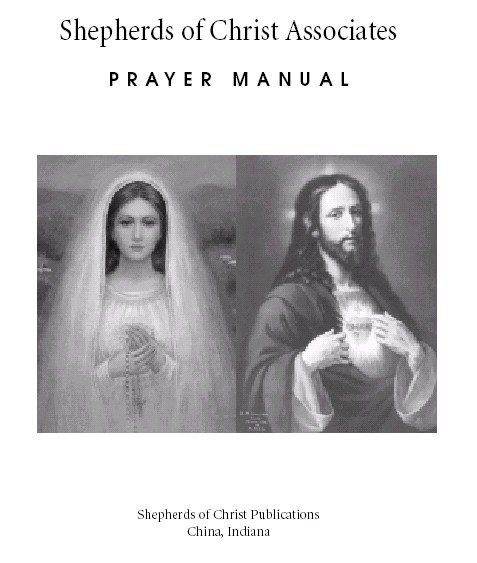
the Shepherds of Christ Prayer Manual PrayersChapter Meeting Prayer Format
The prayer format below should be followed at chapter meetings of Shepherds of Christ Associates. All prayers, not just those said specifically for priests, should include the intention of praying for all the needs of priests the world over.
1. Hymns. Hymns may be sung at any point of the prayer part of the meeting.
2. Holy Spirit Prayer. Come, Holy Spirit, almighty Sanctifier, God of love, who filled the Virgin Mary with grace, who wonderfully changed the hearts of the apostles, who endowed all Your martyrs with miraculous courage, come and sanctify us. Enlighten our minds, strengthen our wills, purify our consciences, rectify our judgment, set our hearts on fire, and preserve us from the misfortunes of resisting Your inspirations. Amen.
3. The Rosary.
4. Salve Regina. "Hail Holy Queen, Mother of mercy, our life, our sweetness, and our hope. To you do we cry, poor banished children of Eve. To you do we send up our sighs, our mourning, our weeping in this vale of tears. Turn, then, most gracious advocate, your eyes of mercy toward us and after this, our exile, show unto us the blessed fruit of your womb, Jesus, O clement, O loving, O sweet Virgin Mary."
5. The Memorare. "Remember, O most gracious Virgin Mary, that never was it known that anyone who fled to your protection, implored your help, or sought your intercession was left unaided. Inspired by this confidence, I fly unto you, O Virgin of virgins, my Mother. To you I come, before you I stand, sinful and sorrowful. O Mother of the Word Incarnate, despise not my petitions, but, in your mercy, hear and answer me. Amen."
6. Seven Hail Marys in honor of the Seven Sorrows of Mary. Mary has promised very special graces to those who do this on a daily basis. Included in the promises of Our Lady for those who practice this devotion is her pledge to give special assistance at the hour of death, including the sight of her face. The seven sorrows are:
(1) The first sorrow: the prophecy of Simeon (Hail Mary).
(2) The second sorrow: the flight into Egypt (Hail Mary).
(3) The third sorrow: the loss of the Child Jesus in the temple (Hail Mary).
(4) The fourth sorrow: Jesus and Mary meet on the way to the cross (Hail Mary).
(5) The fifth sorrow: Jesus dies on the cross (Hail Mary).
(6) The sixth sorrow: Jesus is taken down from the cross and laid in Mary's arms (Hail Mary).
(7) The seventh sorrow: the burial of Jesus (Hail Mary).
7. Litany of the Blessed Virgin Mary.
Lord, have mercy on us. Christ, have mercy on us.
Lord, have mercy on us. Christ, hear us. Christ, graciously hear us.
God, the Father of heaven, have mercy on us.
God, the Son, Redeemer of the world, have mercy on us.
God, the Holy Spirit, have mercy on us.
Holy Trinity, one God, have mercy on us.Holy Mary, pray for us (repeat after each invocation).
Holy Mother of God,
Holy Virgin of virgins,
Mother of Christ,
Mother of the Church,
Mother of divine grace,
Mother most pure,
Mother most chaste,
Mother inviolate,
Mother undefiled,
Mother most amiable,
Mother most admirable,
Mother of good counsel,
Mother of our Creator,
Mother of our Savior,
Virgin most prudent,
Virgin most venerable,
Virgin most renowned,
Virgin most powerful,
Virgin most merciful,
Virgin most faithful,
Mirror of justice,
Seat of wisdom,
Cause of our joy,
Spiritual vessel,
Vessel of honor,
Singular vessel of devotion,
Mystical rose,
Tower of David,
Tower of ivory,
House of gold,
Ark of the Covenant,
Gate of heaven,
Morning star,
Health of the sick,
Refuge of sinners,
Comforter of the afflicted,
Help of Christians,
Queen of angels,
Queen of patriarchs,
Queen of prophets,
Queen of apostles,
Queen of martyrs,
Queen of confessors,
Queen of virgins,
Queen of all saints,
Queen conceived without original sin,
Queen assumed into heaven,
Queen of the most holy rosary,
Queen of families,
Queen of peace,Lamb of God, who take away the sins of the world, spare us, O Lord.
Lamb of God, who take away the sins of the world, graciously hear us, O Lord.
Lamb of God, who take away the sins of the world, have mercy on us.
Pray for us, O holy Mother of God, that we may be made worthy of the promises of Christ.Let us pray: Grant, we beseech You, O Lord God, that we Your servants may enjoy perpetual health of mind and body and, by the glorious intercession of the blessed Mary, ever virgin, be delivered from present sorrow, and obtain eternal joy. Through Christ our Lord. Amen.
We fly to your patronage, O holy Mother of God. Despise not our petitions in our necessities, but deliver us always from all dangers, O glorious and blessed Virgin. Amen.
8. Prayer to St. Joseph. St. Joseph, guardian of Jesus and chaste spouse of Mary, you passed your life in perfect fulfillment of duty. You supported the Holy Family of Nazareth with the work of your hands. Kindly protect those who trustingly turn to you. You know their aspirations, their hardships, their hopes; and they turn to you because they know you will understand and protect them. You too have known trial, labor, and weariness. But, even amid the worries of material life, your soul was filled with deep peace and sang out in true joy through intimacy with the Son of God entrusted to you, and with Mary, His tender Mother. Amen. --(Pope John XXIII)
9. Litany of the Sacred Heart, promises of the Sacred Heart.
Lord, have mercy on us. Christ, have mercy on us.
Lord, have mercy on us. Christ, hear us.
Christ, graciously hear us.
God the Father of heaven, have mercy on us (repeat after each invocation).
God the Son, Redeemer of the world,
God the Holy Spirit,
Holy Trinity, one God,
Heart of Jesus, Son of the eternal Father,
Heart of Jesus, formed by the Holy Spirit in the womb of the Virgin Mother,
Heart of Jesus, substantially united to the Word of God,
Heart of Jesus, of infinite majesty,
Heart of Jesus, sacred temple of God,
Heart of Jesus, tabernacle of the Most High,
Heart of Jesus, house of God and gate of heaven,
Heart of Jesus, burning furnace of charity,
Heart of Jesus, abode of justice and love,
Heart of Jesus, full of goodness and love,
Heart of Jesus, abyss of all virtues,
Heart of Jesus, most worthy of all praise,
Heart of Jesus, king and center of all hearts,
Heart of Jesus, in whom are all the treasures of wisdom and knowledge,
Heart of Jesus, in whom dwells the fullness of divinity,
Heart of Jesus, in whom the Father is well pleased,
Heart of Jesus, of whose fullness we have all received,
Heart of Jesus, desire of the everlasting hills,
Heart of Jesus, patient and most merciful,
Heart of Jesus, enriching all who invoke You,
Heart of Jesus, fountain of life and holiness,
Heart of Jesus, propitiation for our sins,
Heart of Jesus, loaded down with opprobrium,
Heart of Jesus, bruised for our offenses,
Heart of Jesus, obedient even to death,
Heart of Jesus, pierced with a lance,
Heart of Jesus, source of all consolation,
Heart of Jesus, our life and reconciliation,
Heart of Jesus, victim of sin,
Heart of Jesus, salvation of those who hope in You,
Heart of Jesus, hope of those who die in You,
Heart of Jesus, delight of all the saints,
Lamb of God, Who take away the sins of the world, spare us, O Lord.
Lamb of God, Who take away the sins of the world, graciously hear us, O Lord.
Lamb of God, Who take away the sins of the world, have mercy on us.
Jesus, meek and humble of heart, make our hearts like unto Yours.Let us pray: O almighty and eternal God, look upon the Heart of Your dearly beloved Son and upon the praise and satisfaction He offers You in behalf of sinners and, being appeased, grant pardon to those who seek Your mercy, in the name of the same Jesus Christ, Your Son, Who lives and reigns with You, in the unity of the Holy Spirit, world without end. Amen.
Promises of Our Lord to those devoted to His Sacred Heart
(these should be read by the prayer leader):
(1) I will give them all the graces necessary in their state of life.
(2) I will establish peace in their homes.
(3) I will comfort them in all their afflictions.
(4) I will be their refuge during life and above all in death.
(5) I will bestow a large blessing on all their undertakings.
(6) Sinners shall find in My Heart the source and the infinite ocean of mercy.
(7) Tepid souls shall grow fervent.
(8) Fervent souls shall quickly mount to high perfection.
(9) I will bless every place where a picture of My Heart shall be set up and honored.
(10) I will give to priests the gift of touching the most hardened hearts.
(11) Those who promote this devotion shall have their names written in My Heart, never to be blotted out.
(12) I promise you in the excessive mercy of My Heart that My all-powerful love will grant to all those who communicate on the first Friday in nine consecutive months the grace of final penitence; they shall not die in My disgrace nor without receiving their sacraments; My divine Heart shall be their safe refuge in this last moment.
10. Prayer for Priests. "Lord Jesus, Chief Shepherd of the Flock, we pray that in the great love and mercy of Your Sacred Heart You attend to all the needs of Your priest-shepherds throughout the world. We ask that You draw back to Your Heart all those priests who have seriously strayed from Your path, that You rekindle the desire for holiness in the hearts of those priests who have become lukewarm, and that You continue to give Your fervent priests the desire for the highest holiness. United with Your Heart and Mary's Heart, we ask that You take this petition to Your heavenly Father in the unity of the Holy Spirit. Amen"
11. Prayer for all members of the Shepherds of Christ Associates. "Dear Jesus, we ask Your special blessings on all members of Shepherds of Christ Associates. Continue to enlighten them regarding the very special privilege and responsibility you have given them as members of Your movement, Shepherds of Christ Associates. Draw them ever closer to Your Heart and to Your Mother's Heart. Allow them to more and more realize the great and special love of Your Hearts for each of them as unique individuals. Give them the grace to respond to Your love and Mary's love with an increased love of their own. As they dwell in Your Heart and Mary's Heart, abundantly care for all their needs and those of their loved ones. We make our prayer through You to the Father, in the Holy Spirit, with Mary our Mother at our side. Amen"
12. Prayer for the spiritual and financial success of the priestly newsletter. "Father, we ask Your special blessings upon the priestly newsletter, Shepherds of Christ. We ask that You open the priest-readers to the graces You wish to give them through this chosen instrument of Your Son. We also ask that You provide for the financial needs of the newsletter and the Shepherds of Christ Associates. We make our prayer through Jesus, in the Holy Spirit, with Mary at our side. Amen"
13. Prayer for all members of the human family. "Heavenly Father, we ask Your blessings on all Your children the world over. Attend to all their needs. We ask Your special assistance for all those marginalized people, all those who are so neglected and forgotten. United with our Mother Mary, we make this petition to You through Jesus and in the Holy Spirit."
14. Prayer to St. Michael and our Guardian Angels:
"St. Michael the Archangel, defend us in battle. Be our safeguard against the wickedness and snares of the devil. May God rebuke him, we humbly pray, and do thou, O prince of the heavenly hosts, by the power of God, cast into hell Satan and all the other evil spirits who prowl about the world seeking the ruin of souls. Amen."
"Angel of God, my guardian dear, to whom God's love commits me here, ever this day be at my side, to light and guard, to rule and guide. Amen."
15. Pause for silent, personal prayer. This should last at least five minutes.
16. Act of consecration to the Sacred Heart of Jesus and the Immaculate Heart of Mary.
"Lord Jesus, Chief Shepherd of the flock, I consecrate myself to Your most Sacred Heart. From Your pierced Heart the Church was born, the Church You have called me, as a member of Shepherds of Christ Associates, to serve in a most special way. You reveal Your Heart as a symbol of Your love in all its aspects, including Your most special love for me, whom You have chosen as Your companion in this most important work. Help me to always love You in return. Help me to give myself entirely to You. Help me always to pour out my life in love of God and neighbor! Heart of Jesus, I place my trust in You!
"Dear Blessed Virgin Mary, I consecrate myself to your maternal and Immaculate Heart, this Heart which is symbol of your life of love. You are the Mother of my Savior. You are also my Mother. You love me with a most special love as a member of Shepherds of Christ Associates, a movement created by your Son as a powerful instrument for the renewal of the Church and the world. In a return of love, I give myself entirely to your motherly love and protection. You followed Jesus perfectly. You are His first and perfect disciple. Teach me to imitate you in the putting on of Christ. Be my motherly intercessor so that, through your Immaculate Heart, I may be guided to an ever closer union with the pierced Heart of Jesus, Chief Shepherd of the flock."
17. Daily Prayers. All members should say the Holy Spirit prayer daily and make the act of consecration daily. They should also pray the rosary each day. They are encouraged to use the other above prayers as time allows.
© Copyright 1996 Shepherds of Christ Publications
Rights for non-commercial reproduction granted:
May be copied in its entirety, but neither re-typed nor edited.end of
DAILY NOVENA PRAYERS
Opening Prayer
In the name of the Father and of the Son and of the Holy Spirit. Amen.
Dear Father, we come to You in the name of Jesus, in union with Him in the Holy Sacrifice of the Mass, in the Holy Spirit. We come to You united to the Child Jesus of Good Health and the Infant of Prague. We come to You in the perfect, sinless heart of Our Mother Mary, asking her powerful intercession, uniting ourselves to her holy tears. We come to You united to all the angels and saints, and the souls in purgatory.
Prayer for Holy Spirit
We pray for an outpouring of the Holy Spirit on us, to be baptized by the Holy Spirit, that He will descend mightily on us as He did on the Apostles at Pentecost. That the Holy Spirit will transform us from fear to fearlessness and that He will give us courage to do all the Father is asking of us to help bring about the Reign of the Sacred Heart and the triumph of Mary's Immaculate Heart. We pray for the Holy Spirit to descend mightily on the Jesuits and the Poor Clares on the Shepherds of Christ leaders and members and on the whole Body of Christ and the world.
Protection by the Blood of Jesus
We pray that the Blood of Jesus will be spread on us, everyone in our families, and the Shepherds of Christ Movement, that we will be able to move steadfastly ahead and be protected from the evil one.
Healing
We pray for healing in body, mind, and soul and generational healing in ourselves, in all members in our families, and in all members of the Shepherds of Christ Movement, the Jesuit Community, the Poor Clares, the Body of Christ, and the world.
Prayer for Strength and Light
We adore You, oh Holy Spirit. Give us strength, give us light, console us. We give ourselves entirely to You. Oh Spirit of light and grace, we want to only do the will of the Father. Enlighten us that we may live always in the Father's will.
Eternal Spirit fill us with Your Divine Wisdom that we may comprehend more fully insight into Your Divine Mysteries.
Give us lights, Oh Holy Spirit that we may know God. Work within the heart, the spiritual womb of the Virgin Mary, to form us more and more into the image of Jesus.
Prayer to Be One with God, Father, Son and Holy Spirit
We long for You, Oh Spirit of Light, we long to know God, we want to be one with Him, our Divine God. We want to be one with the Father, know Him as a Person most intimately. We want to know the beloved One, the Sacred Heart of Jesus, and live and dwell in Him at all times, every moment of our lives. We want to be one with You, Oh Spirit of Light, that You move in us in our every breath.
Prayer to Be One in Jesus
Let us experience life in the Sacred Heart of Jesus, so we can say as Saint Paul, "I have been crucified with Christ and yet I am alive; yet it is no longer I, but Christ living in me...." Let us live, united to the Mass, all through the day being one in Him. Let us be able to love and know in this elevated state of oneness with our God. We long for Thee, oh beauteous God, we love You, we love You, we love You. We praise You, worship You, honor You, adore You, and thank You, our beloved God, Father, Son, and Holy Spirit.
Prayer to Dwell in the Hearts of Jesus and Mary
We seek to be one in God, to live and dwell in the Hearts of Jesus and Mary, our little heaven on earth, to experience life in the all perfect, pure, sinless heart of our Mother. We want the Holy Spirit to move in us and to be united to Jesus as the Bridegroom of our souls and be a most perfect sacrifice offered to the Father at every moment as we unite in the Holy Sacrifice of the Mass around the world to help in the salvation of souls.
Prayer for the Holy Spirit and His Gifts
Come Holy Spirit, come, come into our hearts, inflame all people with the fire of Your love.
Leader: Send forth Your Spirit and all will be reborn.
All: And You will renew the face of the earth.We pray for the seven gifts of the Holy Spirit, we ask for perfection in our souls to make us holy, holy souls likened to God.
Dear Holy Spirit, we give ourselves to You soul and body. We ask You to give us the Spirit of Wisdom, Understanding, Counsel, Fortitude, Knowledge, Piety, and Fear of the Lord.
Prayer for the Word Alive in Our Hearts
We know, dear Holy Spirit, the Word in His human nature was brought forth within the womb of the woman. We pray that His word will be brought forth in our hearts as He lives and dwells in us. We want the incarnation to go on in our lives. Dear Holy Spirit, work in us.
Little Prayers to the Holy Spirit
Dear Holy Spirit, help us not to be ignorant or indifferent or weak, help us to be strong with the love of God.
Dear Holy Spirit, please pray for our needs for us.
Dear Holy Spirit, help us to respect God and to avoid sin. Help us to live in the Father's will.
Dear Holy Spirit, help us to keep Your commandments and to respect authority. Help us to love all things as You will us to love them. Help us to want to pray and always serve God with the greatest love. Help us to know the truth. Help us to have the gift of faith, hope, and love. Help us to know what is right and what is wrong.
A Prayer for Intimacy with the Lamb, the Bridegroom of the Soul
Oh Lamb of God, Who take away the sins of the world, come and act on my soul most intimately. I surrender myself, as I ask for the grace to let go, to just be as I exist in You and You act most intimately on my soul. You are the Initiator. I am the soul waiting Your favors as You act in me. I love You. I adore You. I worship You. Come and possess my soul with Your Divine Grace, as I experience You most intimately.
First Period
Meditations Nine Days
- Romans 8: 14-17
All who are guided by the Spirit of God are sons of God; for what you received was not the spirit of slavery to bring you back into fear; you received the Spirit of adoption, enabling us to cry out, 'Abba, Father!' The Spirit himself joins with our spirit to bear witness that we are children of God. And if we are children, then we are heirs, heirs of God and joint-heirs with Christ, provided that we share his suffering, so as to share his glory.- Romans 8: 5-9
Those who are living by their natural inclinations have their minds on the things human nature desires; those who live in the Spirit have their minds on spiritual things. And human nature has nothing to look forward to but death, while the Spirit looks forward to life and peace, because the outlook of disordered human nature is opposed to God, since it does not submit to God's Law, and indeed it cannot, and those who live by their natural inclinations can never be pleasing to God. You, however, live not by your natural inclinations, but by the Spirit, since the Spirit of God has made a home in you. Indeed, anyone who does not have the Spirit of Christ does not belong to him.- 1 John 4: 12-16
No one has ever seen God, but as long as we love one another God remains in us and his love comes to its perfection in us. This is the proof that we remain in him and he in us, that he has given us a share in his Spirit. We ourselves have seen and testify that the Father sent his Son as Saviour of the world. Anyone who acknowledges that Jesus is the Son of God, God remains in him and he in God. We have recognised for ourselves, and put our faith in, the love God has for us. God is love, and whoever remains in love remains in God and God in him.- 1 John 4: 17-21
Love comes to its perfection in us when we can face the Day of Judgement fearlessly, because even in this world we have become as he is. In love there is no room for fear, but perfect love drives out fear, because fear implies punishment and no one who is afraid has come to perfection in love. Let us love, then, because he first loved us. Anyone who says 'I love God' and hates his brother, is a liar, since whoever does not love the brother whom he can see cannot love God whom he has not seen. Indeed this is the commandment we have received from him, that whoever loves God, must also love his brother.- 1 John 4: 7-11
My dear friends, let us love one another, since love is from God and everyone who loves is a child of God and knows God. Whoever fails to love does not know God, because God is love. This is the revelation of God's love for us, that God sent his only Son into the world that we might have life through him. Love consists in this: it is not we who loved God, but God loved us and sent his Son to expiate our sins. My dear friends, if God loved us so much, we too should love one another.- Acts of the Apostles 1: 1-5
In my earlier work, Theophilus, I dealt with everything Jesus had done and taught from the beginning until the day he gave his instructions to the apostles he had chosen through the Holy Spirit, and was taken up to heaven. He had shown himself alive to them after his Passion by many demonstrations: for forty days he had continued to appear to them and tell them about the kingdom of God. While at table with them, he had told them not to leave Jerusalem, but to wait there for what the Father had promised. 'It is', he had said, 'what you have heard me speak about: John baptised with water but, not many days from now, you are going to be baptised with the Holy Spirit.'- Acts of the Apostles 1: 6-9
Now having met together, they asked him, 'Lord, has the time come for you to restore the kingdom to Israel?' He replied, 'It is not for you to know times or dates that the Father has decided by his own authority, but you will receive the power of the Holy Spirit which will come on you, and then you will be my witnesses not only in Jerusalem but throughout Judaea and Samaria, and indeed to earth's remotest end.'
As he said this he was lifted up while they looked on, and a cloud took him from their sight.- Acts of the Apostles 1: 12-14
So from the Mount of Olives, as it is called, they went back to Jerusalem, a short distance away, no more than a Sabbath walk; and when they reached the city they went to the upper room where they were staying; there were Peter and John, James and Andrew, Philip and Thomas, Bartholomew and Matthew, James son of Alphaeus and Simon the Zealot, and Jude son of James. With one heart all these joined constantly in prayer, together with some women, including Mary the mother of Jesus, and with his brothers.
- Acts of the Apostles 2: 1-4
When Pentecost day came round, they had all met together, when suddenly there came from heaven a sound as of a violent wind which filled the entire house in which they were sitting; and there appeared to them tongues as of fire; these separated and came to rest on the head of each of them. They were all filled with the Holy Spirit and began to speak different languages as the Spirit gave them power to express themselves.
Second Period
Meditations Nine Days
- John 14: 21-31
Whoever holds to my commandments and keeps them is the one who loves me; and whoever loves me will be loved by my Father, and I shall love him and reveal myself to him.'
Judas-not Judas Iscariot-said to him, 'Lord, what has happened, that you intend to show yourself to us and not to the world?' Jesus replied:
Anyone who loves me will keep my word, and my Father will love him, and we shall come to him and make a home in him. Anyone who does not love me does not keep my words. And the word that you hear is not my own: it is the word of the Father who sent me. I have said these things to you while still with you; but the Paraclete, the Holy Spirit, whom the Father will send in my name, will teach you everything and remind you of all I have said to you. Peace I bequeath to you, my own peace I give you, a peace which the world cannot give, this is my gift to you. Do not let your hearts be troubled or afraid. You heard me say: I am going away and shall return. If you loved me you would be glad that I am going to the Father, for the Father is greater than I. I have told you this now, before it happens, so that when it does happen you may believe. I shall not talk to you much longer, because the prince of this world is on his way. He has no power over me, but the world must recognise that I love the Father and that I act just as the Father commanded. Come now, let us go.- John 17: 11-26
I am no longer in the world, but they are in the world, and I am coming to you. Holy Father, keep those you have given me true to your name, so that they may be one like us. While I was with them, I kept those you had given me true to your name. I have watched over them and not one is lost except one who was destined to be lost, and this was to fulfil the scriptures. But now I am coming to you and I say these things in the world to share my joy with them to the full. I passed your word on to them, and the world hated them, because they belong to the world no more than I belong to the world. I am not asking you to remove them from the world, but to protect them from the Evil One. They do not belong to the world any more than I belong to the world. Consecrate them in the truth; your word is truth. As you sent me into the world, I have sent them into the world, and for their sake I consecrate myself so that they too may be consecrated in truth. I pray not only for these but also for those who through their teaching will come to believe in me. May they all be one, just as, Father, you are in me and I am in you, so that they also may be in us, so that the world may believe it was you who sent me. I have given them the glory you gave to me, that they may be one as we are one. With me in them and you in me, may they be so perfected in unity that the world will recognise that it was you who sent me and that you have loved them as you have loved me.
Father, I want those you have given me to be with me where I am, so that they may always see my glory which you have given me because you loved me before the foundation of the world. Father, Upright One, the world has not known you, but I have known you, and these have known that you have sent me. I have made your name known to them and will continue to make it known, so that the love with which you loved me may be in them, and so that I may be in them.- I Corinthians 15: 20-28
In fact, however, Christ has been raised from the dead, as the first-fruits of all who have fallen asleep. As it was by one man that death came, so through one man has come the resurrection of the dead. Just as all die in Adam, so in Christ all will be brought to life; but all of them in their proper order: Christ the first-fruits, and next, at his coming, those who belong to him. After that will come the end, when he will hand over the kingdom to God the Father, having abolished every principality, every ruling force and power. For he is to be king until he has made his enemies his footstool, and the last of the enemies to be done away with is death, for he has put all things under his feet. But when it is said everything is subjected, this obviously cannot include the One who subjected everything to him. When everything has been subjected to him, then the Son himself will be subjected to the One who has subjected everything to him, so that God may be all in all.- Revelation 3: 1-3,12,16-19
'Write to the angel of the church in Sardis and say, "Here is the message of the one who holds the seven spirits of God and the seven stars: I know about your behaviour: how you are reputed to be alive and yet are dead. Wake up; put some resolve into what little vigour you have left: it is dying fast. So far I have failed to notice anything in your behaviour that my God could possibly call perfect; remember how you first heard the message. Hold on to that. Repent! If you do not wake up, I shall come to you like a thief, and you will have no idea at what hour I shall come upon you.
Anyone who proves victorious I will make into a pillar in the sanctuary of my God, and it will stay there for ever; I will inscribe on it the name of my God and the name of the city of my God, the new Jerusalem which is coming down from my God in heaven, and my own new name as well.
'...but since you are neither hot nor cold, but only lukewarm, I will spit you out of my mouth. You say to yourself: I am rich, I have made a fortune and have everything I want, never realising that you are wretchedly and pitiably poor, and blind and naked too. I warn you, buy from me the gold that has been tested in the fire to make you truly rich, and white robes to clothe you and hide your shameful nakedness, and ointment to put on your eyes to enable you to see. I reprove and train those whom I love: so repent in real earnest.'- Revelation 5: 9-14
They sang a new hymn: You are worthy to take the scroll and to break its seals, because you were sacrificed, and with your blood you bought people for God of every race, language, people and nation and made them a line of kings and priests for God, to rule the world.
In my vision, I heard the sound of an immense number of angels gathered round the throne and the living creatures and the elders; there were ten thousand times ten thousand of them and thousands upon thousands, loudly chanting:Worthy is the Lamb that was sacrificed to receive power, riches, wisdom, strength, honour, glory and blessing.
Then I heard all the living things in creation-everything that lives in heaven, and on earth, and under the earth, and in the sea, crying:
To the One seated on the throne and to the Lamb, be all praise, honour, glory and power, for ever and ever.
And the four living creatures said, 'Amen'; and the elders prostrated themselves to worship.
- Revelation 7: 14-17
I answered him, 'You can tell me, sir.' Then he said, 'These are the people who have been through the great trial; they have washed their robes white again in the blood of the Lamb. That is why they are standing in front of God's throne and serving him day and night in his sanctuary; and the One who sits on the throne will spread his tent over them. They will never hunger or thirst again; sun and scorching wind will never plague them, because the Lamb who is at the heart of the throne will be their shepherd and will guide them to springs of living water; and God will wipe away all tears from their eyes.'- Revelation 12: 1-8
Now a great sign appeared in heaven: a woman, robed with the sun, standing on the moon, and on her head a crown of twelve stars. She was pregnant, and in labour, crying aloud in the pangs of childbirth. Then a second sign appeared in the sky: there was a huge red dragon with seven heads and ten horns, and each of the seven heads crowned with a coronet. Its tail swept a third of the stars from the sky and hurled them to the ground, and the dragon stopped in front of the woman as she was at the point of giving birth, so that it could eat the child as soon as it was born. The woman was delivered of a boy, the son who was to rule all the nations with an iron sceptre, and the child was taken straight up to God and to his throne, while the woman escaped into the desert, where God had prepared a place for her to be looked after for twelve hundred and sixty days.
And now war broke out in heaven, when Michael with his angels attacked the dragon. The dragon fought back with his angels, but they were defeated and driven out of heaven.- Revelation 14: 1-7
Next in my vision I saw Mount Zion, and standing on it the Lamb who had with him a hundred and forty-four thousand people, all with his name and his Father's name written on their foreheads. I heard a sound coming out of heaven like the sound of the ocean or the roar of thunder; it was like the sound of harpists playing their harps. There before the throne they were singing a new hymn in the presence of the four living creatures and the elders, a hymn that could be learnt only by the hundred and forty-four thousand who had been redeemed from the world. These are the sons who have kept their virginity and not been defiled with women they follow the Lamb wherever he goes; they, out of all people, have been redeemed to be the first-fruits for God and for the Lamb. No lie was found in their mouths and no fault can be found in them.
Then I saw another angel, flying high overhead, sent to announce the gospel of eternity to all who live on the earth, every nation, race, language and tribe. He was calling, 'Fear God and glorify him, because the time has come for him to sit in judgement; worship the maker of heaven and earth and sea and the springs of water.'
Revelation 19: 7-8
let us be glad and joyful and give glory to God, because this is the time for the marriage of the Lamb. His bride is ready, and she has been able to dress herself in dazzling white linen, because her linen is made of the good deeds of the saints.'- Revelation 21: 1-10
Then I saw a new heaven and a new earth; the first heaven and the first earth had disappeared now, and there was no longer any sea. I saw the holy city, the new Jerusalem, coming down out of heaven from God, prepared as a bride dressed for her husband. Then I heard a loud voice call from the throne, 'Look, here God lives among human beings. He will make his home among them; they will be his people, and he will be their God, God-with-them. He will wipe away all tears from their eyes; there will be no more death, and no more mourning or sadness or pain. The world of the past has gone.'
Then the One sitting on the throne spoke. 'Look, I am making the whole of creation new. Write this, "What I am saying is trustworthy and will come true."' Then he said to me, 'It has already happened. I am the Alpha and the Omega, the Beginning and the End. I will give water from the well of life free to anybody who is thirsty; anyone who proves victorious will inherit these things; and I will be his God and he will be my son. But the legacy for cowards, for those who break their word, or worship obscenities, for murderers and the sexually immoral, and for sorcerers, worshippers of false gods or any other sort of liars, is the second death in the burning lake of sulphur.'
One of the seven angels that had the seven bowls full of the seven final plagues came to speak to me and said, 'Come here and I will show you the bride that the Lamb has married.' In the spirit, he carried me to the top of a very high mountain, and showed me Jerusalem, the holy city, coming down out of heaven from God.
Revelation 22: 20
The one who attests these things says: I am indeed coming soon.
Amen; come, Lord Jesus.
Scriptural quotations are taken from The New Jerusalem Bible, Doubleday & Co.
Imprimatur granted by Cardinal Hume.
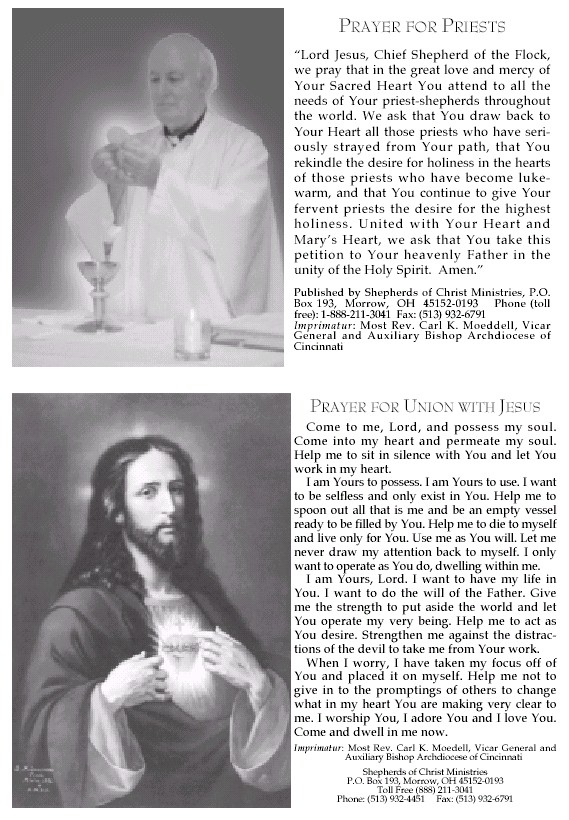
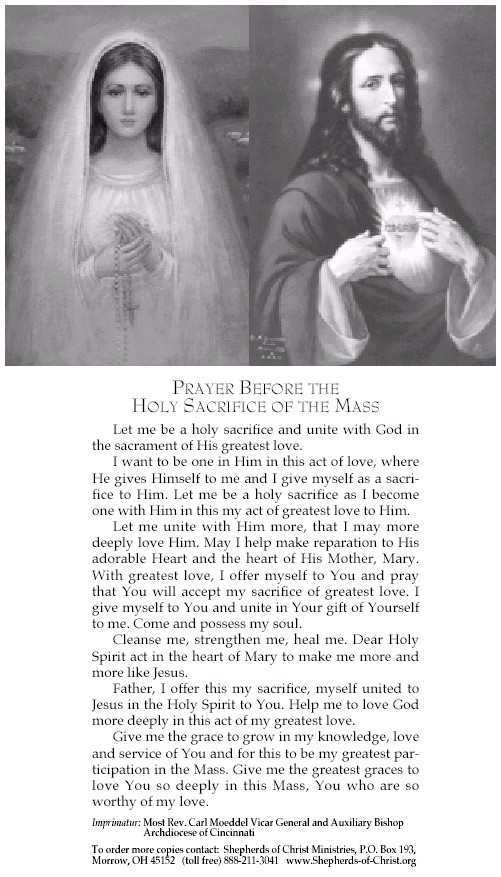

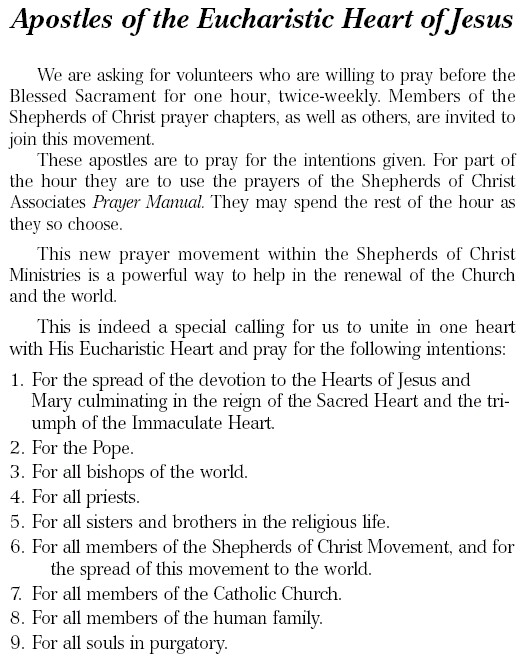
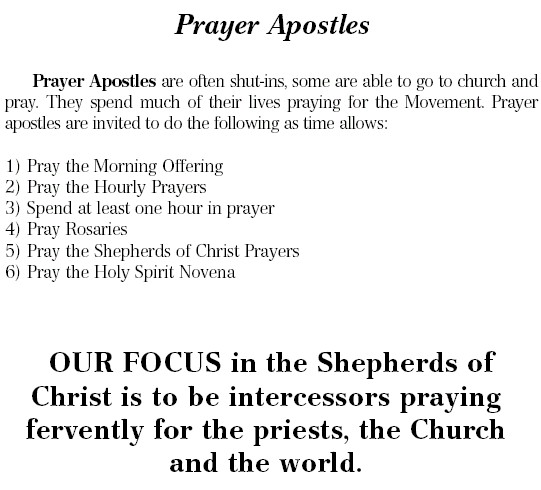
|
|
|
WE PRAY FOR PRIESTS, THE RENEWAL OF THE CHURCH, AND THE WORLD. We join as a body united to the Holy Sacrifice of the Mass offering our lives to the Father as intercessors praying for our priests, the Church, and the world. WILL YOU PRAY WITH US? Your prayers united to ours will help the priests, the Church, and the world. |
| Our Focus
WE HAVE PRAYER CHAPTERS PRAYING ALL OVER THE WORLD for the priests, the Church, and the world. OUR PRIMARY FOCUS is the circulation of a newsletter. WE CIRCULATE A SPIRITUALITY NEWSLETTER written by Fr. Edward Carter, S.J., a Jesuit Theologian with a Doctor's degree in Theology and author of 17 books, to about 75,000 priests in the world in both English and Spanish. Father Carter has been a professor of Theology for over 30 years. Besides being sent to about 75,000 priests and bishops in the U.S.A., the newsletter is sent internationally to about 225 bishops, including 4 cardinals, who distribute copies to all of their priests, and also, in some cases, to their deacons and seminarians. The newsletter is centered in consecration to the Hearts of Jesus and Mary. It features writings regarding our union with Jesus and the Father and the Holy Spirit and Mary. The newsletter also stresses the Eucharist, the Church, prayer, and one's responsibility regarding the social order. The newsletter stresses sound doctrine as found in Scripture, the writings of the Popes and other Church documents. It also presents selected writings from the saints and competent priest-theologians and others. The newsletter can be used by all for development in the spiritual life centered in consecration. |
|
About Shepherds of Christ Ministries |
MINISTRIES
WE WANT TO BE INTERCESSORS PROMOTING UNITY IN PRAYER WITH ALL PEOPLE OF THE WORLD, PRAYING FOR THE PRIESTS, THE CHURCH, AND THE WORLD. We have described above the primary ministry of the Movement, the spirituality newsletter for priests, Shepherds of Christ. The 2nd most important ministry is the prayer chapters, whose members pray for the needs of priests and for the needs of all others also. Other ministries include promoting the act of consecration to the Hearts of Jesus and Mary as widely as possible. Promoting this act of consecration permeates all of our ministries. We also promote the praying of the rosary, and we have a special program regarding the rosary and the act of consecration for school children. We have programs for prisons and nursing homes to encourage the residents to pray for priests, the Church, and the world. We also publish various books, cassette tapes, and other materials to help in the ongoing work of spiritual renewal. The mission of the Shepherds of Christ Movement is closely connected to Our Lady of Fatima's mission. We hope to play a major role in helping to bring fulfillment of the Peace Plan of Our Lady of Fatima. This plan includes:
In helping to bring the Fatima message to completion, the Shepherds of Christ Movement is helping to bring about the Reign of the Sacred Heart and the triumph of the Immaculate Heart. This is a great privilege and a great responsibility! We ask for your prayers and help in other ways also. May God bless you abundantly! LEVELS OF COMMITMENT There are seven levels of commitment in the Shepherds of Christ Movement.
Whatever one's level of commitment in the Shepherds of Christ Movement, all share in promoting the overall goal of the Movement. This goal is to help in the spiritual renewal of the Church and the world. All varied ministries of the Movement are directed toward this purpose. The spirituality which the Shepherds of Christ Movement presents to its members and to those outside the Movement through its various ministries is very basic. This spirituality is explicitly Trinitarian and Christocentric. Our spirituality helps others, especially priests, to develop a very deep union with Jesus, this Jesus Who leads us to the Father in the Holy Spirit with Mary at our side. Our spirituality is deeply Eucharistic. We stress very much participation in the Mass and prayer before the Blessed Sacrament. We also emphasize the extremely important role of prayer in the spiritual life. Devotion to the Hearts of Jesus and Mary, especially consecration to Their Hearts, is also a most important and central element. We are very much interested in helping to bring the Fatima message to completion, a message which has consecration to the Hearts of Jesus and Mary at its very core. |
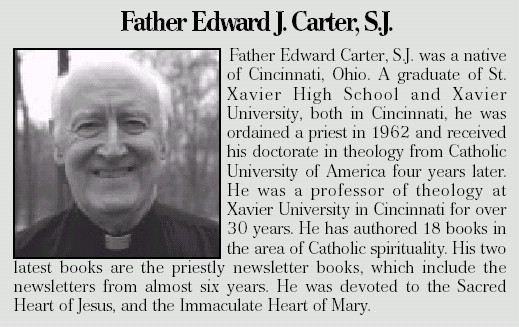 |
| Be Part Of It!
PLEASE HELP US THROUGH YOUR PRAYERS UNITED TO OURS. PRIESTS PRAYING WITH US WILL INCREASE THE PRAYER POWER; THEY ARE ANOINTED BY CHRIST AS HOLY PRIESTS. PEOPLE ALL OVER THE WORLD offering up their lives in the Morning Offering for the priests, the Church, the world, and for the work of the Shepherds of Christ will help so much. LITTLE PRAYER BOOKS OF SHORT PRAYERS CALLED THE SHEPHERDS OF CHRIST PRAYER MANUAL ARE AVAILABLE. Praying these short prayers together with us as a body united to the Holy Sacrifice of the Mass being celebrated around the world can help great grace be released on the souls of the earth. PLEASE UNITE WITH US. |
| For additional information, contact us:
Shepherds of Christ Ministries |
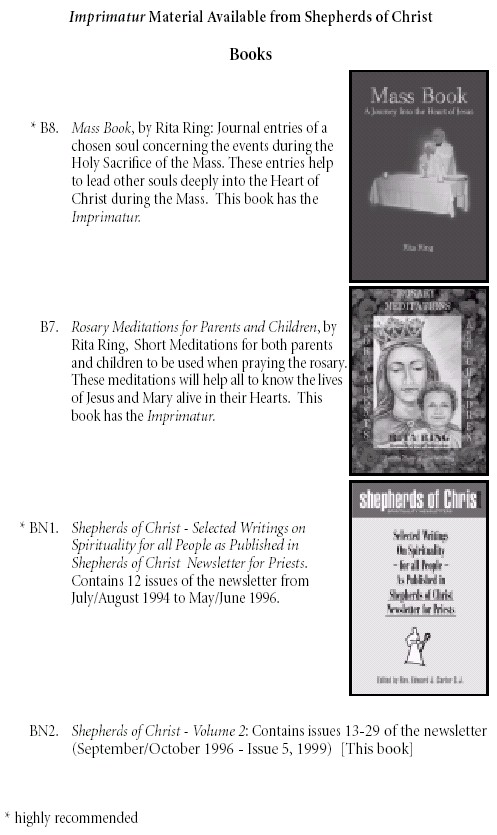
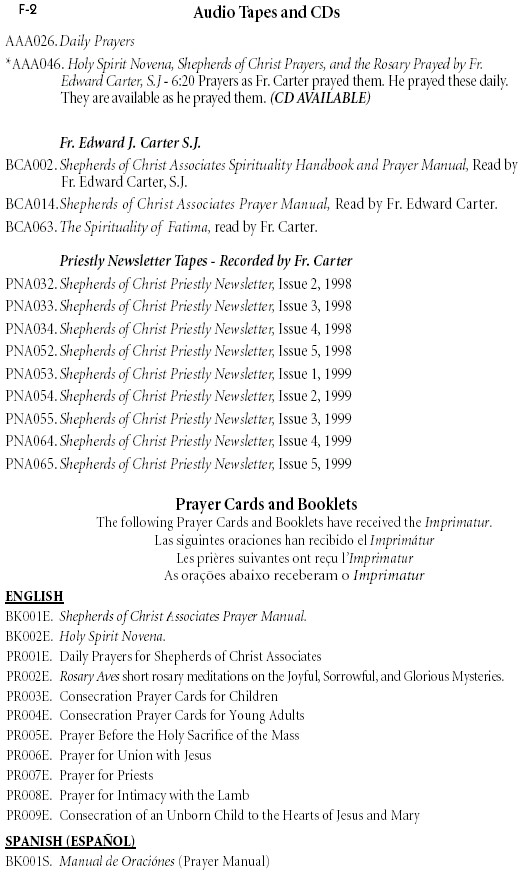
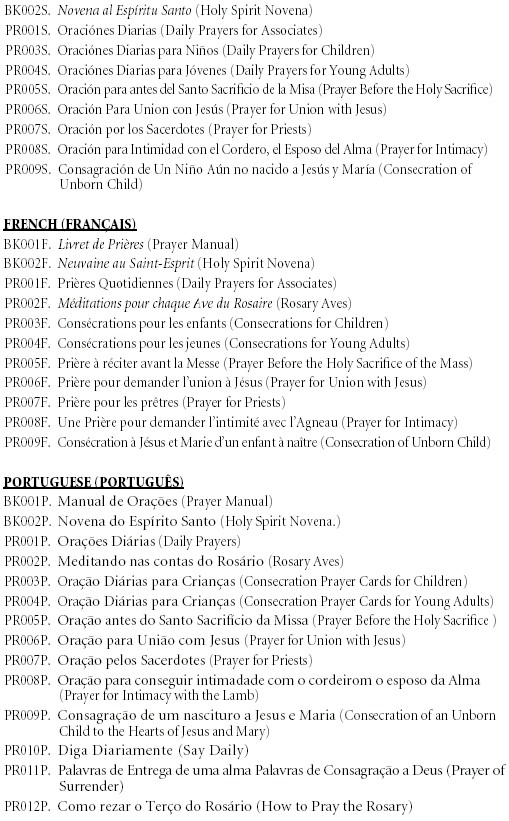

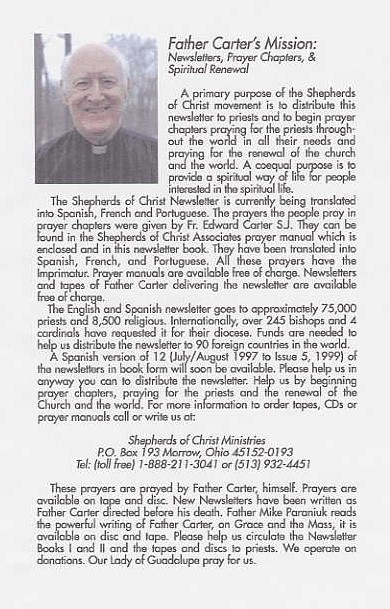
 Copyright
© 2001 Shepherds of Christ.
Copyright
© 2001 Shepherds of Christ.